
Updated October 2026
Beauty is one of the most exciting markets for small brands. Customers love discovering independent makeup, skincare, haircare and fragrance lines, and social media lets a small brand reach them directly. But beauty is also a regulated industry. Since the Modernization of Cosmetics Regulation Act of 2022 (MoCRA), the FDA has much stronger oversight of cosmetics, and many small brands aren’t yet aware of their obligations.
This guide covers the rules you must follow, how to make your products, where to sell them, and how to market a beauty brand that customers trust and buy from again.
Beauty business models
Table of Contents
| Model | How it works | Best for |
|---|---|---|
| Your own formulas, made by you | You develop and produce products in small batches | Makers with formulation skills, such as soap, balms and body care |
| Private label | A manufacturer’s existing formula with your brand on it | Fast launch, lower development cost |
| Custom formulation with a contract manufacturer | A lab develops and produces your unique formula | Brands with a clear product vision and a larger budget |
| Reselling other brands | Buy wholesale and sell in your store or online | Curated retail, salons, boutiques |
| Salon or service-led sales | Sell products alongside beauty services | Salons, spas and makeup artists |
The rules: what MoCRA requires
MoCRA was signed into law in December 2022 and is the biggest change to US cosmetics law in decades. Key requirements include:
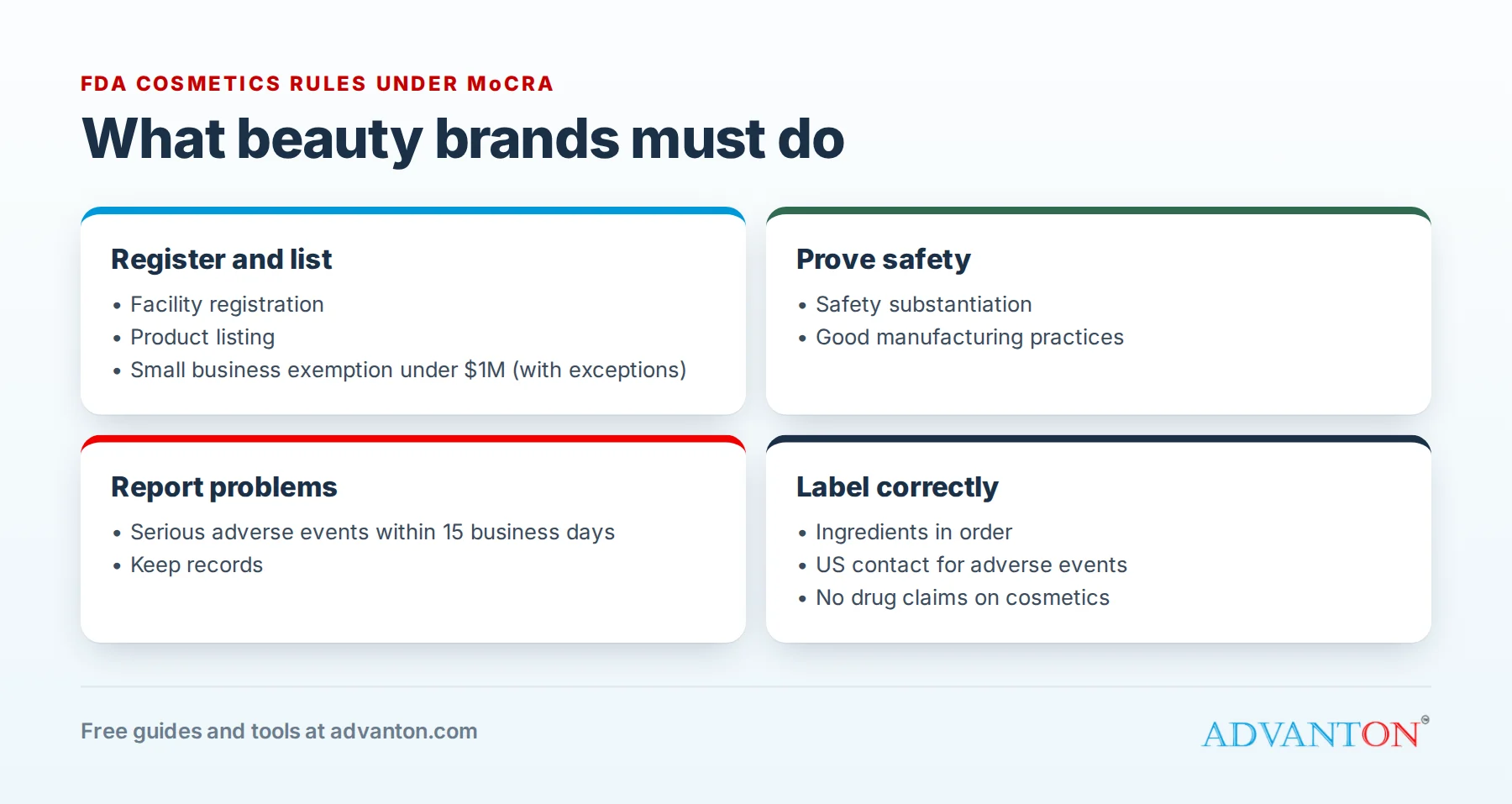
- Facility registration: facilities that manufacture or process cosmetics for US distribution must register with the FDA.
- Product listing: the company responsible for a product (often the brand, called the "responsible person") must list each product and its ingredients with the FDA.
- Safety substantiation: you must have adequate evidence that your products are safe for their intended use.
- Serious adverse event reporting: serious adverse events, such as significant injuries or reactions, must be reported to the FDA within 15 business days, and records of adverse events must be kept.
- Label contact information: labels must include a US address, phone number or electronic contact through which consumers can report adverse events.
A small business exemption: businesses with average gross annual sales of less than $1 million in the US over the previous three years are generally exempt from facility registration and product listing, but not if they make certain higher-risk products, such as products that contact the eye area, are injected, are meant for internal use, or alter appearance for more than 24 hours. Small businesses must still meet the other requirements, including adverse event reporting and safety. Check the FDA’s MoCRA guidance for the details that apply to you.
Cosmetic or drug? Watch your claims
What you claim a product does can turn a cosmetic into a drug, which is regulated far more strictly. Under FDA rules:
- Cosmetics cleanse, beautify, promote attractiveness or alter appearance: "moisturizes skin", "adds color", "reduces the look of fine lines".
- Drugs treat or prevent disease or affect the body’s structure or function: "treats acne", "protects against sunburn", "stimulates collagen", "regrows hair".
Products such as sunscreens, acne treatments, antiperspirants and anti-dandruff shampoos are regulated as over-the-counter drugs. Avoid drug claims on cosmetics unless you follow the drug rules.
The FTC also requires marketing claims to be truthful and supported by evidence, including claims like "clinically proven", "dermatologist recommended" and "natural".
Labeling basics
Cosmetic labels generally need:
- The product’s identity (what it is) and net quantity on the front.
- Ingredients in descending order of predominance, using standard ingredient names.
- The name and place of business of the manufacturer, packer or distributor.
- Warnings, where required, and directions for safe use.
- Contact information for adverse event reports (under MoCRA).
Color additives must be FDA-approved for their intended use, including use near the eyes. The FDA’s Cosmetics Labeling Guide explains the details.
Making your products safely
- Follow good manufacturing practices: clean facilities, documented recipes, batch records and lot numbers.
- Test stability and preservation so products stay safe for their shelf life, especially water-based products that can grow bacteria.
- Keep records of ingredients, suppliers, batches and complaints.
- Choose manufacturers carefully: ask about registration, quality systems, testing and minimum order quantities.
Startup costs to plan for
| Item | What to budget for |
|---|---|
| Product development | Formulation, samples and testing |
| First production run | Minimum order quantities from manufacturers, or ingredients and equipment if you make your own |
| Packaging and labels | Containers, boxes, labels and design |
| Testing and compliance | Stability and safety testing, and professional advice on labeling and claims |
| Insurance | Product liability insurance, which many retailers require |
| Website and photography | Your online store and professional product photos |
| Marketing | Samples, creator partnerships and advertising |
Use our startup cost calculator for your total, and the pricing calculator to price for profit.
A worked example: pricing one product
These are illustrative costs for a 50 ml face moisturizer. Use your own numbers from suppliers and manufacturers.
| Cost per unit | Amount |
|---|---|
| Formula (ingredients or manufacturer price) | $2.10 |
| Jar and lid | $1.10 |
| Box | $0.30 |
| Label | $0.30 |
| Filling and labor | $0.70 |
| Total cost to make | $4.50 |
A common approach is to price wholesale at about twice your cost and retail at about twice wholesale:
- Wholesale price (to salons and shops): about $9.00.
- Retail price (to customers): about $18.00.
Selling direct on your own website at $18 keeps the full margin, but you’ll pay for marketing, payment fees, shipping and returns. Selling wholesale earns less per unit, but the retailer brings the customers. Whatever you choose, make sure your prices cover marketing and returns, not just the cost to make.
Working with retailers
Salons, spas, boutiques and larger retailers will usually ask for:
- Wholesale pricing and minimum order quantities.
- Product liability insurance, often naming the retailer as an additional insured.
- Proof of compliance: correct labels, ingredient lists and, where they apply, MoCRA registration and listing.
- Barcodes, consistent packaging and reliable delivery times.
- Marketing support: display materials, samples and staff training.
Start with a few local stores that fit your brand, learn what sells, then approach larger retailers with real sales data.
Where to sell
- Your own online store: more control and better margins. See our guide to ecommerce business ideas.
- Marketplaces such as Amazon and Etsy: built-in shoppers, but competition and fees, and some beauty categories have extra requirements.
- Salons, spas and boutiques: wholesale or consignment, plus in-person recommendations from professionals.
- Markets and pop-ups: customers can try products, and you get instant feedback.
- Social commerce: selling directly through Instagram, TikTok and Facebook shops.
How to market a beauty brand
- Pick a clear niche: for example, sensitive skin, a specific hair type, vegan makeup or fragrance-free products.
- Show real results honestly: before-and-after photos and videos, with permission and without exaggeration.
- Work with creators: send products to beauty creators who fit your niche, and make sure they disclose any paid or gifted partnerships, as the FTC requires.
- Collect reviews: see how to get online reviews from customers.
- Make sampling easy: trial sizes reduce the risk of trying something new.
- Build repeat purchases: subscriptions, refill reminders and loyalty rewards.
- Teach: short tutorials on how to use your products get shared and build trust. See video marketing for small businesses.
Common mistakes
- Making drug claims on cosmetic products.
- Ignoring MoCRA, including adverse event reporting and label contact details.
- Launching too many products before one hero product is selling well.
- Underpricing, without accounting for packaging, testing, returns and marketing.
- Weak preservation, leading to spoiled products and complaints.
Your first 90 days
- Choose your niche and business model.
- Develop or source one to three hero products.
- Check MoCRA obligations, labels and claims, ideally with professional advice.
- Arrange stability testing and product liability insurance.
- Set up your online store and sales channels.
- Send samples to ten carefully chosen creators or professionals.
- Ask every early customer for feedback and a review.
Frequently asked questions
Do I need FDA approval to sell cosmetics?
Cosmetics (other than color additives) don’t need FDA approval before sale, but they must be safe and properly labeled, and MoCRA adds registration, listing, safety and reporting requirements. Products that make drug claims follow drug rules.
Can I make cosmetics at home and sell them?
Many small makers start at home, but you’re responsible for safety, labeling and MoCRA obligations, and some states and cities have additional rules. Check local requirements and follow good manufacturing practices.
Does the small business exemption mean I can ignore MoCRA?
No. It generally exempts very small businesses from registration and listing (with exceptions for certain products), but safety, adverse event reporting and labeling obligations still apply.
What does "clean beauty" mean legally?
There’s no legal definition of "clean" for cosmetics. Any claims you make must be truthful and supported, and avoid implying competitors’ products are unsafe without evidence.
How many products should I launch with?
Usually one to three. A small, focused range is cheaper to develop, easier to market and quicker to prove. Add products once customers tell you, through repeat orders and reviews, what they want next.
Keep learning
Related guides
Sources
- US Food and Drug Administration, Modernization of Cosmetics Regulation Act of 2022 (MoCRA)
- US Food and Drug Administration, Is it a cosmetic, a drug, or both?
- US Food and Drug Administration, Cosmetics labeling guide
- Federal Trade Commission, Health products compliance guidance
Last reviewed October 28, 2026. Startup costs are estimates; check local prices, licensing and tax rules before you commit money.


Very good advice on growing cosmetics and beauty products business. Well researched!