
Shipping is one of the biggest costs for any business that sends products to customers, and the cheapest carrier depends on the package. USPS, UPS and FedEx each win for different weights, sizes, distances and delivery speeds, and 2026 brought price increases and new rules at all three. Choosing well, and checking regularly, can protect a meaningful share of your profit.
This guide compares the three carriers for small businesses, explains the surcharges that often matter more than the base price, and gives a simple way to decide which carrier to use for each package.
The quick answer
Table of Contents
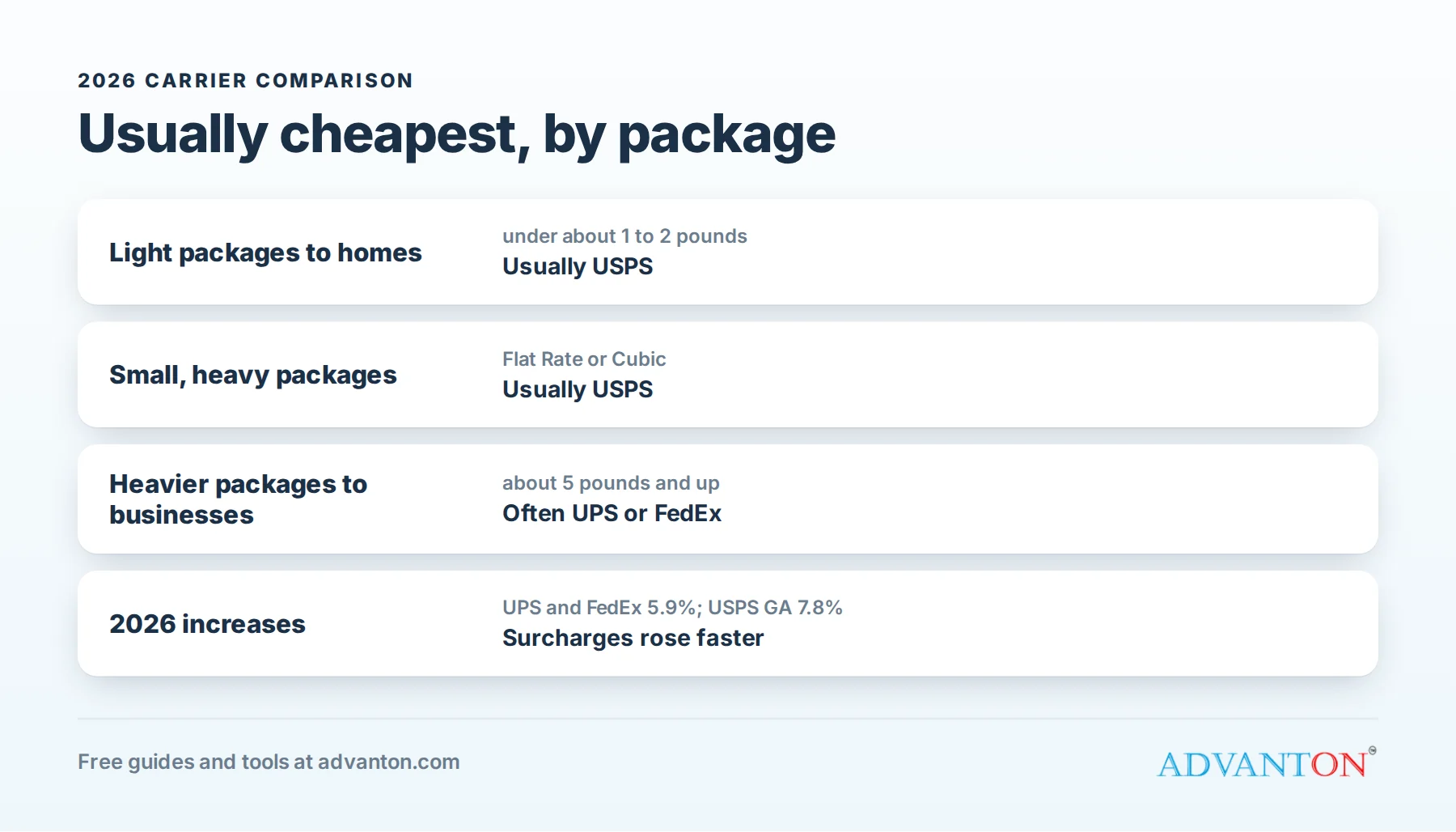
| Package | Usually cheapest | Why |
|---|---|---|
| Light packages (under about 1 to 2 pounds) to homes | USPS | Low base prices for light packages, and no traditional residential surcharge |
| Small, heavy packages | USPS (Priority Mail Flat Rate or Cubic) | Priced by box size, not weight |
| Heavier packages (roughly 5 pounds and up), especially to businesses | UPS or FedEx | Ground prices become competitive as weight rises, and there’s no residential surcharge on business deliveries |
| Large, bulky boxes | It depends | All three now charge by dimensional weight for large boxes; compare each time |
| Urgent overnight | UPS or FedEx, sometimes USPS Priority Mail Express | Broad overnight networks and guaranteed delivery times |
These are tendencies, not rules. Always compare prices for your actual packages, ideally with shipping software that shows all three side by side.
2026 price changes at a glance
| Carrier | 2026 headline increase | Other changes |
|---|---|---|
| UPS | 5.9% average list rate increase, effective December 22, 2025 | Residential surcharge up about 6.6%; new large package and handling triggers from January 26, 2026 |
| FedEx | 5.9% average increase, effective January 5, 2026 | Residential surcharge up about 8.4%; delivery area surcharges up; peak surcharges through January 17, 2027 |
| USPS | Ground Advantage up 7.8%, Priority Mail 6.6%, Priority Mail Express 5.1%, effective January 18, 2026 | Temporary 8% surcharge April 26, 2026 to January 17, 2027; July 12, 2026 changes to commercial Ground Advantage and dimensional weight |
Surcharges: the hidden part of the price
A carrier’s base rate is only part of the cost. UPS and FedEx add surcharges that small businesses pay on most orders:
- Residential delivery surcharge: a per-package fee for delivering to homes, which applies to most online orders. It rose about 6.6% at UPS and 8.4% at FedEx Home Delivery in 2026.
- Fuel surcharge: a percentage of the base rate that changes weekly with fuel prices.
- Delivery area surcharges: extra fees for rural and less-accessible ZIP codes.
- Additional handling and large package surcharges: for heavy, long or awkwardly shaped packages.
- Peak season surcharges: during the busy holiday period.
USPS has traditionally not charged residential or fuel surcharges, which is a big reason it often wins for light packages to homes. In 2026, however, USPS added a temporary 8% surcharge on many package prices through January 17, 2027.
Dimensional weight: why box size matters
All three carriers charge large, light packages by dimensional weight: length × width × height divided by a "divisor". UPS and FedEx commonly use a divisor of 139 for business shipments, and from July 12, 2026, USPS also uses 139 for packages larger than one cubic foot (down from 166).
Example: a 16 × 12 × 10 inch box (1,920 cubic inches) has a dimensional weight of 1,920 ÷ 139 = 13.8, billed as 14 pounds, even if the contents weigh 4 pounds. A smaller box can cut the price dramatically.
Service and convenience compared
| USPS | UPS | FedEx | |
|---|---|---|---|
| Delivers to PO Boxes and military addresses | Yes | No (most services) | No (most services) |
| Free pickup | Yes, with regular mail delivery | With daily pickup accounts or for a fee | With scheduled accounts or for a fee |
| Free boxes | Priority Mail boxes | For some air services | For some Express services |
| Drop-off locations | Post Offices nationwide | UPS Stores and Access Points | FedEx Office and retail partners |
| Weekend delivery | Saturday delivery standard; Sunday in some areas | Saturday ground delivery in many areas | Saturday home delivery in many areas |
| Best known for | Light packages to homes | Heavier packages, business deliveries, reliability | Express and overnight, heavier packages |
International shipping compared
- USPS is often the most affordable way to send light packages abroad, through First-Class Package International and Priority Mail International, though delivery can be slower and tracking less detailed in some countries.
- UPS and FedEx are usually faster and offer more detailed tracking and customs support, at higher prices, which suits valuable or urgent shipments.
- For all three, complete customs forms accurately, and tell customers whether import duties and taxes are included or due on delivery.
Let software compare for you
The fastest way to choose the cheapest carrier is shipping software that shows USPS, UPS and FedEx prices side by side for each order, including surcharges, and prints the label for whichever you pick. Many platforms connect to online stores and marketplaces, apply discounted rates automatically and send tracking emails. Start with a free plan, and check that it includes all three carriers.
Economy services and regional carriers
For light packages that aren’t urgent, the big carriers also offer economy services that hand packages to USPS or use lower-cost networks for the final delivery:
- UPS Ground Saver for lightweight residential packages.
- FedEx Ground Economy for low-weight, non-urgent residential deliveries.
These can be cheaper but slower, and delivery times are less predictable. Regional carriers such as OnTrac can also be competitive for packages within their delivery areas. Shipping software often includes these options alongside the main carriers.
Insurance, tracking and claims
| USPS | UPS | FedEx | |
|---|---|---|---|
| Included coverage | Up to $100 on Ground Advantage and Priority Mail | Declared value coverage up to $100 by default | Declared value coverage up to $100 by default |
| Extra coverage | Available for purchase | Available for purchase (declared value) | Available for purchase (declared value) |
| Tracking | Included on Ground Advantage, Priority and Express | Included | Included |
Whichever carrier you use, keep invoices and packing photos for valuable items, and file claims promptly.
Planning for the holiday season
- Expect higher costs: FedEx and UPS add peak surcharges, and USPS’s temporary surcharge runs through January 17, 2027.
- Publish shipping cut-off dates on your website for orders to arrive before holidays.
- Ship early in the week and allow extra time for delivery.
- Stock up on supplies before the rush.
- Communicate: send tracking promptly, and answer "where’s my order?" questions quickly.
Returns: how the carriers compare
All three carriers offer return labels you can email to customers or include in the box. USPS and some shipping software offer pay-on-use return labels, so you only pay when a customer actually sends something back. UPS and FedEx have many convenient drop-off points, and some locations accept returns without a box or printed label. Decide on a return policy first, then choose the return method that matches it.
How to get the best prices from each
- USPS: buy labels online for commercial pricing, use Priority Mail Flat Rate or Cubic pricing for small heavy items, and schedule free pickups. See Click-N-Ship and commercial pricing.
- UPS and FedEx: open a free business account, which gives lower prices than retail counters, and use shipping software that offers discounted rates. As your volume grows, ask an account representative about negotiated discounts.
- All three: compare prices for every shipment through shipping software, rather than defaulting to one carrier.
A worked example: choosing a carrier for three orders
These are illustrative scenarios that show how to think, not quoted prices.
| Order | Likely winner | Reasoning |
|---|---|---|
| A 10-ounce T-shirt to a home 800 miles away | USPS Ground Advantage | Light, residential, and no traditional residential surcharge |
| An 8-pound tool kit to a business across the country | UPS or FedEx Ground | Heavier, and business delivery avoids the residential surcharge |
| A 6-pound box of candles in a small box, going far | USPS Priority Mail Flat Rate or Cubic | Small and dense, so size-based pricing wins |
How to decide, step by step
- List your five most common packages: size, weight and typical destinations.
- Get prices from all three carriers for each, including surcharges, using shipping software.
- Set a default carrier for each package type.
- Re-check after every price change, at least each January and July.
- Adjust what you charge for shipping so your margins stay intact.
Common mistakes
- Using one carrier for everything out of habit.
- Comparing base prices only, ignoring residential and fuel surcharges.
- Oversized boxes that trigger dimensional weight charges.
- Not passing on price increases through shipping charges or product prices.
- Retail counter prices instead of discounted online rates.
Frequently asked questions about USPS vs UPS vs FedEx
Is USPS cheaper than UPS and FedEx?
Usually for light packages to homes, and often for small, heavy items using Flat Rate or Cubic pricing. UPS and FedEx can be cheaper for heavier packages, especially to business addresses.
Why did my shipping costs rise more than 5.9%?
Surcharges, including residential, fuel and delivery area fees, rose faster than the base rates in 2026, and USPS added a temporary surcharge.
Should I use more than one carrier?
Yes, if you ship a variety of package sizes. Shipping software makes it easy to compare and choose the cheapest option for each order.
How do I get discounted UPS or FedEx rates?
Open a free business account, use shipping software with pre-negotiated rates, and ask about volume discounts as your shipping grows.
Which carrier is most reliable?
All three deliver the vast majority of packages on time. Reliability varies by route, season and service level, so track your own delivery times and customer complaints by carrier, and adjust if one consistently underperforms in your area.
Keep learning
- USPS for small business: every service explained
- USPS Click-N-Ship and commercial pricing
- Profitable ecommerce business ideas
Sources
- Beancount, 2026 shipping rate hikes: UPS, FedEx, USPS (July 2026)
- ShipperHQ, 2026 carrier rate increases
- ShipperHQ, Carrier rule changes (peak surcharges and the USPS temporary surcharge)
- ParcelPath, Is FedEx or UPS cheaper? (2026 residential surcharges)
- USPS Newsroom, Competitive price changes for July 2026
Last reviewed October 27, 2026. Startup costs are estimates; check local prices, licensing and tax rules before you commit money.
This article is general information, not financial, legal or tax advice. Check the rules that apply to you or talk to a qualified professional before making decisions. See our disclaimer.
Leave a Reply