
Choosing a business structure is one of the first real decisions you make as a business owner, and it shapes three things for years: whether your personal savings are at risk if the business is sued or can’t pay its debts, how much tax you pay and when, and how much paperwork you take on. The good news is that for most small businesses the choice comes down to a few clear questions, and you can change structure later as you grow.
This guide compares the four options most owners consider, shows worked tax examples using 2026 figures, and gives you a simple way to decide.
This is general information, not legal or tax advice. Rules vary by state and by your situation, so confirm your choice with a CPA or attorney.
The four options at a glance
Table of Contents
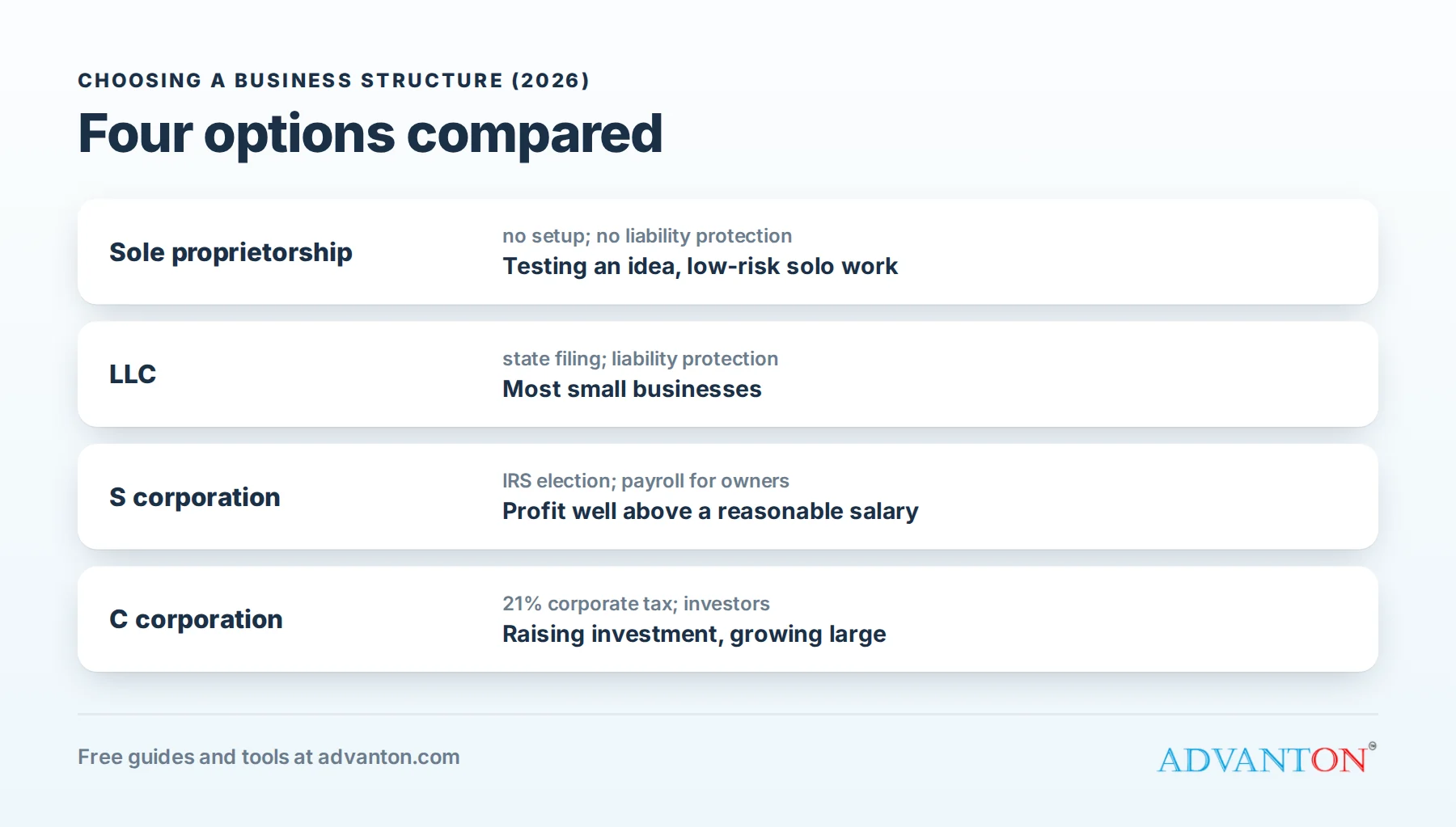
| Sole proprietorship | LLC | S corporation | C corporation | |
|---|---|---|---|---|
| Personal liability protection | No | Yes | Yes | Yes |
| How profit is taxed | On your personal return | On your personal return by default (pass-through) | Pass-through, after an IRS election | The company pays 21% federal corporate tax; dividends taxed again |
| Self-employment tax | On all profit | On all profit, unless taxed as an S corporation | Only on your salary (as payroll tax) | Payroll tax on salary only |
| 20% QBI deduction | Yes, if eligible | Yes, if eligible | Yes, if eligible | No |
| Setup | None required | State filing and fee | A corporation or LLC plus IRS Form 2553 | State filing and fee |
| Ongoing paperwork | Lowest | Low: annual report in most states | Moderate: payroll and a business tax return | Highest: corporate formalities and a corporate return |
| Best for | Testing an idea, low-risk solo work | Most small businesses | Profitable owners who pay themselves a salary | Raising investment, planning to grow large |
Sole proprietorship: the default
You become a sole proprietor automatically when you start doing business alone without registering an entity. There’s nothing to file with the state (though you’ll still need local licenses, and a DBA if you use a business name; see how to register a DBA).
How it’s taxed: you report profit on Schedule C of your personal return, and pay self-employment tax on it. In 2026 that’s 12.4% Social Security tax on net earnings up to $184,500, plus 2.9% Medicare on all of it, calculated on 92.35% of your profit, with half deductible from your income.
The big drawback: there’s no legal separation between you and the business. If a customer sues or a supplier isn’t paid, your personal savings, car and sometimes home can be at risk. Insurance helps, but doesn’t cover everything.
Good for: testing an idea, freelancing with low risk, or very small side businesses.
Limited liability company (LLC): the most popular choice
An LLC is created by filing articles of organization with your state. It separates your personal assets from the business’s debts and claims, as long as you treat it as a separate business: separate bank account, signed contracts in the LLC’s name, adequate insurance and no mixing of personal and business money. If you don’t, a court can "pierce the veil" and hold you personally liable.
How it’s taxed: by default, a single-owner LLC is taxed exactly like a sole proprietorship, and a multi-owner LLC like a partnership, so profit passes through to your personal return. An LLC can also elect to be taxed as an S corporation once profits justify it.
What it costs: filing fees range widely, from about $35 in Montana to $500 in Massachusetts, and many states charge an annual report fee or tax. California charges an $800 minimum annual tax from the first year. Our guide to business ideas in California explains the full first-year cost.
Other things to set up: an operating agreement (essential with partners, wise even when you’re alone) and a registered agent to receive legal papers.
S corporation: a tax election, not a business type
"S corporation" is a federal tax status that a corporation or LLC can elect by filing Form 2553 with the IRS. Owners who work in the business are paid a reasonable salary through payroll, and remaining profit can be taken as distributions without self-employment tax. That can save real money once profits are healthy, but it adds payroll, a separate business tax return (Form 1120-S) and higher accounting fees. We explain the rules, deadline and worked numbers in what an S corporation is and when to elect it.
C corporation: built for investors
A C corporation is a separate taxpayer that pays 21% federal corporate income tax on its profit. When it pays dividends, shareholders pay tax again ("double taxation"). It isn’t eligible for the 20% QBI deduction. But it’s the structure investors expect: it can issue different classes of stock, grant stock options and eventually go public, and some founders qualify for valuable tax breaks on qualified small business stock when they sell.
Good for: startups planning to raise venture capital, or businesses that will reinvest most profits rather than pay them out.
Partnerships: what happens when two people start a business
If two or more people go into business together without forming an entity, the law usually treats them as a general partnership automatically. Each partner can be personally liable for the whole business’s debts, including debts another partner took on. That’s a serious risk, which is why most co-owners form an LLC instead.
- General partnership: no filing required; partners share profits and personal liability; taxed as a partnership (Form 1065, with a K-1 for each partner).
- Limited liability partnership (LLP): available in many states, often only for licensed professionals such as accountants or lawyers; protects partners from each other’s malpractice.
- Multi-member LLC: liability protection for all owners, taxed as a partnership by default, with the flexibility of an operating agreement.
Whatever you choose with a co-owner, put the agreement in writing: who owns what, who decides what, how profits are shared, and what happens if someone wants out, becomes ill or dies.
What LLCs really cost: state examples
| State | What to know |
|---|---|
| California | $70 filing fee, plus an $800 minimum annual tax from the first year, and a Statement of Information every two years |
| Texas | $300 filing fee; franchise tax reports are due yearly, though businesses under the "no tax due" revenue threshold owe no franchise tax |
| Florida | $125 filing fee and a $138.75 annual report |
| Delaware | A $300 annual tax for LLCs, and you’ll usually also register (and pay fees) in your home state |
| New York | Filing fee plus a publication requirement: new LLCs must publish a notice in two newspapers within 120 days, which can cost hundreds of dollars or more in some counties |
| Massachusetts | $500 filing fee and a $500 annual report |
Fees change, so confirm current amounts with your secretary of state before you file.
The 20% QBI deduction is now permanent
Owners of sole proprietorships, partnerships, LLCs and S corporations can generally deduct up to 20% of qualified business income on their personal returns. The One Big Beautiful Bill Act, signed in July 2025, made this deduction permanent. From 2026 it also widens the income range before limits apply to service businesses, and adds a $400 minimum deduction for owners with at least $1,000 of qualified business income from a business they actively run. This keeps pass-through structures (sole proprietorships, LLCs and S corporations) attractive for most small businesses.
Worked examples: how the choice affects taxes
These are simplified illustrations using 2026 self-employment tax rates. They ignore income tax brackets, state taxes and the QBI deduction, which apply similarly to the first three options.
Example 1: $50,000 profit
- Sole proprietorship or default LLC: self-employment tax of about $7,065 (15.3% of 92.35% of profit).
- LLC taxed as an S corporation, paying a $35,000 salary: payroll taxes of about $5,355, a saving of about $1,710. But extra payroll and tax return costs can easily eat that saving, so the election rarely makes sense at this profit level.
Example 2: $120,000 profit
- Sole proprietorship or default LLC: self-employment tax of about $16,955.
- S corporation with a $60,000 reasonable salary: payroll taxes of about $9,180, a saving of about $7,775 before extra costs. After paying for payroll and a business tax return, the owner may still save several thousand dollars a year.
The pattern: liability protection is the reason to form an LLC early; tax savings from an S corporation election usually come later, once profit is well above a reasonable salary.
How to choose: a decision guide
- Is there meaningful liability risk? Customers on your premises, physical work, employees, contracts, vehicles or valuable advice all count. Form an LLC rather than staying a sole proprietor.
- Are you just testing an idea, with almost no risk and little income? A sole proprietorship is fine for now. Get insurance and switch when you gain traction.
- Is profit consistently well above what you’d pay yourself as a salary? Ask a CPA about an S corporation election for your LLC.
- Will you raise money from investors or offer stock options? Form a C corporation, usually in Delaware.
- Do you have business partners? Form an LLC and sign a detailed operating agreement covering ownership, decisions, money and what happens if someone leaves.
Common mistakes to avoid
- Assuming an LLC protects you no matter what. Mixing personal and business money, or signing contracts personally, can undo the protection.
- Electing S corporation status too early, before profits justify the extra costs.
- Forgetting state costs, such as annual reports and minimum taxes.
- Skipping the operating agreement with partners.
- Ignoring insurance. Even an LLC needs general liability and, often, professional liability coverage.
A recent change: beneficial ownership reporting
In March 2025, FinCEN exempted US companies and US persons from beneficial ownership information (BOI) reporting under the Corporate Transparency Act. Today, only companies formed outside the US that register to do business in a state must report. Rules can change, so check FinCEN’s website when you form your business.
Next steps after choosing
- Form your entity with your state, if needed.
- Get an EIN, free from the IRS. See how to get an EIN.
- Open a business bank account. See how to open a business bank account.
- Register a DBA if you’ll use a different name, and consider trademarking your name.
- Get licenses, permits and insurance.
Frequently asked questions
Can I change my business structure later?
Yes. Many owners start as sole proprietors, form an LLC as the business grows, and later elect S corporation taxation. Some changes need a new EIN, and converting a corporation to an LLC can have tax consequences, so plan with a CPA.
Is an LLC better than a sole proprietorship for taxes?
By default, no: a single-owner LLC is taxed the same way. The main benefit is liability protection. Tax savings come from an S corporation election once profits are high enough.
Do I need a lawyer to form an LLC?
Not usually. Most states let you file online in minutes. A lawyer is worth it for multi-owner operating agreements, complex industries or significant assets.
Which state should I form my LLC in?
Usually the state where you live and do business. Forming elsewhere (such as Delaware or Wyoming) often means registering in your home state too, paying two sets of fees.
Keep learning
- What is an S corporation and when to elect it
- How to start a business: the A to Z guide
- Small business taxes and bookkeeping
Sources
- US Small Business Administration, Choose a business structure
- IRS, Business structures
- Journal of Accountancy, Social Security wage base for 2026
- Texas Society of CPAs, QBI deduction under the One Big Beautiful Bill Act
- FinCEN, Beneficial ownership information reporting
Last reviewed October 26, 2026. Startup costs are estimates; check local prices, licensing and tax rules before you commit money.


Leave a Reply