
A DBA, short for “doing business as”, lets you operate under a name that’s different from your own legal name or your company’s registered name. It’s one of the cheapest and simplest filings in business, but the rules vary a surprising amount from state to state, and getting it wrong can mean a bank won’t accept checks made out to your business, or a filing that quietly becomes void.
Depending on your state, a DBA is called an assumed name, fictitious business name, fictitious name or trade name. They all mean the same thing: a public record that links a business name to the real person or company behind it.
When you need a DBA
Table of Contents
| Situation | Example | Do you need a DBA? |
|---|---|---|
| Sole proprietor using their own full name | “Maria Lopez” | No |
| Sole proprietor using a business name | Maria Lopez operating as “Sunrise Cleaning” | Yes |
| LLC using its exact registered name | “Sunrise Cleaning LLC” | No |
| LLC using a different name | “Lopez Services LLC” operating as “Sunrise Cleaning” | Yes |
| One company with several brands | “Lopez Services LLC” running “Sunrise Cleaning” and “Sunrise Windows” | Yes, one for each brand name |
| Partnership using a name other than the partners’ surnames | “Lopez & Chen” operating as “Bright Home Services” | Yes |
Why it matters: many states require a DBA filing before you use a business name, and banks usually ask for proof of your DBA before they’ll open an account or deposit checks made out to that name.
Where you file: county, state or both
There’s no national DBA system. States fall into three groups:
- County-level states, such as California: you file with the county clerk where your business is based.
- State-level states, such as Florida: you file with a state office.
- Split states, such as Texas and New York: where you file depends on whether you’re an individual or a registered company.
How the rules differ: four big states
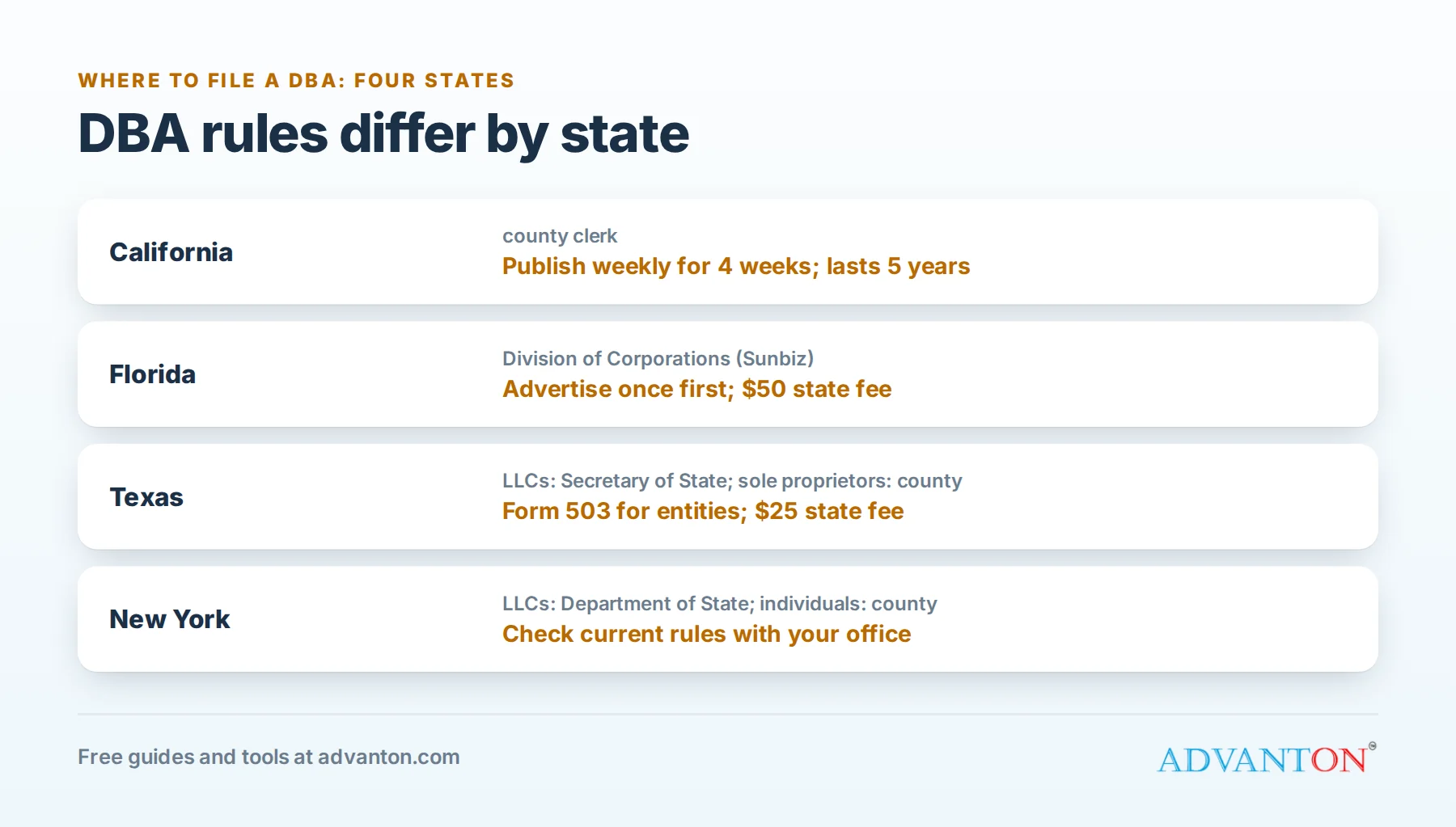
| State | Where to file | Publication | Good to know |
|---|---|---|---|
| California | County clerk where your principal place of business is | Publish in a local newspaper once a week for four weeks, starting within 45 days of filing | Registration typically lasts five years; no statewide name database |
| Florida | State: Division of Corporations (Sunbiz), online | Advertise once in a newspaper in your county before registering | Statewide filing fee of $50 |
| Texas | LLCs and corporations: Secretary of State (Form 503); sole proprietors and general partnerships: county clerk | No newspaper publication | State filing fee of $25 for entities |
| New York | LLCs and corporations: Department of State; sole proprietors and partnerships: county clerk | Check current rules with your filing office | Corporations can pay extra to cover multiple counties |
Other states have their own twists. For example, Illinois county filers must publish their assumed name once a week for three consecutive weeks, or the registration can be void. Always check your own state and county rules before you file.
How to register a DBA, step by step
- Choose a name and check it’s available. Search your state’s business entity database and your county’s DBA index, and run a quick search for trademarks and domains. A DBA doesn’t stop someone with a trademark from objecting to your use of a similar name; see how to trademark a business name.
- Confirm where to file (county, state or both) and whether publication is required.
- Complete the form. You’ll typically list the DBA name, your legal name or company name, your business address, the type of business and owners’ details.
- File and pay the fee. Many states and counties accept online filing.
- Publish a notice, if required, in an approved newspaper, and file the proof of publication (an affidavit) by the deadline.
- Get your certificate and take it to your bank to open an account in the business name.
- Diary the renewal date. Many DBAs expire after a set period and must be renewed.
Before you file: a quick checklist
- The exact legal name of the owner or company, as it appears on state records.
- The DBA name, spelled exactly as you’ll use it.
- Your business address (many offices don’t accept a PO box alone).
- Owner or officer details, and a signature from each owner where required.
- The filing fee, plus the publication cost if your state or county requires it.
- A note of the publication deadline and renewal date in your calendar.
What it costs
| Cost | Typical range |
|---|---|
| Filing fee | Usually small, often about $10 to $150 depending on the state or county |
| Newspaper publication | Where required, often roughly $25 to $200 or more, depending on the newspaper and county |
| Renewals | Similar to the original filing, every few years in many places |
Some companies charge extra to file for you. That can save time if you’re forming a business in several places, but DBA filings are usually simple enough to do yourself.
Three real-world scenarios
1. The freelancer. Jordan, a graphic designer in Austin, Texas, wants to invoice clients as “Smith Creative”. As a sole proprietor, Jordan files an assumed name certificate with the Travis County clerk, then opens a business checking account in the name “Jordan Smith DBA Smith Creative”. Clients can now pay Smith Creative by check or bank transfer, and Jordan keeps business and personal money separate.
2. The growing LLC with a second brand. “Lopez Services LLC” in Miami runs a cleaning business under its own name and wants to launch a window cleaning brand called “Sunrise Windows”. Because Florida registers fictitious names at the state level, the LLC advertises the name once in a Miami-Dade County newspaper, then registers “Sunrise Windows” with the Division of Corporations. Both brands operate under the same LLC, with the same liability protection and tax return.
3. The business that moved. A bakery in Los Angeles County, California, moves to Orange County. California DBAs are filed by county, so the owner files a new fictitious business name statement in Orange County, publishes it for four weeks, and files a statement of abandonment for the Los Angeles County filing.
DBAs for online sellers
Selling online adds a few practical points:
- Payment processors and marketplaces check names. Stripe, PayPal, Square, Amazon and Etsy may ask for documents showing that your business name and legal name are linked, and a DBA certificate does exactly that.
- Your website and invoices should show your legal name somewhere, such as “Smith Creative is a trade name of Jordan Smith” in your footer or terms. This builds trust and meets disclosure rules in many places.
- Register where you’re based. An online business usually files its DBA where the owner or company is located, not everywhere its customers live.
- Brand names for products that you plan to sell widely deserve a trademark search before you invest in packaging and marketing.
Common DBA mistakes
- Using a business name for months without filing, then discovering the bank won’t deposit a large check made out to that name.
- Forgetting the publication step where it’s required, so the registration is incomplete or void.
- Letting a DBA expire without renewing it.
- Assuming a DBA protects the name from competitors.
- Filing in the wrong place: for example, a Texas LLC filing only with the county instead of the Secretary of State.
- Not updating the DBA after changing owners or addresses.
What a DBA doesn’t do
This is where many owners get caught out:
- It doesn’t create a business or protect your personal assets. A sole proprietor with a DBA is still a sole proprietor, personally liable for business debts. For protection, form an LLC or corporation; see LLC vs sole proprietorship vs corporation.
- It doesn’t give you exclusive rights to the name. Two businesses in different counties, or different states, can register the same DBA. Only a trademark gives you exclusive rights, and a federal trademark covers the whole country.
- It doesn’t replace licenses, permits or tax registrations.
- It doesn’t change your tax treatment. You still file taxes under your own name or your company’s name.
DBA vs LLC vs trademark
| DBA | LLC | Federal trademark | |
|---|---|---|---|
| What it does | Lets you trade under a different name | Creates a legal business separate from you | Gives exclusive rights to a brand name for certain goods or services |
| Liability protection | No | Yes | No |
| Name protection | Very limited | Usually blocks identical company names in that state only | Nationwide, for your goods or services |
| Typical cost | Low | Moderate, plus yearly fees in many states | $350 per class to apply, plus maintenance |
Many businesses use all three: an LLC for protection, DBAs for brand names, and a trademark for the brand they plan to grow.
Changing or cancelling a DBA
- Changing ownership or address: most states require an amended filing, and some require a brand-new DBA.
- Stopping use of the name: file a statement of abandonment or withdrawal; in California, this also has to be published in a newspaper.
- Closing your business: cancel your DBAs so the name is released and your records stay accurate.
Tips for choosing a business name
- Make it easy to say, spell and remember.
- Check the domain name and social media handles before you file; see our guide to domain name generators.
- Avoid names that suggest services you don’t offer, or that include words like “Bank” or “Insurance”, which many states restrict.
- Avoid names close to a competitor’s or a well-known brand, which can lead to trademark disputes.
- Think about growth: “Austin Window Cleaning” is clear but may feel limiting if you expand to new cities or services.
Frequently asked questions
Does a DBA work in every state?
No. A DBA covers only where it’s registered, often a single county or state. If you trade under the name in other states, check whether you need to register there too.
Can an LLC have more than one DBA?
Yes. Many companies register several DBAs for different brands or locations.
Do I need a DBA if I’m a freelancer?
Only if you use a name other than your own legal name. If you invoice as “Jordan Smith”, you don’t; if you invoice as “Smith Creative”, you usually do.
How long does a DBA last?
It depends on the state: some last five years (California), others have no set expiration. Check your filing office’s rules and renewal dates.
Can I open a business bank account with just a DBA?
Usually, yes. Many banks let sole proprietors open a business account using their DBA certificate, their Social Security number or EIN, and photo ID. It keeps business money separate, which makes bookkeeping and taxes much easier, even though it doesn’t give you the liability protection of an LLC.
My LLC is “Sunrise Cleaning Services LLC”, but my logo just says “Sunrise Cleaning”. Do I need a DBA?
Small variations, such as dropping “LLC” in your logo, are generally fine. But if you regularly do business under a meaningfully different name, such as “Sunrise Cleaning” on contracts and invoices, check your state’s rules: many expect a DBA whenever the name customers see differs from your registered name in a meaningful way.
Keep learning
Sources
- US Small Business Administration, Choose your business name
- Swyft Filings, California fictitious business name
- LegalZoom, Fictitious business name statement
- Startup Owl, DBA filing by state
Last reviewed October 26, 2026. Startup costs are estimates; check local prices, licensing and tax rules before you commit money.


Leave a Reply