
Crowdfunding lets a business raise money from many people, each contributing a small amount, usually online. It can fund a product launch, a new location or an expansion, and it does something no bank loan can: it proves people want what you’re making before you spend big.
But crowdfunding isn’t free money. Platforms take fees, rewards cost money to make and ship, and most campaigns that succeed are the result of weeks of preparation. This guide explains the types of crowdfunding, what they really cost, and how to run a campaign that has a real chance of success.
The four types of crowdfunding
Table of Contents
| Type | What backers get | Best for |
|---|---|---|
| Rewards | A product, experience or perk, often a pre-order | Consumer products, creative projects, launches |
| Equity | A small ownership stake in your business | Businesses aiming for significant growth |
| Donation | Nothing in return, just support | Community causes, disaster recovery, nonprofits |
| Debt (lending) | Repayment with interest | Established businesses with steady revenue |
Rewards crowdfunding
With rewards crowdfunding, backers pay in advance for a reward, usually your product at a special price. It’s essentially pre-selling, and it’s the most common type for small businesses.
How Kickstarter works: projects are all-or-nothing: if you don’t reach your goal, backers aren’t charged and you receive nothing. If you succeed, Kickstarter takes a 5% platform fee, and payment processing adds roughly 3% plus 20 cents per pledge. About 42% of Kickstarter projects reach their goal, so preparation matters.
Other rewards platforms work similarly, with different fees and funding options; check each platform’s current terms before choosing.
Equity crowdfunding
Under the SEC’s Regulation Crowdfunding, businesses can sell small ownership stakes to the public, raising up to $5 million in a 12-month period, through an SEC-registered funding portal or broker-dealer. Non-accredited investors can take part within limits, and securities generally can’t be resold for a year.
Equity crowdfunding involves legal and financial disclosures (filed on Form C), ongoing annual reporting, and platform fees typically higher than rewards platforms. It suits businesses with strong customer communities and plans to grow significantly. See how to find investors for a small business.
What crowdfunding really costs: a worked example
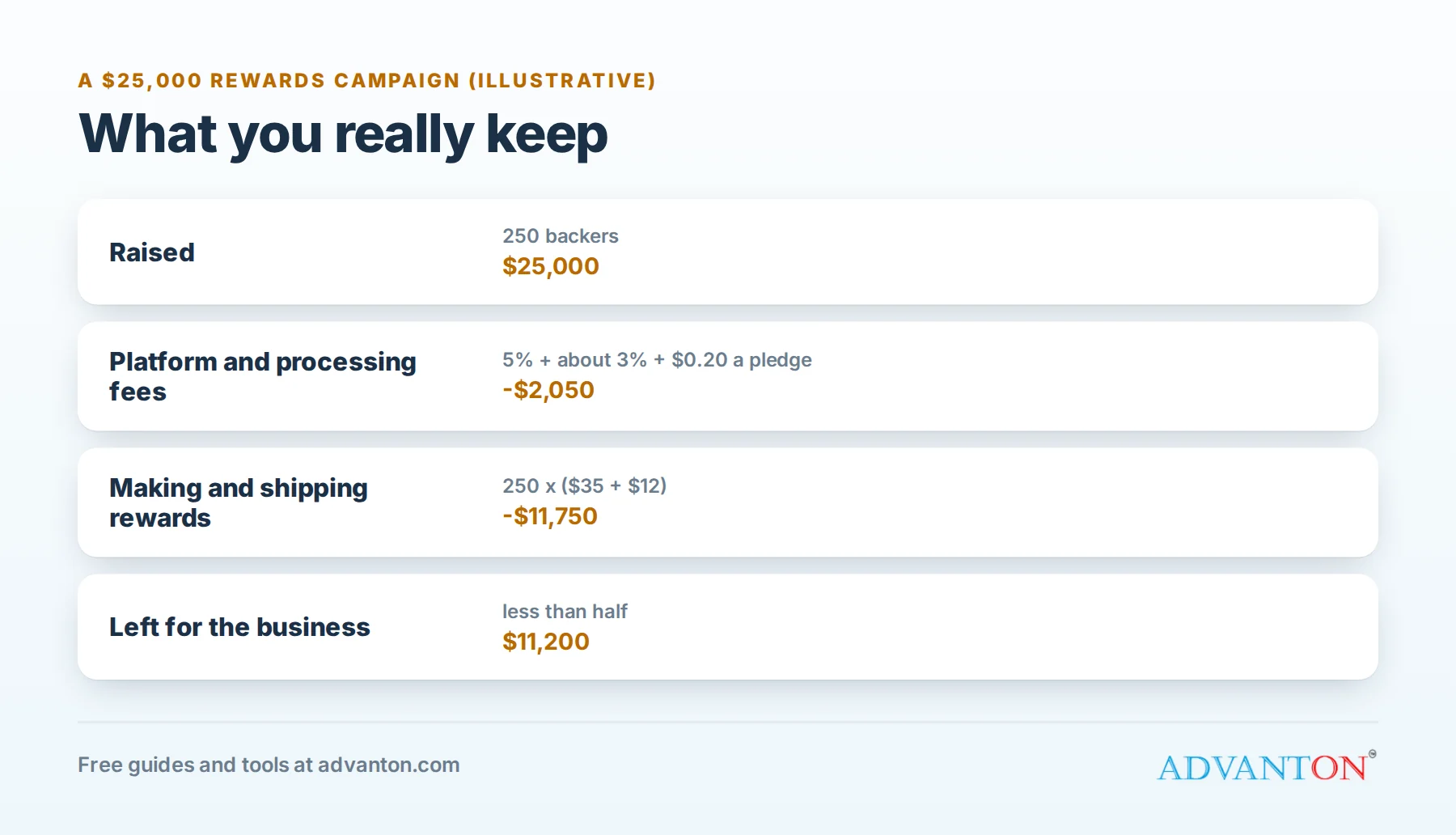
A coffee roaster runs a rewards campaign for a new subscription box, raising $25,000 from 250 backers (an average of $100 each). These figures are illustrative.
| Amount | |
|---|---|
| Raised | $25,000 |
| Platform fee (5%) | −$1,250 |
| Payment processing (about 3% + $0.20 per pledge) | −$800 |
| Cost to produce rewards (250 × $35) | −$8,750 |
| Shipping (250 × $12) | −$3,000 |
| Left to invest in the business | $11,200 |
What this shows: less than half of the money raised is left after fees, rewards and shipping. Set your goal from the bottom up: what you need to keep, plus the cost of fulfilling every reward, plus fees.
Choosing a platform
| Consider | Why it matters |
|---|---|
| Type | Rewards, equity, donation or debt platforms serve different goals |
| Funding model | All-or-nothing protects you from underfunded promises; flexible models let you keep what you raise |
| Fees | Platform fee plus payment processing, and for equity, legal and other costs |
| Audience | Some platforms are known for gadgets, games or creative work; others for local businesses |
| Rules | What you can offer, where you can ship, and approval requirements |
Read each platform’s current terms; fees and funding options change.
Is crowdfunding right for your business?
Crowdfunding works best when:
- You have a product people can get excited about, and show clearly in photos and video.
- You already have an audience: customers, an email list, social followers or a community.
- You can deliver rewards on time and on budget.
- You can commit several weeks to preparing and running the campaign.
It’s harder for services, local businesses without a following, and ideas that are hard to explain in a short video.
How to run a campaign, step by step
- Set a realistic goal from the bottom up, including fees, reward costs, shipping and a buffer.
- Build your audience before launch: collect emails of interested people for weeks beforehand. Most successful campaigns get a strong start from people who already know them.
- Design reward tiers: a low-cost thank-you, your core product at an early-bird price, and premium bundles. Price each tier to cover its costs.
- Make a short, clear video: who you are, what you’re making, why it matters and what backers get.
- Write the campaign page: the story, product details, photos, timeline, risks and how you’ll deliver.
- Plan your launch day: email your list, post on social media and ask friends and family to back early. Early momentum attracts new backers.
- Keep momentum with updates, new photos, stretch goals and outreach to local press and bloggers.
- Fulfill on time, with regular honest updates if anything slips.
Writing your campaign story
A strong campaign page answers, in this order:
- What are you making? One clear sentence and a great photo.
- Why does it matter? The problem it solves or the joy it brings.
- Who are you? Your experience and why backers can trust you to deliver.
- What do backers get? Rewards, prices and delivery dates.
- How will the money be used? A simple breakdown builds confidence.
- What are the risks? Honest risks and your plan to handle them.
Video tips
Keep the video short (often two to three minutes), start with the product in the first seconds, show it in real use, introduce yourself on camera, and end with a clear ask. Good sound matters more than fancy footage; a clip-on microphone makes a big difference. Our video editing tools roundup lists free editors.
Example reward tiers
| Tier | Price | Reward | Notes |
|---|---|---|---|
| Supporter | $10 | Thank-you email and sticker | Low cost, easy for anyone to back |
| Early bird | $45 | First subscription box at 25% off | Limited quantity creates urgency |
| Standard | $60 | First box plus mug | Your core offer |
| Family pack | $150 | Three boxes and a tasting kit | Raises average pledge |
| Local partner | $500 | Wholesale starter order for a café | For businesses in your community |
Keep tiers few and clear, and price each one to cover its production and shipping costs.
An 8-week campaign timeline
| Weeks | Focus |
|---|---|
| 1 to 3 | Finalize product and costs, build landing page, start email list |
| 4 to 5 | Make video and photos, write campaign page, line up press and partners |
| 6 | Preview with friends and early supporters, fix any confusion |
| 7 to 8 | Launch, daily outreach, updates and stretch goals |
The campaign itself might run about 30 days, but the work that makes it succeed happens before launch.
Stretch goals
Once you reach your goal, stretch goals (extra rewards unlocked at higher totals) keep momentum going. Choose stretch goals that are cheap to add and easy to deliver, such as a bonus recipe card or an upgraded package, rather than costly new products.
Building your pre-launch audience
- A simple landing page collecting emails, built free with our website builder.
- Social posts showing progress: prototypes, behind the scenes and samples.
- Local events and pop-ups where people can see and try the product.
- Partnerships with complementary businesses and community groups.
Fulfillment: where campaigns go wrong
Many campaigns succeed at raising money and then struggle to deliver. Get production and shipping quotes before launch, add a buffer for delays, order packaging early, and communicate honestly with backers about timelines. Late but well-communicated rewards keep backers’ trust; silence loses it.
Community crowdfunding for local businesses
Local businesses can run smaller, community-focused campaigns: pre-selling memberships, gift cards or "founding member" perks to fund a new location, equipment or renovation. Neighbors often back businesses they want to keep nearby. Promote in person, through local media and with signs in your shop, and make the rewards easy to redeem.
Keep backers informed
Plan a regular update schedule: weekly during the campaign, then at every production milestone (samples approved, production started, shipping began). Share photos and honest timelines. Backers forgive delays far more easily than silence, and well-informed backers become repeat customers and promoters for your next launch.
Shipping and international backers
Shipping costs and customs rules can turn a profitable reward into a loss. Price shipping separately by region, get real quotes for your packaged product’s weight and size, decide whether to ship internationally at all, and check whether any countries restrict your product. Many first campaigns limit shipping to their own country, then expand later.
Keep selling after the campaign
When the campaign ends, interest doesn’t. Add a pre-order page on your website for people who missed it, keep your email list warm with updates, and turn backers into repeat customers once rewards are delivered.
Taxes and accounting
Money from rewards crowdfunding is often treated as business income, and reward costs and fees may be deductible expenses. Equity crowdfunding is an investment in your company, with different treatment. Talk to an accountant before launching, so you can plan for any tax due and track every reward cost.
Plan your budget with the Business Planner
Before setting your goal, use the free Business Planner to work out your startup costs, pricing and break-even point. Knowing how many units you must sell, and at what price, keeps reward tiers profitable and your goal realistic, and gives you confident answers when backers ask exactly how the money will be used, and when they’ll receive their rewards.
Common mistakes to avoid
- Setting the goal too low to cover real costs.
- Launching without an audience.
- Too many reward tiers, which confuse backers and complicate fulfillment.
- Underestimating shipping, especially internationally.
- Going quiet after the campaign ends.
Crowdfunding vs other funding
| Crowdfunding | Loan | Investors | |
|---|---|---|---|
| Repayment | Rewards owed (rewards) | Payments with interest | None, but you give up ownership |
| Proves demand | Yes, publicly | No | Partly |
| Speed | Weeks of preparation plus campaign | Weeks | Months |
| Control | Full (rewards) | Full | Shared |
For other options, see how to fund a startup with no money and how to apply for small business grants.
Frequently asked questions
What happens if I don’t reach my goal?
On all-or-nothing platforms like Kickstarter, backers aren’t charged and you receive nothing, which protects you from having to deliver rewards you can’t afford.
Can a local business use crowdfunding?
Yes, especially with a loyal community, for example to fund a new location or equipment in exchange for memberships, merchandise or experiences.
How long should a campaign run?
Many run about 30 days. Shorter campaigns create urgency; much longer ones often lose momentum.
Is equity crowdfunding worth it for a small business?
It can be, for businesses with strong communities and growth plans, but the legal work and ongoing reporting make it a bigger commitment than rewards crowdfunding.
What if my campaign fails publicly?
It happens to many first campaigns. Learn from the data, grow your audience, adjust your goal or product, and relaunch; many products succeed on their second attempt.
Keep learning
Sources
- U.S. Securities and Exchange Commission, Regulation Crowdfunding
- PledgeBox, How much does Kickstarter take? (fees, 2026)
- PledgeBox, How Kickstarter works (success rate)
Last reviewed October 28, 2026. Startup costs are estimates; check local prices, licensing and tax rules before you commit money.


Leave a Reply