
Not having savings doesn’t have to stop you from starting a business. Many successful businesses began with almost nothing: a skill, a few early customers, and creative ways to cover the first costs. The key is choosing a business model that needs little money up front, then funding what’s left in ways that don’t put you deep into risky debt.
This guide covers twelve realistic options, in roughly the order to consider them: start with the ones that cost nothing, then move to small, low-risk funding, and only then to bigger commitments.
First, shrink how much you need
Table of Contents
The cheapest money is the money you don’t need. Before looking for funding, reduce your startup costs:
- Choose a service business built on skills you already have. Services such as cleaning, consulting, tutoring, pet care, bookkeeping and repairs need far less money than stores or restaurants.
- Start part-time while keeping your job, so your living costs are covered.
- Work from home or at clients’ locations instead of renting space.
- Use what you own: your phone, computer, car and tools.
- Use free tools for your website, branding, invoices and planning.
Use our startup cost calculator to find your real minimum. Many owners discover they need far less than they feared. See how much it costs to start a business.
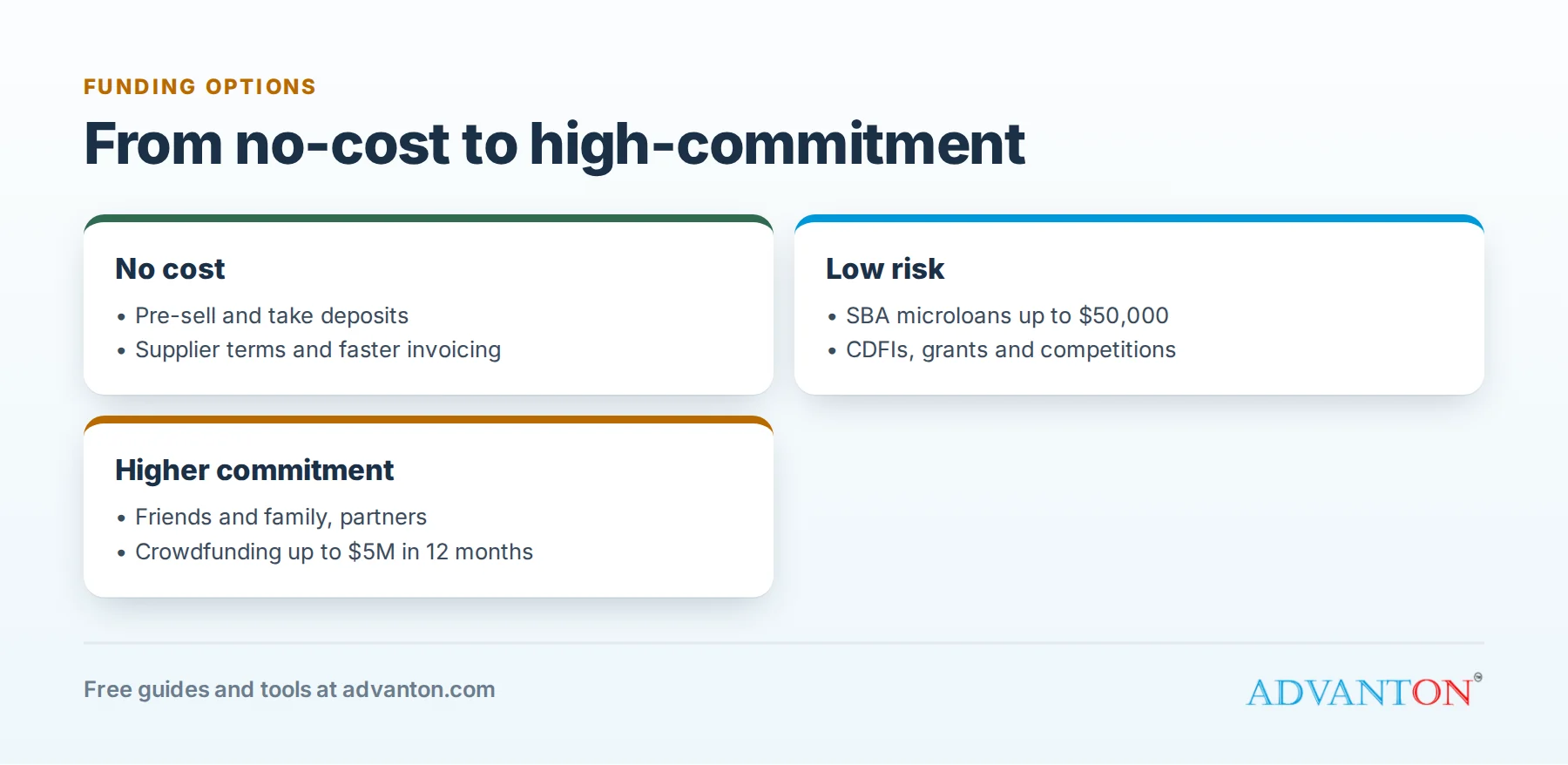
No-cost options: let customers fund you
1. Pre-sell. Sell your product or service before you deliver it. Pre-orders, packages and early-bird pricing turn customer interest into cash you can use to buy supplies. Be clear about delivery dates, and deliver on time.
2. Take deposits. Contractors, caterers, event businesses and custom makers commonly ask for a deposit (often a portion of the job) before starting. Deposits cover materials, so you’re not funding jobs out of your own pocket.
3. Get paid faster. Invoice immediately, offer easy online payment, and set short payment terms. Every day a customer takes to pay is a day you’re financing them. Our free quote and invoice generator helps you send professional invoices the same day.
4. Use supplier terms. Ask suppliers for "net 30" terms, meaning you pay 30 days after delivery. If you can sell the goods before the bill is due, the supplier has effectively funded your inventory.
5. Barter and trade services. Trade your skills for what you need: design work for a website, bookkeeping for marketing help. Keep records, because bartered services can be taxable income.
Earn your startup money from your skills first
Many owners fund their business by selling the same skills on a smaller scale first: freelance work, weekend jobs or consulting in the same field. It builds savings, a client list, testimonials and confidence that people will pay, all before you commit. A plumber who takes evening repair jobs, or a baker who sells at a weekend market, is testing and funding the business at the same time.
Lease or finance equipment
If you need expensive equipment, leasing or equipment financing spreads the cost over time, and the equipment itself usually secures the loan, which can make approval easier for new businesses. Compare the total cost with buying used, and read the terms about early return and maintenance.
Low-cost, low-risk funding
6. SBA microloans. The SBA’s microloan program offers loans of up to $50,000, with an average of about $13,000, through nonprofit community lenders. Interest is generally 8% to 13%, and terms can run up to seven years. Many microlenders also offer free business training and support, and they often work with owners who can’t get bank loans. See SBA microloans explained.
7. Community development financial institutions (CDFIs). CDFIs are mission-driven lenders that serve underserved communities and new businesses. They often offer small loans, flexible requirements and coaching.
8. Grants. Grants don’t need to be repaid, but they’re competitive, and most fund specific purposes or groups, such as research, rural businesses, or businesses owned by women, veterans or people in particular communities. Check your state economic development agency, local programs, and large companies’ small business grant programs. Never pay a fee to apply for a grant, and be wary of anyone promising guaranteed grants; these are common scams.
9. Pitch competitions and accelerators. Local business competitions, university programs and accelerators sometimes award cash prizes, mentoring and free services.
Higher-commitment options
10. Friends and family. Many businesses start with help from people who know them. Protect the relationship: put the terms in writing, decide whether it’s a loan or an investment, agree repayment terms, and only accept money they can afford to lose. For larger family loans, ask a tax professional about interest rules.
11. Crowdfunding.
- Rewards crowdfunding (on platforms like Kickstarter) lets supporters pre-buy your product. It’s a way to test demand and pre-sell at the same time. Platforms charge fees: Kickstarter, for example, takes 5% of funds raised, plus payment processing fees.
- Equity crowdfunding (Regulation Crowdfunding) lets you sell small ownership stakes to the public through an SEC-registered platform, raising up to $5 million in 12 months. It involves legal filings and ongoing reporting, so it suits businesses ready to grow quickly.
12. A business partner. A partner who brings money, equipment or skills can replace the need for funding, in exchange for a share of ownership. Put everything in writing: ownership shares, roles, decisions and what happens if someone leaves. An LLC operating agreement is the usual place for this.
Where to look for grants
- Your state economic development agency and local city or county programs, which often fund new businesses in specific areas or industries.
- Small Business Development Centers and Women’s Business Centers, which know local grant programs.
- Large companies’ small business grant programs, often announced yearly.
- Industry associations and community foundations.
- Grants.gov for federal grants, which mostly fund research, nonprofits and specific programs rather than new businesses.
Most grants have specific eligibility rules and deadlines. Make a list, note each deadline, and apply only where you clearly qualify.
Revenue-based financing
Some lenders advance money in exchange for a fixed share of your future monthly revenue until a set amount is repaid. Payments shrink in slow months, which helps cash flow, but the total repaid can be well above what you received, and most providers want to see existing revenue first. It suits businesses with steady sales rather than brand-new startups, so treat it as a later option.
Options to approach with caution
- Credit cards. Easy to get, but interest is often high. A 0% introductory offer can help with small, short-term costs if you’re certain you can repay before the rate rises.
- Merchant cash advances. Fast money repaid from a share of your daily card sales, but the effective cost can be very high. Read every term.
- Retirement account withdrawals. Early withdrawals can bring taxes and penalties, and put your retirement at risk.
- Personal loans and home equity. These put personal assets on the line if the business struggles.
According to the Federal Reserve’s 2026 Report on Employer Firms, 59% of small businesses with debt used a personal guarantee to get it, meaning the owner is personally responsible if the business can’t repay. Understand what you’re signing.
How to ask friends and family
- Share a short written plan: what you need, what it’s for, and how you’ll repay or share profits.
- Decide: loan or investment? A loan has repayment terms and interest; an investment gives them part ownership. Mixing the two causes disputes.
- Put it in writing, signed by everyone: amount, repayment schedule or ownership share, and what happens if the business closes.
- Only take money they can afford to lose.
- Keep them updated with regular, honest news, good and bad.
Build credit for future funding
Even if you start without funding, set yourself up to qualify later:
- Separate business and personal finances with a business bank account.
- Get an EIN and register your business properly. See how to get an EIN.
- Open supplier accounts that report payments to business credit bureaus, and pay early.
- Keep clean records of income and expenses; lenders want to see them.
- Repay any small loan on time. A repaid microloan is one of the best ways to qualify for a larger loan.
A worked example: starting a dessert catering business with $500
- Start from home under your state’s cottage food law, if your products qualify, so no commercial kitchen is needed yet.
- Pre-sell holiday dessert boxes to friends, coworkers and neighbors, taking payment up front.
- Take 50% deposits on event orders to cover ingredients.
- Use free tools for a website, logo and invoices.
- Apply for a small microloan once you have sales history, to buy equipment for larger orders.
This path funds most of the startup costs from customers, keeps debt small, and builds a track record that makes later funding easier.
A simple funding plan
| Need | Amount | Source | When |
|---|---|---|---|
| Licenses and insurance | $900 | Savings | Before opening |
| Equipment | $1,800 | Microloan or used equipment | Before opening |
| Materials for first jobs | Varies | Customer deposits | As jobs are booked |
| Inventory | $1,500 | Pre-sales and supplier terms | Opening month |
Writing it down shows exactly where each dollar comes from, and where the gaps are.
How to choose
| If you need… | Consider |
|---|---|
| A few hundred to a few thousand dollars | Pre-sales, deposits, supplier terms, savings from a side income |
| Up to $50,000, without bank credit | SBA microloans, CDFIs |
| Money that doesn’t need repaying | Grants and competitions, though they’re competitive |
| Large amounts for fast growth | Investors or equity crowdfunding. See bootstrapping vs raising money |
Common mistakes
- Borrowing before testing demand. Prove people will pay first.
- Mixing personal and business money. Open a separate business bank account from the start.
- Taking expensive debt to cover slow sales. Fix the sales problem first.
- Paying for "guaranteed" grants or funding.
- Skipping written agreements with family and partners.
Frequently asked questions
Can I get a business loan with no money and bad credit?
It’s harder, but microlenders and CDFIs often consider your plan, character and community ties alongside credit. A small loan, repaid on time, builds the history you need for larger financing later.
Are there free government grants to start a business?
The federal government rarely gives grants simply to start a business; most federal grants fund research or specific programs. State, local and private grants exist, but they’re competitive. Never pay to apply.
What’s the fastest way to fund a startup with no money?
Pre-selling and taking deposits, because customers pay you before you spend.
Is it a bad idea to use my own savings?
Not necessarily. Most small businesses start with the owner’s savings. Just decide in advance how much you’re willing to risk, keep a personal emergency fund, and don’t put in more money to cover losses without first fixing the underlying problem.
Keep learning
- How much does it cost to start a business?
- SBA microloans explained
- Plan your business in the free Business Planner
Sources
- U.S. Small Business Administration, Microloans
- U.S. Securities and Exchange Commission, Regulation Crowdfunding
- Federal Reserve Banks, 2026 Report on Employer Firms (Small Business Credit Survey)
Last reviewed October 28, 2026. Startup costs are estimates; check local prices, licensing and tax rules before you commit money.


Leave a Reply