
"How much money do I need to start?" is usually the first serious question a new owner asks, and the honest answer is: it depends enormously on what you start. A mobile pet groomer can open for a few thousand dollars. A restaurant can need several hundred thousand. Most small businesses fall somewhere in between, and the owners who succeed are usually the ones who calculate their own number rather than guessing.
The SBA has long estimated that most very small businesses (microbusinesses) cost about $3,000 to start, and most home-based franchises $2,000 to $5,000. That’s a useful starting point, but your real number depends on your industry, location and plans. This guide walks through what drives startup costs, the categories to budget for, worked examples, and how to make sure you don’t run out of cash in the first months.
Typical startup costs by type of business
Table of Contents
These are broad ranges to set expectations, not quotes. Your location, scale and choices move them a lot.
| Type of business | Typical range | Biggest costs |
|---|---|---|
| Home-based service (consulting, bookkeeping, tutoring, design) | A few hundred to a few thousand dollars | Computer and software, licenses, website, insurance |
| Mobile service (cleaning, pet grooming, lawn care, detailing) | A few thousand to around $20,000 | Equipment, vehicle setup, insurance, marketing |
| Online store | A few thousand to tens of thousands | Inventory, product photos, website, ads |
| Trades and contracting | Several thousand to $50,000 or more | Truck, tools, licensing, insurance, bonding |
| Food truck | Tens of thousands to well over $100,000 | The truck and kitchen equipment, permits |
| Retail shop or studio | Tens of thousands to six figures | Lease deposits, build-out, inventory, fixtures |
| Restaurant | Often six figures | Build-out, kitchen equipment, staff, working capital |
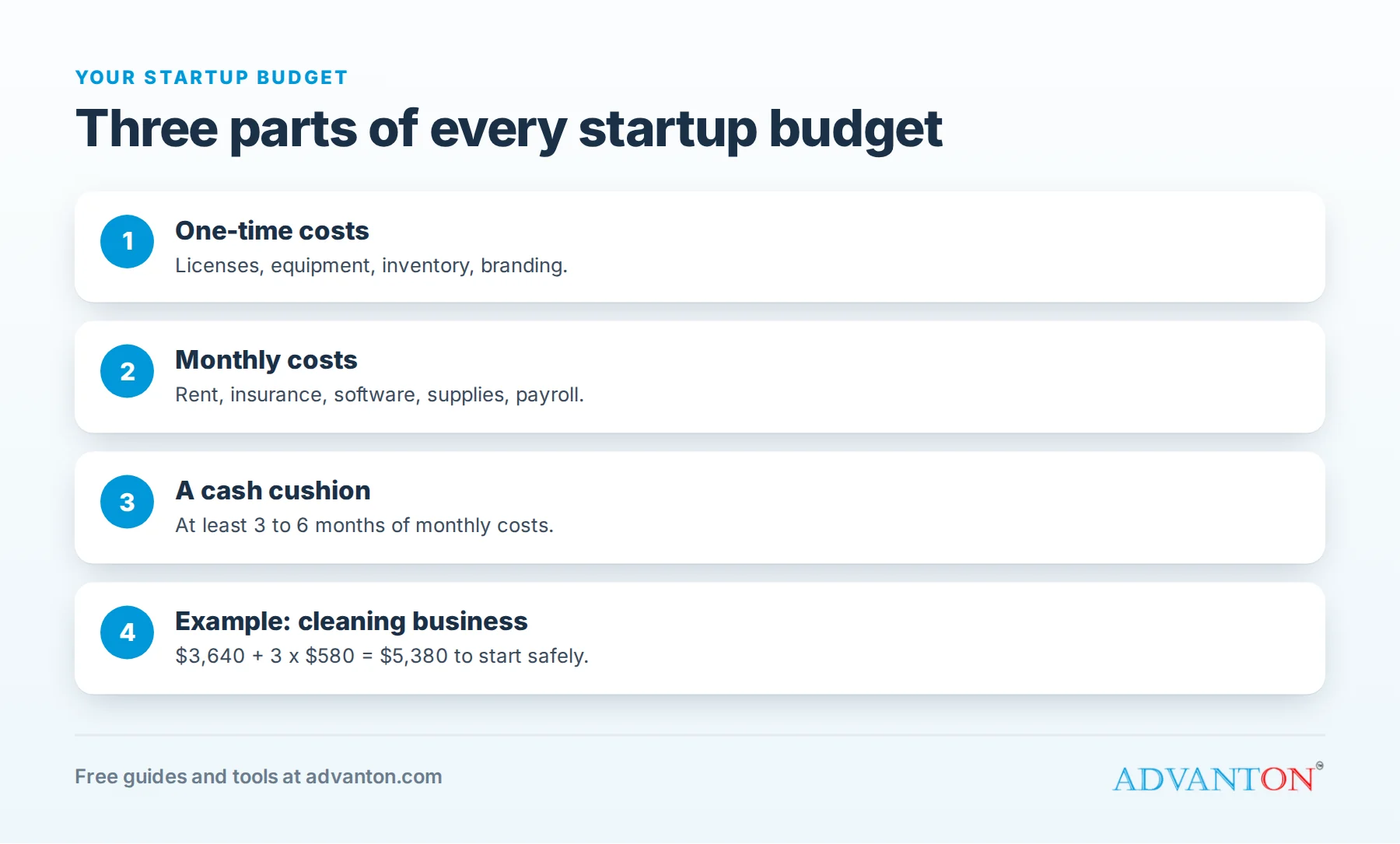
The three parts of your startup budget
Every startup budget has three parts. Leaving out the third is the most common, and most dangerous, mistake.
1. One-time costs (before you open)
- Business registration and licenses: LLC filing, local business license, permits.
- Equipment and tools.
- Initial inventory and supplies.
- Lease deposits and build-out or renovation.
- Branding: logo, signs, business cards, a website.
- Professional help: an accountant or attorney to set up correctly.
- Launch marketing.
2. Monthly operating costs (once you’re open)
- Rent and utilities.
- Insurance premiums.
- Software, phone and internet.
- Supplies and inventory replacement.
- Payroll, including your own pay if you’ll take any.
- Marketing.
- Loan payments.
- Vehicle and fuel costs.
3. A cash cushion
New businesses rarely earn enough to cover costs from day one. Plan to have enough cash to cover at least three to six months of operating costs while sales build. Businesses with long sales cycles, such as contractors waiting on payments, or seasonal businesses, often need more.
A worked example: a home-based cleaning business
These are illustrative figures to show the method. Replace them with real quotes for your area.
| One-time costs | Amount |
|---|---|
| LLC filing and local business license | $300 |
| General liability insurance, first year (about the median of $45 a month) | $540 |
| Equipment and supplies (vacuum, caddies, products) | $1,800 |
| Website and domain, first year | $150 |
| Logo, business cards and flyers | $250 |
| Launch marketing | $600 |
| Total one-time | $3,640 |
| Monthly costs | Amount |
|---|---|
| Phone and software | $80 |
| Supplies | $150 |
| Fuel | $200 |
| Marketing | $150 |
| Total monthly | $580 |
Total needed to start safely: $3,640 one-time + 3 months × $580 = $5,380. That’s close to the SBA’s rough estimate for a microbusiness, but now it’s a number you can trust, because it’s built from your own costs.
You can do this calculation in our free startup cost calculator, which is the third step of the Business Planner and carries your total into your loan and break-even steps.
A second example: an online candle shop
Again, illustrative figures:
| One-time costs | Amount |
|---|---|
| Business registration and sales tax permit | $150 |
| Starting inventory: wax, wicks, jars, fragrance, labels | $1,500 |
| Product photography setup (lightbox, backdrop) | $200 |
| Online store setup and domain | $100 |
| Packaging and shipping supplies | $300 |
| Product liability coverage, first months | $200 |
| Total one-time | $2,450 |
| Monthly costs | Amount |
|---|---|
| Online store plan and apps | $60 |
| Inventory replacement | $600 |
| Ads | $250 |
| Packaging | $100 |
| Total monthly | $1,010 |
With a three-month cushion, this shop needs about $5,480. Notice that inventory replacement is the largest monthly cost. For product businesses, cash is often tied up in stock you haven’t sold yet, which is why a cash flow forecast matters so much.
How to calculate your cash cushion
- Add up your monthly operating costs, including your own pay if the business is your income.
- Estimate how many months until sales reliably cover those costs. Three months is a minimum for most businesses; six or more for businesses with long sales cycles, seasonal demand or slow-paying customers.
- Multiply: monthly costs × months = your cushion.
- Keep it separate, in your business account, so it isn’t spent on nice-to-haves.
When the money goes out
Startup costs don’t all hit at once, which affects how much you need on day one:
| When | Typical costs |
|---|---|
| Months before opening | Registration, licenses, deposits, equipment, branding, website |
| Opening month | Inventory, launch marketing, first insurance payments |
| First months open | Rent, payroll, supplies and loan payments, while sales are still building |
Map these in a cash flow forecast to see your lowest point, and make sure your funding covers it.
If you’ll hire from the start
Employees change your startup budget more than anything else. Beyond wages, budget for employer payroll taxes, unemployment taxes, workers’ compensation insurance and any benefits, which can add a significant share on top of pay. Recruiting, training and equipment for each person add one-time costs too. Our hiring cost calculator shows the true yearly cost of an employee, and how much cash you need before they start bringing in revenue.
How location changes your costs
The same business can cost very different amounts in different places. Rent, wages, insurance, and license and permit fees all tend to be higher in large cities and some states, while customers there may also pay higher prices. Get local quotes rather than national averages, and check your state’s business registration and annual fees in our LLC by state guides.
Costs new owners often forget
- Licenses and permits, which vary a lot by city and trade. See business licenses and permits explained.
- Insurance, including workers’ comp once you hire. See how to get business insurance.
- Payment processing fees on card sales, usually a few percent of each sale.
- Taxes: set money aside for income and self-employment taxes from your first sale.
- Your own living costs if the business is your main income.
- Repairs and replacements: equipment breaks, especially in the first year.
- Software subscriptions that add up month by month.
- Professional help at tax time.
How to estimate your own startup costs
- List everything you’ll need to open and run for the first year, in the three categories above.
- Get real prices: quotes, websites and conversations with suppliers, landlords and insurers. Avoid guesses.
- Separate must-haves from nice-to-haves. Start lean, and buy upgrades from profits.
- Add 10% to 20% for surprises. Almost every new business spends more than planned.
- Calculate your cash cushion from your monthly costs.
- Compare it with what you have, and decide how to cover any gap: savings, a loan, investors or a slower, leaner start.
Ways to start for less
- Start at home or from a shared space before committing to a lease.
- Buy used equipment for things that don’t need to be new.
- Lease rather than buy expensive equipment.
- Pre-sell or take deposits before buying inventory.
- Start part-time while keeping your job, until revenue is steady.
- Use free tools for your website, branding, invoices and planning.
- Negotiate supplier terms, such as paying in 30 days instead of up front.
For more ideas, see how to fund a startup with no money.
The startup cost tax deduction
Many costs you pay before your business opens can be deducted on your taxes. Under the federal tax code, you can generally deduct up to $5,000 of startup costs in your first year of business (and separately, up to $5,000 of organizational costs, such as forming an LLC or corporation). The $5,000 is reduced dollar for dollar once total startup costs exceed $50,000; for example, with $52,000 of startup costs, the first-year deduction falls to $3,000. Costs you can’t deduct right away are spread (amortized) over 15 years.
Equipment you buy is usually handled separately, through depreciation rules. Keep every receipt from your planning stage, and ask a tax professional how to treat your costs.
Funding your startup costs
Once you know your number, you can choose how to cover it:
- Personal savings, the most common source for small businesses.
- Friends and family, ideally with a written agreement.
- Small loans, including SBA microloans of up to $50,000.
- Startup loans from banks and other lenders. See how to get a startup loan.
- Investors, for businesses with high growth potential. See how to find investors.
Signs your budget isn’t realistic
- Every cost is a round number, suggesting guesses rather than quotes.
- There’s no line for your own living costs if you’ll leave a job.
- Monthly costs are covered by sales in month one. Most new businesses take longer.
- The plan only works if everything goes right. Add a 10% to 20% contingency, and test what happens if sales arrive two months later than planned.
Common mistakes
- Budgeting only for opening day, with no cash cushion.
- Overspending on fit-out and equipment before proving demand.
- Forgetting your own living costs in the first months.
- Underpricing, which makes every cost harder to cover. Use a pricing calculator to set prices that pay you.
- Not tracking cash weekly once you open. A cash flow forecast shows your lowest week before it arrives.
Frequently asked questions
Can I start a business with no money?
Some service businesses can start with very little, using skills and equipment you already have. You’ll still usually need small amounts for licenses, insurance and marketing.
How much should I have saved before quitting my job?
Enough for your business’s startup and operating costs, plus several months of personal living expenses, because new businesses often take time to pay their owners.
Are startup costs tax-deductible?
Generally, up to $5,000 in the first year, with the rest spread over 15 years, as explained above. Ask a tax professional about your situation.
What’s the cheapest business to start?
Service businesses built on skills you already have, such as consulting, tutoring, bookkeeping, cleaning and pet care, usually cost the least to start.
Should I use savings or borrow for startup costs?
Many owners use some of each. Savings avoid interest and debt; a loan keeps an emergency fund intact. If you borrow, keep the amount modest until the business proves itself, and compare the total cost of borrowing, not just the monthly payment. Our business loan calculator shows both.
Keep learning
Sources
- Business News Daily, Startup costs: how much cash will you need? (citing the SBA estimate)
- Insureon, Small business insurance costs
- Congressional Research Service, The small business start-up deduction (IF12970, April 2025)
Last reviewed October 28, 2026. Startup costs are estimates; check local prices, licensing and tax rules before you commit money.


Leave a Reply