
Finding investors is one of the hardest parts of starting a business, partly because most small businesses aren’t what investors are looking for. Investors take big risks on young companies, and most of their investments don’t succeed, so they look for businesses that could grow large enough to return many times their money. A great local bakery or plumbing business can be an excellent business without being an investor’s kind of business.
If your business is a fit, or could become one, this guide explains who invests in small businesses, where to find them, what they look for, how to pitch, and the legal basics you need to follow when selling ownership.
First, are investors right for you?
Table of Contents
Investors usually fit businesses that:
- Could grow well beyond one location or region, with a large market.
- Need significant money before they earn much revenue, such as product development or inventory for national retailers.
- Have founders willing to share ownership and control, and to aim for a sale or other way for investors to get their money back.
If that doesn’t describe your business, consider growing on revenue, loans or customer pre-sales instead. See bootstrapping vs raising money.
Types of investors
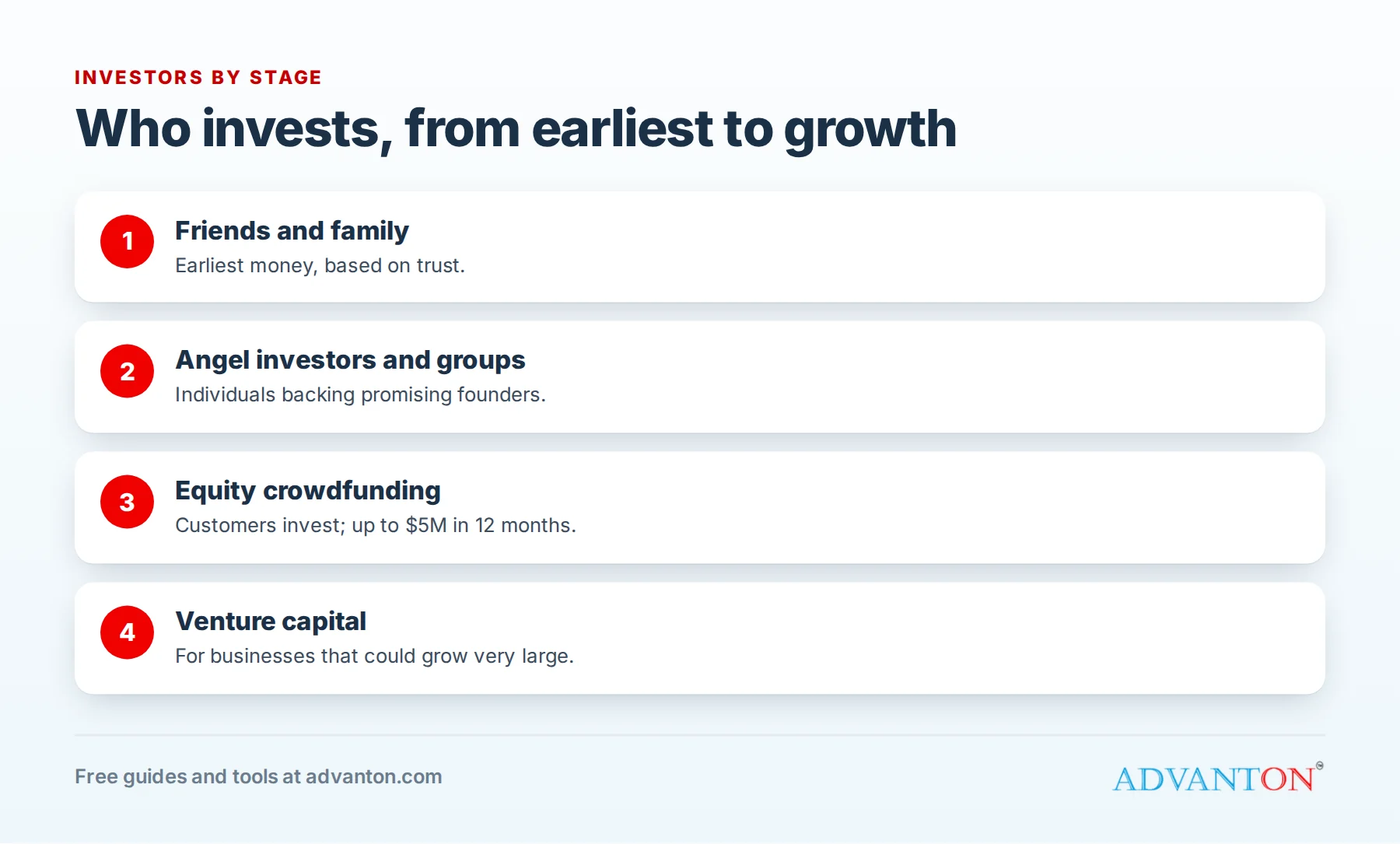
| Investor | Typical stage | What they look for |
|---|---|---|
| Friends and family | Earliest | Trust in you; often small amounts |
| Angel investors | Early | Individuals investing their own money in promising founders and ideas |
| Angel groups and networks | Early | Angels who review and invest together, often locally |
| Equity crowdfunding investors | Early to growth | Customers and fans investing small amounts through SEC-registered platforms |
| Venture capital firms | Early to growth | Businesses that could grow very large, very fast |
| Strategic investors | Any | Companies in your industry seeking a partnership or future acquisition |
| Small Business Investment Companies (SBICs) | Usually established businesses | SBA-licensed private funds investing in small businesses |
Two lesser-known investor types
- Small Business Investment Companies (SBICs) are privately managed investment funds licensed by the SBA. They invest in, or lend to, small businesses, usually ones with some revenue and a track record, rather than brand-new startups.
- Family offices manage the wealth of a single wealthy family, and some invest directly in private businesses, often with more patience than venture capital funds. They’re usually reached through personal introductions.
Accredited investors: an important legal detail
Many private investments can only be offered to accredited investors, individuals the SEC considers able to bear the risk. Broadly, that includes people with income over $200,000 (or $300,000 together with a spouse or partner) in each of the last two years, or a net worth over $1 million not counting their home, along with certain licensed professionals. Equity crowdfunding is the main exception that lets non-accredited investors take part, within limits.
Where to find investors
- Your network: former colleagues, mentors, customers and industry contacts. Warm introductions are far more effective than cold emails.
- Local angel groups: many cities and regions have angel networks that hold regular pitch meetings.
- Pitch events and competitions, often hosted by universities, economic development agencies and business organizations.
- Accelerators and incubators, which offer mentoring, connections and sometimes investment.
- Small Business Development Centers and SCORE mentors, who know local investors and can review your pitch.
- Online investor platforms and professional networks where founders and investors connect.
- Equity crowdfunding platforms, where you can raise up to $5 million in 12 months under Regulation Crowdfunding.
- Industry companies that might benefit from your product, as strategic investors.
Build relationships before you need money
Investors prefer to back founders they’ve watched make progress. Start conversations months before you plan to raise: share what you’re building, ask for advice rather than money, and send occasional updates. When you’re ready to raise, you’ll be contacting people who already know your story and have seen you deliver.
Equity crowdfunding: pros and cons
Pros:
- Customers and fans can invest, becoming loyal promoters of the business.
- Non-accredited investors can take part, within limits.
- It doubles as marketing: a campaign raises awareness as well as money.
Cons:
- Legal and financial disclosures are required, through Form C filings and ongoing annual reports.
- Platform fees reduce what you receive.
- Many small shareholders to keep informed.
- A public campaign that falls short can be visible to customers and competitors.
It tends to suit consumer businesses with an enthusiastic customer base, such as food and drink brands, local favorites and products with loyal fans.
What investors look for
- The team: experience, commitment and the ability to execute.
- The problem and the market: a real, painful problem, and a market large enough to build a big business.
- Traction: proof that customers want what you offer, such as sales, pre-orders, growth or signed agreements.
- A clear business model: how you make money, and why customers will keep paying.
- Competition and advantage: why you’ll win.
- The use of funds: exactly what the investment will achieve.
- The return: how investors could eventually get their money back, with growth.
How much should you raise?
Raise enough to reach your next major milestone (such as launching a product, reaching a revenue target or opening a second location) plus a safety margin, often enough for 12 to 18 months of planned spending. Raising too little means running out before you hit the milestone; raising too much means giving up more ownership than you needed to. Build the number from your plan: what will each dollar achieve, and by when?
Questions investors will ask
- Who exactly is your customer, and how do you reach them?
- How much does it cost to win a customer, and what is a customer worth?
- What are your margins, and how will they change as you grow?
- Who are your competitors, and why will customers choose you?
- What are the biggest risks, and how will you handle them?
- What will this money achieve, and what will you need next?
- Why are you the right person or team to build this?
Practice your answers with a mentor before your first meeting.
Your pitch materials
A pitch deck of about 10 to 15 slides usually covers:
- The problem
- Your solution
- The market and its size
- Your product
- Traction so far
- The business model
- Competition
- Go-to-market plan
- The team
- Financial projections
- The amount you’re raising and how you’ll use it
Also prepare: a one-page summary, financial projections for three to five years, and answers to tough questions. Our Business Planner helps you build the core numbers: startup costs, pricing and break-even.
How investment rounds work
- Valuation: what the business is worth determines how much ownership investors get. For example, $250,000 invested at a $1,000,000 pre-investment valuation buys 20% of the business.
- SAFEs and convertible notes: early investors often invest now for shares later, usually with a discount or valuation cap. A $150,000 SAFE with a $3,000,000 cap converts into roughly 5% if a later round values the company above the cap.
- Terms beyond price: board seats, voting rights, liquidation preferences (who gets paid first in a sale) and information rights all matter as much as valuation.
Always have a lawyer experienced in startup investments review terms before you sign.
How early valuations are set
There’s no formula for valuing a young business. Early valuations come from negotiation, shaped by your traction, your market, the team, how much you’re raising, and what similar businesses have raised at. Revenue and growth strengthen your position the most. Rather than fixating on the highest valuation, aim for fair terms with investors who’ll genuinely help, and enough money to reach your next milestone.
The legal basics of selling ownership
Selling shares in your business is selling securities, which is regulated by federal and state securities laws. You must either register the offering (rare for small businesses) or use an exemption, such as:
- Regulation D, used for most private raises from accredited investors, with a notice (Form D) filed with the SEC.
- Regulation Crowdfunding, through a registered platform, raising up to $5 million in 12 months.
Getting this wrong can give investors the right to demand their money back, so get legal advice before taking investment, even from friends and family.
The investor process, step by step
- Prove traction with real customers and revenue where possible.
- Prepare your materials: deck, summary, financials and a data room of key documents.
- Build a target list of investors who invest in your industry, stage and region.
- Get warm introductions through your network wherever possible.
- Pitch, follow up, and keep investors updated on progress; many decide only after watching you execute for a while.
- Negotiate terms with legal advice.
- Complete due diligence, where investors check your financials, legal documents and claims.
- Close the round, file the required paperwork, and keep investors informed afterward.
Keep investors updated
Send short monthly or quarterly updates to investors and to promising prospects: key numbers (revenue, customers, cash), wins, challenges, and specific ways they could help, such as introductions. Regular, honest updates build trust, and prospects who watch you hit goals over several months are far more likely to invest.
If investors say no
Most founders hear "no" many times. Ask for feedback, look for patterns, and keep building: grow on revenue, use loans or customer pre-sales, and return when you have stronger traction. A "not yet" often becomes a "yes" once the numbers improve.
Red flags
- Investors who ask you to pay fees to be considered or introduced.
- Pressure to sign quickly without legal review.
- Terms that give away control you didn’t expect, such as majority board control in an early round.
- Unclear sources of money, or reluctance to provide documentation.
Common mistakes
- Pitching before you have traction.
- Approaching investors who don’t invest in your industry or stage.
- Focusing only on valuation and ignoring other terms.
- Raising more than you need, and giving up more ownership than necessary.
- Skipping legal advice.
Frequently asked questions
How much ownership do investors usually take?
It depends on the amount raised and the valuation. Early rounds commonly involve selling a minority stake. Model your ownership across future rounds before agreeing.
Can I raise money from customers?
Yes, through equity crowdfunding under Regulation Crowdfunding, or through pre-sales and rewards crowdfunding, which don’t involve selling ownership.
Do I need a business plan to get investors?
Investors usually want a pitch deck and financial projections more than a long written plan, but the thinking behind a plan is essential.
How long does it take to raise money from investors?
Often several months from first meetings to money in the bank, and longer for a first-time founder. Start building relationships well before you need the money, and keep enough cash to keep operating while you raise.
Keep learning
- Bootstrapping vs raising money
- How much does it cost to start a business?
- Plan your numbers in the Business Planner
Sources
Last reviewed October 28, 2026. Startup costs are estimates; check local prices, licensing and tax rules before you commit money.


Leave a Reply