
Updated October 2026
Your online presence is everything people find when they look you up: your Google Business Profile, reviews, website, social media pages, directory listings and, increasingly, what AI assistants say about you. A strong presence makes your business easy to find, easy to trust and easy to contact. This guide explains what matters most in 2026 and gives you a step-by-step plan.
Want a quick score first? Take the free online presence checkup: 25 questions, a score out of 100 and a prioritized action plan.
What’s changed
A few years ago the advice was simply "get a website." That battle is mostly won: a 2025 Clutch survey found that 83% of US small businesses have a website, up from 64% in 2018. Being online is no longer an advantage on its own. What sets businesses apart now is:
- Reviews. In BrightLocal’s 2026 survey, 97% of consumers read reviews for local businesses, using about six review sites on average.
- Your Google Business Profile, which people often see before your website.
- AI search. AI assistants are now the third most used source of local recommendations, behind Google and Facebook. They draw on the same information as search engines: your profiles, reviews, website and listings.
Your online reputation is built across all of these at once, so consistency matters as much as any single channel.
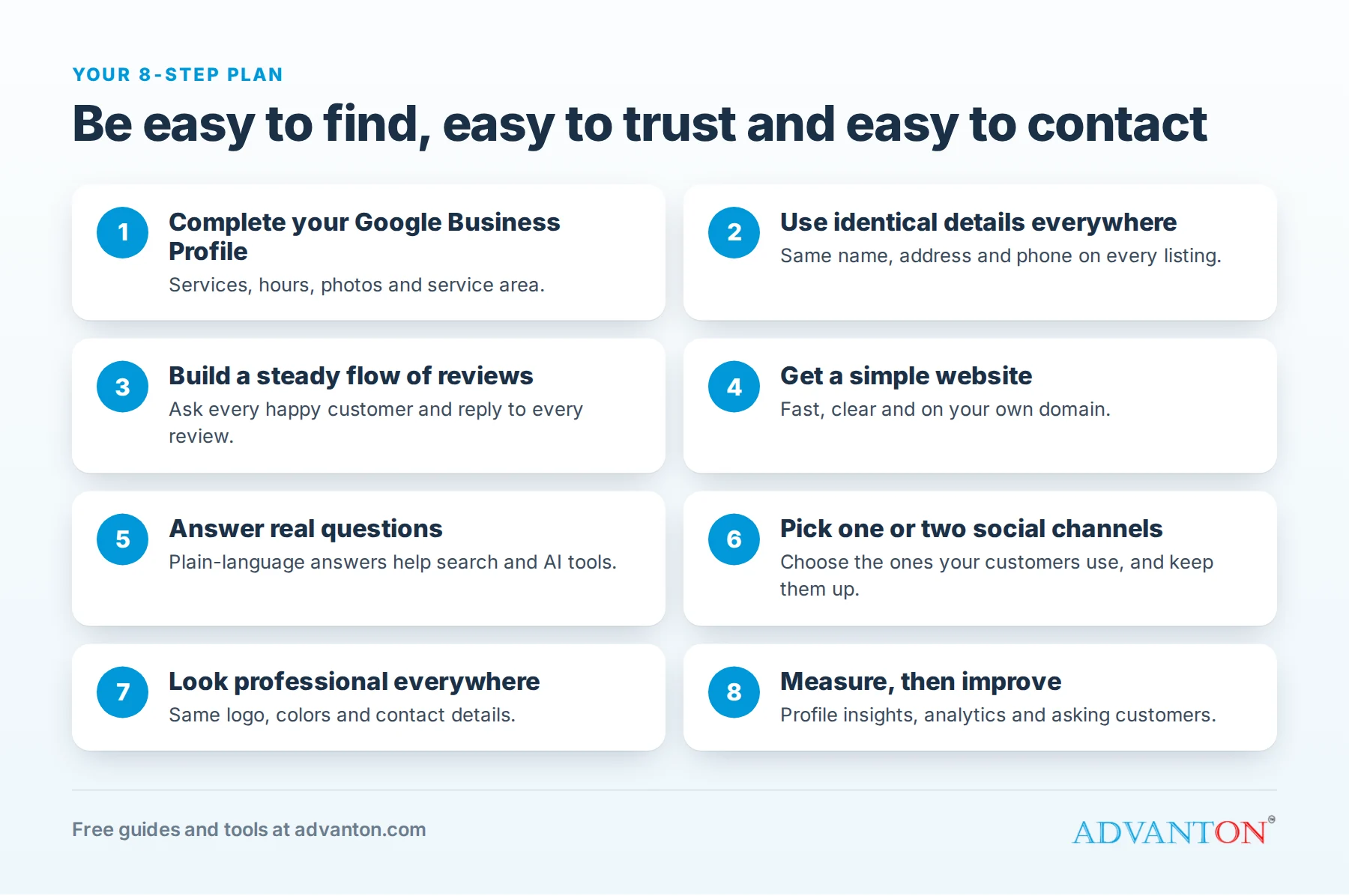
Step 1: Complete your Google Business Profile
For local businesses, this free profile is the single most important piece. Fill in every section: business category, services, hours (including holidays), service area or address, phone, website, photos of your work and premises, and answers to common questions. Post updates or offers occasionally, and keep your hours accurate. See our guide on how to create a Google Business Profile listing.
Step 2: Make your details identical everywhere
Search engines and customers cross-check your business name, address and phone number. Use exactly the same details on your website, Google, Bing, Apple Maps, Yelp, social media and directories. These mentions are called local citations, and consistent citations help you show up in local results. Add your business to the free Advanton directory, then check the main directories in your industry.
Step 3: Build a steady flow of reviews
Ask every happy customer, at the moment they’re happiest, with a direct link. Reply to every review, positive or negative, politely and promptly. Never buy reviews or offer rewards for positive ones. Our free review request kit gives you ready-to-send messages and a printable QR counter card.
Step 4: Get a simple, fast website on your own domain
Your website is the one place you fully control. It doesn’t need to be elaborate: clear pages for your services, your area, real photos, reviews and an easy way to call or book from a phone. Register a domain name in your own name and use matching business email. Our small business website guide and how to create a website free of cost walk you through it, and what website design involves covers the design side. For email on your domain, see Zoho Mail for business.
Step 5: Answer real questions in plain language
People ask search engines and AI assistants specific questions: "Who repairs tankless water heaters near me?" or "Do you need a permit for a fence in Austin?" Pages that answer these clearly help customers and help search engines and AI tools recommend you. Start with Google’s own SEO Starter Guide, the Moz beginner’s guide to SEO and our SEO basics for small business websites. For more depth, read our guide to search engine optimization and Google ranking.
Step 6: Choose one or two social channels you’ll keep up
An abandoned page looks worse than none. Pick the platforms your customers actually use:
- Visual businesses (food, beauty, home improvement, fitness): Instagram and Facebook.
- Professional and B2B services: LinkedIn. See how LinkedIn can help grow your business.
- Neighborhood services: local groups and neighborhood apps, where being helpful earns referrals.
Post real work, behind-the-scenes moments and useful tips. Consistency beats volume. For practical ideas, see Constant Contact’s guide to building your online presence.
Step 7: Look professional everywhere
Use the same logo, colors and contact details on your website, profiles, cards and flyers. Set them up once in our free Brand Kit, then make matching business cards and flyers.
Step 8: Measure, then improve
Online presence management means checking what’s working and fixing what isn’t:
- Google Business Profile insights: searches, calls, direction requests and website clicks.
- Google Analytics and Google Search Console (both free): visits, top pages and the searches that bring people to your site.
- Ask every new customer how they found you.
- Re-take the online presence checkup every few months.
Your online presence checklist
- A complete Google Business Profile.
- Identical name, address and phone everywhere.
- Recent reviews, with a reply to each.
- A simple, fast website on your own domain, with business email.
- Pages that answer customers’ real questions.
- One or two social channels, kept up.
- A consistent look across everything.
- A monthly check of what’s working.
Common mistakes
- Outdated hours or phone numbers on any profile.
- Paying for "guaranteed" rankings or bulk directory submissions.
- Ignoring negative reviews instead of replying calmly and helpfully.
- Letting someone else own your domain, website or profiles.
- Spreading yourself across too many platforms.
Industry guides
- Local online marketing
- Marketing for roofing contractors
- Marketing for HVAC contractors
- Leads for contractors in New Jersey
- Sales leads for flooring contractors
- Websites for clothing companies
- Websites for real estate firms
- Web design in Maryland
- Launch your business online: domain, hosting and website costs
- Business ideas in California
- Best payroll software for small business
- Marketing success stories
New to running a business? Start with the Start a Business A–Z guide, and learn more about what Advanton is.
Sources
- Clutch, 2025 small business website survey, via Business Wire
- BrightLocal, Local Consumer Review Survey 2026
- Google Search Central, SEO Starter Guide
Last reviewed October 29, 2026. Startup costs are estimates; check local prices, licensing and tax rules before you commit money.

