
Your domain and hosting are subscriptions: you register a domain for a period (usually one year or more) and pay for hosting monthly or yearly. If either expires, your website and email can go offline, and an expired domain can eventually be lost to someone else. A few minutes of setup now prevents that.
How renewals work
Table of Contents
| Domain | Hosting | |
|---|---|---|
| Term | Usually 1 to 10 years at a time | Monthly, yearly or longer |
| What expiry affects | Your website and email stop working, and you can eventually lose the name | Your website and email go offline |
| How to renew | In your customer control panel, before the expiry date | In your customer control panel, before the due date |
Turn on auto-renew
The simplest protection is auto-renew, where available: your domain and hosting renew automatically using your saved payment method or account funds. Log in to your customer control panel, open each service, and check the renewal settings. Then:
- Keep your payment details current, especially when your card expires.
- Keep your contact email current, so reminders reach you.
- Consider renewing your domain for several years, so you renew less often.
Renewal reminders
You’ll receive reminder emails before your domain and hosting are due. Don’t ignore them: renew early rather than at the last minute, because payment problems can take time to fix.
What happens if a domain expires?
The exact rules depend on the domain ending (.com, .net and so on), but the general pattern is:
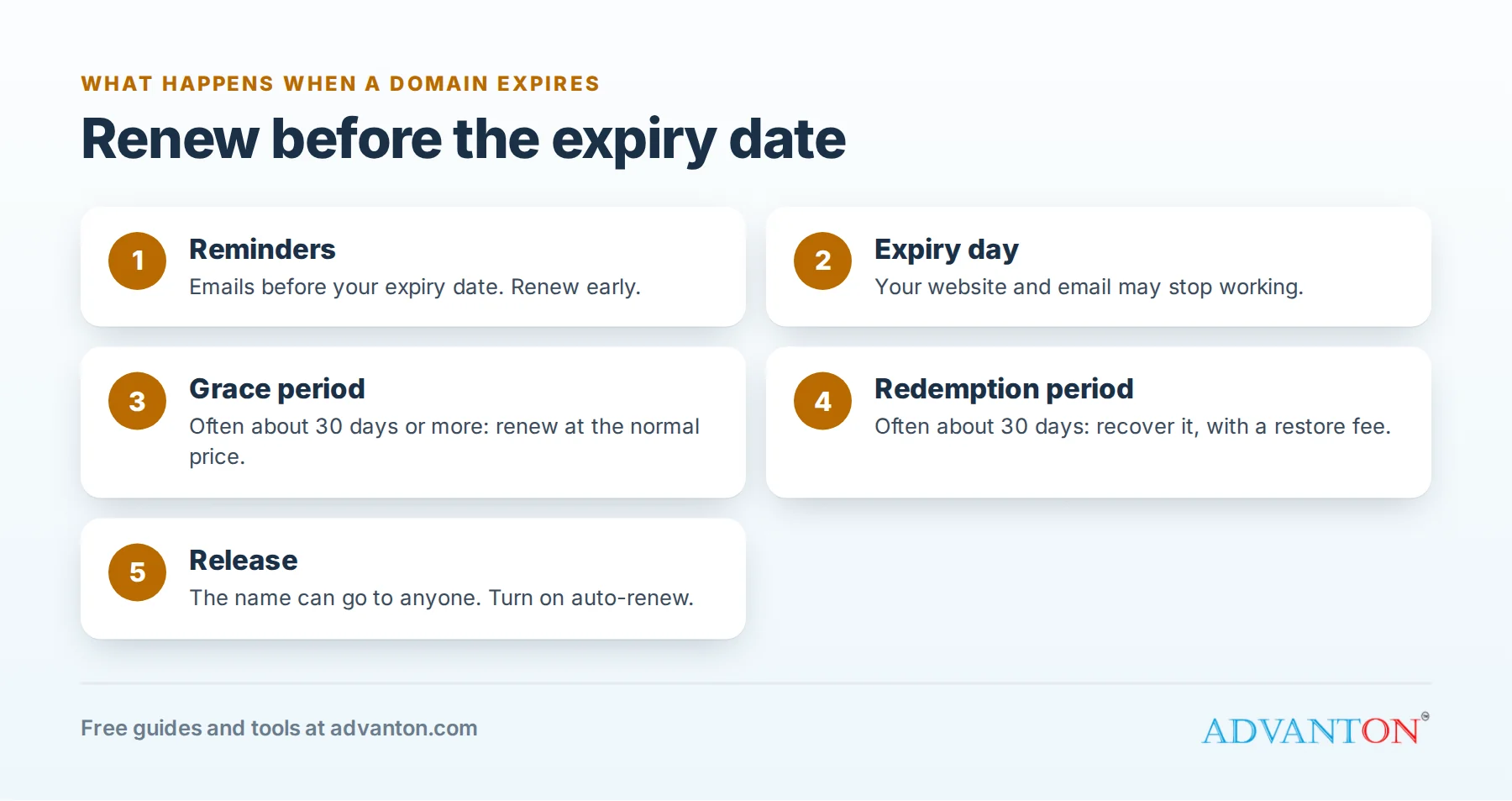
- Expiry day: your website and email may stop working.
- Renewal grace period (often about 30 days or more, depending on the ending): you can usually still renew at the normal price.
- Redemption period (often about 30 days): you can usually still recover the domain, but with an extra restoration fee.
- Release: the domain can then be deleted and become available for anyone to register, including people who look for expiring names.
Don’t rely on these periods. Renew before your expiry date.
Hosting that expires
When hosting isn’t renewed, your website and email are usually suspended. After a period, the host may delete your files. Keep your own backup of your website (for Advanton builder sites, keep your downloaded ZIP) and important emails.
Beware of fake renewal notices
Some companies send official-looking letters or emails offering to "renew" your domain, often at high prices, sometimes transferring it to them. Only renew through the store where you bought your domain, by logging in to your customer control panel directly rather than clicking links in unexpected emails.
Your renewal checklist
- [ ] Auto-renew turned on for your domain and hosting.
- [ ] Payment method up to date.
- [ ] Contact email up to date and checked regularly.
- [ ] Expiry dates noted in your calendar, with a reminder a month before.
- [ ] A backup copy of your website files.
Frequently asked questions
How long can I register a domain for?
Usually 1 to 10 years. Longer registrations mean fewer renewals to remember.
Can I renew early?
Yes. Renewing early adds time to your current expiry date; you don’t lose the remaining time.
I missed the expiry date. Is my domain gone?
Not necessarily. Contact support right away; you can often still renew during the grace period, or restore it during redemption for an extra fee.
Next steps
Last reviewed October 27, 2026. Startup costs are estimates; check local prices, licensing and tax rules before you commit money.


Leave a Reply