
You don’t need a big budget to keep a small contracting business busy. Many of the most effective marketing tools for contractors are free or nearly free: a complete Google Business Profile, a steady flow of reviews, happy customers who refer their neighbors, and partners who send work. Paid advertising can help later, but it works far better on top of a strong, low-cost foundation.
This guide lays out a practical plan for contractors with little or no marketing budget, ranked by what usually brings jobs fastest.
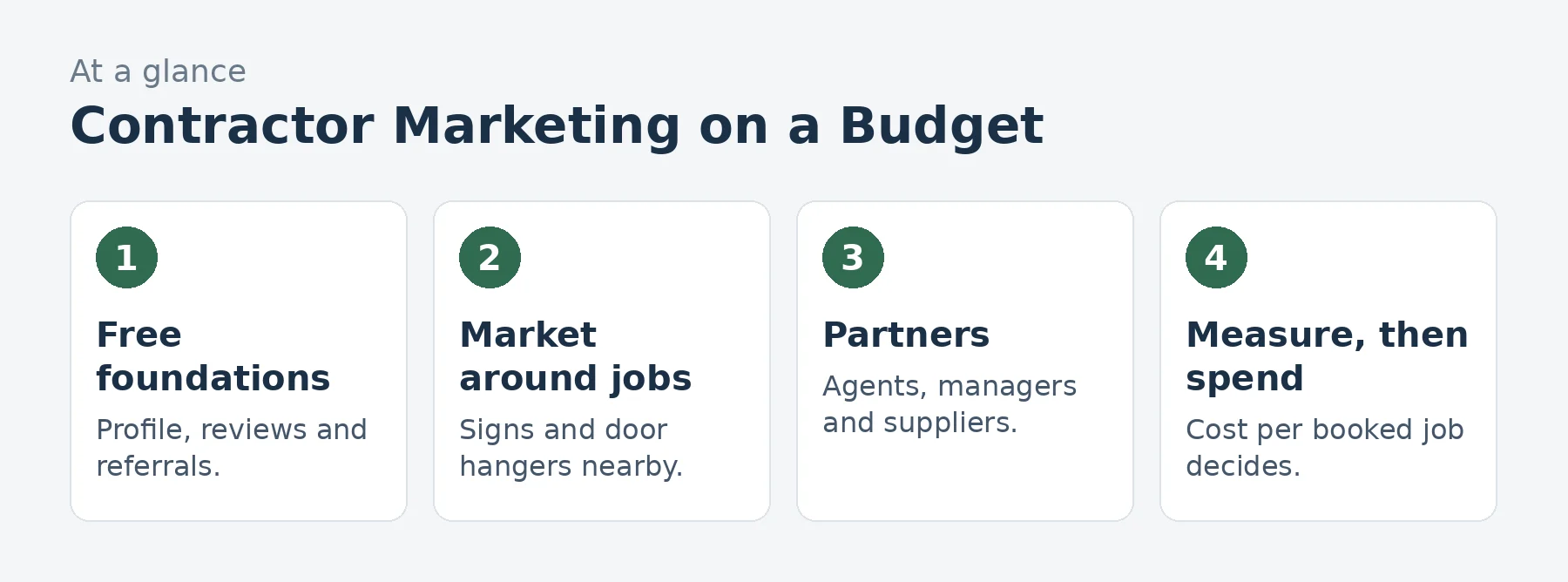
The free foundations
Table of Contents
| Foundation | Cost | Why it matters |
|---|---|---|
| Google Business Profile | Free | Appears in Google Maps and local results |
| Reviews | Free | 97% of consumers read local reviews (BrightLocal 2026) |
| Answering every call fast | Your time | The quickest contractor often wins the job |
| Referrals from past customers | Free or small rewards | Warm leads that book at high rates |
| Directory listings | Free | Consistent information across the web |
| Simple website | Free to low cost | Proof of work, services and towns served |
Set these up before spending money on ads. See Google Business Profile for contractors and how to get found online for free.
Low-cost channels, ranked
- Ask every customer for a review, the same day. See review request templates.
- Ask happy customers for referrals, and thank them.
- Market around every job: yard signs (with permission), door hangers and a few postcards to neighbors. See neighborhood marketing.
- Build partner relationships: real estate agents, property managers, supply houses and complementary trades. See real estate agent referrals and supply house referrals.
- Post project photos to your Business Profile and social pages weekly.
- Join local community groups and Nextdoor, helpfully, not with constant ads.
- Contact past customers with seasonal reminders.
- Get listed in free directories, including the Advanton Business Directory.
A referral program that works
Referrals are the cheapest high-quality leads most contractors get, but they rarely happen on their own. Ask at the right moment (when a customer thanks you for great work), make it easy with a card or text they can forward, and say thank you every time: a handwritten note, a small gift card or a discount on their next service. Track who refers, and treat your top referrers like VIPs. Check any platform or professional rules before offering rewards.
The partnerships playbook
Partners who meet your customers before you do can send steady work:
| Partner | What they need from you |
|---|---|
| Real estate agents | Fast repairs before listings and after inspections |
| Property managers | Reliable service, clear pricing and invoices |
| Supply houses | Professional reputation; they’re asked for recommendations |
| Complementary trades | Referrals back and dependable scheduling |
| Insurance agents | Honest, reputable contractors to suggest |
Introduce yourself in person with a one-page sheet, follow up after every referral, and send work back when you can.
Sample budgets
| Monthly budget | Where to spend |
|---|---|
| $0 | Business Profile, reviews, referrals, free directories, community groups, past customer texts |
| $100 | Add yard signs and door hangers around every job |
| $300 | Add small postcard drops near completed jobs and a referral reward program |
| $600 | Add a modest Local Services Ads or search ads test in your best service and town |
| $1,000 | Expand what’s working, measured by cost per booked job |
These amounts are illustrative. Scale them to your trade, job values and goals.
A 90-day plan
Days 1 to 30: foundations
- Complete your Google Business Profile: categories, services, service areas, hours, photos.
- Build a simple website with service pages and your phone number on every page. Our free contractor website builder can help.
- Create a review link and start asking every customer.
- List your business in free directories with consistent details.
Days 31 to 60: neighborhoods and referrals
- Order yard signs and door hangers and use them on every job.
- Start a simple referral program.
- Introduce yourself to five local partners.
- Text past customers with a seasonal offer or reminder.
Days 61 to 90: measure and expand
- Track every lead’s source and outcome.
- Calculate cost per booked job for each channel.
- Test one paid channel with a small budget if the foundations are working.
- Double down on what books jobs.
A weekly marketing hour
| Task | Time |
|---|---|
| Post 3 to 5 new project photos to your Business Profile | 10 minutes |
| Reply to every new review | 10 minutes |
| Send review requests you missed | 10 minutes |
| Text or call one partner or past customer | 15 minutes |
| Check last week’s leads and sources | 15 minutes |
One focused hour a week, every week, builds more momentum than an occasional burst of effort.
Free content that brings calls
Answer the questions customers ask you every day: "How much does it cost to replace a water heater?", "Should I repair or replace my roof?", "What should I do when my AC stops working?" Turn each answer into a short page on your website, a Business Profile post and a quick video. Helpful content builds trust, supports search visibility and saves time on the phone.
Low-cost ideas by season
- Before your busy season: contact past customers with reminders and early-booking offers.
- During peaks: ask every customer for a review and use signs around jobs.
- Slow months: visit partners, update your website and photos, and offer maintenance plans. See maintenance agreements.
When to spend more
Increase spending when your foundations are solid (a complete profile, steady reviews, fast responses) and your tracking shows a channel books jobs below your maximum affordable cost per booked job. Add budget gradually, one channel at a time, and keep measuring. If results drop, find out why before spending more.
Track what works
Ask every caller how they found you, record the answer, and note whether the lead booked and for how much. After a few months, you’ll know exactly which channels pay off. See contractor cost per lead and our free lead source tracker.
Your phone is your best marketing tool
Every dollar of marketing ends with a phone call or message, so how you answer decides whether it pays off. Answer live whenever possible, set up missed-call text-back, return voicemails within an hour, and use a friendly, consistent greeting. Track missed calls for a week; many contractors discover they’re losing more jobs to unanswered calls than to competitors. See speed to lead.
Your truck is a billboard
A clean, clearly branded truck parked at job sites and driven through your service area every day is one of the best low-cost investments a contractor can make. Even simple magnetic signs or lettering with your name, trade, phone number and website work. Keep the truck clean and park it where neighbors can see it while you work. See vehicle wraps for contractors.
Free ways to look more professional
- Branded email with your own domain instead of a free webmail address.
- Consistent logo and colors on your truck, shirts, estimates and invoices.
- Professional estimates and invoices from a free template.
- Real project photos instead of stock images.
Our free Brand & Print Studio and quote and invoice generator help with the basics.
Keep your details consistent
Your business name, address and phone number should match everywhere: website, Business Profile, directories, social pages and truck. Inconsistent details confuse customers and search engines. Check them once a quarter. See NAP consistency.
Common mistakes
- Paying for ads before fixing your Business Profile and reviews.
- Missing calls that cost more than any ad.
- Spreading a small budget across too many channels.
- Not tracking results.
- Stopping marketing when you’re busy, then starting over when it’s slow.
Frequently asked questions
What’s the cheapest way for a contractor to get leads?
A complete Google Business Profile, steady reviews and referrals from past customers usually cost little and book well.
How much should a small contractor spend on marketing?
Start with the free foundations, then spend on channels whose cost per booked job is below what a typical job can afford.
Do yard signs still work?
Yes. Signs and door hangers near completed jobs reach neighbors with similar homes and needs.
Should I pay for lead services?
Only after your foundations are solid, and only if you can respond quickly; track cost per booked job.
How long does low-budget marketing take to work?
Reviews and referrals build over weeks and months; neighborhood marketing can bring calls within days.
Is social media worth it for contractors on a budget?
Yes, in moderation: post real project photos and helpful tips where your customers spend time, and focus most effort on Google and reviews.
What’s the most important free marketing step?
Completing your Google Business Profile and asking every customer for a review.
Do I need a website if I have a Google Business Profile?
A simple website helps: it shows your services, towns and work, and supports your profile in search results.
How Advanton helps
Advanton is a free resource for small businesses. Build a site with the free contractor website builder, make signs and door hangers with the yard sign maker, check your local SEO with the Local SEO Check and add your business to the Advanton directory for free. Advanton earns money when you buy a domain or hosting through our store, which helps keep everything else free.
Keep learning
Last reviewed November 1, 2026. Startup costs are estimates; check local prices, licensing and tax rules before you commit money.


Leave a Reply