
"What should a lead cost?" is one of the most common questions contractors ask, and one of the most misleading. A cheap lead that never answers the phone is expensive; a pricey lead that books a $15,000 roof is a bargain. The useful question isn’t what a lead costs, but what it costs you to book a job, and how much profit that job brings.
This guide shows how to calculate the numbers that actually matter, compare marketing channels fairly, and lower your costs without cutting the marketing that works.
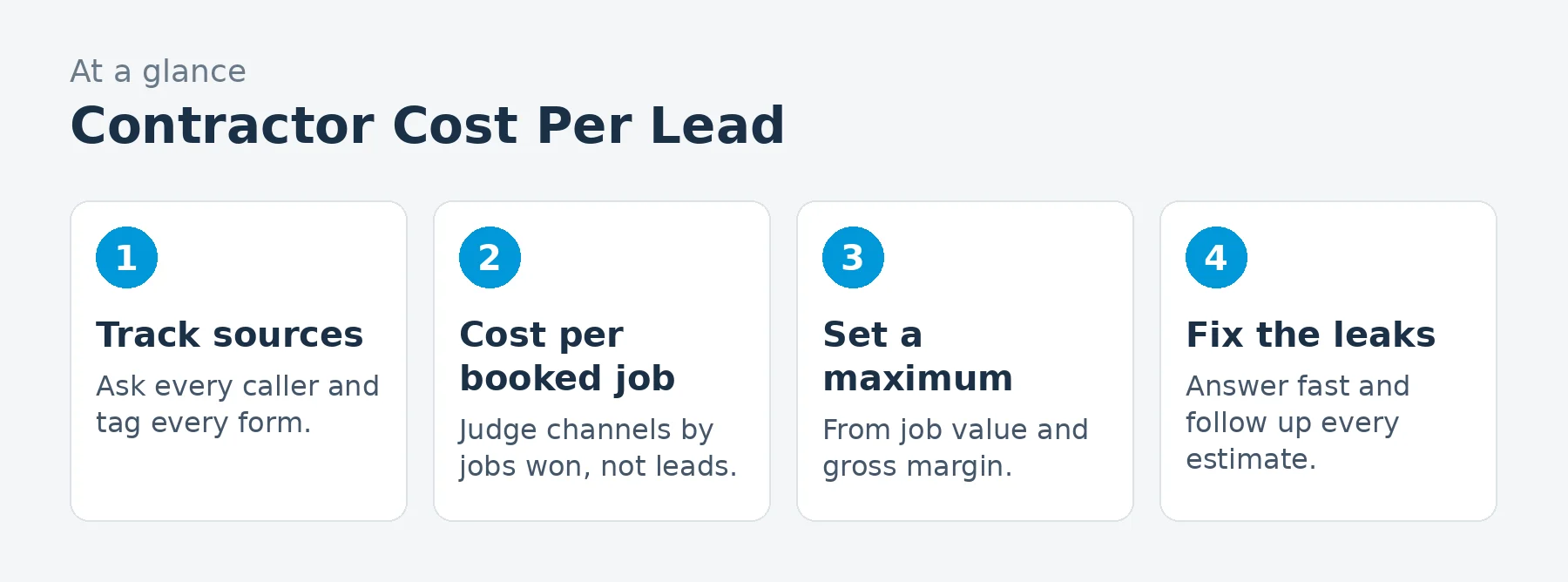
The three numbers that matter
Table of Contents
| Metric | Formula | What it tells you |
|---|---|---|
| Cost per lead | Marketing spend ÷ leads | How efficiently a channel produces inquiries |
| Cost per booked job | Marketing spend ÷ booked jobs | What it really costs to win work |
| Marketing cost as a share of revenue | Marketing spend ÷ revenue from that channel | Whether the channel is profitable |
Cost per lead is a starting point. Cost per booked job and the share of revenue tell you whether to keep spending.
Why industry averages mislead
You’ll find many "average cost per lead" figures online, but they vary wildly by source, trade, city, season and definition of a lead. A roofing lead in a storm-hit metro, a handyman lead in a small town and a commercial HVAC lead have little in common. Your own numbers, tracked consistently, are far more useful than any national average.
A worked example
| Channel | Monthly spend | Leads | Booked jobs | Average job | Revenue | Cost per lead | Cost per booked job | Marketing cost share |
|---|---|---|---|---|---|---|---|---|
| Google search ads | $3,000 | 60 | 15 | $900 | $13,500 | $50 | $200 | 22% |
| Local Services Ads | $2,000 | 40 | 14 | $850 | $11,900 | $50 | $143 | 17% |
| Shared lead service | $1,500 | 50 | 6 | $800 | $4,800 | $30 | $250 | 31% |
| Postcards near jobs | $800 | 12 | 5 | $1,100 | $5,500 | $67 | $160 | 15% |
| Referral rewards | $300 | 8 | 6 | $1,000 | $6,000 | $38 | $50 | 5% |
These numbers are illustrative. Notice that the shared lead service has the cheapest leads but the most expensive booked jobs, while postcards look expensive per lead but book at a strong rate. Judging by cost per lead alone would lead to the wrong decisions.
How to track your numbers
- Record the source of every lead: ask "how did you hear about us?" and use tracking numbers and forms. See call tracking for contractors.
- Mark each lead’s outcome: booked, estimate only, lost or not a fit.
- Record revenue for each booked job.
- Total spend by channel each month, including fees and your time where it matters.
- Review monthly and compare channels on cost per booked job and revenue.
Our free lead source tracker does this in a spreadsheet-style tool.
How different channels charge
| Channel | How you pay | What to watch |
|---|---|---|
| Google search ads | Per click | Click quality, landing page conversion, call answering |
| Local Services Ads | Per lead | Lead disputes, reviews, responsiveness |
| Shared lead services | Per lead or subscription | Leads sent to several contractors; speed decides wins |
| Exclusive lead services | Per lead, often higher | Lead quality and refund policies |
| Direct mail and door hangers | Printing and postage | Targeting near past jobs |
| SEO and content | Time or agency fees | Slower to build, lower cost over time |
| Referrals | Rewards and relationships | Consistency of asking |
See shared vs exclusive leads and Google Local Services Ads.
What drives your cost per booked job
- Speed to respond: the first contractor to call back often wins. See speed to lead.
- Answering every call: missed calls waste the money spent to make the phone ring.
- Reviews: a strong rating lifts click and booking rates on every channel.
- Website and landing pages: clear offers and easy contact raise conversion.
- Follow-up: estimates that get followed up close more often. See estimate follow-up scripts.
- Targeting: focusing on services and areas you want avoids paying for poor-fit leads.
How much should you spend overall?
There’s no universal right number. Many contractors set marketing budgets as a share of revenue, adjusting for growth goals and season. A practical approach: decide what you can afford to pay to win a typical job, given your average job value and gross margin, then fund the channels that book jobs below that number.
Maximum affordable cost per booked job
| Average job | Gross margin | Gross profit | Share you’ll spend to win it | Maximum cost per booked job |
|---|---|---|---|---|
| $600 | 50% | $300 | 30% | $90 |
| $2,500 | 40% | $1,000 | 25% | $250 |
| $12,000 | 30% | $3,600 | 20% | $720 |
These figures are illustrative: replace them with your own job values and margins.
Lowering your costs
- Fix the leaks first: answer every call, reply to forms within minutes and follow up on every estimate.
- Grow reviews: ask every customer, every time. See review request templates.
- Market around jobs you’ve done: neighbors convert well. See neighborhood marketing.
- Invest in your website and Google Business Profile: they lift every channel. Check your site with our free Local SEO Check.
- Build referral and partner relationships.
- Cut channels whose cost per booked job stays above your maximum after a fair test.
- Sell more to existing customers: maintenance plans and repeat work cost little to win. See maintenance agreements.
Repairs vs replacements: different math
Small repair jobs can’t support the same acquisition cost as replacements or remodels, but they often lead to bigger work later. Track channels separately for small jobs and large projects. A channel that books many $300 repairs may be worth it if those customers return for $8,000 replacements; a channel that only books one-off small jobs at a high cost may not be.
Questions to ask lead services
- Is each lead shared with other contractors, and with how many?
- How are leads verified before they’re sent?
- What is the refund or credit policy for bad leads?
- Can I choose services, areas and budgets?
- Is there a contract, setup fee or minimum spend?
- Do I own the customer relationship and data?
Write down the answers and compare them with your results after a fair test period.
Budgeting through the seasons
Lead costs often rise during peak demand, when competitors spend more, and fall in slower months. Plan budgets by month: invest ahead of your busy season, keep core channels running through peaks, and use slower months for low-cost channels such as reviews, referrals, past-customer outreach and content. See the HVAC, roofing and plumbing marketing calendars.
A simple monthly report
Each month, list every channel with spend, leads, booked jobs, revenue, cost per booked job and marketing cost as a share of revenue. Highlight the best and worst performers, note what changed, and decide one action for next month. A one-page report reviewed consistently is worth more than complex dashboards nobody reads.
How long to test a channel
New channels need time to show results. Give a channel enough time and budget to produce a meaningful number of leads, often two to three months, before judging it, and change one thing at a time so you know what worked. Seasonal trades should compare like-for-like months.
Lifetime value changes the math
A customer who books a $300 repair and then signs a maintenance plan, refers two neighbors and replaces their system five years later is worth far more than the first ticket. Factor repeat business and referrals into what you can afford to spend to win a customer, especially in trades with recurring work.
When higher lead costs are worth it
Sometimes paying more per lead is the smart choice. Exclusive leads, high-intent searches and referrals from trusted partners often cost more but book at much higher rates and bring better customers. If a channel’s cost per booked job is well under your maximum and the jobs are profitable, spending more there can grow the business faster than chasing the cheapest leads.
Common mistakes
- Judging channels by cost per lead instead of booked jobs and revenue.
- Not tracking lead sources at all.
- Blaming the channel when the real problem is slow follow-up.
- Stopping marketing in busy months and scrambling later.
- Ignoring lifetime value and referrals.
Frequently asked questions
What is a good cost per lead for contractors?
It depends on your trade, market and job values. Focus on cost per booked job compared with the gross profit a typical job brings.
What’s the difference between cost per lead and cost per booked job?
Cost per lead counts inquiries; cost per booked job counts only leads that became paying work.
Are lead services worth it?
Sometimes. Track cost per booked job; shared leads require very fast response to win.
How can I lower my cost per lead?
Improve reviews, website conversion and targeting, and fix missed calls and slow follow-up.
How much should a contractor spend on marketing?
Enough to fund channels that win jobs below your maximum affordable cost per booked job, adjusted for growth goals and season.
How do I track where leads come from?
Ask every caller, use separate tracking numbers or forms per channel, and record outcomes in a tracker.
How Advanton helps
Advanton is a free resource for small businesses. Track every lead with the free lead source tracker, check your website with the Local SEO Check and grow reviews with the review request kit. You can also add your business to the Advanton directory for free. Advanton earns money when you buy a domain or hosting through our store, which helps keep everything else free.
Keep learning
Last reviewed November 1, 2026. Startup costs are estimates; check local prices, licensing and tax rules before you commit money.


Leave a Reply