
Every lead seller promises "quality leads," but one detail changes everything about what you’re buying: whether the lead goes only to you, or to several contractors at once. A shared lead is a chance to compete for a job. An exclusive lead is a chance to win it without a race. Both can be profitable, and both can waste money, depending on price, your response speed and how honestly the lead was generated.
This guide explains the difference, the math behind each and how to test lead sources so you pay only for what works. For platform-specific guides, see is Angi worth it?, Thumbtack for contractors and Angi vs Thumbtack vs HomeAdvisor.
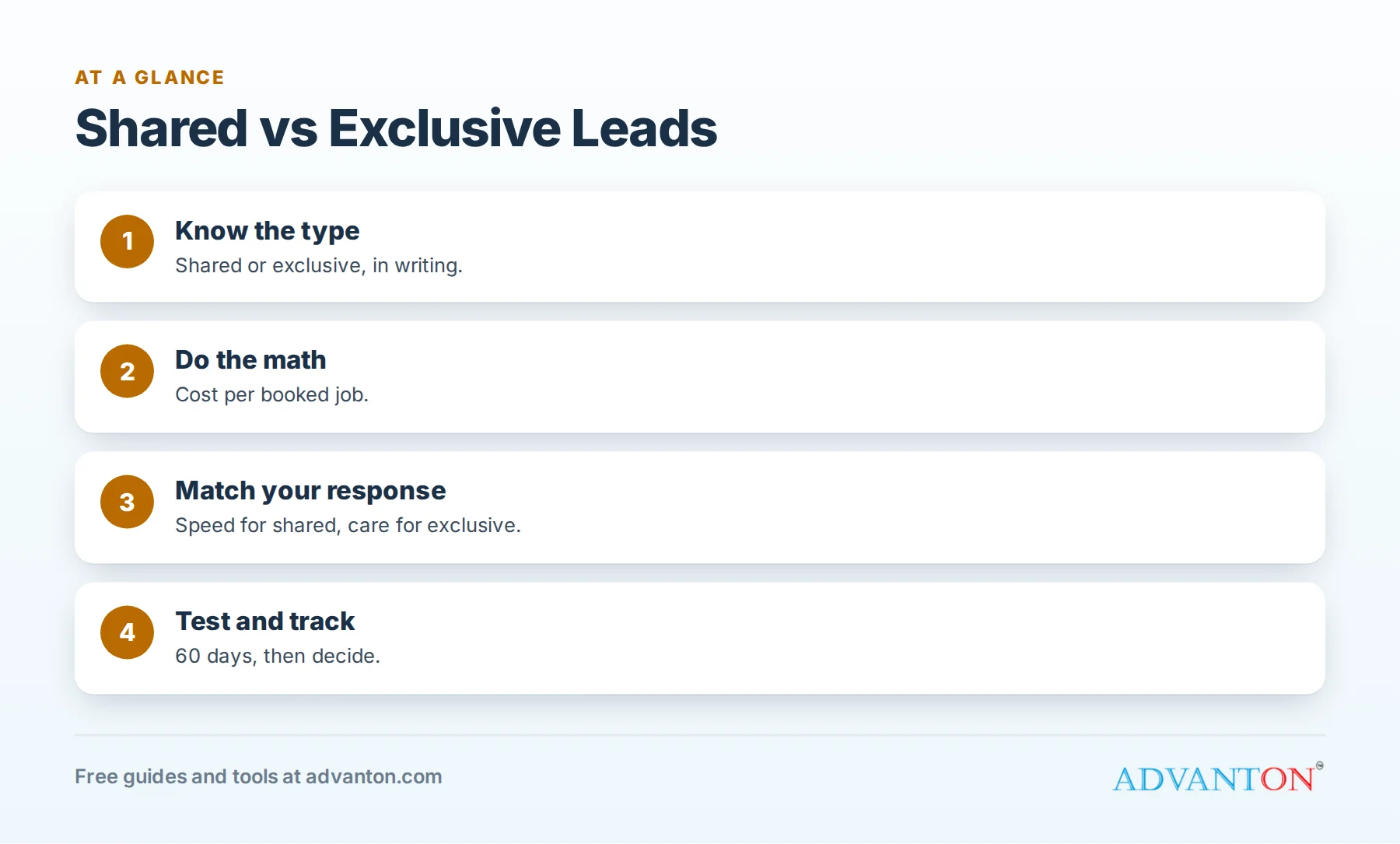
Shared vs exclusive at a glance
Table of Contents
| Shared leads | Exclusive leads | |
|---|---|---|
| Who receives the lead | Several contractors | Only you |
| Typical price per lead | Lower | Higher |
| Competition | A race to respond | Little or none, if truly exclusive |
| Win rate | Lower, depends on speed and price | Higher, depends on lead quality |
| Best for | Fast responders, frequent smaller jobs | Higher-value jobs, slower sales cycles |
| Main risk | Paying for many chances, winning few | Paying a premium for leads that aren’t truly exclusive or ready |
The math that decides everything
What matters is cost per booked job: lead price divided by your booking rate, plus any membership or platform fees spread across your jobs.
| Lead type | Price per lead | Booking rate | Leads per job | Cost per booked job |
|---|---|---|---|---|
| Shared | $40 | 1 in 5 | 5 | $200 |
| Shared (fast responder) | $40 | 1 in 3 | 3 | $120 |
| Exclusive | $120 | 1 in 2 | 2 | $240 |
| Exclusive (well qualified) | $120 | 2 in 3 | 1.5 | $180 |
These numbers are illustrative. Notice that a fast responder can make cheap shared leads cheaper per job than expensive exclusive ones, and that exclusive leads only win when they’re genuinely qualified.
How leads are generated
Knowing where leads come from helps you judge quality:
- Marketplaces match homeowner requests to pros, often sharing them.
- Pay-per-lead ad programs such as Google Local Services Ads send calls and messages directly to you.
- Lead generation companies run their own ads and websites, then sell the inquiries, sometimes to one contractor, sometimes to several.
- Your own marketing (website, Business Profile and referrals) produces leads that are exclusive by nature.
How to verify "exclusive" claims
- Ask in writing whether each lead is sold to anyone else, ever.
- Ask where leads come from: which websites, ads or partners.
- Call leads quickly and ask, politely, whether other contractors have contacted them.
- Track patterns: if many "exclusive" leads mention other calls, raise it with the seller.
- Check contract terms for credits or refunds when exclusivity isn’t met.
Response strategy for shared leads
Speed decides shared leads. Call within minutes, text if they don’t answer, and offer specific appointment times. Be the most helpful, not just the first: a clear price range, credentials and reviews help you stand out among several callers. See speed to lead.
Response strategy for exclusive leads
Without a race, you can focus on qualification and relationship: understand the project, set expectations, book a visit and follow up patiently. But don’t relax too much; homeowners who don’t hear back quickly often go looking elsewhere.
Which trades suit which type
| Trade situation | Often better with |
|---|---|
| Frequent smaller jobs (handyman, cleaning, repairs) | Shared leads, if you respond instantly |
| Urgent jobs (plumbing, HVAC repairs) | Pay-per-lead calls with fast answering |
| High-value projects (remodeling, roofing replacements) | Exclusive or self-generated leads, with patient follow-up |
| Specialized services | Exclusive leads or referral partnerships |
Questions to ask any lead seller
- Are leads shared or exclusive, and with how many contractors?
- How are leads generated, and from which sources?
- What’s the price per lead, and are there setup or membership fees?
- What qualifies as an invalid lead, and how do credits work?
- Can I set budgets, pause and cancel anytime?
- Can I see sample leads or talk to current customers in my trade?
A 60-day comparison test
- Choose two or three lead sources, including at least one you control (such as your Business Profile).
- Set fixed budgets for each.
- Respond to every lead within minutes.
- Track each lead: source, type (shared or exclusive), contacted, booked and revenue.
- Calculate cost per booked job and average job value per source.
- Keep the winners, adjust the middle and cut the losers.
Our free lead source tracker makes this simple.
Don’t forget the leads you own
Leads from your website, Google Business Profile, referrals and repeat customers are exclusive by nature and usually the cheapest per booked job. Bought leads can fill gaps, but channels you own build a business that doesn’t depend on someone else’s pricing. See how to get more contractor leads.
Red flags
- Guaranteed numbers of jobs rather than leads.
- Vague answers about where leads come from.
- Long contracts with expensive cancellation.
- "Exclusive" leads where homeowners report several calls.
- No credit policy for invalid leads.
Watch for resold and aged leads
Some sellers resell older inquiries ("aged leads") at lower prices, or sell the same lead to new buyers after a few days. These can work for patient follow-up, but they’re not the same as fresh, urgent leads, and they shouldn’t be priced like them. Ask how old each lead is when you receive it, and track results for aged leads separately.
Signals of lead quality
| Signal | Why it matters |
|---|---|
| Correct contact details | Basic validity |
| Specific project description | Shows real intent |
| In your service area | Avoids wasted travel |
| Timing stated | "This week" beats "someday" |
| Homeowner expects your call | Leads generated with clear consent convert better |
Rate every lead on these signals for a month, and you’ll see which sources deliver real prospects.
Negotiate with lead sellers
Price per lead is often negotiable, especially for exclusive leads. Ask for a trial period, lower prices for narrower service areas, credits for invalid leads and caps on weekly spending. Sellers who refuse reasonable terms are telling you something.
Nurture leads that don’t book yet
Many leads, especially for larger projects, aren’t ready today. Add them to a simple follow-up list: a thank-you message, a helpful article or seasonal tip a few weeks later, and a check-in before your busy season. Leads you’ve already paid for can still become jobs months later.
Build a team process
If several people handle leads, assign clear owners by lead type, set response-time targets (minutes for shared leads), use the same scripts and log every outcome. Without a process, expensive leads slip through the cracks.
Consent and contact rules
Leads should come from homeowners who agreed to be contacted. Calling or texting people who never asked to hear from you can violate telemarketing and consumer protection rules, and it damages your reputation. Ask sellers how consent is collected, and keep records of how each lead reached you. If a homeowner says they never requested contact, apologize, stop contacting them and report the issue to the seller.
A monthly lead review
Once a month, list every source with its spend, leads, booked jobs, revenue and cost per booked job, separating shared and exclusive leads. Move budget toward the sources that book profitably, and cut the rest. Sharing this review with your team shows them why fast responses and careful follow-up matter.
Common mistakes
- Comparing prices per lead instead of cost per booked job.
- Slow responses to shared leads.
- Paying premiums for unverified exclusivity.
- Not tracking results by source and type.
- Relying on bought leads instead of building your own.
Frequently asked questions
Are exclusive leads better than shared leads?
Not always. Exclusive leads can be better for high-value jobs, but fast responders often book shared leads at a lower cost per job.
How many contractors receive a shared lead?
It varies by platform and seller; ask in writing before buying.
How do I know if a lead is really exclusive?
Ask the seller in writing, ask homeowners whether others have contacted them, and track patterns over time.
What’s a good cost per booked job?
One your average job profit can comfortably cover; it varies by trade, job size and region.
Are Google Local Services Ads leads shared?
LSA leads come from homeowners contacting your business through your ad; they choose whom to contact, and may contact several businesses.
Should new contractors buy leads?
Bought leads can help fill a new calendar, but start small, respond fast and build your own channels from day one.
Can I ask for refunds on bad leads?
Many sellers offer credits for invalid leads, such as wrong numbers or out-of-area requests; get the policy in writing and act quickly.
How Advanton helps
Advanton is a free resource for small businesses. Free tools that help: the lead source tracker, the contractor website builder for leads you own, and the review request kit. You can also add your business to the Advanton directory for free. Advanton earns money when you buy a domain or hosting through our store, which helps keep everything else free.
Keep learning
- Is Angi worth it for contractors?
- Thumbtack for contractors
- Google Local Services Ads for contractors
Last reviewed October 30, 2026. Startup costs are estimates; check local prices, licensing and tax rules before you commit money.


Leave a Reply