
For many trade contractors (electricians, plumbers, HVAC, drywall, flooring, painting, concrete and more), general contractors are the steadiest source of larger projects. A GC that trusts you can send work year after year without you spending a dollar on advertising. Getting onto their bid lists takes preparation, though: GCs protect their schedules and reputations by choosing subcontractors carefully.
This guide explains what general contractors look for, how to get invited to bid, and how to turn a first project into repeat work.
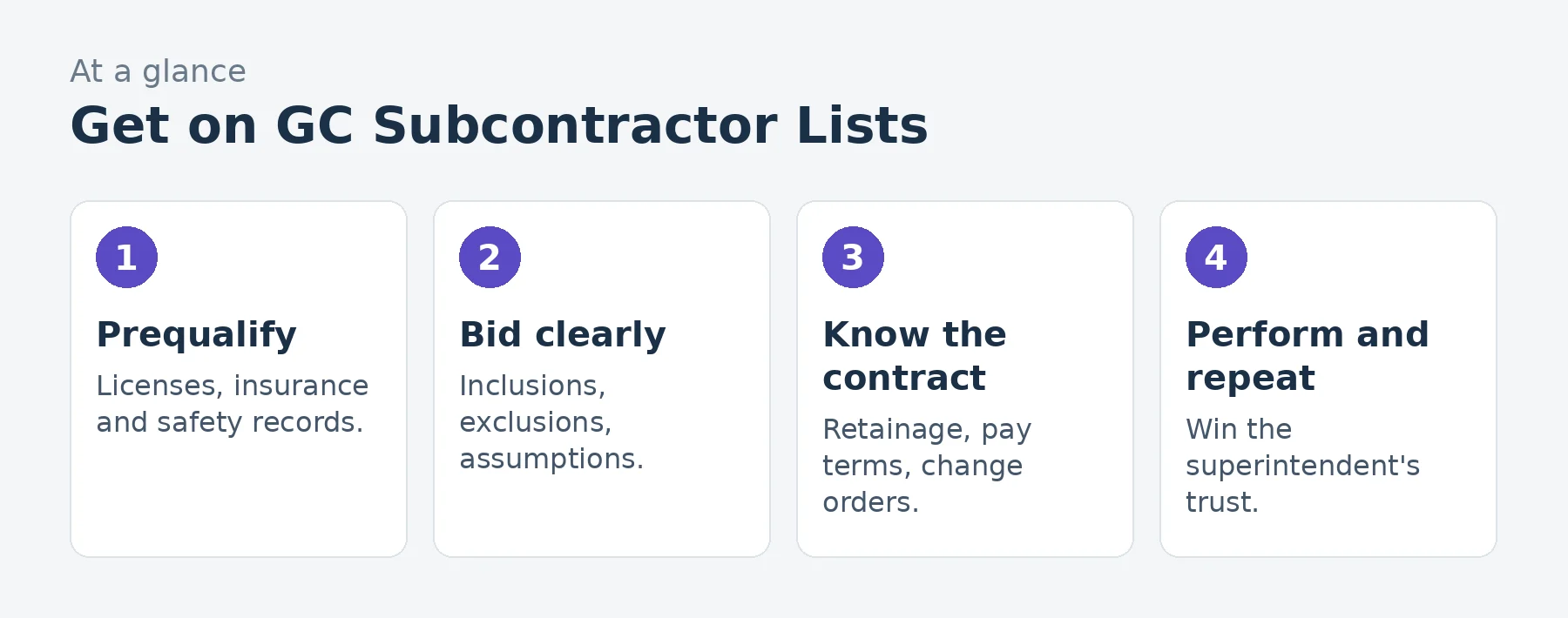
What general contractors look for
Table of Contents
| What GCs want | Why it matters to them |
|---|---|
| Reliability | Their schedule depends on every trade showing up |
| Quality | Rework delays projects and hurts their reputation with owners |
| Safety | Accidents affect their insurance, sites and contracts |
| Insurance and licensing | They need to pass requirements on to every sub |
| Clear, complete bids | Gaps create change orders and disputes |
| Communication | Fast answers keep projects moving |
| Capacity | Enough crew to meet the schedule |
| Financial stability | Subs who can carry payroll until paid |
Step 1: Choose the right general contractors
Not every GC is a good fit. Look for builders whose projects match your size, trade and service area: residential builders, remodelers, commercial GCs doing tenant improvements, multifamily builders or public-works contractors. Check their reputation with other subs and suppliers, including how they pay.
Residential vs commercial GCs
| Residential builders and remodelers | Commercial GCs | |
|---|---|---|
| Project size | Single homes, additions, remodels | Offices, retail, multifamily, public buildings |
| Paperwork | Lighter: insurance certificate, license | Heavier: prequalification, safety records, submittals |
| Payment | Often per phase | Monthly progress billing with retainage |
| Relationships | Owner-builders choose subs personally | Estimators and project managers manage bid lists |
| Best starting point | Newer subs with residential experience | Subs with crews, safety programs and bonding |
Many trade contractors start with residential builders and remodelers, then add commercial GCs as they build capacity and documentation.
Step 2: Build a prequalification packet
Many GCs require prequalification before inviting bids. Prepare:
- Company overview: trade, services, service area, years in business and team size.
- Licenses for your trade and business.
- Certificate of insurance showing general liability, auto, workers’ compensation and umbrella coverage.
- Safety information: written program, training records and any safety statistics GCs request.
- Project list with photos, sizes, dates and GC references.
- Bonding letter if you have bonding capacity.
- W-9 and financial information if requested.
Keep it current and ready to send the same day it’s requested.
Safety records GCs check
Commercial GCs often ask for your workers’ compensation experience modification rate (EMR), a number insurers calculate from your claims history, along with injury logs and safety training records. A lower EMR signals a safer company and can be required to bid on some projects. Investing in safety training and documentation protects workers and opens doors to larger GCs.
Step 3: Get invited to bid
- Contact estimating or preconstruction teams directly with a short introduction and your packet.
- Register on GCs’ subcontractor portals and bid platforms.
- Attend industry events and association meetings where estimators and project managers network.
- Ask suppliers and other trades for introductions.
- Bid on small jobs first to prove yourself.
- Follow up politely every few months, especially when you have new capabilities or capacity.
Step 4: Write bids GCs trust
GCs compare sub bids line by line and need confidence they’re covered. Strong bids:
- Follow the drawings, specifications and addenda.
- List inclusions and exclusions clearly, so the GC knows what’s missing.
- Note assumptions: working hours, access, sequencing and who provides what.
- Arrive on time, in the requested format.
- Hold prices for the stated period.
A clear bid that’s slightly higher often beats a vague low bid that leaves the GC exposed.
Bid platforms and digital plans
Many GCs send invitations to bid through online platforms where subs download plans, submit questions and upload bids. Create profiles on the platforms your target GCs use, keep your trade and service area current, and set alerts so you see invitations quickly. Learn to read digital plans and use takeoff tools; accurate quantities are the foundation of competitive bids.
Unit pricing and alternates
Some bids ask for unit prices (per fixture, per square foot, per opening) and alternates (optional add or deduct items). Price them carefully: they’re often used for change orders later. Clear unit prices make adjustments faster and reduce disputes when scope changes.
Understand the contract
| Term | What to watch |
|---|---|
| Scope of work | Exactly what you’re responsible for |
| Schedule | Start dates, durations and penalties for delays |
| Payment terms | Monthly progress billing and timing |
| Retainage | Percentage held until completion |
| Pay-when-paid or pay-if-paid | Whether your payment depends on the owner paying the GC; enforceability varies by state |
| Change orders | Written approval before extra work |
| Indemnity and insurance | Additional insured requirements and risk transfer |
| Lien waivers | Paperwork exchanged with payments |
Read every subcontract before signing, and ask an attorney to review unfamiliar terms. Understand your state’s mechanic’s lien rights and deadlines.
Perform on the first job
Your first project decides whether there’s a second:
- Show up when scheduled with the right crew and materials.
- Communicate daily with the superintendent.
- Keep the site clean and safe.
- Document progress with photos and notes.
- Raise problems early and propose solutions.
- Finish punch lists quickly and submit closeout documents.
Getting paid on time
Submit invoices in the GC’s required format and schedule, with lien waivers and backup the GC needs to bill the owner. Track every invoice, retainage balance and change order. Know your state’s preliminary notice and mechanic’s lien deadlines; missing them can cost you your lien rights. Follow up promptly and professionally on late payments, and keep records of every communication.
Winning over superintendents
The superintendent runs the job site and often influences which subs get invited back. Be on time, coordinate with other trades, keep your area clean, respond to calls and texts quickly and fix issues without excuses. A superintendent who trusts your crew will ask for you by name.
Turn one GC into steady work
After a successful job, ask the project manager for feedback and a reference, and ask what projects are coming. Stay in touch with estimators, respond quickly to bid invitations, and keep pricing fair and consistent. Many subs find that a handful of loyal GC relationships provide most of their revenue.
Pricing to win and still profit
GCs often compare several sub bids for each trade, so pricing matters, but chasing the lowest number is risky. Know your true costs (labor at fully loaded rates, materials, equipment, supervision, overhead and profit), then compete on clarity, reliability and schedule. Track your hit rate: if you win almost every bid, you may be priced too low; if you rarely win, check whether your scope, pricing or relationships need work. Many subs aim to win a steady share of bids rather than every one.
Capacity planning
Before accepting a project, map it against your crews’ schedule. Overcommitting leads to missed dates and damaged relationships; turning down a project politely, with a clear reason, is better than performing poorly.
Avoid depending on one GC
A single large GC can fill your calendar and then disappear when their pipeline slows. Aim to spread work across several GCs and keep some direct customers, so one slowdown doesn’t stall your business.
Common mistakes
- Bidding with vague scopes that lead to disputes.
- Signing subcontracts without reading them.
- Underestimating retainage and slow payments.
- Starting extra work without written change orders.
- Overcommitting crews across too many projects.
Frequently asked questions
How do I get on a general contractor’s bid list?
Contact their estimating team with a prequalification packet, register on their portal, and bid small jobs to prove yourself.
What do GCs look for in subcontractors?
Reliability, quality, safety, proper insurance and licensing, clear bids and good communication.
What is retainage?
A percentage of each payment held until the project is complete.
What does pay-when-paid mean?
A clause tying the timing of your payment to the owner paying the GC; how it’s enforced depends on state law.
Should I bid on every invitation?
No. Bid where the project fits your trade, size, schedule and capacity.
What is an EMR?
An experience modification rate, calculated by insurers from your workers’ compensation claims history; many commercial GCs use it to screen subcontractors.
How long does it take to get regular work from a GC?
Often several bids and at least one successful project; consistent follow-up and performance build the relationship.
Do I need bonding to work for general contractors?
Not always; many private projects don’t require sub bonds, but larger and public projects often do.
How Advanton helps
Advanton is a free resource for small businesses. Design a capability statement with the Brand & Print Studio, create quotes and invoices with the free quote and invoice generator, and plan cash flow with the Cash & Payroll Planner. You can also add your business to the Advanton directory for free. Advanton earns money when you buy a domain or hosting through our store, which helps keep everything else free.
Keep learning
- How to win commercial contracting jobs
- Government contracts for contractors
- Supply house referrals for contractors
Last reviewed November 1, 2026. Startup costs are estimates; check local prices, licensing and tax rules before you commit money.


Leave a Reply