
Government agencies build, repair and maintain an enormous amount of property: schools, offices, military bases, parks, housing and roads. Much of that work is done by private contractors, and a meaningful share is reserved for small businesses. Public work can provide steady projects and reliable payment, but it comes with registrations, rules and paperwork that private jobs don’t.
This guide explains how small contractors can find and win government work at the federal, state and local levels, and how to start without overreaching.
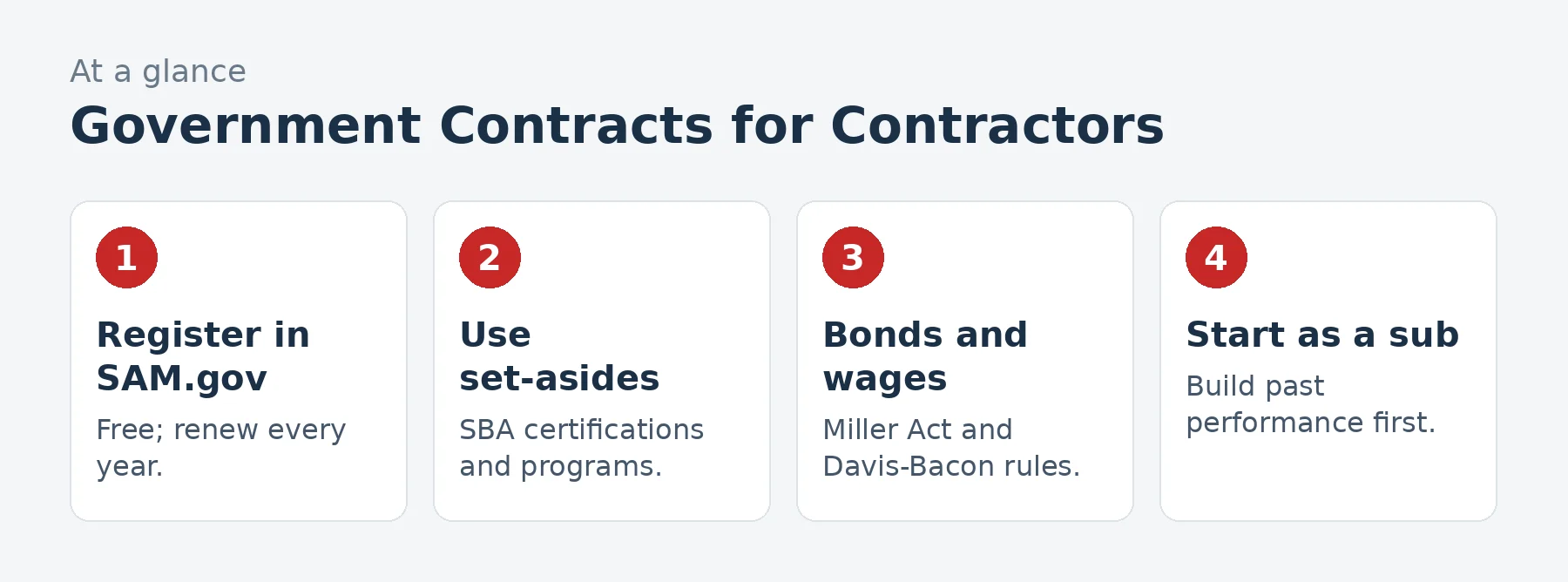
Where government work comes from
Table of Contents
| Level | Typical buyers | Typical work |
|---|---|---|
| Federal | Military bases, federal agencies, the General Services Administration, Army Corps of Engineers | Repairs, renovations, maintenance and construction |
| State | Transportation departments, universities, state agencies | Buildings, maintenance, roads and facilities |
| Local | Cities, counties, school districts, housing authorities, utilities | Repairs, parks, schools and public buildings |
Small contractors often find local and state work easier to start with: smaller projects, nearby locations and simpler requirements.
Federal small business goals and set-asides
The federal government has a government-wide goal of awarding at least 23% of prime contract dollars to small businesses. Agencies "set aside" some contracts for small businesses only, and some for specific groups through SBA programs:
| Program | Who qualifies |
|---|---|
| Small business set-asides | Businesses under SBA size standards for the industry |
| 8(a) Business Development | Small businesses owned by socially and economically disadvantaged individuals |
| HUBZone | Small businesses in historically underutilized business zones that meet employee residency rules |
| Women-Owned Small Business (WOSB) | Small businesses at least 51% owned and controlled by women |
| Service-Disabled Veteran-Owned (SDVOSB) | Small businesses owned and controlled by service-disabled veterans |
Each program has eligibility rules and certification steps through the SBA. See the SBA’s contracting programs.
Step 1: Register in SAM.gov
To do business directly with the federal government, register your business in the System for Award Management (SAM.gov), which assigns a Unique Entity ID. Registration is free; be cautious of companies charging to register you. Renew registration every year. You’ll also identify your industry codes (NAICS codes) so agencies can find you.
Step 2: Confirm your size and certifications
Check SBA size standards for your NAICS codes, then apply for any certifications you qualify for. Certifications can open set-aside contracts with less competition.
Step 3: Find opportunities
- SAM.gov contract opportunities for federal solicitations.
- State procurement portals and vendor registrations.
- City, county and school district bid pages.
- Prime contractors’ subcontracting opportunities.
- Local procurement assistance offices that help small businesses find and prepare bids.
Free help: APEX Accelerators
APEX Accelerators (formerly called Procurement Technical Assistance Centers) are funded by the Department of Defense to help businesses pursue government contracts at no or low cost. Counselors can help with SAM.gov registration, finding opportunities, understanding solicitations and preparing bids. Many states also run small business development centers with similar help.
State and local certifications
Many states, cities and transit agencies run their own programs for minority-owned (MBE), women-owned (WBE) and small or local businesses, often with participation goals on public projects. Transportation projects funded by the U.S. Department of Transportation use the Disadvantaged Business Enterprise (DBE) program, certified through state agencies. These certifications can make you attractive to prime contractors who need to meet participation goals.
Step 4: Read the solicitation carefully
Government bids are formal. Read the scope, drawings, specifications, wage determinations, bonding and insurance requirements, submission format and deadlines. Ask questions only through the official process, attend pre-bid meetings and site visits when offered, and follow instructions exactly; late or incomplete bids are usually rejected.
A bid/no-bid checklist
Before investing hours in a bid, ask:
- Is the work in our core trade and within our crew capacity?
- Can we meet the schedule alongside current commitments?
- Do we have the bonding capacity and required insurance?
- Do prevailing wage and reporting rules fit our systems?
- Is the location practical for our crews?
- Can we price it profitably against likely competitors?
If several answers are "no," pass and save your effort for better-fit opportunities.
Pricing a public bid
Price every line item from the drawings and specifications: labor at the required wage rates, materials, equipment, bonds, insurance, permits, supervision, safety, cleanup, overhead and profit. Include time for meetings, submittals and certified payroll. Public bids are often awarded to the lowest responsive, responsible bidder, so accuracy matters as much as price; a winning bid that loses money is worse than no award.
Bonding and the Miller Act
Federal construction contracts above $150,000 generally require performance and payment bonds under the Miller Act, and many state and local contracts have similar "Little Miller Act" requirements. Bid bonds may be required when bidding. Your bonding capacity limits the size of projects you can pursue. The SBA’s Surety Bond Guarantee Program helps small businesses obtain bonds they might not qualify for otherwise. Talk to a surety bond agent early.
Prevailing wages: Davis-Bacon
Federal and federally funded construction contracts above $2,000 are generally covered by the Davis-Bacon and Related Acts, which require paying laborers and mechanics at least the locally prevailing wages and fringe benefits set by the Department of Labor, and submitting certified payroll. Many states have their own prevailing wage laws for public work. Build these requirements into your bids.
Start as a subcontractor
Many small contractors begin government work as subcontractors to larger prime contractors. Primes on large federal contracts often have subcontracting goals for small businesses, so they actively look for capable small firms. Subcontracting lets you learn the paperwork, build past performance and grow bonding capacity before bidding as a prime. See getting on general contractors’ sub lists.
Past performance and capability statements
Agencies and primes look for proof you can deliver. Create a one-page capability statement with your services, NAICS codes, certifications, Unique Entity ID, bonding capacity, past projects and contact information. Document every completed project with photos and references.
Building past performance
Every completed public job becomes proof for the next. Keep project records, photos, final acceptance letters and contact information for project managers, and ask for written references or performance evaluations. Strong past performance helps you win larger contracts and bonding increases over time.
Payment and cash flow
Government payments are reliable but follow set processes. Progress payments, retainage and paperwork can slow cash flow. Submit invoices correctly and on time, and plan working capital for the gap between paying crews and getting paid. Our free Cash & Payroll Planner helps.
Job order and maintenance contracts
Not every government opportunity is a single project. Agencies often award job order contracts, indefinite-delivery contracts and maintenance agreements that cover many small tasks over a period of years. These can suit small contractors well: steady work orders, repeat relationships and predictable pricing. Watch for them on procurement portals and ask agency facility managers how they buy routine repairs.
Marketing to government buyers
Agencies and primes still buy from businesses they know. Attend industry days and small business outreach events, introduce yourself to small business specialists at agencies, keep your SAM.gov profile complete with accurate NAICS codes and a clear description, and follow up after events with your capability statement. Relationships won’t replace formal bidding, but they help you learn what’s coming and who to team with.
Compliance you’ll encounter
- Certified payroll on prevailing wage jobs.
- Safety requirements and job-site documentation.
- Equal opportunity and labor rules.
- Insurance certificates naming the agency.
- Buy American and domestic content rules on some projects.
- Ethics and gift restrictions when dealing with public employees.
Common mistakes
- Bidding projects too large for your capacity or bonding.
- Ignoring prevailing wage requirements when pricing.
- Missing deadlines or submission instructions.
- Paying for free registrations such as SAM.gov.
- Underestimating paperwork and cash flow needs.
Frequently asked questions
How do small contractors get government contracts?
Register in SAM.gov, confirm size and certifications, search federal, state and local opportunities, and often start as a subcontractor.
Is SAM.gov registration free?
Yes. Registration in SAM.gov is free.
What is a set-aside contract?
A contract reserved for small businesses or specific SBA program participants.
Do government construction jobs require bonds?
Federal construction contracts above $150,000 generally require performance and payment bonds; many state and local contracts have similar rules.
What is Davis-Bacon?
A federal law requiring prevailing wages and fringe benefits on covered federal and federally funded construction contracts above $2,000.
What are APEX Accelerators?
Organizations funded by the Department of Defense that help businesses pursue government contracts, often at no cost.
Should I start with federal or local work?
Many small contractors start with local and state projects or as subcontractors, then grow into federal prime contracts.
Can a new business win government contracts?
Yes, though past performance helps; many new firms start with small local projects or subcontracts to build a track record.
How Advanton helps
Advanton is a free resource for small businesses. Plan cash flow with the free Cash & Payroll Planner, design a capability statement with the Brand & Print Studio, and add your business to the Advanton directory for free. Advanton earns money when you buy a domain or hosting through our store, which helps keep everything else free.
Keep learning
Sources
- SAM.gov, System for Award Management
- U.S. Small Business Administration, Contracting assistance programs
- U.S. Small Business Administration, Surety Bond Guarantee Program
- U.S. Department of Labor, Davis-Bacon and Related Acts
Last reviewed November 1, 2026. Startup costs are estimates; check local prices, licensing and tax rules before you commit money.


Leave a Reply