
General contractors turn plans into finished projects by coordinating subcontractors, materials, permits and schedules. In residential work, demand is driven by remodeling: Harvard’s Joint Center for Housing Studies projects homeowner improvement and repair spending of about $518 billion by the end of 2026, with growth slowing. The Bureau of Labor Statistics reported a median wage of $58,360 for construction and extraction occupations and $59,310 for carpenters in May 2024.
General contracting is a management business. Profit depends on accurate estimates, reliable subcontractors, controlled change orders and steady cash flow, because subcontractors and materials take most of every dollar.
The workforce
| Occupation | Jobs (2024) | Median pay (May 2024) | Projected growth, 2024 to 2034 |
|---|---|---|---|
| Construction and extraction occupations (all) | n/a | $58,360 | n/a |
| Carpenters | about 959,000 | $59,310 | +4% |
Source: U.S. Bureau of Labor Statistics, Occupational Outlook Handbook.
Market data
| Measure | Value |
|---|---|
| Projected homeowner improvement and repair spending, end of 2026 | about $518 billion |
Business models compared
The figures below are illustrative months from our step-by-step guides, not industry averages. They show how revenue and costs typically fit together; your market, prices and costs will differ.
| Business model | Startup costs | Example monthly revenue | Costs | Profit before owner pay | Margin |
|---|---|---|---|---|---|
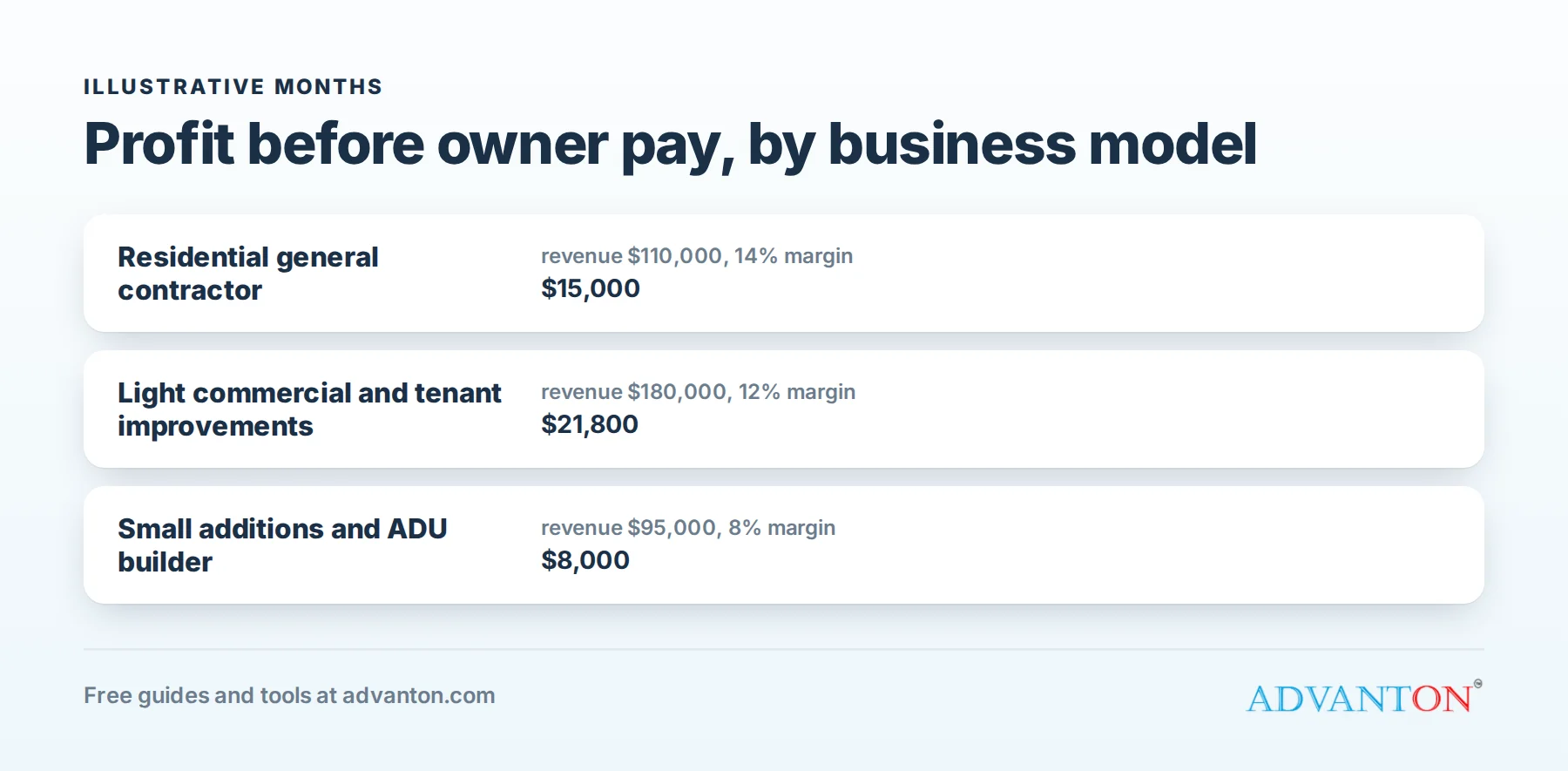
| Residential general contractor (owner, lead carpenter, subs) | Moderate to high: license, insurance, truck, tools, working capital | $110,000 | $95,000 | $15,000 | 14% |
| Light commercial and tenant improvements | High: licensing, bonding, insurance limits, working capital | $180,000 | $158,200 | $21,800 | 12% |
| Small additions and ADU builder | High: licensing, design partners, crews, working capital | $95,000 | $87,000 | $8,000 | 8% |
Fixed and variable costs
For projections, the most useful split is between variable costs, which rise and fall with sales (materials, parts, hourly labor), and fixed costs, which you pay every month regardless (rent, salaried staff, insurance, loan payments).
| Business model | Variable costs (% of revenue) | Fixed costs per month | What it means |
|---|---|---|---|
| Residential general contractor (owner, lead carpenter, subs) | 69.3% | $18,800 | Mostly variable: profitable early, but watch cash flow |
| Light commercial and tenant improvements | 75.0% | $23,200 | Mostly variable: profitable early, but watch cash flow |
| Small additions and ADU builder | 72.6% | $18,000 | Mostly variable: profitable early, but watch cash flow |
What the numbers say
Margins are thin. Subcontractors and materials take most of the revenue, so small estimating errors erase profit.
Fixed costs need steady volume. Project managers, lead carpenters, office and insurance must be covered between projects.
Cash flow is critical. Payment schedules tied to milestones keep subcontractors and suppliers paid on time.
The three models in brief
Residential GC. Remodels and repairs managed with a lead carpenter and trusted subcontractors. See how to get more remodeling leads.
Light commercial. Tenant improvements and small commercial projects with bonding and higher insurance limits.
Additions and ADUs. Larger residential projects with design coordination and longer timelines.
Cost structure: residential general contractor (owner, lead carpenter, subs)
Each cost as a share of the example month’s revenue ($110,000):
| Cost | Monthly amount | Share of revenue | Type |
|---|---|---|---|
| Subcontractors | $44,000 | 40.0% | Variable |
| Materials | $30,000 | 27.3% | Variable |
| Lead carpenter | $6,500 | 5.9% | Fixed |
| Office and estimating | $4,000 | 3.6% | Fixed |
| Marketing | $3,000 | 2.7% | Fixed |
| Insurance | $2,500 | 2.3% | Fixed |
| Permits and dumpsters | $2,200 | 2.0% | Variable |
| Truck and tools | $1,500 | 1.4% | Fixed |
| Payroll taxes and benefits | $1,300 | 1.2% | Fixed |
| Profit before owner pay | $15,000 | 14% |
A first-year projection: residential general contractor (owner, lead carpenter, subs)
New businesses rarely start at full speed. This projection assumes revenue ramps from 35% of the example month in month 1 to 100% by month 12, variable costs move with revenue, and fixed costs stay the same every month. It’s a planning illustration, not a forecast.
| Month | Revenue | Variable costs | Fixed costs | Profit | Cumulative |
|---|---|---|---|---|---|
| 1 | $38,500 | $26,670 | $18,800 | -$6,970 | -$6,970 |
| 2 | $49,500 | $34,290 | $18,800 | -$3,590 | -$10,560 |
| 3 | $60,500 | $41,910 | $18,800 | -$210 | -$10,770 |
| 4 | $68,200 | $47,244 | $18,800 | $2,156 | -$8,614 |
| 5 | $77,000 | $53,340 | $18,800 | $4,860 | -$3,754 |
| 6 | $83,600 | $57,912 | $18,800 | $6,888 | $3,134 |
| 7 | $90,200 | $62,484 | $18,800 | $8,916 | $12,050 |
| 8 | $95,700 | $66,294 | $18,800 | $10,606 | $22,656 |
| 9 | $100,100 | $69,342 | $18,800 | $11,958 | $34,614 |
| 10 | $104,500 | $72,390 | $18,800 | $13,310 | $47,924 |
| 11 | $107,800 | $74,676 | $18,800 | $14,324 | $62,248 |
| 12 | $110,000 | $76,200 | $18,800 | $15,000 | $77,248 |
Year one: revenue $985,600, profit before owner pay $77,248. The first profitable month is month 4. Cumulative results bottom out at -$10,770, which is the minimum cash cushion this plan would need, before any startup costs.
A residential GC carries a lead carpenter, office and insurance from the start, so this illustration turns profitable in month 4, with a cumulative low of about $10,800. Deposits and progress payments are essential.
How general contractors price
- Fixed-price contracts from detailed scopes.
- Cost-plus for uncertain projects.
- Allowances for selections not yet made.
- Change orders for every scope change, signed before work.
A startup checklist
- Get licensed in your state, with bonds and insurance as required.
- Build a reliable subcontractor network.
- Create contract templates with payment schedules and change orders.
- Set up job costing so you know each project’s profit.
- Plan working capital for materials and payroll.
Where the opportunities are
- ADUs and additions where local rules allow.
- Aging-in-place modifications.
- Insurance restoration projects.
- Tenant improvements for small businesses.
Key terms
| Term | Meaning |
|---|---|
| Job costing | Tracking costs and profit for each project |
| Bonding | A guarantee that you’ll complete work or pay subcontractors |
| Retainage | Payment held back until a project is complete |
| Change order | A signed agreement changing scope and price |
Choose subcontractors carefully
Your reputation depends on theirs. Check licenses and insurance, agree on scope and payment in writing, and pay promptly to keep the best trades available.
Marketing a general contracting business
Project galleries, detailed reviews, referrals from past clients and partnerships with architects and designers bring the best leads. See how to get more remodeling leads.
Protect your cash
Never let deposits and progress payments fall behind costs. Review every project’s numbers weekly, and stop work on scope changes until change orders are signed.
How to use these numbers for your own plan
- Start with the closest model above and its cost structure.
- Replace every price and cost with local quotes: insurance, wages, vehicles, materials and your expected prices.
- Estimate your ramp: how many jobs you can realistically win each month in year one.
- Separate fixed and variable costs, then calculate your break-even point with our free break-even calculator.
- Map cash month by month with our cash flow forecast, including equipment and loan payments.
- Build the plan in our free Business Planner.
These figures will also feed a planned Advanton projection tool, so you’ll be able to start from an industry template and adjust it to your situation.
About this data
Workforce figures come from the U.S. Bureau of Labor Statistics (Occupational Outlook Handbook and Occupational Employment and Wage Statistics, May 2024 and the 2024 to 2034 projections). Market figures cite their sources in the list above. Business model figures are illustrative months built from typical prices and costs to show how revenue, fixed costs and variable costs fit together; they are not industry averages or guarantees. We review these profiles when new government data is released, at least once a year. The same figures are available in a structured format for Advanton’s upcoming business projection tool.
Licensing and rules
Most states license general contractors above a project value, often with exams, bonds and insurance; building permits and inspections; home improvement contract rules (deposit limits and written contracts) for residential work; licensed trades for electrical, plumbing and HVAC. Requirements change; confirm with your state and local agencies before you start.
Frequently asked questions
Do general contractors need a license?
Most states require a license above certain project values, often with exams, bonds and insurance.
Why are general contractor margins thin?
Subcontractors and materials take most of each dollar, so estimating and change orders decide profit.
How big is the remodeling market?
Harvard JCHS projects about $518 billion in homeowner improvement spending by the end of 2026.
How can I use these numbers?
Start with the closest general contractor model, then replace every figure with your own local prices, wages and expected job volume.
Keep learning
- Residential general contractor
- Local SEO for contractors
- How to get more contractor leads
- Specialty trades industry data
Sources
- U.S. Bureau of Labor Statistics, Construction and extraction occupations
- U.S. Bureau of Labor Statistics, Carpenters
- Joint Center for Housing Studies of Harvard University, Remodeling growth set to downshift in late 2026
Last reviewed October 30, 2026. Startup costs are estimates; check local prices, licensing and tax rules before you commit money.

