
Most contractors’ best customers live close to their existing customers. Homes on the same street are often the same age, with similar roofs, systems and yards, and neighbors talk to each other. Neighborhood marketing is the practice of deliberately winning more work on the streets you already serve, using signs, door hangers, mail, branded vehicles, online neighborhood platforms and genuine community involvement.
This guide brings those pieces together into one system, with links to detailed guides for each tactic.
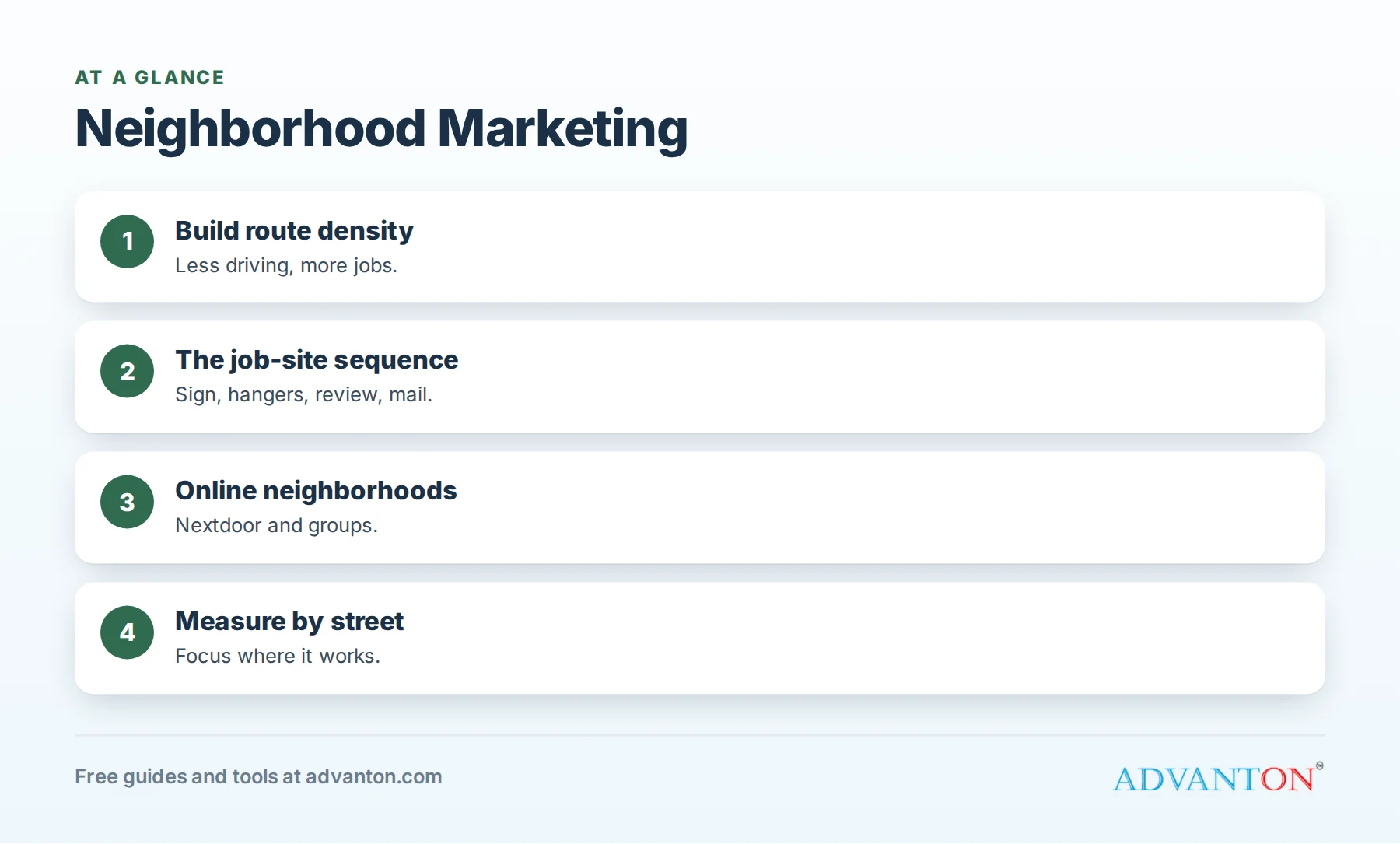
Why route density matters
Table of Contents
| Benefit | Why it matters |
|---|---|
| Less driving | More time working, lower fuel costs |
| More jobs per day | Especially for recurring services |
| Faster response | Customers nearby get quicker service |
| Stronger word of mouth | Neighbors see your work and recommend you |
| Lower marketing costs | Each job advertises to the next customer |
For recurring trades like landscaping, pest control and pool service, density is the difference between a profitable route and an exhausting one. For project trades like roofing and fencing, it means each job can lead to the next one down the street.
The neighborhood marketing toolkit
| Tactic | Role | Guide |
|---|---|---|
| Yard signs | Show neighbors where you’re working | Yard signs |
| Door hangers | Give nearby homes a reason to call | Door hangers |
| Postcards | Reach whole postal routes repeatedly | Direct mail |
| Branded vehicles | Build recognition with every visit | Vehicle wraps |
| Nextdoor and community groups | Neighbor recommendations online | Nextdoor and Facebook |
| Reviews | Proof neighbors find when they search | Getting reviews |
| Referral offers | Reward customers who bring neighbors | Referral programs |
The job-site sequence
Every job is a neighborhood marketing opportunity:
- Day one: place a yard sign (with permission) and hang door hangers on 20 to 50 nearby homes.
- During the job: keep the site tidy and vehicles parked courteously; neighbors are watching.
- Completion: ask for a review and photograph the finished job with the sign.
- Two to four weeks later: mail postcards to the surrounding route mentioning the completed project.
- Next season: return with a seasonal hanger or postcard.
Online neighborhood platforms
Nextdoor and local Facebook groups are where neighbors ask for recommendations. Claim your Nextdoor Business Page, encourage satisfied customers to recommend you, and participate helpfully in groups, following their rules. When neighbors ask "Who did your fence?", you want your customers ready to tag you.
Neighbor referral offers
Offer a simple thank-you when a customer refers a neighbor who books, and a neighbor discount when two homes on the same street book together. These offers turn your customers into local advocates and fill your routes. Keep rewards simple and follow any rules for your trade.
Community involvement
- Sponsor local events: youth sports, school fundraisers, block parties.
- Support neighborhood associations and HOAs with helpful talks or seasonal tips.
- Show up at community events with a friendly booth and useful information.
People hire contractors they know and trust; visible community involvement builds both.
A neighborhood marketing calendar
| Month | Focus |
|---|---|
| January to February | Plan routes; mail past customers; book spring work |
| March to May | Signs and hangers on every job; spring postcards |
| June to August | Peak season: keep every job visible; Nextdoor posts |
| September to November | Fall postcards; seasonal hangers; ask for reviews |
| December | Thank-you cards; plan next year’s neighborhoods |
Measure results by neighborhood
Track calls, bookings and revenue by neighborhood or postal route, along with the tactics used there. Over time you’ll see which streets respond best and where to concentrate effort. Our free lead source tracker helps.
Choose your focus neighborhoods
Pick a handful of neighborhoods where you already have customers, homes fit your services, and travel is easy. Concentrate signs, hangers, mail and online effort there before spreading out. Depth beats breadth.
Recurring trades vs project trades
Recurring trades (landscaping, pest control, pool service, cleaning) build density by signing neighbors to ongoing plans; every new customer on an existing route is almost pure profit. Project trades (roofing, fencing, painting, remodeling) use each job to win the next nearby; the goal is a chain of projects through a neighborhood. Choose tactics accordingly: plans and neighbor discounts for recurring trades, signs, hangers and mail around each project for project trades.
Build relationships with HOAs
HOAs and neighborhood associations influence many homeowners at once. Offer helpful talks or articles for newsletters (seasonal maintenance, approval processes for exterior projects) and make it easy to work within their rules. Being known as the contractor who respects the HOA’s guidelines brings steady referrals.
Your crews are your marketing
Neighbors judge your company by what they see: courteous crews, tidy job sites, careful parking and friendly waves. Train crews to treat every street as a showroom, and to hand a card to curious neighbors rather than ignoring them.
Customer appreciation
A thank-you card after each job, a small gift at the holidays or a customer appreciation event keeps your name front of mind and encourages referrals. Customers who feel appreciated talk about you to neighbors.
A team checklist for every job
| Item | Done |
|---|---|
| Sign permission and placement | |
| Door hangers on nearby homes | |
| Tidy site and courteous parking | |
| Review request at completion | |
| Photo of finished job | |
| Neighborhood logged for follow-up mail |
The block strategy
When a neighborhood responds well, treat it as a "block" to own. Map every home you’ve served there, note when each customer may need you again (roof age, last service date, plan renewal) and schedule reminders. Add seasonal hangers and postcards for the rest of the block. Over a few years, many contractors find a single block can supply a steady share of their work.
Seasonal neighborhood touches
Short, useful touches keep you familiar between jobs: a spring checklist postcard, a summer safety tip on Nextdoor, a fall maintenance hanger and a holiday thank-you to customers. None of these needs to sell hard; they remind neighbors who to call when the need comes.
Combine online and offline
Neighborhood marketing works best when online and offline reinforce each other. A homeowner who sees your sign, gets your hanger, receives your postcard and then finds strong reviews and a clear website when they search your name is far more likely to call than one who sees only a single piece. Keep your Google Business Profile and website current, and make sure every printed piece uses the same name, phone number and branding.
Turn customers into neighborhood ambassadors
Your happiest customers are your best marketing in their neighborhood. Thank them personally, ask whether they’d mind if you mention them to neighbors, invite them to recommend you on Nextdoor and offer a simple reward for referrals who book. Some contractors give loyal customers a few extra cards or door hangers to share. When neighbors hear about you from someone they trust, the sale is half made before you arrive.
Keep promises to the neighborhood
Arrive when you say you will, clean up every day and finish on schedule. In a neighborhood, every missed promise is noticed by more than one household, and every kept promise is too.
Common mistakes
- Scattering marketing across too wide an area.
- One-off efforts instead of a repeatable system.
- Ignoring rules for signs, hangers and groups.
- Not asking for reviews and referrals at the right moment.
- No tracking by neighborhood.
A worked example
A pest control company chooses three neighborhoods where it has 40 customers. Over a year it hangs door hangers around every service visit, mails four seasonal postcards, earns Nextdoor recommendations and offers a neighbor discount. Customers in those neighborhoods grow from 40 to 95, and the average drive time between stops falls noticeably. These numbers are illustrative, but the pattern is common: concentrated effort compounds.
Frequently asked questions
What is neighborhood marketing for contractors?
Deliberately winning more work on streets you already serve, using signs, door hangers, mail, vehicles, online neighborhood platforms and community involvement.
Why does route density matter?
It reduces driving, increases jobs per day and strengthens word of mouth.
Which tactic should I start with?
Yard signs and door hangers around every job, plus asking every customer for a review.
How do I measure neighborhood marketing?
Track calls, bookings and revenue by neighborhood or route, along with the tactics used.
Does neighborhood marketing work for interior trades?
Yes. Vehicles, door hangers, mail, Nextdoor and referrals work even when the work itself isn’t visible from the street.
How many neighborhoods should I focus on?
Start with a few where you already have customers and short drives; expand once those are strong.
Is neighborhood marketing expensive?
No. Signs, hangers and referrals are inexpensive, and mail can be targeted to small areas; track cost per booked job to compare.
Can new contractors use neighborhood marketing?
Yes. Start with your first jobs: sign, hang, ask for reviews and follow up with mail to build density from day one.
How Advanton helps
Advanton is a free resource for small businesses. Free tools for neighborhood marketing: the yard sign and door hanger maker, the EDDM postcard maker, the review request kit, the rewards program and the lead source tracker. You can also add your business to the Advanton directory for free. Advanton earns money when you buy a domain or hosting through our store, which helps keep everything else free.
Keep learning
Last reviewed October 30, 2026. Startup costs are estimates; check local prices, licensing and tax rules before you commit money.


Leave a Reply