
Your trucks and vans spend hours every day in driveways, on streets and in parking lots across your service area. Lettered or wrapped, they become moving billboards that build recognition with every trip, and they reassure homeowners that the people arriving at their door belong to a real, established business.
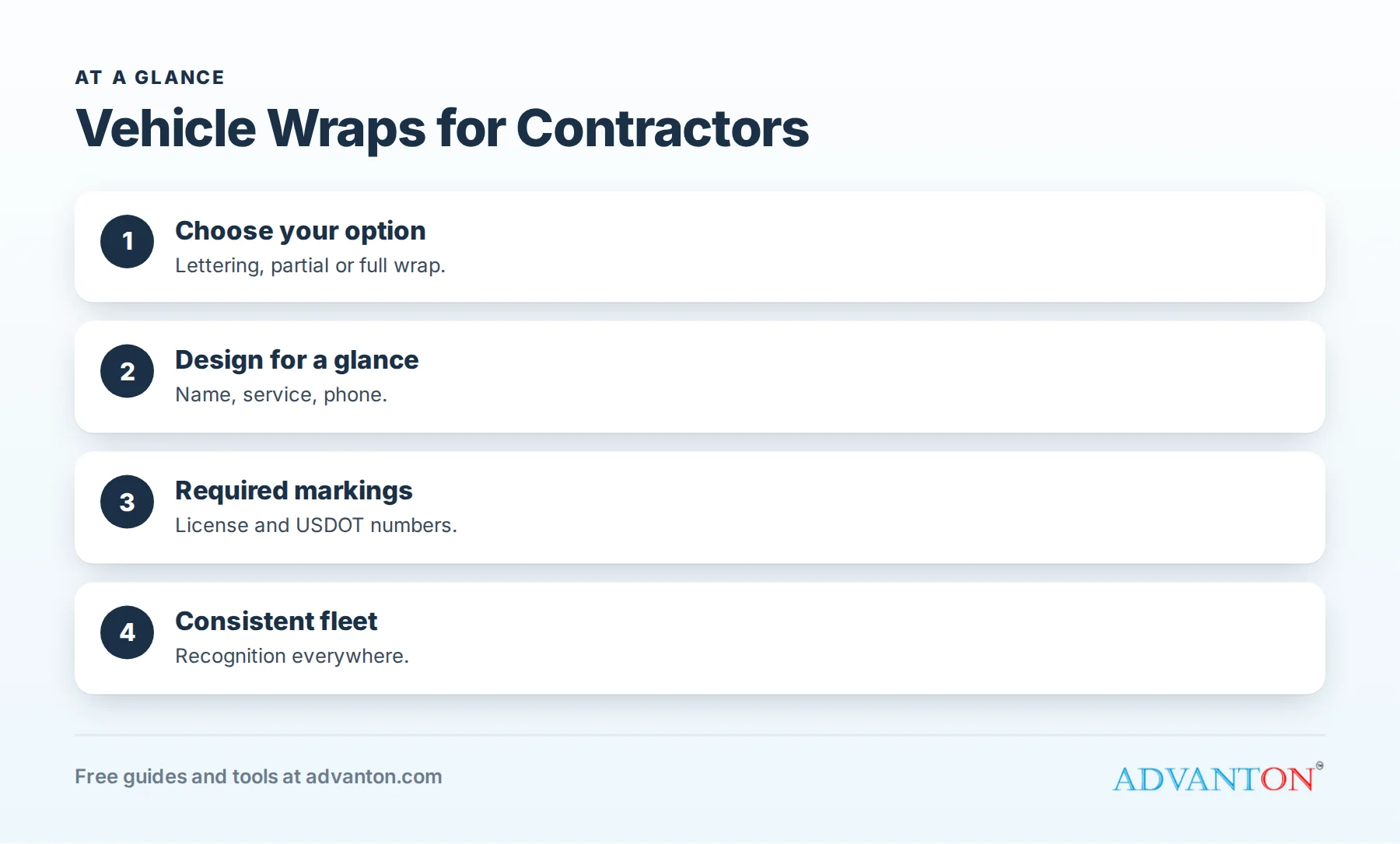
This guide compares vehicle wrap options, explains what makes a design work, covers markings you may be required to display, and shows how to get the most from every vehicle.
Your options
Table of Contents
| Option | What it is | Best for |
|---|---|---|
| Lettering and decals | Business name, logo, phone and website in cut vinyl | Tight budgets, new businesses, small fleets |
| Partial wrap | Printed graphics covering part of the vehicle | Strong branding at a moderate cost |
| Full wrap | Printed vinyl covering most of the vehicle | Maximum visibility and a premium look |
| Magnetic signs | Removable panels | Personal vehicles used occasionally for work |
Costs vary with vehicle size, design complexity and region; get quotes from several installers for your specific vehicles.
Design for a glance
People see your vehicle for a few seconds at a time, often while driving. Keep the design simple:
- Business name or logo, large and clear.
- What you do in one to three words: "Plumbing and Drains," "Roofing," "Lawn Care."
- Phone number and website, large enough to read from a distance.
- High contrast colors that match your brand.
- Minimal clutter: avoid long service lists and small text.
Check the design on all sides: the rear is seen most in traffic, and the sides are seen most when parked.
Markings you may be required to display
- Contractor license numbers: some states require contractors to display their license number on commercial vehicles. California, for example, requires contractors’ business name and license number on vehicles used in the business. Check your state’s licensing board.
- USDOT numbers: commercial vehicles used in interstate commerce above certain weights must display a USDOT number and company name. Check Federal Motor Carrier Safety Administration rules if your vehicles qualify.
- Local rules in some cities and HOAs may restrict parking of lettered commercial vehicles in residential areas.
Include required markings in your design from the start.
Choosing an installer
- Look at their portfolio, especially work vehicles.
- Ask about materials and expected lifespan.
- Ask about warranties for printing and installation.
- Confirm design help and how many revisions are included.
- Get written quotes with timelines.
Care and durability
Wash wrapped vehicles regularly, avoid harsh pressure washing on edges, and repair damaged sections quickly. Quality wraps can last several years with proper care, depending on materials, climate and maintenance. Plan replacements as part of your vehicle budget.
Make the whole fleet consistent
Use the same layout, colors and logo placement on every vehicle, so customers recognize your business instantly, whether they see a pickup, a van or a trailer. Consistency also looks more established than a mix of styles.
Drive and park like a brand ambassador
A branded vehicle that cuts people off or blocks driveways is negative advertising. Set driving and parking expectations for your team, keep vehicles clean and organized, and park courteously at job sites.
Track what vehicles bring
Ask every caller how they found you, and include "saw your truck" as an option in your tracking. Some contractors use a dedicated phone number or web address on vehicles to measure calls. Our free lead source tracker helps.
Pair vehicles with other local marketing
Vehicles parked at a job site work alongside yard signs and door hangers to make your presence obvious on a street. See yard signs for contractors and door hangers for contractors.
Use vehicle photos online
Photos of clean, branded vehicles help your Google Business Profile, website and social pages. They show customers what to look for when you arrive and reinforce trust.
Which option fits your stage
| Stage | Suggested approach |
|---|---|
| Just starting | Lettering or magnets with name, service and phone |
| Growing | Partial wraps on main work vehicles |
| Established fleet | Consistent full or partial wraps across all vehicles |
Design examples by trade
| Trade | Main message | Extras |
|---|---|---|
| Plumbing | "Plumbing and Drains, 24/7" (only if true) | Phone, license number |
| HVAC | "Heating and Cooling" | Phone, website, maintenance plan mention |
| Electrical | "Licensed Electricians" | Phone, license number |
| Roofing | "Roofing and Gutters" | Phone, website, QR code on rear |
| Landscaping | "Lawn Care and Landscaping" | Phone, website, service area |
Don’t forget trailers and equipment
Trailers, lifts and equipment parked at job sites are seen by neighbors for hours. Simple lettering with your name and phone number turns them into extra signs.
QR codes on vehicles
QR codes don’t work for moving traffic, but they can help when vehicles are parked at job sites or in lots. Place a QR code on the rear or lower side, linked to a page with your services and a quote form.
Night visibility
Reflective vinyl for your name or phone number can improve visibility at night, which can help trades that work early or late. Ask your installer about options.
Leased vehicles
If you lease vehicles, check your lease terms before wrapping. Many leases allow removable wraps or lettering, but some require approval or professional removal before return.
Budget and timing
Wrap new vehicles soon after purchase so they start advertising immediately. Add vehicle branding to your budget for each new truck or van, and plan replacements when wraps fade.
Keep vehicles clean
A dirty, dented or cluttered branded vehicle sends the wrong message. Wash vehicles regularly, fix damage promptly and keep cabs and beds organized.
Show your credentials
Besides any required license number, adding "Licensed and Insured," a trade association logo or manufacturer certification (where permitted) builds trust at a glance. Keep it small and secondary to your name, service and phone number.
Plan the design with your website
Your vehicle design should match your website, business cards, yard signs and uniforms. When a homeowner sees your van, searches your name and lands on a website with the same colors and logo, trust builds immediately. Our free Brand & Print Studio helps keep your brand consistent across print.
When to refresh your wraps
Refresh wraps when they fade, peel or no longer match your brand, when you change phone numbers or services, or when you rebrand. Outdated phone numbers on trucks are a common, costly mistake: they send customers to dead lines for years.
Wrap your personal brand into your service
Customers often meet your technicians before anyone else from your business. Branded vehicles, uniforms and ID badges together tell homeowners exactly who has arrived, which matters for safety and trust. Ask technicians to park where homeowners can easily see the vehicle, and to introduce themselves by name and business when they knock. The vehicle starts the conversation; the technician finishes it.
Measure over a full year
Vehicle branding works gradually, through repeated exposure across your service area. Judge it over a full year by tracking "saw your truck" mentions, branded searches for your business name and overall call volume in areas where your vehicles work most.
Common mistakes
- Too much text to read at a glance.
- Hard-to-read fonts or colors.
- Missing required markings.
- Inconsistent fleet designs.
- Neglecting damaged or faded wraps.
A worked example
A plumbing company letters its first two vans with its name, "Plumbing and Drains," phone number and license number. Over a year, it records 14 calls from people who "saw the van," booking 9 jobs. The lettering cost is recovered several times over. As the fleet grows, it adds partial wraps in the same design. These numbers are illustrative; track your own.
Frequently asked questions
Are vehicle wraps worth it for contractors?
For most contractors, yes. Vehicles are seen daily across your service area and reassure customers when you arrive.
What should be on a contractor’s truck?
Your business name or logo, service, phone number, website and any required markings such as license or USDOT numbers.
Do I need my license number on my truck?
Some states require it, including California. Check your state’s licensing board.
How long do vehicle wraps last?
Several years with good materials and care, depending on climate and maintenance.
Should I choose a full wrap or lettering?
Lettering suits tight budgets; partial and full wraps offer more visibility as your budget grows.
Do magnetic signs work?
They can for personal vehicles used occasionally for work, but they’re less durable and can be removed or lost.
Should I show prices on my truck?
Usually not; keep the message simple and let customers call for details.
Can I write off vehicle wraps as a business expense?
Business advertising costs are often deductible, but treatment varies; ask your tax professional.
What’s the most important element on a contractor vehicle?
A large, readable phone number and business name, with a short description of what you do.
How Advanton helps
Advanton is a free resource for small businesses. Create a consistent logo and brand colors with the free Brand & Print Studio, and track calls with the lead source tracker. See our printing and signs industry data for how wrap shops work. You can also add your business to the Advanton directory for free. Advanton earns money when you buy a domain or hosting through our store, which helps keep everything else free.
Keep learning
Last reviewed October 30, 2026. Startup costs are estimates; check local prices, licensing and tax rules before you commit money.


Leave a Reply