
A restaurant consultant helps owners open, fix and grow restaurants: developing concepts, planning kitchens and openings, engineering menus, controlling food and labor costs, improving service, training staff and turning around struggling locations. Thin margins mean small improvements make a real difference, which is why owners pay for experienced help.
Most restaurant consultants come from years of operating experience as chefs, general managers or owners. Food safety and labor rules (including tip rules) are part of the advice. The Bureau of Labor Statistics reports a median pay of $65,310 for food service managers (May 2024), with employment projected to grow about 6%. This guide covers services, cost control, compliance, pricing, a worked example and a 90-day plan.
A restaurant consulting business at a glance
Table of Contents
| Topic | What to expect |
|---|---|
| Startup cost | Very low: a computer, templates and tools, insurance, a website and travel |
| Key expertise | Menu engineering, food and labor costs (prime cost), operations, training and openings |
| Compliance areas | Health codes based on the FDA Food Code, wage and hour and tip rules, licensing and permits |
| How you charge | Fixed project fees, monthly retainers, daily rates for on-site work and opening packages |
| Best for | Experienced operators who can diagnose problems quickly and coach teams |
Who restaurant consulting suits
It suits seasoned chefs, managers and owners who understand both the kitchen and the numbers, and who can coach teams under pressure. Credibility comes from having run successful operations.
Services to offer
- Concept development and business plans for new restaurants.
- Opening support: kitchen layout, equipment, vendors, hiring, training and soft openings.
- Menu engineering: costing every dish and designing the menu around profitable items.
- Cost control: purchasing, inventory, waste and labor scheduling.
- Operations and service: systems, checklists and guest experience.
- Turnarounds for struggling restaurants.
- Bar programs, catering and delivery strategy.
Prime cost and menu engineering
Prime cost (food and beverage cost plus labor) is the biggest controllable expense for most restaurants, and the first number many consultants examine. Menu engineering analyzes each item’s popularity and profit, then adjusts pricing, placement, portions and recipes. Accurate recipe costing is the foundation of both.
Food safety and health codes
Most state and local health codes are based on the FDA Food Code, covering temperature control, cross-contamination, handwashing, allergen awareness and manager certification. Consultants help restaurants build food safety systems, prepare for inspections and train staff; many hold food safety manager certifications.
Labor and tip rules
The Fair Labor Standards Act governs minimum wage, overtime and tips, including when employers may take a tip credit and who may share in tip pools; managers and supervisors generally may not keep employees’ tips. Many states have stricter rules. Help clients set compliant practices, and refer legal questions to employment attorneys.
Proposals and statements of work
Every engagement should start with a written proposal and statement of work: the client’s goals, your approach, deliverables, timeline, what the client must provide, fees and payment terms. Clear scope prevents the most common consulting problem: work growing beyond what was agreed and paid for.
Pricing consulting work
Consultants charge in several ways: hourly for open-ended advice, fixed project fees for defined deliverables, monthly retainers for ongoing support and sometimes value-based fees tied to the size of the result. Fixed fees and retainers usually reward expertise better than hourly billing. Use our pricing calculator to check that your rates cover non-billable time such as sales and admin.
Startup costs to plan for
| Item | What to budget for |
|---|---|
| Templates and tools | Recipe costing, inventory, scheduling and checklists |
| Insurance | Professional liability |
| Website and portfolio | Case studies and results |
| Contracts | Consulting agreement and statement of work |
| Travel | On-site visits |
| Certifications | Food safety manager certification |
Use our startup cost calculator for your total.
An assessment process
- Review financial statements, sales mix and prime cost.
- Observe service and kitchen operations during busy shifts.
- Cost the menu and review purchasing and inventory.
- Interview managers and staff.
- Deliver a prioritized plan with expected savings.
A worked example: a solo consultant
These are illustrative assumptions for an established solo consultant, not predictions.
| Assumption | Monthly | |
|---|---|---|
| Opening support | 1 opening package at $9,000 | $9,000 |
| Assessments and turnarounds | 2 projects at $3,500 | $7,000 |
| Monthly retainers | 3 clients at $1,500 | $4,500 |
| Revenue | $20,500 | |
| Travel | $(900) | |
| Software and templates | $(150) | |
| Insurance | Professional liability | $(150) |
| Marketing, legal and accounting | $(600) | |
| Profit before owner pay and taxes | $18,700 |
That leaves about $18,700 a month before the consultant’s pay and taxes, on about $20,500 of revenue. Opening projects are large but irregular, so retainers and assessments keep income steadier.
Loading the calculator…
Opening a restaurant on schedule
Openings involve permits, construction, equipment, vendors, hiring and training, all on a tight timeline. A consultant’s value is a proven timeline and checklists, vendor relationships and calm leadership during the final weeks. Build realistic timelines, since permit and inspection delays are common.
Finding clients
- New owners and first-time restaurateurs.
- Restaurant associations and local business groups.
- Referral partners: accountants, commercial real estate brokers, equipment dealers and food distributors.
- Struggling restaurants needing turnarounds.
- Hotels, clubs and institutions with food service operations.
Technology
Point-of-sale systems, inventory software, online ordering, reservations and scheduling tools can transform operations when chosen and set up well. Helping clients choose and configure the right systems is a useful service.
Inventory and purchasing
Weekly inventory counts, par levels, comparing vendor prices and tracking waste reveal where food cost goes. Simple systems, consistently used, often deliver the fastest savings for clients.
Staffing and training
Labor shortages and turnover hurt service and costs. Help clients build hiring processes, training manuals, station checklists and schedules matched to sales patterns. Well-trained teams serve faster, waste less and stay longer.
Delivery and off-premise sales
Delivery apps, online ordering and catering can add sales but also add fees and packaging costs. Help clients price delivery menus to protect margins, decide which channels to use and design operations so delivery orders do not disrupt dine-in service.
Buying an existing restaurant
Buyers of existing restaurants need help reviewing financials, leases, equipment condition, health inspection history and staff. A pre-purchase assessment can prevent costly mistakes and leads naturally to opening and turnaround work.
Turnarounds
Struggling restaurants need quick, focused action: stabilize cash, fix the biggest cost leaks, simplify the menu, rebuild service standards and reconnect with regular guests. Turnarounds demand honesty with owners about what can be saved and how fast.
Bars and beverage programs
Beverage programs often carry high margins but also theft and waste risk. Pour controls, inventory tracking, cocktail costing and staff training improve results, and specialists in bars and beverage programs are in demand.
Working with chefs and owners
Recommendations only work if the team adopts them. Respect chefs’ creativity, explain the numbers behind changes, involve staff in solutions and celebrate early wins so changes stick after you leave.
Common mistakes to avoid
- Advice without looking at the numbers.
- Generic recommendations that ignore the concept and market.
- Unclear scope on opening projects.
- Overlooking tip and labor compliance.
- Leaving before changes are in place.
Your first 90 days
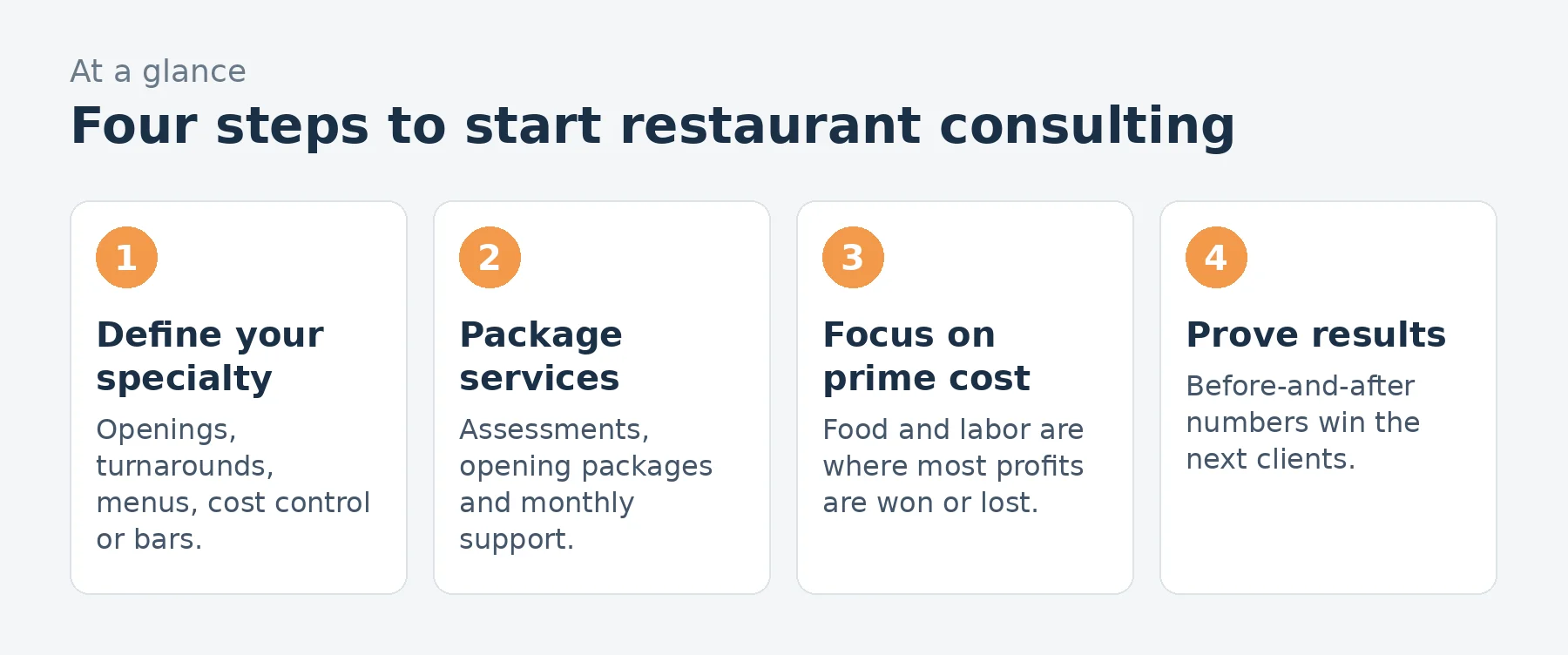
- Days 1-30: define your specialty, build costing and assessment templates and buy insurance.
- Days 31-60: complete two assessments and document savings.
- Days 61-90: build referral partnerships and offer retainers and opening packages.
Frequently asked questions
Do I need a license to be a restaurant consultant?
Generally no, but food safety manager certification and operating experience build credibility.
What is prime cost?
Food and beverage cost plus labor cost, usually the largest controllable expense in a restaurant.
What is menu engineering?
Analyzing each menu item’s popularity and profit, then adjusting pricing, placement and recipes.
Can managers share in tip pools?
Under federal rules, managers and supervisors generally may not keep employees’ tips; state rules may be stricter.
How do restaurant consultants charge?
Fixed project fees, opening packages, monthly retainers and daily rates for on-site work.
Who hires restaurant consultants?
New owners, struggling restaurants, multi-unit operators, hotels and investors.
Can restaurant consultants help with permits?
Many help plan the permit and inspection process and coordinate with contractors, though owners file applications and meet local requirements.
What results should a restaurant consultant measure?
Prime cost, food cost and labor percentages, sales per labor hour, ticket times and guest reviews before and after changes.
Do restaurant consultants need a food safety certification?
It is not always required, but food safety manager certification adds credibility and helps with health code work.
How long does a restaurant opening project take?
Often many months from concept to opening, depending on construction, permits and inspections.
Can a consultant fix a failing restaurant?
Sometimes. Quick cost control, a simpler menu and better service can turn results around, but some locations or leases cannot be saved.
Do restaurant consultants work remotely?
Some analysis and coaching can be remote, but most valuable work, such as observing service and training staff, happens on site.
What does an opening package include?
Typically timelines, vendor and equipment planning, menu and recipe costing, hiring and training plans and support through soft opening and launch.
Keep learning
- Restaurants and food service industry data
- How to start a business consulting firm
- How to start a coffee shop
- Pricing calculator
Sources
- US Bureau of Labor Statistics, Food service managers
- FDA, Food Code
- U.S. Department of Labor, Tips under the FLSA
- U.S. Department of Labor, Fair Labor Standards Act (wages, overtime and tips)
Last reviewed November 3, 2026. Startup costs are estimates; check local prices, licensing and tax rules before you commit money.

