
A business consultant helps owners and managers solve problems and grow: improving operations, building strategy, fixing finances, entering new markets, improving sales or preparing a business for sale. Most successful consultants build their practice on deep experience in an industry or function.
Consulting has very low startup costs, but competition is broad, so a clear niche and proof of results matter. Advanton’s consulting industry data shows a median pay of $80,410 for business operations specialists and $76,950 for market research analysts and marketing specialists, benchmarks for the skills clients pay for; experienced independent consultants can earn much more. This guide covers niche, services, pricing, contracts, client acquisition, a worked example and a 90-day plan.
A business consulting firm at a glance
Table of Contents
| Topic | What to expect |
|---|---|
| Startup cost | Very low: a computer, a professional website, contracts, insurance and marketing |
| Licenses | A business license; no consulting license is generally required, though some regulated advice (legal, tax, investment) has its own rules |
| How you charge | Hourly, fixed project fees, monthly retainers and value-based fees |
| Best niches | An industry you know deeply or a function such as operations, sales, finance or exit planning |
| Best for | Experienced professionals who can diagnose problems and guide change |
Who consulting suits
It suits experienced professionals who can listen, analyze, communicate clearly and help people act on recommendations. You are selling judgment and results, so credibility in your niche matters most.
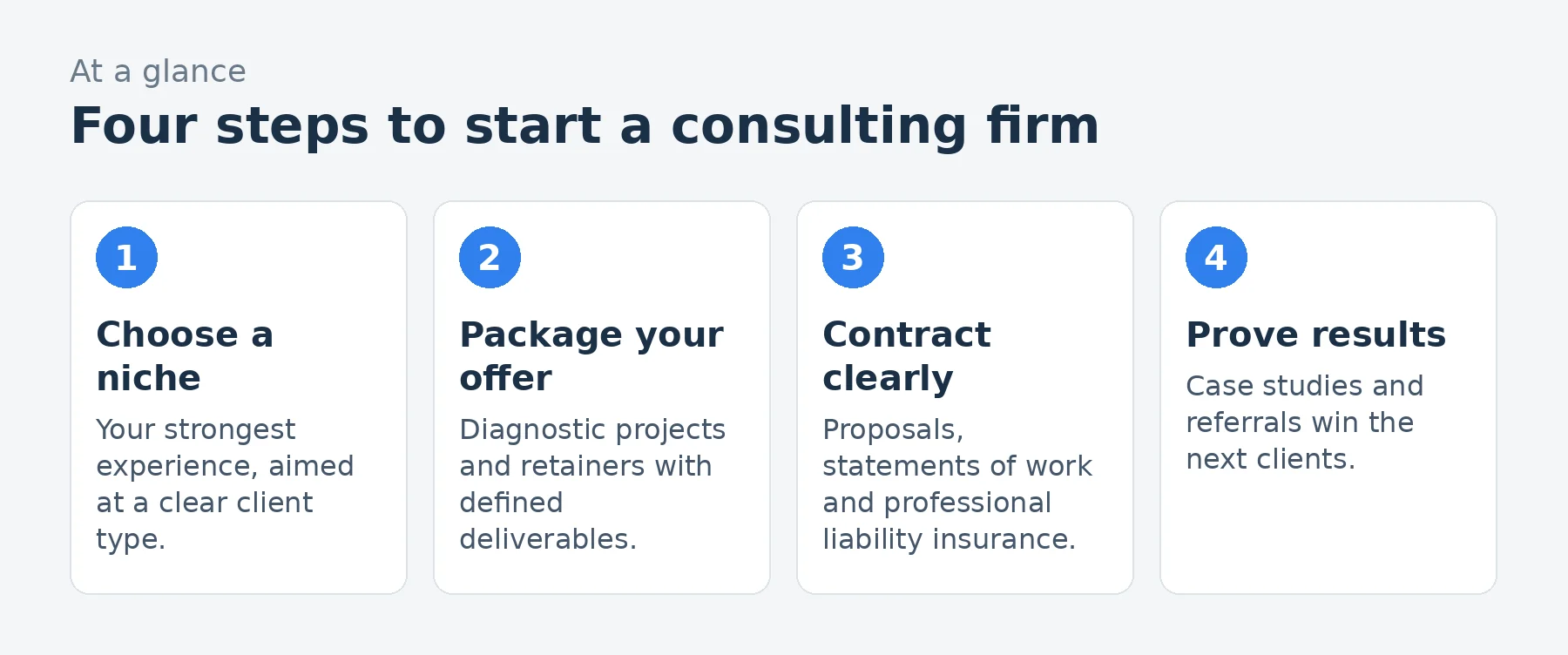
Choosing a niche
- By industry: restaurants, construction, healthcare practices, manufacturing, nonprofits or e-commerce.
- By function: operations and processes, sales, pricing, finance, strategy, leadership or technology.
- By stage: startups, growing companies, businesses in trouble or owners preparing to sell.
- By client size: solo owners, small businesses or mid-sized companies.
A narrow niche feels limiting but makes marketing easier: clients look for specialists who have solved their exact problem.
Services to offer
- Diagnostic or assessment projects: analyzing the business and delivering a prioritized plan.
- Implementation support: helping teams put changes in place.
- Monthly advisory retainers: ongoing guidance, meetings and accountability.
- Workshops and training for teams.
- Interim roles: temporary operations or management leadership.
Proposals and statements of work
Every engagement should start with a written proposal and statement of work: the client’s goals, your approach, deliverables, timeline, what the client must provide, fees and payment terms. Clear scope prevents the most common consulting problem: work growing beyond what was agreed and paid for.
Pricing consulting work
Consultants charge in several ways: hourly for open-ended advice, fixed project fees for defined deliverables, monthly retainers for ongoing support and sometimes value-based fees tied to the size of the result. Fixed fees and retainers usually reward expertise better than hourly billing. Use our pricing calculator to check that your rates cover non-billable time such as sales and admin.
Contracts and insurance
Consulting agreements should cover scope, deliverables, fees, expenses, confidentiality, ownership of materials, limits of liability and termination. Avoid giving legal, tax or investment advice unless you are licensed to do so; refer clients to qualified professionals. Carry professional liability (errors and omissions) insurance.
Startup costs to plan for
| Item | What to budget for |
|---|---|
| Website | Clear niche, services and case studies |
| Contracts | Consulting agreement and statement of work templates |
| Insurance | Professional liability, general liability |
| Software | Proposals, scheduling, accounting, project management |
| Marketing | Networking, speaking, content |
| Business setup | LLC or other entity, bank account |
Use our startup cost calculator for your total.
The discovery call
Use a structured first conversation: the client’s goals, the problem and its cost, what they have tried, decision-makers, timeline and budget. Good discovery lets you propose the right engagement and price, and qualifies out clients who are not ready.
A worked example: a solo consultant
These are illustrative assumptions for an established solo consultant, not predictions.
| Assumption | Monthly | |
|---|---|---|
| Diagnostic and project work | 1 project at $9,000 | $9,000 |
| Monthly retainers | 4 clients at $2,500 | $10,000 |
| Workshops and speaking | $1,500 | |
| Revenue | $20,500 | |
| Software and subscriptions | $(250) | |
| Contract support | Analyst or specialist help | $(1,800) |
| Travel | $(500) | |
| Insurance | Professional liability | $(200) |
| Marketing, legal and accounting | $(800) | |
| Profit before owner pay and taxes | $16,950 |
That leaves about $16,950 a month before the consultant’s pay and taxes, on about $20,500 of revenue. Retainers provide stability; project income can be uneven, so keep a pipeline of new conversations.
Loading the calculator…
Delivering results
- Gather data and interview the team.
- Identify the few changes that matter most.
- Present findings clearly with a prioritized plan.
- Support implementation and remove obstacles.
- Measure results and agree on next steps.
Clients judge consultants by what changes after the engagement, not by the length of the report.
Finding clients
- Your professional network and former employers.
- Referral partners: accountants, attorneys, bankers and business brokers.
- Industry associations and conferences in your niche.
- Speaking and workshops that demonstrate expertise.
- Content: articles, newsletters and case studies about your niche’s problems.
Building credibility
Case studies with measurable results, testimonials, a clear point of view on your niche’s problems and a professional website all help. Certifications, such as the Certified Management Consultant designation, can add credibility for some clients.
From projects to retainers
Diagnostic projects often reveal ongoing needs. Offer monthly retainers for implementation support, regular meetings and on-call advice. Retainers smooth income and deepen relationships.
Growing the firm
Growth options include raising rates, productizing services (standard diagnostics and programs), adding associates or subcontractors and developing training or digital products. Keep quality consistent as you add people.
Workshops as a lead source
Short workshops for business associations, chambers of commerce and industry groups let owners see your expertise firsthand. Offer a practical takeaway, such as a pricing or cash flow checklist, and invite attendees to a free diagnostic call. Workshops often produce your best-qualified prospects.
Exit planning and business sales
Many owners will sell or hand over their businesses in coming years. Helping them improve profitability, systems and records before a sale, often working with business brokers, accountants and attorneys, is a valuable niche with clear, measurable goals.
Productized services
A productized service is a standard offer with a fixed price and scope, such as a 30-day operations review or a pricing strategy sprint. Productized services are easier to market, sell and deliver consistently than fully custom work.
Managing your time
Consultants sell time and judgment, so protect both. Block time for marketing and admin each week, set office hours for client calls and track utilization: the share of your working time spent on billable client work.
Choosing a business structure
Many consultants form an LLC to separate business and personal finances and liability, and some later elect S corporation tax treatment as income grows. Ask an accountant which structure fits, and keep business accounts and records separate from day one.
Measuring your impact
Agree on success measures at the start: revenue growth, margin improvement, time saved or customer retention. Measuring results before and after an engagement gives you case studies and makes renewal conversations easier.
Common mistakes to avoid
- Positioning as a generalist who helps everyone.
- Starting work without a statement of work.
- Underpricing and billing only hourly.
- Giving regulated advice without the right license.
- Stopping marketing while busy with clients.
Your first 90 days
- Days 1-30: define your niche and offers, set up your business and contracts and buy insurance.
- Days 31-60: contact 50 people in your network and referral partners, and run discovery calls.
- Days 61-90: deliver first projects, document results and propose retainers.
Frequently asked questions
Do I need a license to be a business consultant?
Generally no, though advice in regulated areas such as law, taxes and investments requires the right license.
How do consultants charge?
Hourly, fixed project fees, monthly retainers or value-based fees tied to results.
How do I find my first consulting clients?
Through your professional network, referral partners such as accountants and attorneys, and industry associations.
Should I specialize?
Yes. Specialists in an industry or function find it easier to win clients and charge more.
What insurance does a consultant need?
Professional liability (errors and omissions) is the key coverage, plus general liability for meetings and events.
Can I consult part-time?
Many consultants start part-time while employed, if their employment agreement allows it.
How much do business consultants charge?
Rates vary widely by niche and experience; many experienced consultants use fixed project fees and retainers rather than hourly rates.
What is a productized consulting service?
A standard offer with a fixed price and scope, such as a 30-day review, that is easier to sell and deliver consistently.
Do consultants need an LLC?
Not required, but many form one to separate finances and liability; an accountant can advise on structure and taxes.
What should a consulting proposal include?
The client’s goals and situation, your approach, deliverables, timeline, client responsibilities, fees and payment terms, and a clear next step.
How do I set my consulting rates?
Start from the value of the results, your experience and market rates, then check that the price covers non-billable time and overhead.
Keep learning
- Consulting industry data
- How to start an HR consulting business
- How to start a virtual CFO service
- Pricing calculator
Sources
- US Bureau of Labor Statistics, Management analysts
- US Bureau of Labor Statistics, Business and financial occupations (business operations specialists)
- US Small Business Administration, Apply for licenses and permits
Last reviewed November 3, 2026. Startup costs are estimates; check local prices, licensing and tax rules before you commit money.

