
An HR consulting business provides human resources expertise to employers that do not have, or cannot afford, a full HR department: employee handbooks and policies, hiring and onboarding, compliance, performance management, investigations, training and fractional or outsourced HR. Small businesses face complex employment rules and often learn them the hard way.
HR consultants help employers comply with federal, state and local employment laws, but they must also know where HR advice ends and legal advice begins. The Bureau of Labor Statistics reports a median pay of $72,910 for human resources specialists (May 2024), with about 944,300 jobs and employment projected to grow about 6% over the decade. This guide covers services, compliance areas, boundaries, certifications, pricing, a worked example and a 90-day plan.
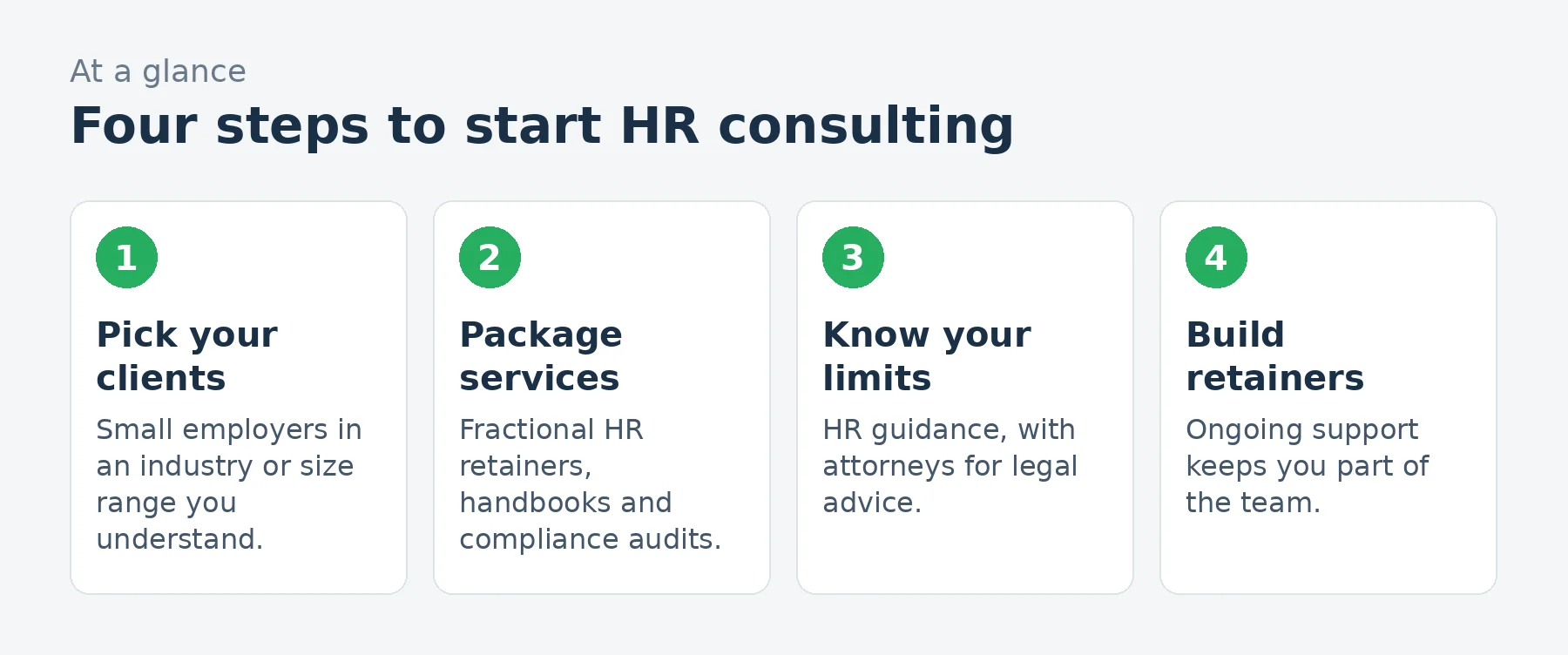
An HR consulting business at a glance
Table of Contents
| Topic | What to expect |
|---|---|
| Startup cost | Low: a computer, HR resources and templates, insurance, a website and certifications |
| Key boundaries | Provide HR guidance, not legal advice; refer clients to employment attorneys for legal questions |
| Compliance areas | Wage and hour (FLSA), anti-discrimination (EEOC), I-9 verification, leave and state and local rules |
| How you charge | Monthly fractional HR retainers, projects (handbooks, audits) and hourly advice |
| Best for | Experienced HR professionals who like helping small business owners |
Who HR consulting suits
It suits experienced HR professionals who are organized, discreet and calm in difficult conversations, and who enjoy explaining rules in practical terms to busy owners.
Services to offer
- Fractional or outsourced HR: a set number of hours each month as the company’s HR resource.
- Employee handbooks and policies reviewed for federal, state and local rules.
- HR compliance audits: records, classifications, postings and processes.
- Hiring and onboarding: job descriptions, interview processes and I-9 procedures.
- Performance management and compensation structures.
- Workplace investigations of complaints.
- Training: harassment prevention, manager skills and onboarding.
- HR technology: selecting and setting up HR and payroll systems.
Key compliance areas
- Wage and hour: the Fair Labor Standards Act covers minimum wage, overtime, recordkeeping and exempt versus nonexempt classification; many states add stricter rules.
- Anti-discrimination: federal laws enforced by the EEOC apply to employers above certain employee counts, and many state laws cover smaller employers.
- Form I-9: every employer must verify identity and work eligibility for each new hire.
- Leave: federal FMLA for covered employers, plus state paid leave and sick leave laws.
- Worker classification: employees versus independent contractors.
Rules differ by state and city, so build a reference for each jurisdiction where your clients have employees.
HR advice vs legal advice
HR consultants guide policies, processes and best practices, but interpreting the law for a specific legal dispute, drafting legal documents as an attorney would or representing clients in claims can cross into the practice of law, which requires a license. Build relationships with employment attorneys, refer legal questions and disputes to them and say so in your contracts.
Certifications
Credentials such as SHRM-CP and SHRM-SCP and HR Certification Institute certifications (such as the PHR and SPHR) show knowledge and commitment, and many clients look for them. Continuing education keeps you current as laws change.
Proposals and statements of work
Every engagement should start with a written proposal and statement of work: the client’s goals, your approach, deliverables, timeline, what the client must provide, fees and payment terms. Clear scope prevents the most common consulting problem: work growing beyond what was agreed and paid for.
Pricing consulting work
Consultants charge in several ways: hourly for open-ended advice, fixed project fees for defined deliverables, monthly retainers for ongoing support and sometimes value-based fees tied to the size of the result. Fixed fees and retainers usually reward expertise better than hourly billing. Use our pricing calculator to check that your rates cover non-billable time such as sales and admin.
Insurance and confidentiality
Carry professional liability insurance, and confirm coverage for advice that might be connected to employment claims. HR consultants handle sensitive employee information, so protect files, limit access and include confidentiality terms in contracts.
Startup costs to plan for
| Item | What to budget for |
|---|---|
| HR resources | Compliance research services, templates, posters |
| Certifications | Exam fees and continuing education |
| Insurance | Professional liability |
| Software | Secure document storage, scheduling, accounting |
| Website | Services, credentials and case studies |
| Marketing | Networking with accountants, payroll firms, attorneys |
Use our startup cost calculator for your total.
A worked example: a solo HR consultant
These are illustrative assumptions for an established solo HR consultant, not predictions.
| Assumption | Monthly | |
|---|---|---|
| Fractional HR retainers | 6 clients at $1,800 | $10,800 |
| Projects | Handbooks, audits and investigations | $4,500 |
| Training workshops | $1,200 | |
| Revenue | $16,500 | |
| HR resources and software | $(300) | |
| Insurance | Professional liability | $(200) |
| Certifications and continuing education | $(100) | |
| Marketing, legal and accounting | $(700) | |
| Profit before owner pay and taxes | $15,200 |
That leaves about $15,200 a month before the consultant’s pay and taxes, on about $16,500 of revenue. Retainers with growing employers are the backbone, and they often lead to projects.
Loading the calculator…
A compliance audit process
- Review personnel files, I-9s and required postings.
- Check worker classifications and overtime practices.
- Review the handbook and key policies against current law.
- Assess hiring, onboarding and termination processes.
- Report findings by risk, with a prioritized action plan.
Finding clients
- Accountants and payroll providers, who see HR problems first.
- Employment attorneys, who refer compliance projects.
- Growing companies hiring their first employees or crossing size thresholds.
- Industry associations for restaurants, healthcare, construction and nonprofits.
- Workshops on hiring, handbooks and new laws.
Staying current
Employment law changes frequently at federal, state and local levels. Follow agency updates (Department of Labor, EEOC, state labor departments), attend HR briefings and update client handbooks when laws change; update reviews can be a recurring service.
Handbook reviews and updates
Laws on leave, pay transparency, background checks and other topics change often at state and local levels. Annual handbook reviews and update notices are a natural recurring service, and they help clients stay current without searching for changes themselves.
Terminations and offboarding
Terminations carry risk. Help clients document performance issues, follow consistent procedures, meet final paycheck rules in their state and handle offboarding respectfully. Encourage clients to consult employment attorneys before high-risk terminations.
Multi-state and remote employers
Remote work means many small companies have employees in several states, each with its own wage, leave and posting rules. Helping clients understand and track multi-state obligations is increasingly valuable.
PEOs and HR technology
Some small businesses use a professional employer organization (PEO) or an HR and payroll platform. Advising on whether these fit, and helping set them up, complements consulting rather than competing with it.
Training as a service
Many states require harassment prevention training for employees and supervisors, and managers everywhere benefit from training on hiring, feedback and documentation. Packaged training sessions, in person or online, are easy to sell and repeat.
Pricing retainers by company size
Price fractional HR retainers by employee count and expected hours, with clear limits on included hours and rates for extra work such as investigations. Review retainers when clients grow, since larger teams need more support.
Common mistakes to avoid
- Giving legal advice instead of referring to an attorney.
- Using generic handbooks that ignore state law.
- Weak protection of confidential employee information.
- Unlimited support in fixed retainers.
- Falling behind on law changes.
Your first 90 days
- Days 1-30: choose your client focus, define retainers and projects and buy insurance.
- Days 31-60: build compliance checklists and templates and meet accountants, payroll firms and employment attorneys.
- Days 61-90: land first audit and handbook projects and convert them to retainers.
Frequently asked questions
Do I need a license to be an HR consultant?
No specific license is generally required, but you cannot give legal advice without being a licensed attorney.
What certifications help HR consultants?
SHRM-CP and SHRM-SCP, and HR Certification Institute credentials such as the PHR and SPHR.
What is fractional HR?
Part-time HR support for a set number of hours each month, acting as the company’s HR resource.
What HR laws matter most for small businesses?
Wage and hour rules, anti-discrimination laws, I-9 verification, leave laws and worker classification, plus state and local rules.
How do HR consultants charge?
Monthly retainers for ongoing support, fixed fees for projects such as handbooks and audits, and hourly advice.
Can HR consultants handle investigations?
Many conduct workplace investigations, often coordinating with the client’s employment attorney.
Can I write employee handbooks for clients?
Yes, as HR guidance, but have clients’ employment attorneys review handbooks for legal compliance, especially in states with complex rules.
Do HR consultants need insurance?
Professional liability insurance is important, since advice may be connected to employment claims.
How many clients can a fractional HR consultant handle?
It depends on client size and hours; many solo consultants serve several retainer clients plus occasional projects.
What is the difference between an HR consultant and a PEO?
An HR consultant advises and supports the employer’s own HR; a PEO enters a co-employment arrangement and handles payroll, benefits and some HR functions.
Keep learning
- HR consulting industry data
- How to start a business consulting firm
- How to start a payroll service
- Pricing calculator
Sources
- US Bureau of Labor Statistics, Human resources specialists
- U.S. Department of Labor, Fair Labor Standards Act (wages, overtime and tips)
- U.S. Equal Employment Opportunity Commission, Small business resources
- USCIS, Form I-9 employment eligibility verification
- SHRM, SHRM-CP and SHRM-SCP certification
Last reviewed November 3, 2026. Startup costs are estimates; check local prices, licensing and tax rules before you commit money.

