
Businesses hire consultants for expertise they don’t have in-house: strategy, marketing, operations, technology, compliance and more. BLS doesn’t track "consultants" as one occupation, but related roles show the landscape: market research analysts and marketing specialists held about 941,700 jobs in 2024, with a median wage of $76,950 and 7% projected growth, and business operations specialists earned a median of $80,410 in May 2024. Below is the key industry data on consulting businesses, with costs, business models and a first-year projection.
Consulting is easy to start and hard to scale. Independent consultants keep most of what they earn; firms grow by hiring consultants and winning larger engagements.
The workforce
| Occupation | Jobs (2024) | Median pay (May 2024) | Projected growth, 2024 to 2034 |
|---|---|---|---|
| Market research analysts and marketing specialists (related role) | about 941,700 | $76,950 | +7% |
| Business operations specialists (group median) | n/a | $80,410 | n/a |
Source: U.S. Bureau of Labor Statistics, Occupational Outlook Handbook.
Business models compared
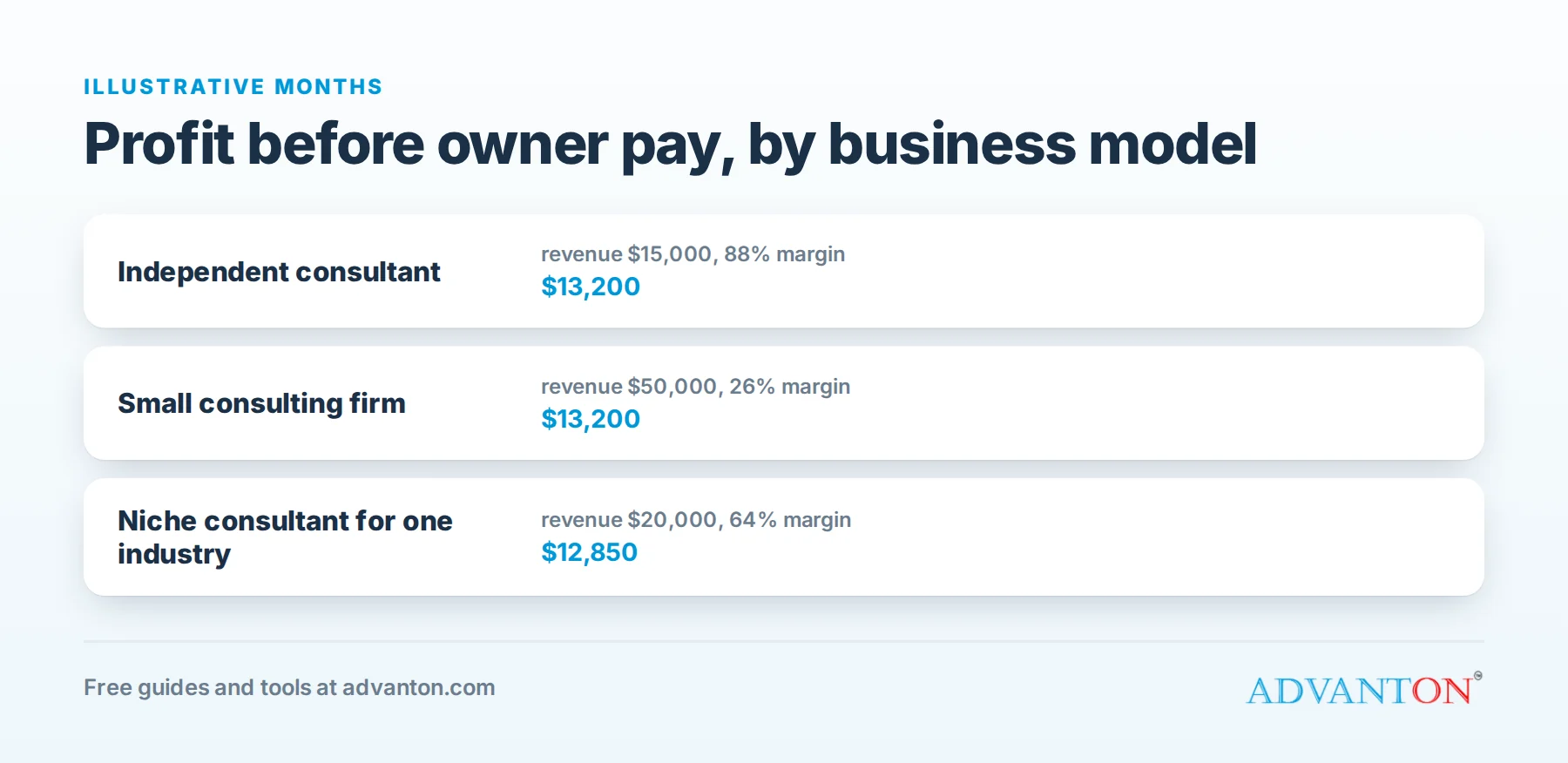
The figures below are illustrative months from our step-by-step guides, not industry averages. They show how revenue and costs typically fit together; your market, prices and costs will differ.
| Business model | Startup costs | Example monthly revenue | Costs | Profit before owner pay | Margin |
|---|---|---|---|---|---|
| Independent consultant | Low: expertise, website, insurance | $15,000 | $1,800 | $13,200 | 88% |
| Small consulting firm (3 consultants) | Moderate: consultants, sales, office | $50,000 | $36,800 | $13,200 | 26% |
| Niche consultant for one industry (e.g. contractors) | Low: industry expertise, case studies | $20,000 | $7,150 | $12,850 | 64% |
Fixed and variable costs
For projections, the most useful split is between variable costs, which rise and fall with sales (materials, parts, hourly labor), and fixed costs, which you pay every month regardless (rent, salaried staff, insurance, loan payments).
| Business model | Variable costs (% of revenue) | Fixed costs per month | What it means |
|---|---|---|---|
| Independent consultant | 3.3% | $1,300 | Low costs overall: time is the main constraint |
| Small consulting firm (3 consultants) | 5.0% | $34,300 | Mostly fixed: slow start-up months are expensive |
| Niche consultant for one industry (e.g. contractors) | 4.0% | $6,350 | Low costs overall: time is the main constraint |
What the numbers say
Independent consultants have very low overhead, so margins are high.
Firms add salaries before engagements grow, creating long ramps.
Niche consultants win referrals faster by specializing in one industry.
The three models in brief
Independent consultant. One expert working with a few clients at a time.
Small consulting firm. Several consultants handling larger projects.
Niche industry consultant. Specialized expertise, for example helping contractors with operations or marketing.
Cost structure: small consulting firm (3 consultants)
Each cost as a share of the example month’s revenue ($50,000):
| Cost | Monthly amount | Share of revenue | Type |
|---|---|---|---|
| Consultants | $24,000 | 48.0% | Fixed |
| Payroll taxes and benefits | $4,000 | 8.0% | Fixed |
| Office | $2,500 | 5.0% | Fixed |
| Travel | $2,500 | 5.0% | Variable |
| Marketing | $2,500 | 5.0% | Fixed |
| Software | $800 | 1.6% | Fixed |
| Insurance | $500 | 1.0% | Fixed |
| Profit before owner pay | $13,200 | 26% |
A first-year projection: small consulting firm (3 consultants)
New businesses rarely start at full speed. This projection assumes revenue ramps from 35% of the example month in month 1 to 100% by month 12, variable costs move with revenue, and fixed costs stay the same every month. It’s a planning illustration, not a forecast.
| Month | Revenue | Variable costs | Fixed costs | Profit | Cumulative |
|---|---|---|---|---|---|
| 1 | $17,500 | $875 | $34,300 | -$17,675 | -$17,675 |
| 2 | $22,500 | $1,125 | $34,300 | -$12,925 | -$30,600 |
| 3 | $27,500 | $1,375 | $34,300 | -$8,175 | -$38,775 |
| 4 | $31,000 | $1,550 | $34,300 | -$4,850 | -$43,625 |
| 5 | $35,000 | $1,750 | $34,300 | -$1,050 | -$44,675 |
| 6 | $38,000 | $1,900 | $34,300 | $1,800 | -$42,875 |
| 7 | $41,000 | $2,050 | $34,300 | $4,650 | -$38,225 |
| 8 | $43,500 | $2,175 | $34,300 | $7,025 | -$31,200 |
| 9 | $45,500 | $2,275 | $34,300 | $8,925 | -$22,275 |
| 10 | $47,500 | $2,375 | $34,300 | $10,825 | -$11,450 |
| 11 | $49,000 | $2,450 | $34,300 | $12,250 | $800 |
| 12 | $50,000 | $2,500 | $34,300 | $13,200 | $14,000 |
Year one: revenue $448,000, profit before owner pay $14,000. The first profitable month is month 6. Cumulative results bottom out at -$44,675, which is the minimum cash cushion this plan would need, before any startup costs.
Consultant salaries come before engagements fill, so this firm illustration turns profitable in month 6, with a cumulative low of about $44,700. Many firms start with the founder’s own client base.
How consultants charge
- Project fees for defined scopes.
- Monthly retainers.
- Hourly or daily rates.
- Value-based fees tied to outcomes, used carefully.
A startup checklist for consulting businesses
- Define your niche and the problems you solve.
- Write clear proposals and contracts.
- Buy professional liability insurance.
- Build case studies with measurable results.
- Check licensing if your field is regulated.
Where the opportunities are
- Small business operations and growth.
- Technology adoption and AI tools.
- Compliance and regulation.
- Industry-specific expertise.
Key terms
| Term | Meaning |
|---|---|
| Engagement | A consulting project with a client |
| Retainer | Ongoing monthly fee for advice |
| Scope | What the engagement includes |
| Utilization | Share of time spent on billable work |
Results win referrals
Clients refer consultants who deliver measurable results. Define success at the start and report on it.
Marketing a consulting business
Referrals, speaking, writing, networking and case studies bring most clients.
Protect your time
Clear scopes and change processes prevent unpaid extra work.
How to use these numbers for your own plan
- Start with the closest model above and its cost structure.
- Replace every price and cost with local quotes: insurance, wages, vehicles, materials and your expected prices.
- Estimate your ramp: how many jobs you can realistically win each month in year one.
- Separate fixed and variable costs, then calculate your break-even point with our free break-even calculator.
- Map cash month by month with our cash flow forecast, including equipment and loan payments.
- Build the plan in our free Business Planner.
These figures will also feed a planned Advanton projection tool, so you’ll be able to start from an industry template and adjust it to your situation.
About this data
Workforce figures come from the U.S. Bureau of Labor Statistics (Occupational Outlook Handbook and Occupational Employment and Wage Statistics, May 2024 and the 2024 to 2034 projections). Market figures cite their sources in the list above. Business model figures are illustrative months built from typical prices and costs to show how revenue, fixed costs and variable costs fit together; they are not industry averages or guarantees. We review these profiles when new government data is released, at least once a year. The same figures are available in a structured format for Advanton’s upcoming business projection tool.
Licensing and rules
No general license for consultants, but regulated fields (accounting, legal, financial, engineering) require licenses; clear contracts; professional liability insurance. Requirements change; confirm with your state and local agencies before you start.
Frequently asked questions about consulting businesses
Do consultants need a license?
Only in regulated fields such as accounting, law, engineering or financial advice.
How do consultants charge?
Project fees, retainers, hourly rates or value-based fees.
Is consulting profitable?
Independent consulting can be very profitable; firms take longer to scale.
How can I use these numbers?
Start with the closest consulting model, then replace every figure with your local prices, wages and expected volume.
Keep learning
- Independent consultant
- Local SEO for contractors
- How to get more contractor leads
- Specialty trades industry data
Sources
Last reviewed October 30, 2026. Startup costs are estimates; check local prices, licensing and tax rules before you commit money.
In India
Small businesses like this in India
In MoSPI’s survey of unincorporated businesses (proprietorships, partnerships and similar firms), this falls under Professional, scientific and technical services. In 2023-24 India had 6.9 lakh such establishments employing 14.3 lakh workers, and 67.2% were run without hired workers. Across the wider other services group, the number of establishments grew 10.29% between 2023-24 and 2025.
| Urban | Rural | All India | |
|---|---|---|---|
| Value added per business a year | ₹5,92,712 | ₹2,37,366 | ₹5,07,055 |
| Value added per worker a year | ₹2,63,104 | ₹1,67,511 | ₹2,47,186 |
| Pay per hired worker a year | ₹1,87,936 | ₹1,04,059 | ₹1,82,391 |
Running it alone or with staff: businesses with no hired workers added about ₹2,50,602 a year on average, while those with hired workers added about ₹10,44,736 (all India).
Where these businesses are: the states with the most small other services businesses are West Bengal (13.1%), Uttar Pradesh (11.6%), Maharashtra (8.8%), Tamil Nadu (6.2%), Gujarat (6.0%) of the national total (2023-24).
Value added is what a business produces minus what it spends on materials and other inputs, before paying its workers and owner, so it’s a rough guide to the income a typical small business generates. These figures cover the whole activity, which can be broader than this one business type. Across all small businesses, average fixed assets such as equipment, furniture and vehicles were ₹3,42,242 per establishment in 2025.
Licences and registrations to expect
- Registration under your state’s Shops and Establishments Act if you have premises or employees.
- A trade licence from your municipal corporation or council for many shop and service businesses.
- GST registration once turnover crosses ₹40 lakh for goods or ₹20 lakh for services (lower in some special category states), or earlier if you sell goods to other states or through e-commerce marketplaces.
- Professional tax registration in states that levy it.
- Free Udyam (MSME) registration, which helps with loans, government schemes and delayed-payment protection.
Rules differ by state and city. Check with your municipal corporation, state departments and a chartered accountant before you start.
Run a business like this in India? List it free in the India Business Directory, with your hours, deals and GST registration.
Free tools for India: Make a GST invoice · Compare business credit cards
Build a market report for Consulting Businesses in India Pick your state and see market size, earnings, competition and licences, from official data. Free, with a PDF download.
Sources: MoSPI, Annual Survey of Unincorporated Sector Enterprises (ASUSE) 2023-24, full report, Appendix A Tables 4, 29, 33, 35 and 37 (survey period October 2023 to September 2024); MoSPI, Annual Survey of Unincorporated Sector Enterprises (ASUSE) 2025, factsheet (survey period January to December 2025, released 24 March 2026). Licensing summary by Advanton, checked November 2026.