
A coffee shop serves espresso drinks, brewed coffee, tea and food in a space people enjoy visiting, or through a drive-thru or walk-up window for people on the move. Independent shops compete with chains on quality, atmosphere, local character and service.
Demand is strong. According to the National Coffee Association’s 2026 Fall report, 66% of American adults drank coffee in the past day, more than any other beverage. Specialty coffee hit a record, with 48% having it in the past day, and 38% of past-day coffee drinkers had coffee prepared away from home, the highest share since January 2020. Espresso drinks are growing fastest: 47% of adults had one in the past week, up 17.5% since 2022. Margins on coffee itself are healthy, but rent, labor and slow hours can sink a shop, so this guide covers location, permits, equipment, menu pricing, a worked example and how to build regulars.
A coffee shop at a glance
Table of Contents
| Topic | What to expect |
|---|---|
| Startup cost | Moderate to high: lease and build-out, espresso machine and grinders, refrigeration, furniture, point-of-sale and opening inventory |
| Licenses | Business license, health department food permit, building and fire inspections, sign permits |
| Demand in 2026 | 66% of adults drank coffee in the past day; specialty at a record 48%; out-of-home coffee highest since 2020 (NCA) |
| Biggest costs | Rent, labor and milk, cups and food; coffee beans are a smaller share than many expect |
| Best for | Hospitality-driven owners who love coffee and can manage staff, costs and early mornings |
Who a coffee shop suits
It suits people who love hospitality and can manage the business side: hiring and scheduling staff, controlling costs and opening early every day. Barista experience helps enormously before investing.
The Bureau of Labor Statistics reports a median pay of $65,310 for food service managers (May 2024), with about 352,800 jobs and 6% projected growth over the decade.
Choosing a location
Most coffee is bought in the morning, so look for morning traffic: commuter routes, office areas, hospitals, campuses, gyms and busy neighborhood corners. The NCA found 55% of out-of-home coffee buyers in the past week ordered at a drive-thru, so a drive-thru or walk-up window can transform sales in car-oriented areas. Check visibility, parking, competition, rent and whether the space already has plumbing, grease and electrical capacity for a café.
Permits and build-out
You will need a health department permit (most states base their rules on the FDA Food Code), a business license, building permits for renovations, fire inspections and sign permits. Health departments review plans for sinks (hand sinks, a three-compartment sink and a mop sink), surfaces, refrigeration and storage. Build-out costs (plumbing, electrical, counters, flooring) are often the biggest surprise, so get contractor estimates before signing a lease.
Equipment
- Espresso machine: commercial two- or three-group machine sized for your volume.
- Grinders: separate espresso and brewed-coffee grinders.
- Brewing: batch brewer and pour-over station if offered.
- Water filtration: protects the machine and the taste.
- Refrigeration: under-counter fridges for milk, a display case for food.
- Ice machine, blenders and dishwasher.
- Point-of-sale system with online and app ordering.
Leasing or financing equipment preserves cash; buy quality, because breakdowns during the morning rush cost far more than repairs.
Startup costs to plan for
| Item | What to budget for |
|---|---|
| Lease and build-out | Deposits, renovations, plumbing and electrical |
| Equipment | Espresso machine, grinders, brewers, refrigeration, ice machine |
| Furniture and decor | Seating, counters, signage |
| Permits and fees | Health, building, fire, signs |
| Opening inventory | Coffee, milk, syrups, cups, food |
| Working capital | Several months of rent and payroll while sales build |
Use our startup cost calculator for your total.
Costing and pricing your menu
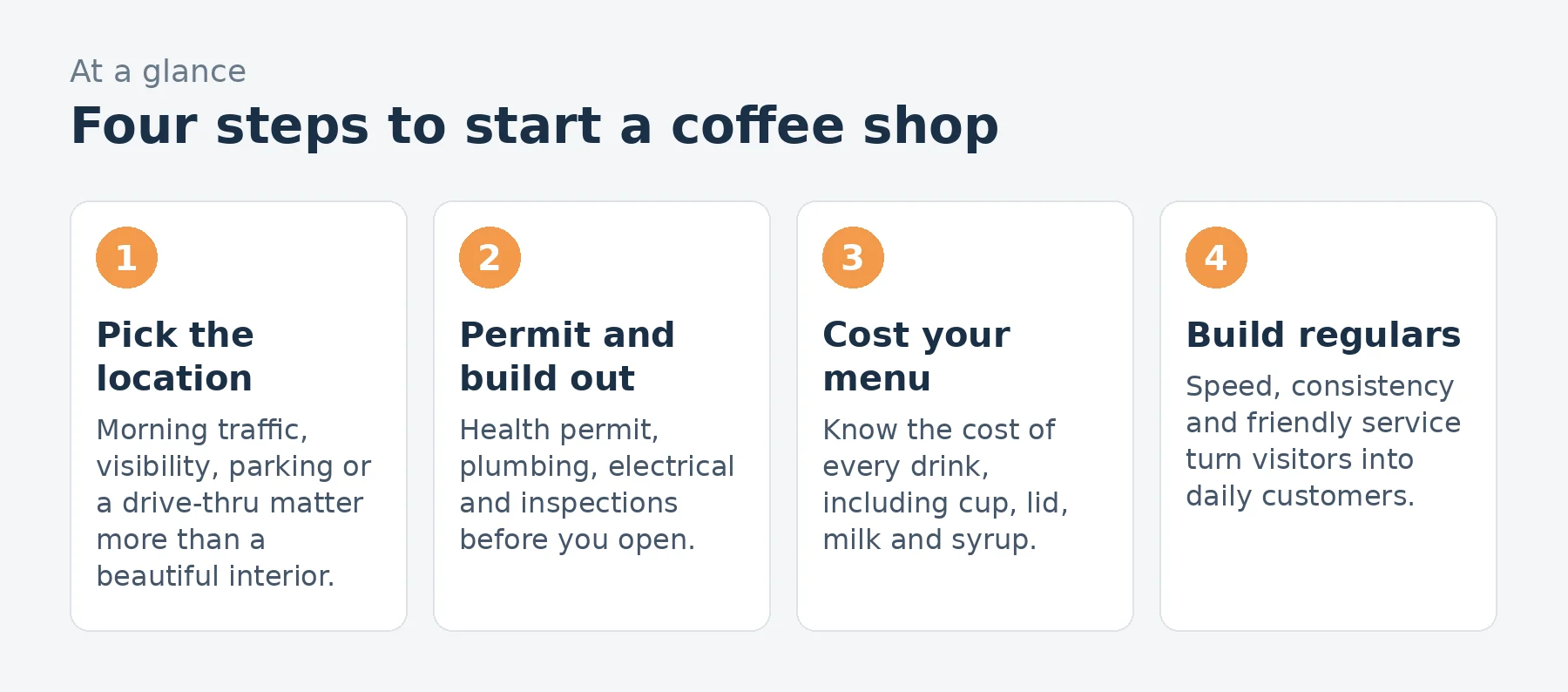
Calculate the cost of every drink: espresso, milk (often the most expensive ingredient), syrups, cup, lid, sleeve and straw. Many shops aim for drink costs well under a third of the price, with food and retail adding sales per customer. Research nearby prices, then price for your quality and setting. The NCA’s Spring 2026 data shows lattes, espresso and cappuccinos as the most popular out-of-home drinks, so get those exactly right.
Use our pricing calculator to check each item’s margin.
A worked example: a small independent shop
These are illustrative assumptions for a small independent shop, not predictions.
| Assumption | Monthly | |
|---|---|---|
| Drink sales | 230 drinks a day, 30 days, $5.75 average | $39,675 |
| Food and retail | Pastries, breakfast items and bags of beans | $7,200 |
| Revenue | $46,875 | |
| Cost of goods | Coffee, milk, syrups, cups and food, about 30% | $(14,060) |
| Labor | Baristas and a shift lead, with payroll costs | $(14,500) |
| Rent and common charges | $(4,500) | |
| Utilities and internet | $(1,100) | |
| Card fees, software and apps | $(1,400) | |
| Equipment loan and maintenance | $(1,200) | |
| Insurance, marketing and supplies | $(1,300) | |
| Profit before owner pay and taxes | $8,815 |
That leaves about $8,815 a month before the owner’s pay and taxes, on about $46,875 of revenue. A shop selling 120 drinks a day instead of 230 would likely lose money, which is why location and morning volume decide success.
Mobile ordering and speed
A record 40% of past-week out-of-home coffee buyers ordered on an app, according to the NCA. Offer online and app ordering through your point-of-sale system, with a clear pickup area, so regulars can skip the line. Design your bar workflow for speed: grinders, machine, milk and cups within reach, and staff positioned for the morning rush.
Building regulars
- Consistent drinks, every time, from every barista.
- Learn regulars’ names and orders.
- A simple loyalty program, such as our free rewards program tool.
- Local partnerships with offices, gyms and events.
- Community: art, music, meeting space and local suppliers.
Hiring and training baristas
Your baristas are your brand. Hire for attitude and reliability, then train skills: dialing in espresso each morning, steaming milk properly, building drinks to standard recipes and keeping the bar clean during a rush. Use written recipes and short training checklists, taste drinks with new staff until they are consistent, and schedule experienced baristas for the busiest hours. Fair pay, predictable schedules and a share of tips help keep good people.
A simple food program
Food raises the average ticket and brings in customers at lunch. Start simple: pastries and breakfast items from a local bakery, plus a few items you can heat or assemble quickly. Cooking on site adds equipment, permits and labor, so many shops begin with baked goods from partners and expand only when demand is clear.
Making slow hours work
Afternoons are often quiet. Fill them with cold drinks and seasonal specials, happy-hour pricing, study and remote-work seating, small events, or catering and office deliveries. Schedule fewer staff during slow periods, and use the time for prep, cleaning and training.
Choosing coffee and a roaster partner
Most new shops buy from a local or regional roaster rather than roasting themselves. A good roaster partner provides consistent coffee, training, help dialing in your espresso, equipment advice and sometimes co-marketing. Taste several roasters’ coffees as espresso and drip, compare price per pound and delivery schedules, and ask other cafés about their service. Some shops feature a house roaster plus rotating guest coffees to keep regulars interested.
Common mistakes to avoid
- Choosing a beautiful space with weak morning traffic.
- Underestimating build-out costs.
- Not costing drinks, especially milk and cups.
- Overstaffing slow afternoons.
- Too large a menu that slows service.
Your first 90 days
- Days 1-30: study locations at 7 a.m., talk to the health department and get build-out estimates.
- Days 31-60: sign a lease, order equipment, design a focused menu and hire and train staff.
- Days 61-90: pass inspections, soft-open for friends and neighbors, then launch with app ordering and a loyalty program.
Frequently asked questions
How much does it cost to open a coffee shop?
It varies with build-out and equipment. A small shop in a space that already has plumbing costs far less than a full build-out. Use our startup cost calculator with real quotes.
Are coffee shops profitable?
They can be with strong morning volume and tight costs. The worked example shows how quickly rent and labor consume revenue at low volumes.
Do I need a drive-thru?
Not always, but the NCA found 55% of recent out-of-home coffee buyers used a drive-thru, so it matters in car-oriented areas.
What permits does a coffee shop need?
A health department permit, business license, building permits for renovations, fire inspections and sign permits.
Should I roast my own coffee?
Most new shops buy from a local roaster first. Roasting adds equipment, permits and skill; see our coffee roasting guide.
How many drinks does a coffee shop need to sell?
It depends on rent, labor and prices. Work out your monthly costs and divide by your average profit per customer to find a break-even number of sales per day.
What equipment matters most in a coffee shop?
The espresso machine, grinders and water filtration matter most for drink quality, followed by refrigeration and a fast point-of-sale with online ordering.
Keep learning
- Coffee and beverage industry data
- How to start a mobile coffee cart
- How to start a coffee roasting business
- Rewards program tool
Sources
- Beverage Industry, NCA 2026 National Coffee Data Trends Fall Report
- The Shelby Report, NCA 2026 Fall Report: specialty record, espresso drinks
- NACS, NCA specialty coffee consumption hits record high (drive-thru and app ordering)
- Vending Market Watch, NCA Spring 2026 report (top out-of-home drinks)
- US Bureau of Labor Statistics, Food service managers
- FDA, Food Code
Last reviewed November 2, 2026. Startup costs are estimates; check local prices, licensing and tax rules before you commit money.

