
A coffee roaster buys green (unroasted) coffee beans and roasts them for sale to cafés, restaurants, offices, grocery stores and online customers. Roasting combines craft and business: developing roast profiles that bring out each coffee’s character, and building steady wholesale and retail customers.
Specialty coffee is growing. The National Coffee Association’s 2026 Fall report found specialty coffee at a record 48% of adults in the past day, and noted that buying for home use is shifting across retail channels. Many roasters grow through wholesale accounts plus online subscriptions. This guide covers equipment, green coffee, permits, packaging, sales channels, a worked example and a 90-day plan.
A coffee roasting business at a glance
Table of Contents
| Topic | What to expect |
|---|---|
| Startup cost | Moderate: a commercial roaster, ventilation, space, scales, packaging and green coffee inventory |
| Licenses | Business license, FDA food facility registration in most cases, health permits, and air quality or ventilation approvals in some areas |
| How you sell | Wholesale to cafés, restaurants and offices, plus retail bags, online sales and subscriptions |
| Demand | Specialty coffee at a record 48% of adults in the past day (NCA 2026) |
| Best for | Detail-oriented coffee lovers who enjoy craft, consistency and selling to businesses |
Who coffee roasting suits
It suits detail-oriented people with a good palate who enjoy repeatable craft and building relationships with businesses. Much of the work is consistency: every batch should taste the same, week after week.
Roasting businesses often sell to cafés; the Bureau of Labor Statistics reports a median pay of $65,310 for food service managers (May 2024), a reference point for the food business side.
Learning to roast
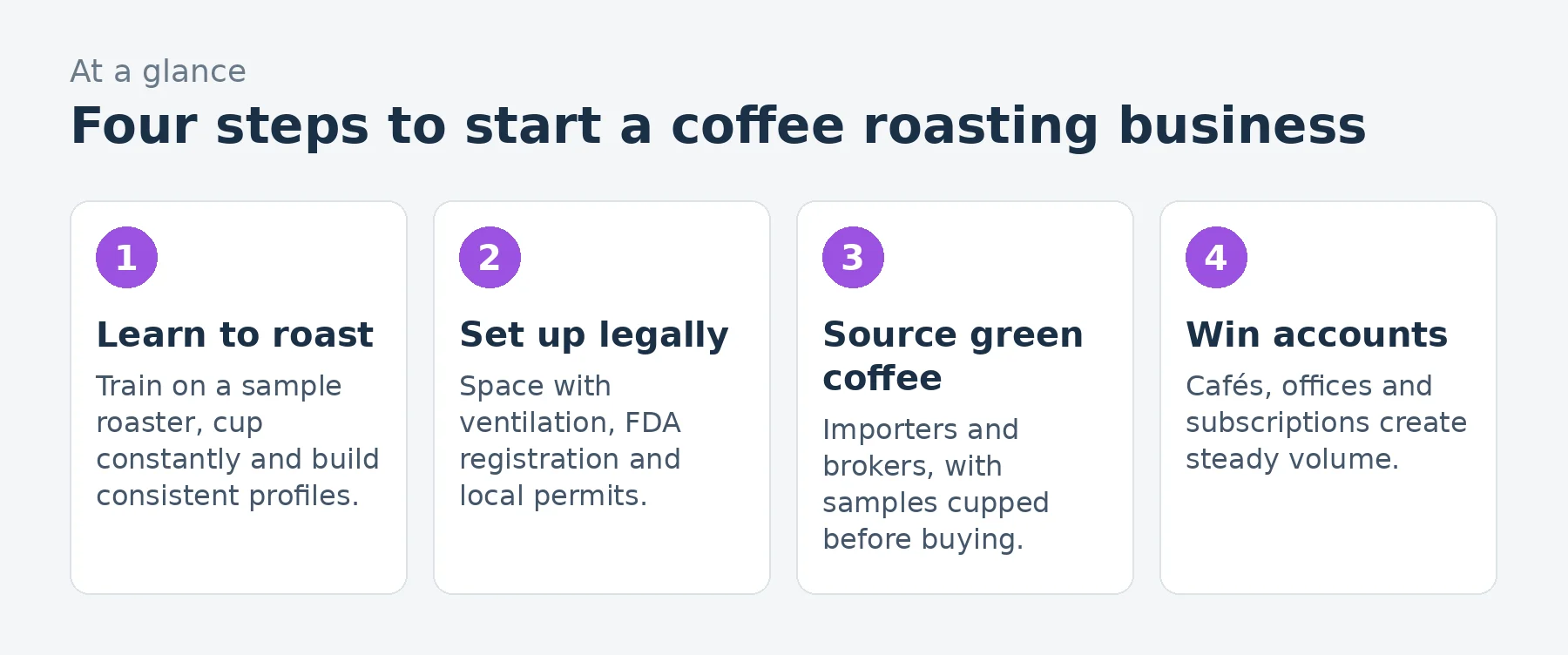
Take roasting classes, work with an established roaster or practice on a small sample roaster before buying production equipment. Learn to cup (taste coffees systematically), track every roast with software or logs and build profiles for each coffee. Start with a small, well-chosen lineup rather than many origins.
Equipment and space
- Roaster: sized for your volume; many start with a small production roaster and upgrade as wholesale grows.
- Ventilation and exhaust: roasting creates smoke and chaff; some areas require afterburners or other emission controls.
- Scales, bins and a bag sealer.
- Grinder for wholesale clients who want ground coffee.
- Cupping equipment for quality control.
- Storage for green coffee in a cool, dry place.
Choose space zoned for light manufacturing or food production, with the electrical or gas supply your roaster needs. Some roasters start in shared roasting facilities that rent time on equipment.
Permits and regulations
Facilities that manufacture or process food for sale in the U.S. generally must register with the FDA, with some exemptions for retail food establishments that sell mainly to consumers. You will also need local health permits, and your city or regional air agency may regulate roaster emissions, especially for larger machines. Label retail bags with the product name, net weight and your business name and address.
Sourcing green coffee
Buy from green coffee importers and brokers who offer samples, small-lot options and information about origin, processing and certifications. Cup samples before buying, buy enough to keep your core blends consistent and track prices: green coffee is a world commodity, and costs can change quickly with harvests and markets. Roasting loses weight (often around 15% to 20% as moisture cooks off), so plan purchases accordingly.
Startup costs to plan for
| Item | What to budget for |
|---|---|
| Roaster | Sample roaster for learning, production roaster for sales |
| Ventilation | Exhaust and any required emission controls |
| Space | Lease and electrical or gas upgrades |
| Green coffee | Opening inventory and samples |
| Packaging | Valve bags, labels, sealer |
| Permits and insurance | FDA, health, air permits, product liability |
Use our startup cost calculator for your total.
Pricing and sales channels
- Wholesale: cafés, restaurants, offices and grocers buy by the pound, with training and equipment support often expected.
- Retail bags: at markets, local shops and your own website.
- Subscriptions: monthly deliveries create predictable revenue.
- Private label and corporate gifts: custom blends for businesses.
Price from your cost per roasted pound (green coffee after weight loss, labor, packaging and overhead), then check local and online competitors. Wholesale prices are lower per pound but move more volume.
A worked example: a small roaster
These are illustrative assumptions for a small roaster selling about 1,200 pounds a month, not predictions.
| Assumption | Monthly | |
|---|---|---|
| Wholesale coffee | 800 pounds at $12 a pound | $9,600 |
| Retail and online bags | 400 pounds sold as 12-ounce bags, about $22 a pound equivalent | $8,800 |
| Revenue | $18,400 | |
| Green coffee | About 1,450 pounds of green coffee (roasting loses weight) at $6 | $(8,700) |
| Packaging and labels | $(1,300) | |
| Rent and utilities | Small production space | $(2,200) |
| Part-time help | Packing and deliveries | $(1,600) |
| Shipping and online fees | $(900) | |
| Insurance, software and marketing | $(700) | |
| Profit before owner pay and taxes | $3,000 |
That leaves about $3,000 a month before the owner’s pay and taxes, on about $18,400 of revenue. Green coffee prices can swing sharply with world markets, so watch costs closely and adjust prices when needed. The green coffee price in this example is an assumption, not a market quote.
Winning wholesale accounts
Cafés want consistency, reliable delivery and support. Offer cupping sessions, barista training, help dialing in recipes and responsive service. Start with a few accounts you can serve well, and use their success as references. Offices and restaurants often value convenience and consistency over rare origins.
Packaging and freshness
Roasted coffee loses aroma over time, so packaging matters. Use bags with one-way degassing valves, seal them well and print a roast date on every bag. Many specialty roasters encourage customers to use coffee within several weeks of roasting. Plan production around orders so customers receive fresh coffee, and keep labels clear about origin, roast level and tasting notes.
Quality control
Cup every batch or every production day, compare against your target profile and keep notes. Consistency is what keeps wholesale accounts. Track roast data, green coffee lot numbers and customer feedback so you can trace and fix problems quickly.
Building subscriptions
Subscriptions give roasters predictable revenue and steady production planning. Offer flexible frequencies, easy pausing and a small discount for subscribers, and include brewing tips and origin stories. Follow automatic renewal laws in your state: clear terms and easy cancellation.
Selling at markets and online
Farmers markets and local shops let customers taste your coffee and meet you, which builds loyalty. Online, a simple store with clear coffee descriptions, roast dates, brewing guides and fast shipping can grow steadily. Offer sampler packs to help new customers choose, and collect emails to announce new coffees and limited releases.
Certifications and sourcing stories
Some customers look for certified coffees (organic, Fair Trade and others) or direct-trade relationships with farms. Certifications can add cost and paperwork; organic handling, for example, requires certification of your facility if you label products organic. Whatever you choose, describe sourcing honestly and specifically, because customers increasingly value transparency about where coffee comes from.
Common mistakes to avoid
- Buying a large roaster before you have customers.
- Ignoring ventilation and air permits.
- Offering too many coffees too soon.
- Pricing without accounting for roast weight loss.
- Inconsistent roasts that lose wholesale clients.
Your first 90 days
- Days 1-30: take roasting training, practice on a sample roaster and research space, permits and FDA registration.
- Days 31-60: secure space or a shared roastery, source green coffee, develop three core coffees and design packaging.
- Days 61-90: launch online and at a farmers market, and pitch five local cafés and offices.
Frequently asked questions
Do coffee roasters need to register with the FDA?
Most facilities that manufacture or process food for sale must register with the FDA, with exemptions for some retail food establishments. Check your situation.
How much coffee weight is lost in roasting?
Often around 15% to 20%, as moisture is driven out. Plan purchases and pricing accordingly.
Can I roast coffee at home to sell?
Some states allow limited home-based food businesses, but roasted coffee is not always included. Most commercial roasters use permitted production space.
Where do roasters buy green coffee?
From green coffee importers and brokers, which offer samples and small lots.
Should I start with wholesale or retail?
Many roasters do both: wholesale for volume, retail and subscriptions for higher margins.
How do I keep roasted coffee fresh?
Package it in valve bags soon after roasting, print the roast date and plan production so customers receive coffee within a few weeks.
Do I need organic certification to sell organic coffee?
If you label roasted coffee as organic, your roasting facility generally needs organic certification under USDA rules, in addition to buying certified green coffee.
What size roaster should I start with?
Many start with a small production roaster sized for a few hundred to a few thousand pounds a month, or rent time at a shared roastery, then upgrade when wholesale demand grows.
How do I price wholesale coffee?
Start from your cost per roasted pound, including weight loss, packaging, labor and overhead, then compare with local roasters’ wholesale prices and include the support you offer.
Keep learning
- Coffee and beverage industry data
- How to start a coffee shop
- How to start a beverage brand
- Startup cost calculator
Sources
- FDA, Registration of food facilities
- Beverage Industry, NCA 2026 National Coffee Data Trends Fall Report
- The Shelby Report, NCA 2026 Fall Report: specialty record, espresso drinks
- US Bureau of Labor Statistics, Food service managers
- US EPA, Air permits
Last reviewed November 2, 2026. Startup costs are estimates; check local prices, licensing and tax rules before you commit money.

