
Kitchens and bathrooms are the most popular home remodeling projects, and among the most valuable for homeowners. A kitchen and bath remodeling business manages the whole job: design, demolition, plumbing and electrical changes, cabinets, countertops, tile, fixtures and finishes, coordinating several trades into one smooth project.
It’s a business of project management as much as craftsmanship. Homeowners judge you on clear designs and prices, a realistic schedule, clean and respectful crews, and how you handle surprises behind the walls. You’ll also need the right licenses and permits, licensed subcontractors for regulated trades, and lead-safe and asbestos precautions in older homes.
A kitchen and bath remodeling business at a glance
Table of Contents
| Topic | What to expect |
|---|---|
| Startup cost | Moderate: tools, truck, design software, insurance, licensing and working capital |
| Key rules | Contractor licensing, permits and inspections, licensed trades, EPA RRP, asbestos caution, contract and lien rules |
| Revenue model | Fixed-price or cost-plus projects, often with a design fee |
| How you earn | Full remodels, bath conversions, updates and accessibility modifications |
| Best for | Experienced tradespeople or managers who can lead projects and communicate well |
Who kitchen and bath remodeling suits
It suits experienced carpenters, tradespeople or construction managers who can estimate accurately, coordinate subcontractors and keep homeowners informed. Many owners start as lead carpenters or project managers for established remodelers. Design skills help, but you can also partner with designers.
Choose your model
- Design-build: you design and build, charging a design fee and controlling the whole process.
- Build-only: you build projects designed by kitchen designers, architects or homeowners.
- Specialist: bathroom conversions (tub to shower), accessibility remodels, or cabinet refacing.
- Trade partner: working for larger remodelers or showrooms as an installer.
Licensing, permits and licensed trades
Check contractor licensing with your state and city: many states license general or specialty contractors, some require registration for home improvement work, and others license above a project value. Most cities require a business license, and many projects need a building permit and inspections. Carry general liability and commercial auto insurance, get workers’ compensation once you hire (some states require it even for small crews), and put scope, price, schedule, payment terms and change-order rules in a written contract. Many states require specific contract terms and a right to cancel for home improvement contracts signed at a customer’s home, under state law and the FTC’s Cooling-Off Rule.
Kitchen and bath work usually needs building permits, with separate permits for plumbing, electrical and sometimes gas and mechanical work. In most states, plumbing and electrical work must be done by licensed plumbers and electricians; hire licensed subcontractors and make sure inspections are passed before closing walls.
Lead-safe and asbestos rules
In homes built before 1978, renovation that disturbs painted surfaces is covered by the EPA’s Renovation, Repair and Painting (RRP) rule: your firm must be EPA-certified (or certified by an authorized state program), work must be supervised by a certified renovator, and you must follow lead-safe practices and give homeowners the required pamphlet.
Older homes may also contain asbestos in vinyl flooring and adhesives, drywall joint compound, textured ceilings, pipe insulation and other materials. Have suspect materials tested before demolition, and use licensed asbestos professionals where required by your state.
Water damage, mold and surprises
Opening up kitchens and bathrooms often reveals rot, leaks, mold, outdated wiring or framing problems. Explain in your contract how hidden conditions will be handled and priced, include an allowance or contingency, document findings with photos, and get written approval before extra work.
Training and certification
The National Kitchen and Bath Association (NKBA) offers education and certifications for kitchen and bath designers and professionals. Manufacturer training on cabinets, waterproofing systems and fixtures also helps, as does RRP certification for older homes.
Contracts, change orders and liens
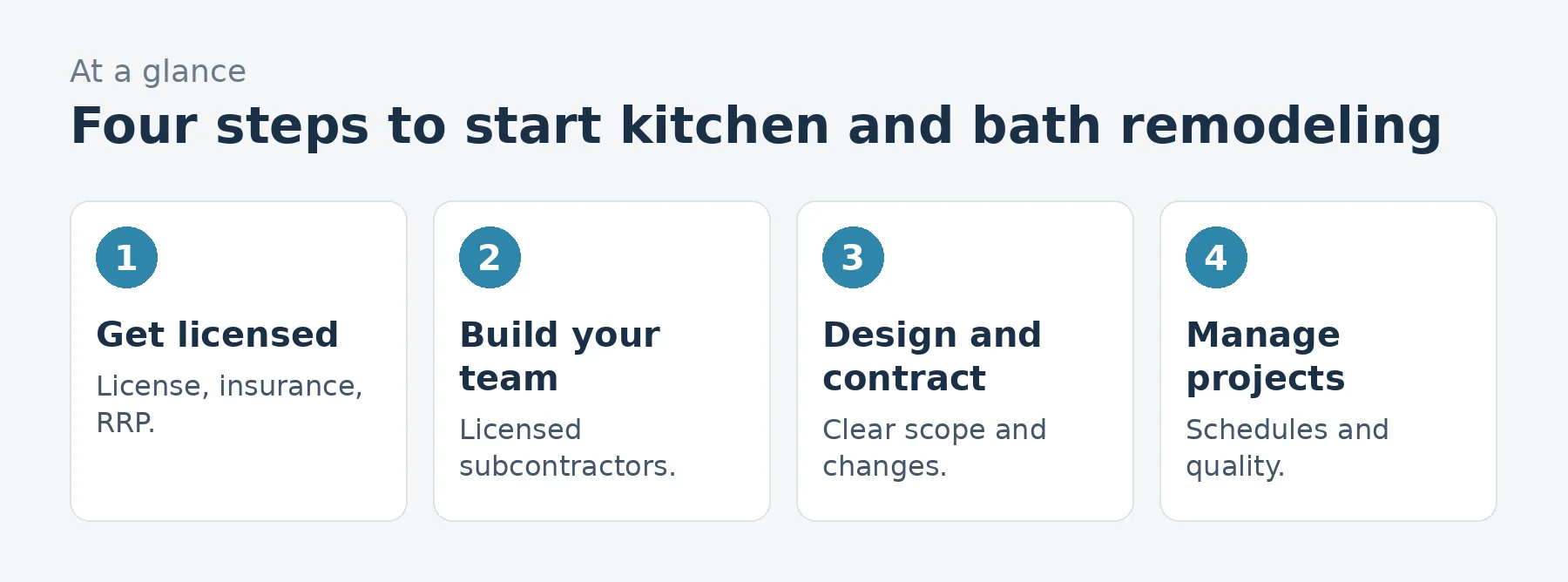
Use detailed written contracts with scope, specifications, allowances, schedule, payment milestones, warranty, and how change orders work, with written, priced approvals before changes. Many states regulate home improvement contracts, limit deposits, and require specific notices, including a right to cancel for contracts signed in the customer’s home under the FTC’s Cooling-Off Rule and state law. Learn your state’s mechanic’s lien rules, including preliminary notices and lien waivers, which protect you and your subcontractors’ right to be paid.
Managing subcontractors
Build a reliable team of licensed plumbers, electricians, tile setters, countertop fabricators, drywall finishers and painters. Check their licenses and insurance, agree on prices and schedules in writing, and collect lien waivers when you pay them. Your reputation depends on their work, so supervise quality and keep schedules tight.
Pricing and financing
Price from detailed estimates of materials, subcontractors, your labor, permits, disposal and overhead, plus profit and a contingency. Many remodelers charge a design fee that’s credited to the project. Offer financing options through lenders, and set payment schedules tied to milestones. Use our pricing calculator.
Accessibility and aging-in-place
Many homeowners want bathrooms and kitchens that work as they age: curbless showers, grab bars, wider doorways, comfort-height toilets and accessible storage. These projects are a growing niche; training such as aging-in-place specialist programs helps. See how to start an aging-in-place home modification business.
Running a project day to day
- Pre-construction meeting: confirm the design, selections, schedule, working hours, access, parking and how the homeowner will live during the work (such as a temporary kitchen).
- Protection and dust control: protect floors and furniture, seal off work areas, and use dust collection, especially on older homes.
- Demolition and discovery: document what you find, and agree any changes in writing.
- Rough-in and inspections: plumbing, electrical and framing inspected before walls are closed.
- Finishes: cabinets, countertops, tile, fixtures and paint, in a clear sequence so trades don’t wait.
- Punch list and walkthrough: fix every item, clean thoroughly and hand over warranties and care instructions.
Communicating with homeowners
Remodeling disrupts people’s homes, so communication is the product as much as the finished room. Give a weekly update on progress, the next steps and decisions needed; confirm selections and delivery dates early, since late cabinets or tile delay everything; and respond quickly to concerns. Homeowners forgive delays they understand, but not silence.
Warranties and aftercare
Give a written workmanship warranty and pass on manufacturers’ warranties for cabinets, fixtures and appliances. Check in a month after completion, and fix any issues quickly. Happy customers become your best source of referrals and repeat projects.
Startup costs for a kitchen and bath remodeling business
| Item | What to budget for |
|---|---|
| Tools and equipment | Carpentry and demolition tools, dust control, protection materials |
| Vehicle | Work van or truck |
| Design software | Kitchen and bath design and estimating tools |
| Insurance | General liability, commercial auto, workers’ compensation, builder’s risk |
| Licensing and certification | Contractor license, bonds, EPA RRP certification |
| Working capital | To cover materials and subcontractors between payments |
Use our startup cost calculator for your total.
A worked example: a small remodeling company
These are illustrative assumptions for a small remodeling company completing about two kitchens and two bathrooms a month, not predictions.
| Assumption | Monthly | |
|---|---|---|
| Kitchen remodels | 2 projects averaging $38,000 | $76,000 |
| Bathroom remodels | 2 projects averaging $16,000 | $32,000 |
| Revenue | $108,000 | |
| Materials, cabinets and fixtures | $(42,000) | |
| Subcontractors (plumbing, electrical, tile, countertops) | $(30,000) | |
| Lead carpenter and helper wages | $(11,000) | |
| Permits, dumpsters and disposal | $(2,200) | |
| Vehicle, insurance and licensing | $(2,600) | |
| Marketing, design software and office | $(3,500) | |
| Profit before owner pay and taxes | $16,700 |
That leaves about $16,700 a month before the owner’s pay and taxes, on about $108,000 of revenue. Margins depend on accurate estimates and controlled change orders.
Marketing
- A portfolio of before-and-after photos.
- Kitchen and bath showrooms and cabinet suppliers.
- Real estate agents and home inspectors.
- Google Business Profile reviews.
- Home shows and local events.
Common mistakes to avoid when starting a kitchen and bath remodeling business
- Starting work without permits.
- Unlicensed plumbing or electrical work.
- Ignoring lead and asbestos in older homes.
- Verbal change orders.
- Underestimating hidden conditions and schedules.
Your first 90 days as a kitchen and bath remodeling business owner
- Days 1-30: get licensed, insured and RRP-certified, and line up licensed subcontractors.
- Days 31-60: build contracts, estimating templates and a portfolio, and set up supplier accounts.
- Days 61-90: complete first projects, collect reviews and build referral relationships.
Frequently asked questions about starting a kitchen and bath remodeling business
Do I need a license to remodel kitchens and bathrooms?
Usually; most states and cities require contractor licenses or home improvement registration, and plumbing and electrical work need licensed trades.
What is the EPA RRP rule?
A rule requiring certified firms and lead-safe practices for renovations disturbing paint in pre-1978 homes.
Do remodels need permits?
Usually, especially when plumbing, electrical or structural work is involved.
How should I handle change orders?
In writing, with a price and the homeowner’s approval before the work.
What is a mechanic’s lien?
A legal claim against property for unpaid work or materials; follow your state’s notice rules.
Should I charge a design fee?
Many design-build remodelers do, credited to the project if the client goes ahead.
How do I handle asbestos?
Test suspect materials before demolition and use licensed professionals where required.
What is NKBA?
The National Kitchen and Bath Association, which offers education and certifications.
How long does a kitchen remodel take?
Often several weeks to a few months, depending on scope, permits, inspections and material lead times.
Keep learning
- Remodeling industry data
- How to start a countertop installation business
- How to start a cabinet making business
- Pricing calculator
Sources
- EPA, Lead Renovation, Repair and Painting (RRP) program
- EPA, Protect your family from exposures to asbestos
- National Kitchen and Bath Association (NKBA)
- FTC, Cooling-Off Rule (door-to-door sales)
- US Small Business Administration, Apply for licenses and permits
- OSHA, Respirable crystalline silica standard for construction (29 CFR 1926.1153)
Last reviewed November 7, 2026. Startup costs are estimates; check local prices, licensing and tax rules before you commit money.

