
A beverage brand creates and sells packaged drinks: sparkling waters, iced teas, cold brew coffee, juices, functional and energy drinks, kombucha, mixers and more. Beverages can grow quickly, but they are one of the most capital-intensive food categories: production runs are large, packaging is expensive and distribution is competitive.
This guide focuses on non-alcoholic drinks (breweries, wineries and distilleries have their own guides). It covers choosing a category, formulation and safety rules, co-packers, labels, distribution and pricing, a worked example and a 90-day plan.
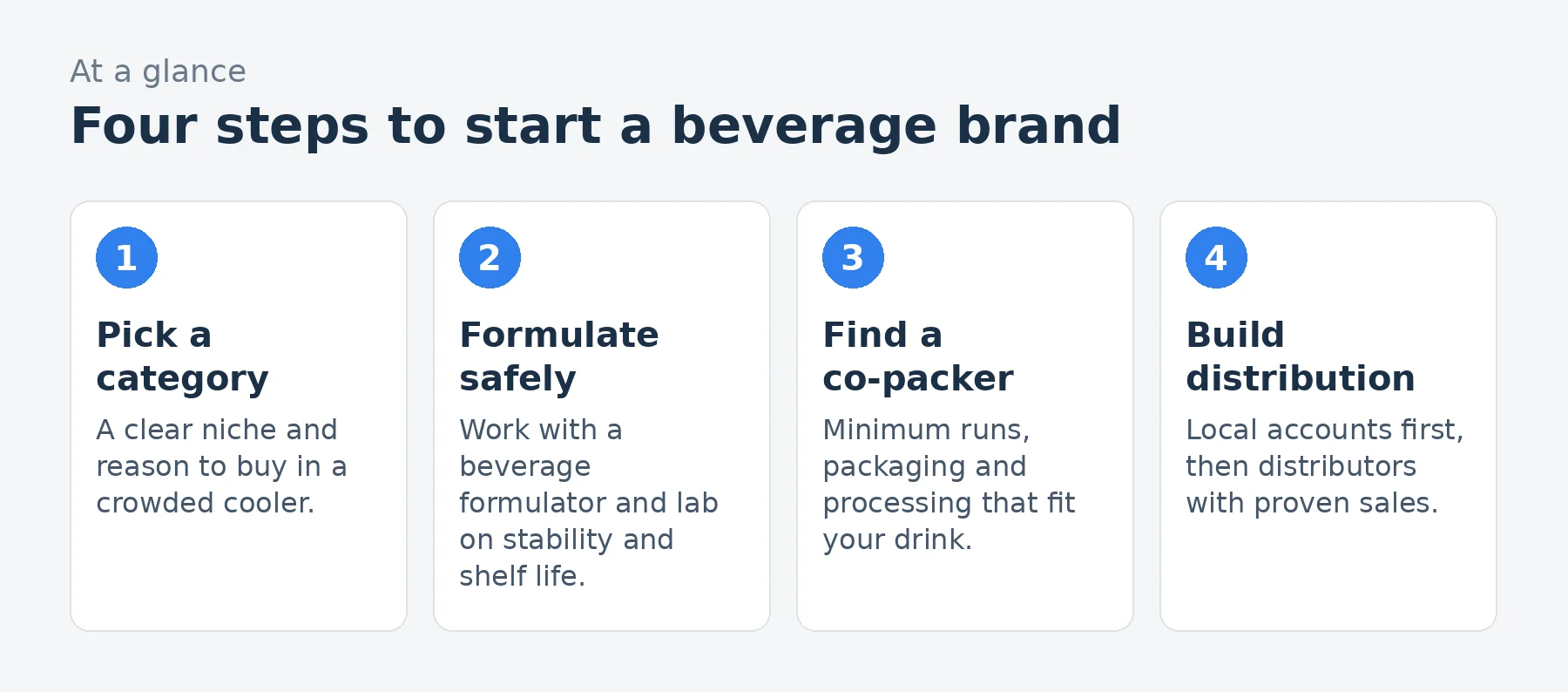
A beverage brand at a glance
Table of Contents
| Topic | What to expect |
|---|---|
| Startup cost | High: formulation, lab testing, packaging minimums, co-packer runs, inventory and marketing |
| Key rules | FDA facility registration (your co-packer), labeling and allergens; juice HACCP for juices; acidified food rules for some drinks |
| How you sell | Local stores, cafés and gyms, online, then distributors and chains |
| Biggest challenges | Minimum production runs, shipping heavy products, retailer fees and cash tied up in inventory |
| Best for | Founders with capital, sales drive and patience to build distribution |
Who a beverage brand suits
It suits founders with sales energy, access to capital and patience. Beverage brands are built account by account through demos, relationships with store buyers and distributors, and steady marketing.
Choosing a category
- Sparkling and flavored waters: simple to produce, very competitive.
- Teas and cold brew: popular, with options for ready-to-drink cans and bottles.
- Juices and smoothies: fresh positioning but stricter safety rules and short shelf life.
- Functional drinks: ingredients for energy, focus or relaxation, with careful attention to claims.
- Kombucha and fermented drinks: strong niche demand; watch alcohol content limits for non-alcoholic sales.
- Mixers and non-alcoholic alternatives: a growing category.
Formulation and safety rules
Work with a beverage formulator and food lab to make the drink taste right at scale, stay stable and remain safe through its shelf life. The processing method (hot fill, pasteurization, high-pressure processing, preservatives) depends on the drink. Key rules:
- FDA facility registration for the facility making the drink, usually your co-packer.
- Juice HACCP rules for juices, which require a hazard analysis plan and processes that reduce pathogens.
- Acidified food rules can apply to some drinks with added acid.
- Labels with ingredients, nutrition facts unless exempt, allergens and net contents.
- Claims: structure and function or health claims, and ingredients such as caffeine or botanicals, have specific rules.
- Container deposits in states with bottle bills, which require deposit labeling and participation.
Co-packers and minimum runs
Most beverage brands use co-packers with filling lines for cans or bottles. They set minimum production runs that can mean thousands of cases, and can minimums from suppliers may be large too, so small brands sometimes start with smaller-run co-packers, printed shrink sleeves on stock cans or local commercial kitchens for small batches. Compare costs per case, minimums, lead times and quality controls.
Startup costs to plan for
| Item | What to budget for |
|---|---|
| Formulation and testing | Formulator, lab testing, shelf-life studies |
| Packaging | Cans or bottles, labels or sleeves, cases |
| Production | Co-packer minimum runs and setup fees |
| Inventory and storage | Warehousing and freight |
| Sales and marketing | Samples, demos, events, retailer fees |
| Compliance and insurance | Labels, testing, product liability |
Use our startup cost calculator for your total.
Pricing and distribution
Beverages pass through several hands: brand, distributor and retailer, each with a margin, plus promotions and sometimes slotting fees. Build your price backward from the shelf price shoppers will pay, and make sure the cost per unit leaves room for every margin and for marketing. Direct sales and events carry better margins but limited volume. Use our pricing calculator.
A worked example: an early-stage brand
These are illustrative assumptions for an early-stage brand selling about 1,500 cases a month, not predictions.
| Assumption | Monthly | |
|---|---|---|
| Sales to stores and distributors | 1,300 cases of 12 at $21 a case | $27,300 |
| Direct sales online and at events | 200 cases at $36 | $7,200 |
| Revenue | $34,500 | |
| Product cost | 1,500 cases at $11.50 (liquid, cans, labels, co-packing) | $(17,250) |
| Freight and warehousing | $(3,200) | |
| Promotions, demos and retailer fees | $(3,500) | |
| Marketing | $(2,500) | |
| Sales help | Part-time field sales | $(2,000) |
| Insurance, software and fees | $(700) | |
| Profit before owner pay and taxes | $5,350 |
That leaves about $5,350 a month before the founder’s pay and taxes, on about $34,500 of revenue. Many beverage brands run at a loss for a long time while building distribution, because promotions and freight costs rise as they expand.
Building distribution
- Start with local accounts you can deliver yourself: cafés, gyms, specialty stores and restaurants.
- Run demos and events to drive trial and repeat purchases.
- Track sales per store per week; distributors and chains want proof that the drink sells.
- Approach regional distributors with that data.
- Expand to chains only with a marketing and promotion budget to support them.
Shipping and storage
Drinks are heavy, so freight is a major cost. Plan warehousing near your customers, ship full pallets when possible and understand temperature needs (some drinks must stay cold). Online direct sales of beverages are costly to ship, so bundles and subscriptions help. Track inventory by lot and date, rotating stock so older product sells first.
Marketing a drink
Trial is everything: people must taste the drink before they buy again. Use in-store demos, events, sampling at gyms and offices, partnerships with cafés and restaurants and social media that shows real people enjoying it. A clear, memorable can or bottle design and a simple message about why the drink is different help it stand out in a crowded cooler.
Funding a beverage brand
Beverage brands often need more capital than other food startups because of production minimums, inventory, freight and promotions. Common sources are savings, friends and family, small business loans, crowdfunding and investors who specialize in consumer brands. Build a budget that covers several production runs and months of promotion, not just the first batch.
Quality control and recalls
Check every production run: taste, appearance, carbonation or fill levels and lab tests your process requires. Keep lot codes and production records so you can trace and recall a specific batch if needed, and carry product liability insurance before selling to stores.
Working with distributors
Distributors deliver to many stores and restaurants, but they carry thousands of products and focus on those that sell. Before signing, understand their margin, payment terms, territories, whether the agreement is exclusive and how long it lasts. Support them with sales data, promotions and your own time visiting stores; brands that rely on distributors alone often stall.
Kombucha and fermented drinks
Fermented drinks can produce alcohol as they sit. Drinks sold as non-alcoholic must stay below the legal limit for alcohol content, so kombucha makers monitor fermentation, keep products cold and test alcohol levels. Drinks above the limit are regulated as alcoholic beverages, with federal and state permits and taxes.
Starting small to test demand
Before committing to large runs, some founders test drinks at farmers markets, cafés or events with small batches made in licensed kitchens, or use smaller co-packers and stock cans with printed labels or sleeves. Small tests cost more per unit but prove demand and refine the recipe before a large investment.
Common mistakes to avoid
- Ordering huge runs before proving demand.
- Pricing without distributor and retailer margins.
- Underestimating freight for heavy drinks.
- Making health claims that break FDA rules.
- Expanding too widely without support for each account.
Your first 90 days
- Days 1-30: define your category, work with a formulator and research co-packers and minimums.
- Days 31-60: finalize the formula, run shelf-life and lab tests, design compliant labels and get barcodes.
- Days 61-90: produce a first run, sign ten local accounts and run demos to prove sales.
Frequently asked questions
How much does it cost to start a beverage brand?
Often more than other food products, because of formulation, testing, packaging minimums and co-packer runs. Many brands raise capital or start with small-batch production.
Do beverage brands need FDA approval?
Most drinks do not need pre-approval, but production facilities must register, labels must comply and juices must follow juice HACCP rules.
What is a co-packer minimum run?
The smallest production a co-packer will make, often thousands of cases, plus packaging minimums from suppliers.
How do beverage brands get into stores?
By building local accounts, proving sales with demos and data, then working with distributors.
Can I make health claims on my drink?
Only within FDA rules for structure and function or health claims, which are strict. Get regulatory advice before printing claims.
Should I start with cans or bottles?
Cans are lighter, recyclable and common for sparkling drinks; bottles suit some premium and still drinks. Your co-packer’s equipment and minimums often decide.
Do I need a distributor at first?
Not usually. Many brands self-distribute to local accounts first, then bring in distributors once they can show steady sales.
Can I test a drink before a big production run?
Yes. Small licensed batches, smaller co-packers and stock packaging let you test recipes and demand before committing to large minimums.
Keep learning
- Packaged food brands industry data
- How to start a coffee roasting business
- How to start a craft brewery
- Pricing calculator
Sources
- FDA, Registration of food facilities
- FDA, Juice HACCP
- FDA, Acidified and low-acid canned foods
- FDA, Food labeling guide
- FDA, Food allergies: what you need to know
- GS1 US, Get a barcode
Last reviewed November 2, 2026. Startup costs are estimates; check local prices, licensing and tax rules before you commit money.

