
A craft brewery makes beer and sells it through its own taproom, to bars and restaurants, in cans and kegs through distributors, or all of these. For many founders it is a dream that combines craft, community and hospitality.
It is also a hard market right now, and this guide is frank about it. According to the Brewers Association, the number of U.S. craft breweries fell 2.9% to 9,578 in 2025, with 481 closings against just 300 openings, and craft production fell about 5%. Total beer volume fell 5.7%. The decline continued in 2026, with about 9,344 breweries operating in June and volume down another 4% in the first half. One bright spot: brewpubs and taprooms held up better than production-focused breweries. This guide covers business models, permits, taxes, equipment, a worked example and how to compete.
A craft brewery at a glance
Table of Contents
| Topic | What to expect |
|---|---|
| Startup cost | High: brewhouse and fermenters, build-out, taproom, permits and working capital; financing is common |
| Licenses | TTB Brewer’s Notice, state manufacturer license, local zoning and health permits; label approvals for distributed products |
| Market in 2026 | Craft breweries down 2.9% in 2025 (481 closings vs 300 openings); taprooms and brewpubs held up better (Brewers Association) |
| Federal excise tax | $3.50 a barrel on the first 60,000 barrels for qualifying small domestic brewers |
| Best for | Brewers with hospitality skills, capital and a clear local niche |
Be honest about the market
The craft beer boom has turned into consolidation. More breweries closed than opened in both 2024 and 2025, and overall beer volume is shrinking as drinkers try other options. That does not mean a new brewery cannot succeed, but it does mean success depends on a strong local niche, a welcoming taproom, careful costs and realistic sales projections. Visit breweries that closed and ones that thrive near you, and talk to their owners before investing.
Choosing a business model
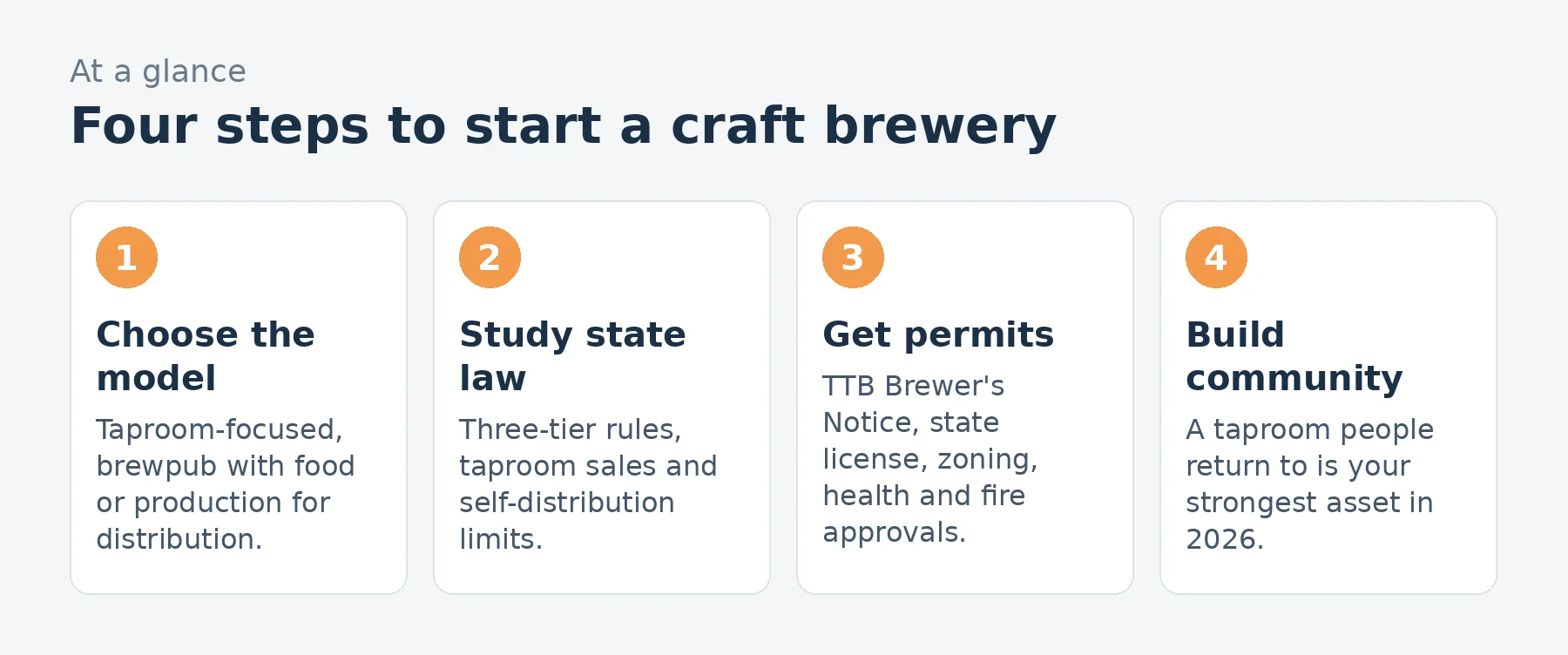
- Taproom-focused brewery: sells most beer by the glass on site, with cans to go; highest margins and the model that held up best in 2025.
- Brewpub: brewery plus full restaurant; more complexity and staff, but food brings families and lunch crowds.
- Production brewery: sells mainly through distributors in kegs and cans; needs scale, sales staff and marketing, and faces the most competition.
- Nano or contract brewing: very small systems or brewing at another brewery to test recipes and demand with less capital.
Permits and licenses
Commercial brewers need a Brewer’s Notice from the Alcohol and Tobacco Tax and Trade Bureau (TTB) before producing beer, plus a state manufacturer license, local zoning approval, building, health and fire permits and, for food service, a food permit. Many small brewers qualify for exemption from posting a federal bond if their expected tax liability is low. Beer sold across state lines needs approved labels (a COLA from TTB), and states have their own label and registration rules.
Most states regulate alcohol through a three-tier system (producers sell to distributors, distributors to retailers and bars), with exceptions that vary by state: many allow producers to sell directly in their own taproom or tasting room, and some allow limited self-distribution or direct shipping to consumers. Your state’s rules shape your business model, so study them before choosing a site.
Federal and state taxes
Federal excise tax on beer for qualifying domestic brewers is $3.50 a barrel on the first 60,000 barrels each year (higher rates apply above that), under rates made permanent in 2020. States add their own excise taxes, and sales taxes apply to taproom sales. Keep careful production and removal records, because tax is reported based on beer removed from the brewery.
Equipment and space
- Brewhouse sized for your model, often 3 to 15 barrels for taproom breweries.
- Fermenters and brite tanks (fermenter capacity limits how much you can sell).
- Glycol chiller, walk-in cooler and keg washer.
- Canning line or mobile canning service.
- Taproom build-out: bar, draft system, seating, restrooms.
Choose a site zoned for brewing with adequate drainage, water, power and floor strength, plus parking and visibility for the taproom. Industrial areas near neighborhoods often work well.
Startup costs to plan for
| Item | What to budget for |
|---|---|
| Equipment | Brewhouse, fermenters, chiller, cooler, kegs, canning |
| Build-out | Drains, utilities, taproom construction |
| Permits and legal | TTB, state, local, label approvals |
| Opening inventory | Ingredients, cans, glassware, merchandise |
| Working capital | Many months of payroll and rent while sales build |
| Insurance | Liquor liability, property, workers’ compensation |
Use our startup cost calculator for your total.
Pricing and margins
Calculate cost per barrel (ingredients, packaging, labor, utilities and taxes), then compare channels. A barrel sold by the pint in your taproom earns far more than a barrel sold in kegs to bars or in cans through distributors, who each take a margin. Many successful small breweries sell the majority of their beer on site.
A worked example: a taproom-focused brewery
These are illustrative assumptions for a small taproom-focused brewery, not predictions.
| Assumption | Monthly | |
|---|---|---|
| Taproom beer sales | About 5,200 pints a month at $7 | $36,400 |
| Cans to go and merchandise | $4,000 | |
| Kegs to local bars | 20 half-barrel kegs at $170 | $3,400 |
| Revenue | $43,800 | |
| Ingredients and packaging | Malt, hops, yeast, cans, CO2 | $(5,200) |
| Federal and state excise taxes | About 35 barrels a month at the small brewer rate plus state tax | $(600) |
| Taproom and brewing staff | With payroll costs | $(15,000) |
| Rent and utilities | $(6,500) | |
| Equipment loan payments | $(4,200) | |
| Insurance, licenses and software | $(1,500) | |
| Marketing, events and food truck partners | $(1,200) | |
| Profit before owner pay and taxes | $9,600 |
That leaves about $9,600 a month before the owners’ pay and taxes, on about $43,800 of revenue. Taproom sales carry far better margins than kegs or cans sold through distributors, which is why the taproom model has held up best.
Building a taproom people return to
- A welcoming space for different groups: friends, families where allowed, dog owners, remote workers.
- Events: trivia, live music, run clubs, game nights and charity fundraisers.
- Food through partners or your own kitchen.
- Non-alcoholic options and lower-alcohol beers for a wider audience.
- A rotating lineup that gives regulars something new.
The Bureau of Labor Statistics reports median pay of $33,530 for bartenders; good taproom staff who know the beer and regulars are worth paying well.
Financing a brewery
Breweries are usually financed with a mix of owner savings, investors, equipment loans and bank or SBA-backed loans. Lenders will want a detailed plan with conservative sales projections, especially given recent closures. Consider buying used equipment from breweries that closed, which has become more available, and leasing rather than buying a building. Keep a cash reserve; many breweries fail not from bad beer but from running out of money before the taproom matures.
Beyond beer
Many breweries now broaden their appeal with non-alcoholic beers, hard seltzers, ciders (which may need different permits), sodas and coffee. Non-alcoholic options help groups where not everyone drinks. Check federal and state rules before adding beverages outside beer, since some require separate permits or tax treatment.
Finding your local niche
In a crowded market, a clear identity helps: a neighborhood gathering place, a focus on lagers or a regional style, family-friendly space, a strong food program or a theme tied to local history. Study what nearby breweries do well and where there is a gap, then design your beer list and taproom around it.
Common mistakes to avoid
- Projecting sales from the boom years instead of today’s market.
- Overbuilding production capacity before the taproom is busy.
- Underestimating build-out costs for drains and utilities.
- Relying on distribution in a crowded market.
- Running out of working capital before sales mature.
Your first 90 days
- Days 1-30: study the local market, visit breweries (including ones that closed) and learn your state’s three-tier and taproom rules.
- Days 31-60: choose your model, find sites zoned for brewing and build a conservative financial plan.
- Days 61-90: line up financing, apply for your TTB Brewer’s Notice once you have a site and design the taproom.
Frequently asked questions
Is opening a brewery a good idea in 2026?
It can be with a strong local niche and taproom, but the market is shrinking: 481 craft breweries closed and 300 opened in 2025, according to the Brewers Association.
What permits does a brewery need?
A TTB Brewer’s Notice, a state manufacturer license, local zoning, building, health and fire approvals, and label approvals for beer sold across state lines.
How much is federal beer tax?
$3.50 a barrel on the first 60,000 barrels for qualifying domestic brewers, with higher rates above that.
Can breweries sell directly to customers?
Most states allow taproom sales; rules on self-distribution and shipping vary widely.
Taproom or production brewery?
In 2025, taprooms and brewpubs held up better than production-focused breweries, according to the Brewers Association.
Can I buy used brewing equipment?
Yes. With more breweries closing, used equipment is widely available, which can lower startup costs. Have it inspected before buying.
How big should my brewhouse be?
Size it for realistic taproom sales with room to grow fermenter capacity. Many taproom breweries start with a small system and add fermenters before replacing the brewhouse.
Keep learning
- Craft beverages industry data
- How to start a winery
- How to start a craft distillery
- Business Idea Reality Check
Sources
- Axios, Craft beer's decline sets new records in 2025 (Brewers Association annual report)
- Vinetur, Brewers Association 2025 data and 2026 midyear figures
- TTB, Brewers: permits and Brewer's Notice
- TTB, Tax rates for alcohol beverages
- TTB, Labeling and COLAs
- US Bureau of Labor Statistics, Bartenders
Last reviewed November 2, 2026. Startup costs are estimates; check local prices, licensing and tax rules before you commit money.

