
A craft distillery makes spirits such as vodka, gin, rum, whiskey and liqueurs, and sells them through a tasting room or cocktail bar, to restaurants and bars, and through distributors to stores. Distilling combines chemistry, craft and branding, and a good tasting room experience builds loyal local fans.
It is also one of the most regulated small businesses you can start: federal permits, detailed recordkeeping, label approvals, state three-tier rules, fire codes for flammable alcohol and excise taxes. Spirits that need years of aging tie up cash for a long time. The broader alcohol market has been under pressure in recent years, so this guide focuses on realistic models. It covers permits, taxes, equipment, product strategy, a worked example and a 90-day plan.
A craft distillery at a glance
Table of Contents
| Topic | What to expect |
|---|---|
| Startup cost | High: still and equipment, a site meeting fire codes, permits, barrels and inventory, often financed |
| Licenses | TTB distilled spirits plant (DSP) permit, generally a basic permit, state licenses, local zoning and fire approvals, label approvals |
| Federal excise tax | $2.70 per proof gallon on the first 100,000 proof gallons for qualifying producers, higher above that |
| How you sell | Tasting room and cocktails where allowed, bars and restaurants, distributors and stores |
| Best for | Detail-oriented founders with capital, patience and strong branding and hospitality skills |
Who a distillery suits
It suits detail-oriented founders who enjoy both production and hospitality, can manage strict compliance and have the patience and capital for a long build. Many distillers train through courses, apprenticeships or work at existing distilleries before opening.
The Bureau of Labor Statistics reports median pay of $33,530 for bartenders and $65,310 for food service managers (May 2024), benchmarks for tasting room roles.
Federal permits and approvals
Before producing spirits, you need a distilled spirits plant (DSP) permit from the Alcohol and Tobacco Tax and Trade Bureau (TTB), and generally a basic permit to sell at wholesale. You must keep detailed production, storage and processing records and file regular reports. Some products need formula approval, and spirits sold across state lines need approved labels (COLAs) meeting rules for class and type, alcohol content and age statements.
State law and tasting rooms
Most states regulate alcohol through a three-tier system (producers sell to distributors, distributors to retailers and bars), with exceptions that vary by state: many allow producers to sell directly in their own taproom or tasting room, and some allow limited self-distribution or direct shipping to consumers. Your state’s rules shape your business model, so study them before choosing a site.
Distillery rules vary especially widely: some states allow tastings only, others allow cocktails, bottle sales and limited self-distribution, and some cap on-site sales. These rules can make or break the tasting room model, so study them first.
Federal excise tax
Federal excise tax on spirits is $2.70 per proof gallon on the first 100,000 proof gallons for qualifying producers, with higher rates above that, under rates made permanent in 2020. States add their own excise taxes and fees. Tax is generally owed when spirits are removed from bond, so careful inventory records matter.
Site, safety and equipment
Distilleries handle large amounts of flammable alcohol, so zoning and fire codes are critical: many require specific building classifications, ventilation, explosion-proof electrical equipment in some areas and fire suppression. Work with your fire marshal and an engineer before signing a lease.
- Still: pot still, column still or hybrid, sized for your plans.
- Mash and fermentation tanks if you make spirits from grain or other base ingredients.
- Barrels and storage for aged spirits.
- Bottling, labeling and proofing equipment.
- Tasting room build-out.
Startup costs to plan for
| Item | What to budget for |
|---|---|
| Equipment | Still, tanks, barrels, bottling |
| Site and build-out | Fire-code compliance, utilities, tasting room |
| Permits and legal | TTB, state, local, formulas and labels |
| Inventory | Base ingredients, bottles, closures, labels, barrels |
| Working capital | Months of payroll, plus aging inventory |
| Insurance | Liquor liability, property, product liability |
Use our startup cost calculator for your total.
Product strategy: unaged and aged spirits
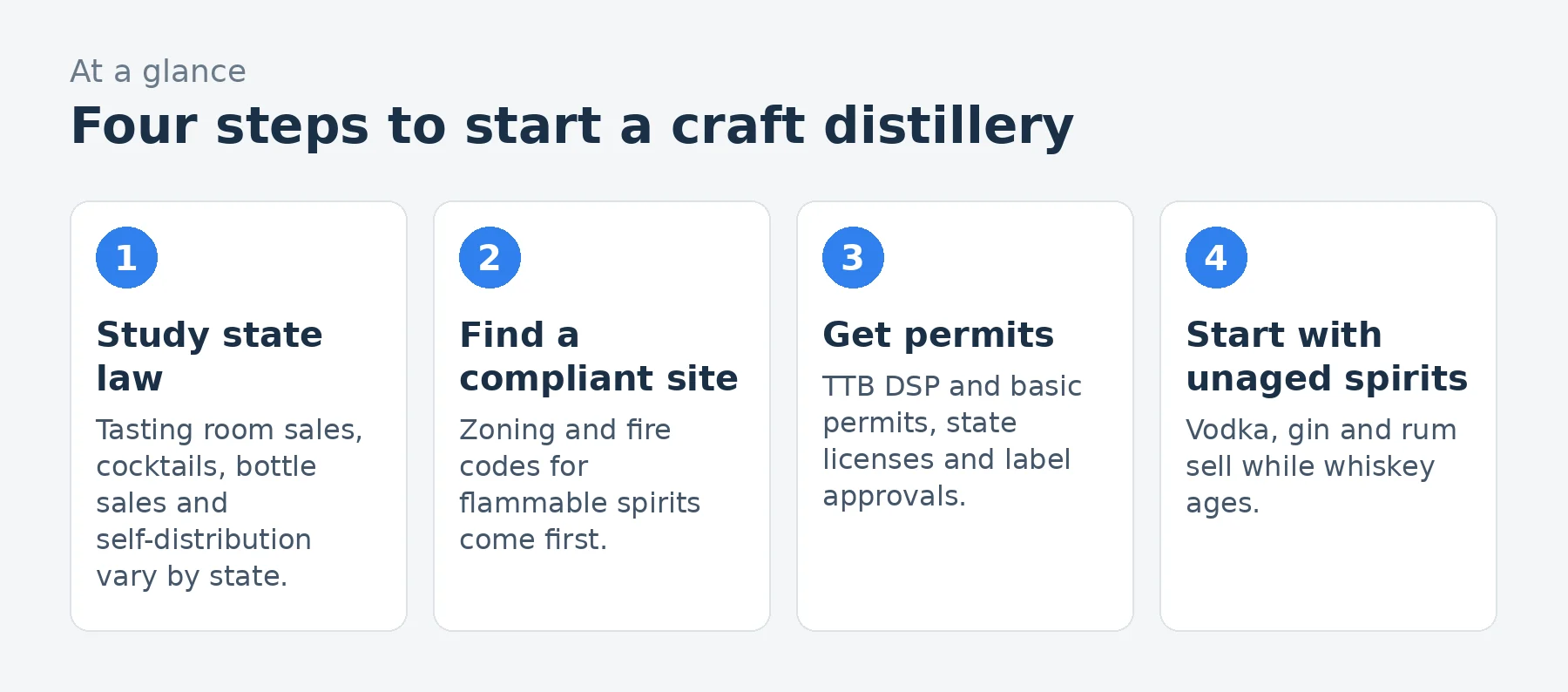
Whiskey and other aged spirits can take years to mature, tying up cash in barrels. Many craft distilleries start by selling unaged or lightly aged spirits (vodka, gin, white rum, liqueurs) while barrels age. Some also blend and bottle sourced spirits while their own products mature, and they must label sourced products accurately. Focus on a small, distinctive lineup rather than many products at once.
A worked example: a small distillery with a cocktail room
These are illustrative assumptions for a small distillery with a cocktail tasting room, not predictions.
| Assumption | Monthly | |
|---|---|---|
| Tasting room cocktails and flights | Where state law allows | $22,000 |
| Bottle sales on site | 600 bottles at $35 | $21,000 |
| Distributor and account sales | 250 bottles at $18 wholesale | $4,500 |
| Revenue | $47,500 | |
| Ingredients, bottles and packaging | $(7,000) | |
| Federal and state excise taxes | $(3,500) | |
| Staff | Distiller and tasting room staff with payroll costs | $(15,500) |
| Rent and utilities | $(5,500) | |
| Equipment loan payments | $(3,200) | |
| Insurance, compliance and software | $(1,800) | |
| Marketing and events | $(1,500) | |
| Profit before owner pay and taxes | $9,500 |
That leaves about $9,500 a month before the owners’ pay and taxes, on about $47,500 of revenue. On-site sales drive the model; distributor sales add reach at much lower margins. Whiskey aging in barrels is a separate long-term investment not shown here.
Selling spirits
- Tasting room and cocktails: the highest margins and the best way to build fans, where state law allows.
- Bars and restaurants: feature your spirits in local cocktails.
- Distributors and stores: reach, but with lower margins and strong competition for shelf space.
- Events, tours and classes: distillery tours, cocktail classes and private parties.
Learning to distill
Distilling skill comes from training and practice in licensed settings: courses, workshops and apprenticeships at existing distilleries. Learn fermentation, cuts (separating heads, hearts and tails), safety, recordkeeping and proofing. Equipment manufacturers and industry associations often offer training too.
Branding and packaging
Spirits are a branded product: bottle, label and story drive shelf appeal and price. Invest in distinctive packaging, a clear brand story tied to your place and ingredients and consistent design across your tasting room and marketing. Label designs must meet federal rules and be approved before interstate sales, so plan approval time.
Barrel programs
Some distilleries sell barrels or barrel shares to customers, private barrel selections to bars and stores, or memberships with access to limited releases. These programs can bring cash and loyalty while whiskey ages, but they must be structured within federal and state rules, so get legal advice before offering them.
Cocktails and the tasting room
Where state law allows cocktails, a well-run cocktail room can become the heart of the business: signature drinks that show off your spirits, classes, tours and events. Train staff on responsible service, follow serving limits in your state and design the room so guests can see the still, which is part of the experience.
Common mistakes to avoid
- Signing a lease before confirming zoning and fire code compliance.
- Underestimating permit timelines and recordkeeping.
- Launching only aged spirits and running out of cash while they mature.
- Relying on distributors instead of building a local following.
- Inaccurate labeling of sourced spirits.
Your first 90 days
- Days 1-30: study your state’s distillery laws, take a distilling course and visit small distilleries.
- Days 31-60: find sites that meet zoning and fire codes, choose products and build a conservative financial plan.
- Days 61-90: line up financing, start TTB and state applications once you have a site and design the tasting room.
Frequently asked questions
What permit do I need to open a distillery?
A TTB distilled spirits plant (DSP) permit, generally a basic permit for wholesale sales, state licenses, local zoning and fire approvals and label approvals.
How much is federal excise tax on spirits?
$2.70 per proof gallon on the first 100,000 proof gallons for qualifying producers, with higher rates above that.
Can distilleries sell cocktails?
It depends on the state. Some allow cocktails and bottle sales on site; others limit tastings.
Why do many distilleries start with vodka or gin?
Unaged spirits can be sold soon after production, providing cash while whiskey and other aged spirits mature.
Can I distill at home to test recipes?
No. Distilling spirits without federal permits is illegal, even for personal use. Learn through courses and licensed distilleries.
How long does whiskey need to age?
It depends on the style and labeling claims. Some categories have minimum aging rules, and many craft whiskeys age for years before release.
Do distilleries need special fire safety measures?
Yes. Distilleries handle flammable alcohol, so local fire codes often require specific building classifications, ventilation, electrical equipment and suppression systems. Work with your fire marshal early.
Can I sell bottles to visitors?
In many states distilleries can sell a limited number of bottles on site, but limits and rules vary widely. Check your state before planning sales.
Should I make whiskey first?
Many distilleries lay down whiskey barrels early but sell unaged spirits first, because whiskey takes years to mature.
Keep learning
- Craft beverages industry data
- How to start a craft brewery
- How to start a winery
- Startup cost calculator
Sources
- TTB, Distilled spirits: permits and DSP
- TTB, Tax rates for alcohol beverages
- TTB, Labeling and COLAs
- Axios, Craft beer's decline sets new records in 2025 (Brewers Association annual report)
- US Bureau of Labor Statistics, Bartenders
- US Bureau of Labor Statistics, Food service managers
Last reviewed November 2, 2026. Startup costs are estimates; check local prices, licensing and tax rules before you commit money.

