
Local breweries, wineries and distilleries draw visitors, regulars and tourists, and their taprooms and tasting rooms have become community gathering places. Behind the hospitality is one of the most regulated small businesses in the country, with federal permits, label approvals, excise taxes and state distribution rules. Taproom service draws on hospitality workers; bartenders earned a median of $33,530 in May 2024, and food service managers earned $65,310, according to the Bureau of Labor Statistics. Below is the key industry data on craft breweries, wineries and distilleries, with costs, business models and a first-year projection.
Producers range from nano breweries selling mostly in their own taprooms to craft breweries with distribution and small distilleries or wineries with tasting rooms. Taproom sales usually carry far higher margins than wholesale.
The workforce
| Occupation | Jobs (2024) | Median pay (May 2024) | Projected growth, 2024 to 2034 |
|---|---|---|---|
| Bartenders | n/a | $33,530 | n/a |
| Food service managers | 352,800 | $65,310 | +6% |
Source: U.S. Bureau of Labor Statistics, Occupational Outlook Handbook and Occupational Employment and Wage Statistics.
Business models compared
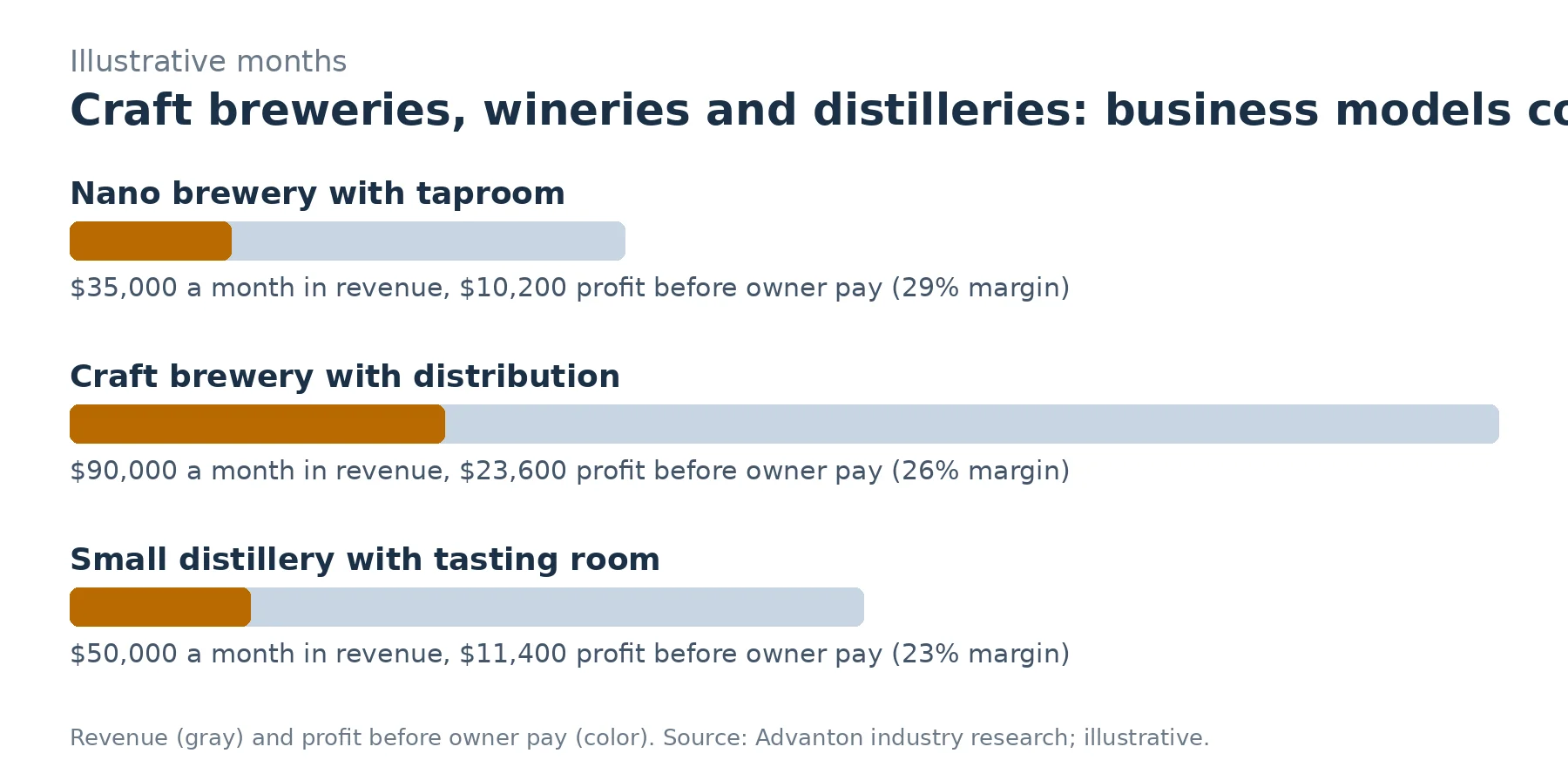
The figures below are illustrative months from our research, not industry averages. They show how revenue and costs typically fit together; your market, prices and costs will differ.
| Business model | Startup costs | Example monthly revenue | Costs | Profit before owner pay | Margin |
|---|---|---|---|---|---|
| Nano brewery with taproom | High: brewhouse, fermenters, taproom build-out, permits | $35,000 | $24,800 | $10,200 | 29% |
| Craft brewery with distribution | Very high: larger brewhouse, canning, cold storage | $90,000 | $66,400 | $23,600 | 26% |
| Small distillery with tasting room | Very high: still, facility, aging inventory, permits | $50,000 | $38,600 | $11,400 | 23% |
Fixed and variable costs
For projections, the most useful split is between variable costs, which rise and fall with sales (materials, supplies, hourly labor, fees), and fixed costs, which you pay every month regardless (rent, salaried staff, insurance, loan payments).
| Business model | Variable costs (% of revenue) | Fixed costs per month | What it means |
|---|---|---|---|
| Nano brewery with taproom | 36.6% | $12,000 | Balanced: margins improve as volume grows |
| Craft brewery with distribution | 46.3% | $24,700 | Balanced: margins improve as volume grows |
| Small distillery with tasting room | 44.4% | $16,400 | Balanced: margins improve as volume grows |
What the numbers say
Taproom sales carry the highest margins because producers keep the full retail price.
Distribution adds volume at lower margins after distributor and retailer markups.
Equipment and facilities are heavy fixed costs, and distilleries tie up cash in aging inventory.
The three models in brief
Nano brewery with taproom. Small batches sold mostly on site. See bars and pubs data.
Craft brewery with distribution. Larger production, canning and sales to bars and stores through distributors.
Small distillery with tasting room. Spirits, cocktails and bottle sales where state law allows. See small manufacturing data.
Cost structure: craft brewery with distribution
Each cost as a share of the example month’s revenue ($90,000):
| Cost | Monthly amount | Share of revenue | Type |
|---|---|---|---|
| Ingredients and packaging | $18,000 | 20.0% | Variable |
| Production and taproom staff | $18,000 | 20.0% | Variable |
| Rent | $8,000 | 8.9% | Fixed |
| Equipment loans | $8,000 | 8.9% | Fixed |
| Sales and marketing | $4,000 | 4.4% | Fixed |
| Utilities | $3,500 | 3.9% | Fixed |
| Distribution and freight | $3,000 | 3.3% | Variable |
| Card fees | $1,500 | 1.7% | Variable |
| Excise taxes | $1,200 | 1.3% | Variable |
| Insurance | $1,200 | 1.3% | Fixed |
| Profit before owner pay | $23,600 | 26% |
A first-year projection: craft brewery with distribution
New businesses rarely start at full speed. This projection assumes revenue ramps from 35% of the example month in month 1 to 100% by month 12, variable costs move with revenue, and fixed costs stay the same every month. It’s a planning illustration, not a forecast.
| Month | Revenue | Variable costs | Fixed costs | Profit | Cumulative |
|---|---|---|---|---|---|
| 1 | $31,500 | $14,584 | $24,700 | -$7,784 | -$7,784 |
| 2 | $40,500 | $18,752 | $24,700 | -$2,952 | -$10,736 |
| 3 | $49,500 | $22,918 | $24,700 | $1,882 | -$8,854 |
| 4 | $55,800 | $25,835 | $24,700 | $5,265 | -$3,589 |
| 5 | $63,000 | $29,169 | $24,700 | $9,131 | $5,542 |
| 6 | $68,400 | $31,669 | $24,700 | $12,031 | $17,573 |
| 7 | $73,800 | $34,169 | $24,700 | $14,931 | $32,504 |
| 8 | $78,300 | $36,253 | $24,700 | $17,347 | $49,851 |
| 9 | $81,900 | $37,920 | $24,700 | $19,280 | $69,131 |
| 10 | $85,500 | $39,586 | $24,700 | $21,214 | $90,345 |
| 11 | $88,200 | $40,837 | $24,700 | $22,663 | $113,008 |
| 12 | $90,000 | $41,670 | $24,700 | $23,630 | $136,638 |
Year one: revenue $806,400, profit before owner pay $136,638. The first profitable month is month 3. Cumulative results bottom out at -$10,736, which is the minimum cash cushion this plan would need, before any startup costs.
Rent, equipment loans and utilities start before the taproom builds a following, so this brewery illustration turns profitable in month 3, with a cumulative low of about $10,700, before equipment and build-out investment.
How craft producers earn
- Taproom and tasting room sales.
- Packaged products to go where allowed.
- Distribution to bars, restaurants and stores.
- Events, tours and private parties.
- Merchandise and memberships (mug clubs, wine clubs).
Federal permits come first
No production can begin until TTB approves the brewer’s notice or permit, which can take months. Applications cover owners, premises, equipment and bonds. Plan your timeline around federal and state approvals.
Labels, taxes and recordkeeping
Many products need COLA label approval before sale across state lines, and producers must keep detailed production records and file excise tax returns. Mistakes can delay sales or bring penalties, so build compliance into daily routines.
A startup checklist for craft breweries, wineries and distilleries
- Confirm zoning for production and taproom use.
- Apply for TTB permits and state manufacturer licenses.
- Plan equipment and utilities (water, power, drainage).
- Design labels and secure approvals.
- Choose point of sale and inventory systems.
The three-tier system
Most states require alcohol to move from producers to distributors to retailers, with exceptions for taprooms and limited self-distribution. Distribution contracts can be hard to exit in some states, so read them carefully.
Where the opportunities are
- Neighborhood taprooms as community spaces.
- Food partnerships with food trucks.
- Clubs and memberships.
- Event and private party revenue.
- Non-alcoholic and low-alcohol options.
Key terms
| Term | Meaning |
|---|---|
| TTB | Federal Alcohol and Tobacco Tax and Trade Bureau |
| COLA | Certificate of Label Approval |
| Three-tier system | Producer, distributor, retailer structure |
| Brewer’s notice | Federal approval to operate a brewery |
Quality and consistency
Cleaning, sanitation, lab testing and recipe control prevent spoiled batches and keep customers returning.
Key numbers to track
Track taproom sales per day, production volume, cost per barrel or case, excise taxes, distribution margins and club members.
Common mistakes
- Signing leases before confirming zoning and permits.
- Underestimating time to approval.
- Overbuilding production capacity.
- Weak recordkeeping.
- Relying only on distribution.
Marketing a craft producer
Events, social media, release days, collaborations, tourism partnerships and memberships build loyal followings. See bars and pubs data.
Food in the taproom
Food trucks, partner kitchens or a small menu keep customers longer; food service needs health permits.
Responsible service
Train staff to check IDs and avoid overserving; liquor liability insurance protects the business and your licenses.
Water and wastewater
Production uses significant water and creates wastewater; confirm utility capacity and discharge rules before signing a lease.
The taproom experience
A taproom is a hospitality business. Comfortable seating, friendly and knowledgeable staff, games, events, family- and pet-friendly policies where allowed and a rotating tap list keep people coming back and bring them to buy packaged products to take home.
Seasonal and limited releases
Seasonal beers, limited spirits and special bottlings create urgency and draw crowds on release days. Plan production and label approvals well ahead, since limited releases still need compliant labels.
Financing
Equipment loans, SBA loans and investors fund many producers; plan cash for long startup periods.
Test these numbers with your own plan
Open this industry in our free Business Idea Reality Check to start from any model above, change prices, costs, startup budget and your own pay, and see your break-even month, the cash you’d need, three scenarios and how new businesses in this sector survive in your state.
- Start with the closest model and its cost structure.
- Replace every price and cost with local quotes.
- Estimate your ramp: how fast customers will realistically come in year one.
- Map cash month by month with the free Cash & Payroll Planner.
- Build the full plan in the free Business Planner.
About this data
Workforce figures come from the U.S. Bureau of Labor Statistics (Occupational Outlook Handbook and Occupational Employment and Wage Statistics, May 2024 wages and the 2024 to 2034 projections, unless noted). Market figures cite their sources above. Business model figures are illustrative months built from typical prices and costs to show how revenue, fixed costs and variable costs fit together; they are not industry averages or guarantees. We review these profiles when new government data is released, at least once a year, and the same figures power the Business Idea Reality Check.
Licensing and rules
Breweries must file a brewer’s notice and wineries and distilleries need basic permits from the federal Alcohol and Tobacco Tax and Trade Bureau (TTB) before production; many products require TTB label approval (a Certificate of Label Approval, or COLA) before sale across state lines; federal excise taxes apply, with reduced rates for small producers; states license manufacturers and regulate taprooms, self-distribution and sales through the three-tier system of producer, distributor and retailer; local zoning, health permits for food and building codes apply. Requirements change; confirm with your state and local agencies before you start.
Frequently asked questions about craft breweries, wineries and distilleries
Do I need a federal permit to brew beer commercially?
Yes. Breweries file a brewer’s notice with TTB before production.
What is a COLA?
A Certificate of Label Approval from TTB required for many alcohol labels.
Can breweries sell directly to customers?
Most states allow taproom sales; rules vary on to-go and self-distribution.
What is the three-tier system?
The producer, distributor and retailer structure that governs most alcohol sales.
Is a craft brewery profitable?
It can be, especially with strong taproom sales and controlled costs.
How long do permits take?
Often several months for federal and state approvals combined.
Do taprooms need food?
Not always; many partner with food trucks, while some states require food service.
How can I test these numbers?
Open craft breweries, wineries and distilleries in the Business Idea Reality Check and enter your own numbers.
Keep learning
- Bars and pubs data
- Restaurants and food service data
- Small manufacturing data
- Business Idea Reality Check
Sources
Last reviewed November 1, 2026. Startup costs are estimates; check local prices, licensing and tax rules before you commit money.
In India
In India: Microbreweries and craft brands, licensed state by state.
Small businesses like this in India
In MoSPI’s survey of unincorporated businesses (proprietorships, partnerships and similar firms), this falls under Beverage manufacturing. In 2023-24 India had 1.1 lakh such establishments employing 2.1 lakh workers, and 80.9% were run without hired workers. Across the wider manufacturing group, the number of establishments grew 6.48% between 2023-24 and 2025.
| Urban | Rural | All India | |
|---|---|---|---|
| Value added per business a year | ₹4,93,590 | ₹1,76,255 | ₹2,58,763 |
| Value added per worker a year | ₹1,76,914 | ₹1,02,638 | ₹1,29,630 |
| Pay per hired worker a year | ₹1,35,245 | ₹1,01,282 | ₹1,20,925 |
Running it alone or with staff: businesses with no hired workers added about ₹1,06,704 a year on average, while those with hired workers added about ₹9,04,225 (all India).
Where these businesses are: the states with the most small manufacturing businesses are West Bengal (16.0%), Uttar Pradesh (11.8%), Maharashtra (7.7%), Gujarat (7.2%), Tamil Nadu (6.9%) of the national total (2023-24).
Value added is what a business produces minus what it spends on materials and other inputs, before paying its workers and owner, so it’s a rough guide to the income a typical small business generates. These figures cover the whole activity, which can be broader than this one business type. Across all small businesses, average fixed assets such as equipment, furniture and vehicles were ₹3,42,242 per establishment in 2025.
Licences and registrations to expect
- A state excise licence. Rules, fees and the number of licences vary widely, and some states prohibit alcohol.
- Registration under your state’s Shops and Establishments Act if you have premises or employees.
- A trade licence from your municipal corporation or council for many shop and service businesses.
- GST registration once turnover crosses ₹40 lakh for goods or ₹20 lakh for services (lower in some special category states), or earlier if you sell goods to other states or through e-commerce marketplaces.
- Professional tax registration in states that levy it.
- Free Udyam (MSME) registration, which helps with loans, government schemes and delayed-payment protection.
Rules differ by state and city. Check with your municipal corporation, state departments and a chartered accountant before you start.
Run a business like this in India? List it free in the India Business Directory, with your hours, deals and GST registration.
Free tools for India: Make a GST invoice · Compare business credit cards
Build a market report for Craft Breweries, Wineries and Distilleries in India Pick your state and see market size, earnings, competition and licences, from official data. Free, with a PDF download.
Sources: MoSPI, Annual Survey of Unincorporated Sector Enterprises (ASUSE) 2023-24, full report, Appendix A Tables 4, 29, 33, 35 and 37 (survey period October 2023 to September 2024); MoSPI, Annual Survey of Unincorporated Sector Enterprises (ASUSE) 2025, factsheet (survey period January to December 2025, released 24 March 2026). Licensing summary by Advanton, checked November 2026.