
A winery makes and sells wine. Some grow their own grapes on an estate vineyard; many buy grapes or juice from growers; urban wineries make wine in city spaces close to customers; and some brands start by having their wine made at a licensed custom crush facility before building their own.
Wine rewards patience. Vineyards take years to produce, many wines age before release and much of the profit comes from direct sales in a tasting room, wine club or online. The broader alcohol market has been under pressure, so this guide focuses on models that reach customers directly. It covers business models, federal and state permits, taxes, direct shipping, a worked example and a 90-day plan.
A winery at a glance
Table of Contents
| Topic | What to expect |
|---|---|
| Startup cost | High: vineyard land or grape contracts, winery equipment, barrels, tasting room and inventory held while wine ages |
| Licenses | TTB basic permit and bonded wine premises registration, state licenses, local zoning, COLA label approvals |
| How you sell | Tasting room, wine club, online and direct shipping where allowed, restaurants and distributors |
| Taxes | Federal excise tax with credits that significantly reduce tax for small producers, plus state taxes |
| Best for | Patient founders with capital, winemaking skill and a love of hospitality |
Who a winery suits
It suits patient founders with access to capital who love both winemaking and hosting guests. Running a winery combines agriculture or grape sourcing, production, compliance, hospitality and marketing.
The Bureau of Labor Statistics reports a median pay of $65,310 for food service managers and $33,530 for bartenders, useful benchmarks for tasting room roles.
Choosing a business model
- Estate vineyard and winery: grow your own grapes; maximum control and story, but land, years of vineyard development and farming risk.
- Buy grapes or juice: contract with growers and make wine in your own winery, faster and less capital-intensive.
- Urban winery: make wine in a city warehouse from purchased grapes, close to customers, with a tasting room and events.
- Custom crush or alternating proprietorship: have wine made at an established winery, or share its licensed space, to launch a brand before building.
Federal permits and labels
Wine producers register with the Alcohol and Tobacco Tax and Trade Bureau (TTB) as a bonded winery and generally need a basic permit to sell wine wholesale. You must keep detailed production and inventory records and file regular reports. Wine sold in interstate commerce needs an approved label, a COLA, and labels must meet rules on alcohol content, appellation, varietal and vintage claims.
State rules and direct sales
Most states regulate alcohol through a three-tier system (producers sell to distributors, distributors to retailers and bars), with exceptions that vary by state: many allow producers to sell directly in their own taproom or tasting room, and some allow limited self-distribution or direct shipping to consumers. Your state’s rules shape your business model, so study them before choosing a site.
Wineries often have more direct-to-consumer options than breweries or distilleries: many states allow direct shipping of wine to consumers with a permit and tax collection, which makes wine clubs and online sales powerful. Each destination state has its own rules, limits and taxes.
Federal excise tax and credits
Federal excise tax applies to wine based on alcohol content and type, and small producers can claim credits that significantly reduce the tax on their first gallons each year, under rules made permanent in 2020. States add their own excise taxes. Keep careful records, because taxes are based on wine removed from the bonded premises.
Equipment and space
- Crusher-destemmer and press.
- Fermentation tanks and temperature control.
- Barrels and barrel storage.
- Pumps, hoses, filtration and lab equipment.
- Bottling line or a mobile bottling service.
- Tasting room with bar, seating and storage.
Startup costs to plan for
| Item | What to budget for |
|---|---|
| Grapes or vineyard | Grape contracts, or land and years of vineyard development |
| Winery equipment | Press, tanks, barrels, pumps, lab |
| Space | Winery build-out, tasting room |
| Permits and labels | TTB, state, local, COLAs |
| Inventory | Bottles, corks, labels; wine aging before sale |
| Working capital | Cash for the months or years before wine sells |
Use our startup cost calculator for your total.
Pricing and channels
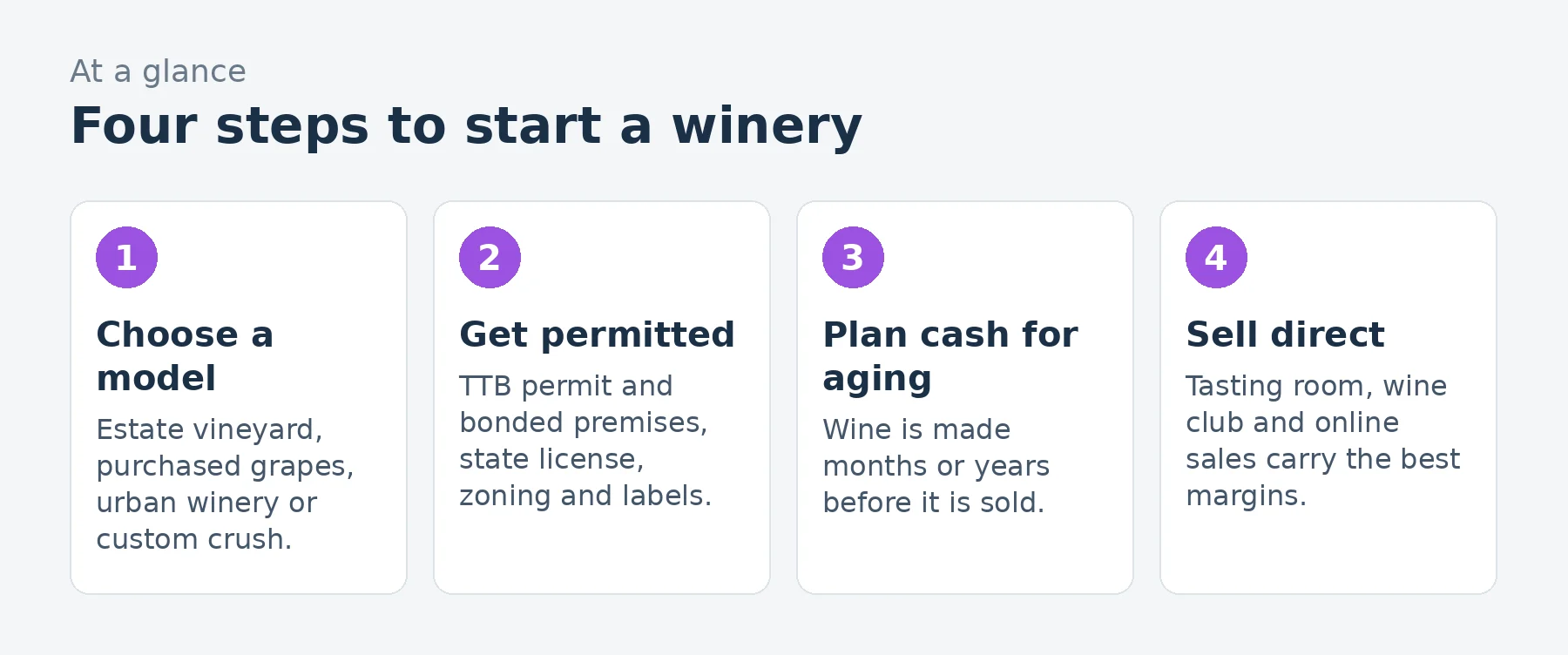
Calculate cost per bottle (grapes, winemaking, packaging, labor, aging and taxes), then price for each channel. Bottles sold in the tasting room or to wine club members earn the full retail price; wine sold to distributors and retailers earns much less per bottle after their margins. Most small wineries rely on direct sales.
A worked example: a small direct-to-consumer winery
These are illustrative assumptions for a small winery selling about 3,000 cases a year, not predictions.
| Assumption | Monthly | |
|---|---|---|
| Tasting room sales | Bottles and tasting fees | $26,000 |
| Wine club shipments | 300 members, average $45 a month equivalent | $13,500 |
| Restaurant and retail accounts | $4,500 | |
| Revenue | $44,000 | |
| Cost of wine sold | Grapes, bottles, corks, labels and winemaking supplies | $(14,500) |
| Excise and state taxes | After small producer credits | $(400) |
| Tasting room and cellar staff | With payroll costs | $(12,500) |
| Rent, utilities and maintenance | $(4,200) | |
| Equipment and barrel payments | $(2,500) | |
| Insurance, compliance and software | $(1,200) | |
| Marketing and events | $(1,500) | |
| Profit before owner pay and taxes | $7,200 |
That leaves about $7,200 a month before the owners’ pay and taxes, on about $44,000 of revenue. The large hidden cost is cash tied up in aging inventory: wine made this year may not be sold until next year or later.
Building a wine club
Wine clubs provide predictable revenue and loyal customers. Offer shipments several times a year with member discounts, early access to releases and member events. Make signing up easy in the tasting room, follow your state’s and destination states’ shipping rules and keep cancellations simple.
Grape sourcing contracts
If you buy grapes, sign written contracts with growers that cover variety, quantity, price per ton, quality standards, harvest timing and what happens in a short crop year. Visit vineyards during the season, build relationships with growers and diversify sources so one bad year does not leave you without fruit.
The tasting room experience
The tasting room is where most small wineries make their money and their fans. Train staff to tell your story and help guests find wines they love, offer seated and reserve tastings at higher prices, sell food pairings where allowed and make joining the wine club easy. Track conversion: how many visitors buy bottles and how many join the club.
Events and agritourism
Events draw visitors and fill quiet days: release parties, harvest celebrations, dinners, live music and private events such as weddings where zoning allows. Partner with nearby lodging, restaurants and tour operators to build a destination.
Choosing wines to make first
Start with a small lineup that fits your grapes, region and customers: often a white, a red and a rosé or sparkling wine, plus one signature wine that tells your story. Wines that release sooner (whites and rosés) bring cash while reds age. Expand the list as you learn what your tasting room guests buy.
Common mistakes to avoid
- Underestimating cash tied up in aging wine.
- Planting a vineyard without understanding the site and years until harvest.
- Ignoring direct shipping rules by state.
- Relying on distributors instead of direct sales.
- Skipping label approval before selling across state lines.
Your first 90 days
- Days 1-30: choose a model, study your state’s winery and shipping rules and visit small wineries.
- Days 31-60: line up grape contracts or a custom crush partner and build a conservative financial plan including aging time.
- Days 61-90: secure a site or alternating proprietorship, begin TTB and state applications and plan your tasting room and club.
Frequently asked questions
Do I need to own a vineyard to start a winery?
No. Many wineries buy grapes or juice, and some start through custom crush or alternating proprietorships.
What federal permits does a winery need?
Registration as a bonded winery with TTB, generally a basic permit for wholesale sales and approved labels for interstate sales.
Can wineries ship directly to customers?
Many states allow direct shipping with a permit and tax collection, but rules vary by destination state.
How are small wineries taxed?
Federal excise tax applies, but small producers can claim credits that significantly reduce it. States add their own taxes.
What is a custom crush facility?
A licensed winery that makes wine for other brands, letting new wineries launch without building a production facility.
How long until a new vineyard produces grapes?
Usually several years before a commercial crop, which is why many new wineries buy grapes while their vineyard matures.
What is an alternating proprietorship?
An arrangement where a new winery shares an established bonded winery’s space and equipment at different times, under its own permits and records.
Do I need a tasting room?
Not legally, but for most small wineries the tasting room and wine club drive the majority of profit, so it is central to the business model.
Keep learning
- Craft beverages industry data
- How to start a craft brewery
- How to start a craft distillery
- How to start a bed and breakfast
Sources
- TTB, Wine: permits and bonded wine premises
- TTB, Tax rates for alcohol beverages
- TTB, Labeling and COLAs
- Axios, Craft beer's decline sets new records in 2025 (Brewers Association annual report)
- US Bureau of Labor Statistics, Food service managers
- US Bureau of Labor Statistics, Bartenders
Last reviewed November 2, 2026. Startup costs are estimates; check local prices, licensing and tax rules before you commit money.

