
A bed and breakfast (B&B) is a small inn, often in the owner’s home, offering a few guest rooms and breakfast with a personal touch. Guests choose B&Bs for character, local knowledge and hospitality they cannot get at a chain hotel: a historic home, a country setting, a memorable breakfast and an innkeeper who knows the area.
It is both a lifestyle and a business. Innkeepers often live on site and work long hours, especially in peak season. The Bureau of Labor Statistics reports a median pay of $68,130 for lodging managers, a benchmark for the management work involved. This guide covers property, zoning and permits, food and fire safety, pricing, a worked example and filling rooms.
A bed and breakfast at a glance
Table of Contents
| Topic | What to expect |
|---|---|
| Startup cost | High: buying or converting a suitable home, renovations, furnishing, safety upgrades and permits |
| Licenses | Zoning approval, lodging or B&B license, health department food permit, fire inspections, occupancy taxes |
| How you earn | Room nights, plus packages, events, gift shop items and extra meals where allowed |
| Demand | Seasonal in many areas; weekends, holidays, festivals and weddings drive bookings |
| Best for | Warm, organized hosts who enjoy cooking, people and living where they work |
Who a B&B suits
It suits people who genuinely enjoy hosting, cooking and sharing their area, and who are comfortable living and working in the same place. You will make breakfast every morning guests are in, clean rooms, handle bookings and maintain an older home, usually with little time off in peak season.
Choosing a property
B&Bs succeed where travelers want to visit: historic towns, wine regions, coastal and mountain areas, college towns and wedding destinations. Look for a home with enough bedrooms that each can have a private bathroom (which guests now expect), space for owners’ private quarters, parking and a dining area. Buying an existing B&B gives you bookings and reviews immediately; converting a home costs less upfront but takes renovation and permitting.
Zoning and licenses
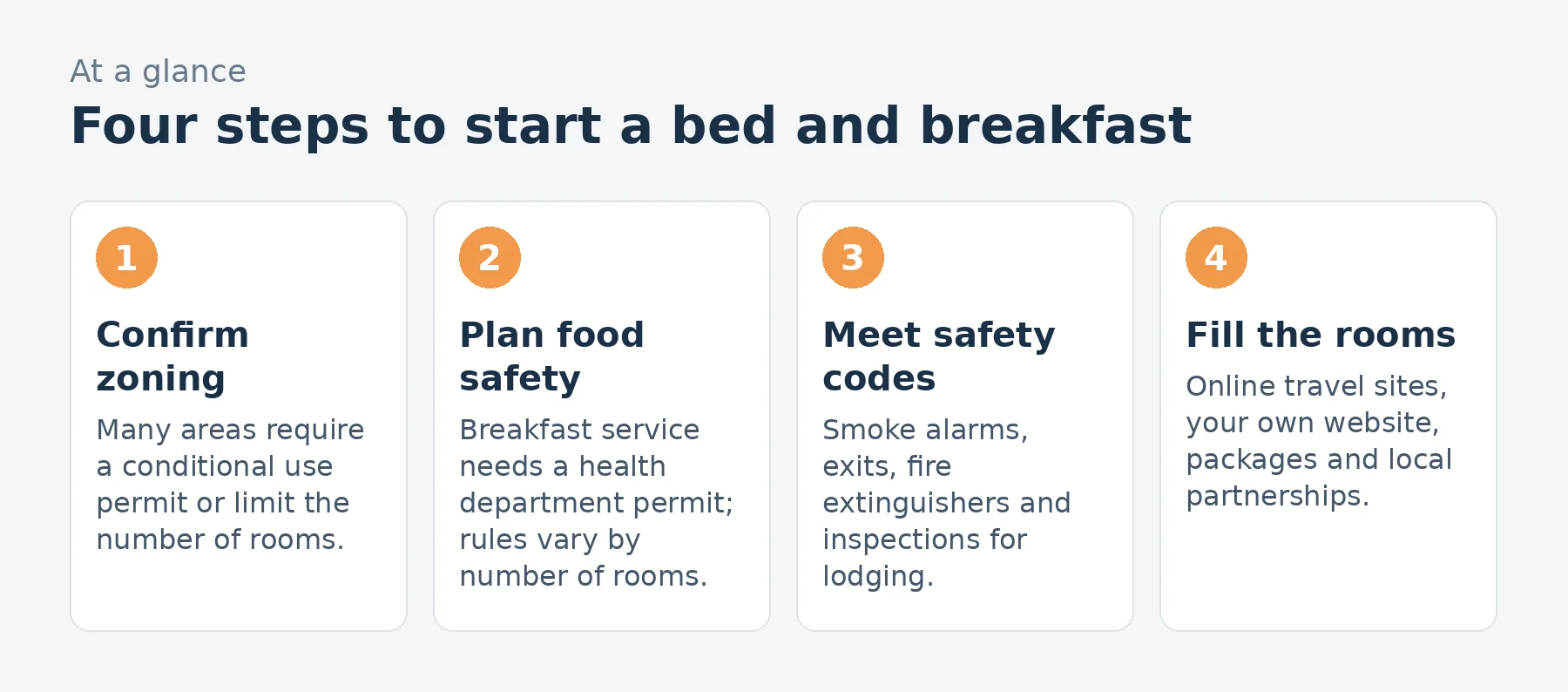
Zoning is the first hurdle. Many residential areas allow B&Bs only with a conditional or special use permit, a limit on rooms and parking requirements. Your state or county may also require a lodging or B&B license, and you will need to collect and remit occupancy taxes. Some areas cap the number of guest rooms for owner-occupied B&Bs before stricter hotel rules apply.
Food permits and fire safety
Serving breakfast usually requires a health department permit, and rules often depend on how many rooms you have and what you serve; very small B&Bs may qualify for simpler rules, while larger ones may need a commercial-style kitchen. Fire codes for lodging typically require interconnected smoke alarms, carbon monoxide detectors, marked exits, fire extinguishers and sometimes sprinklers. Schedule inspections before opening.
Accessibility
Under the Americans with Disabilities Act, places of lodging must meet accessibility requirements, but an exception covers establishments with five or fewer rooms for rent that are also the owner’s residence. Larger B&Bs are generally covered. Check your state’s rules too, and consider accessibility improvements where practical; they widen your market.
Startup costs to plan for
| Item | What to budget for |
|---|---|
| Property | Purchase of an existing B&B or a suitable home |
| Renovations | Private bathrooms, safety upgrades, kitchen improvements |
| Furnishing | Quality beds, linens, decor, dining furniture |
| Permits and inspections | Zoning, lodging, health and fire |
| Insurance | Lodging-specific property and liability coverage |
| Booking and marketing | Website with booking engine, photography, listings |
Use our startup cost calculator for your total.
Pricing your rooms
Research comparable B&Bs, boutique hotels and vacation rentals nearby, and price by room, season and day of week. Weekends, holidays and local events support higher rates and minimum stays. For broader context, AirDNA’s 2026 data put U.S. short-term rental occupancy around 57% for the year; B&B occupancy varies widely by location and season. Packages (romance, wine tasting, local attractions) raise the average stay value.
A worked example: a five-room inn
These are illustrative assumptions for a five-room B&B in a good month, not predictions.
| Assumption | Monthly | |
|---|---|---|
| Room revenue | 5 rooms, 60% occupancy (90 room nights) at $195 | $17,550 |
| Packages and extras | Romance packages, picnic baskets, gift items | $900 |
| Revenue | $18,450 | |
| Food and breakfast supplies | $(1,800) | |
| Housekeeping help | Part-time | $(2,600) |
| Utilities and internet | $(1,100) | |
| Online travel agency commissions | On about half of bookings | $(1,300) |
| Insurance | Property and liability for lodging | $(500) |
| Maintenance and replacements | $(900) | |
| Marketing and booking software | $(400) | |
| Profit before owner pay and taxes | $9,850 |
That leaves about $9,850 a month before mortgage, property taxes, occupancy taxes and the innkeepers’ pay, on about $18,450 of revenue in a good month. Quiet months can be much slower, so plan around annual occupancy, not peak season.
Filling your rooms
- Online travel agencies and vacation rental platforms for reach, balanced against their commissions.
- Your own website with direct booking, encouraged for repeat guests.
- Local partners: wineries, wedding venues, attractions and businesses with visiting clients.
- Packages and events: holiday weekends, murder mystery nights and small retreats.
- Reviews: respond to every review and earn repeat guests.
Running the inn day to day
- Confirm arrivals, special requests and dietary needs before guests arrive.
- Welcome guests personally with local recommendations.
- Serve breakfast at set times with options for allergies.
- Clean and inspect rooms between guests to a high standard.
- Track maintenance and handle small repairs before guests notice.
Breakfast guests remember
Breakfast is your signature. Plan a menu you can execute well every morning, with a house specialty, local ingredients (eggs from a nearby farm, local honey, baked goods) and options for common dietary needs. Ask about allergies and preferences at booking, serve at set times that suit your guests, and keep food safety standards high. Many innkeepers find that a memorable breakfast is mentioned in more reviews than anything else.
The innkeeper’s year
Peak seasons mean full rooms, early mornings and little time off; quiet seasons bring time for maintenance, renovations, marketing and rest. Plan your calendar around both: schedule repairs and deep cleaning in slow months, create off-season packages and events to bring guests in, and arrange backup help so you can take breaks. Many innkeepers close for a few weeks each year to recharge.
Buying an existing B&B
If you buy an operating inn, review at least three years of financial records, occupancy and booking sources, reviews, permits and inspection history, and the condition of the building and systems. Ask why the owners are selling, and whether permits transfer to a new owner. A professional inspection and a lodging-experienced accountant are worth their cost.
Earning repeat guests
Repeat guests and referrals reduce booking commissions and fill quiet months. Collect guest emails (with permission), send a seasonal newsletter with events and packages, remember returning guests’ preferences and offer a returning-guest rate for direct bookings. Small touches, such as a handwritten note or a favorite breakfast, are what guests remember and tell friends about.
Common mistakes to avoid
- Buying a property before confirming zoning and permits.
- Underestimating renovation and maintenance costs in older homes.
- Relying entirely on commission-heavy booking sites.
- Pricing from peak-season occupancy.
- Burning out with no help or time off.
Your first 90 days
- Days 1-30: research markets and zoning, visit existing B&Bs and talk to innkeepers.
- Days 31-60: choose a property, confirm permits and renovation costs and arrange financing.
- Days 61-90: plan renovations and inspections, build your website and booking system, and line up local partners.
Frequently asked questions
Do I need a permit to run a B&B?
Usually yes: zoning approval, often a lodging license, a health permit for breakfast, fire inspections and occupancy tax registration.
Does the ADA apply to bed and breakfasts?
Lodging is generally covered, but establishments with five or fewer rooms for rent that are also the owner’s residence are excepted. Larger B&Bs are generally covered.
Can I serve dinner at my B&B?
That usually requires additional food permits and sometimes a commercial kitchen. Check with your health department.
How many rooms should a B&B have?
Many have three to eight. More rooms raise income but can trigger stricter rules and require staff.
Is it better to buy an existing B&B?
It provides bookings, reviews and approvals immediately but costs more. Converting a home costs less upfront but takes time and permits.
How much can a bed and breakfast earn?
It depends on rooms, rates, occupancy and costs. The worked example above shows how a five-room inn’s monthly numbers add up before mortgage and owner pay.
Do B&B guests expect private bathrooms?
Most travelers now do. Rooms with private bathrooms book more easily and command higher rates, so many innkeepers add bathrooms during renovations.
Can a bed and breakfast host weddings or events?
Some do, which can add significant revenue, but events often require separate zoning approval, parking plans, noise limits and sometimes liquor licensing. Check with your planning department before marketing events.
Keep learning
- Bed and breakfasts industry data
- How to start an Airbnb rental business
- How to start a glamping business
- Startup cost calculator
Sources
- US Bureau of Labor Statistics, Lodging managers
- ADA.gov, Title III regulations (places of lodging)
- ShortTermRentalz, AirDNA 2026 Midyear Outlook
- US Small Business Administration, Apply for licenses and permits
Last reviewed November 2, 2026. Startup costs are estimates; check local prices, licensing and tax rules before you commit money.

