
An Airbnb rental business earns money by renting furnished homes, apartments or rooms to travelers by the night, through platforms such as Airbnb and Vrbo and through direct bookings. Owners range from people renting a spare room to investors operating several vacation homes.
The market has matured. AirDNA’s 2026 Midyear Outlook forecasts U.S. short-term rental occupancy of 57.4% for 2026, slightly above the pre-pandemic level, with revenue per available rental up about 2.9%, driven mainly by higher nightly rates. In March 2026, AirDNA reported an average daily rate of about $269. But local rules decide whether you can operate at all, so this guide starts there, then covers properties, pricing, operations, a worked example and taxes.
An Airbnb rental business at a glance
Table of Contents
| Topic | What to expect |
|---|---|
| Startup cost | Moderate to high: property purchase or lease, furnishing, supplies, permits and insurance |
| Licenses | Local short-term rental permits or registration in many cities; occupancy taxes; some cities ban or limit rentals |
| Market in 2026 | AirDNA forecasts 57.4% U.S. occupancy and revenue per rental up 2.9%; March 2026 average nightly rate about $269 |
| Biggest risks | Local rule changes, too much nearby supply, seasonality, guest damage and high operating costs |
| Best for | Hospitality-minded owners who research markets carefully and run tight operations |
Who this business suits
It suits people who enjoy hospitality and details, respond quickly to messages and can manage cleaners and repairs reliably. Investors who buy properties also need capital and a tolerance for real estate risk.
The Bureau of Labor Statistics reports a median pay of $66,700 for property, real estate and community association managers (May 2024), a useful benchmark for what professional management of rentals is worth.
Check local rules before anything else
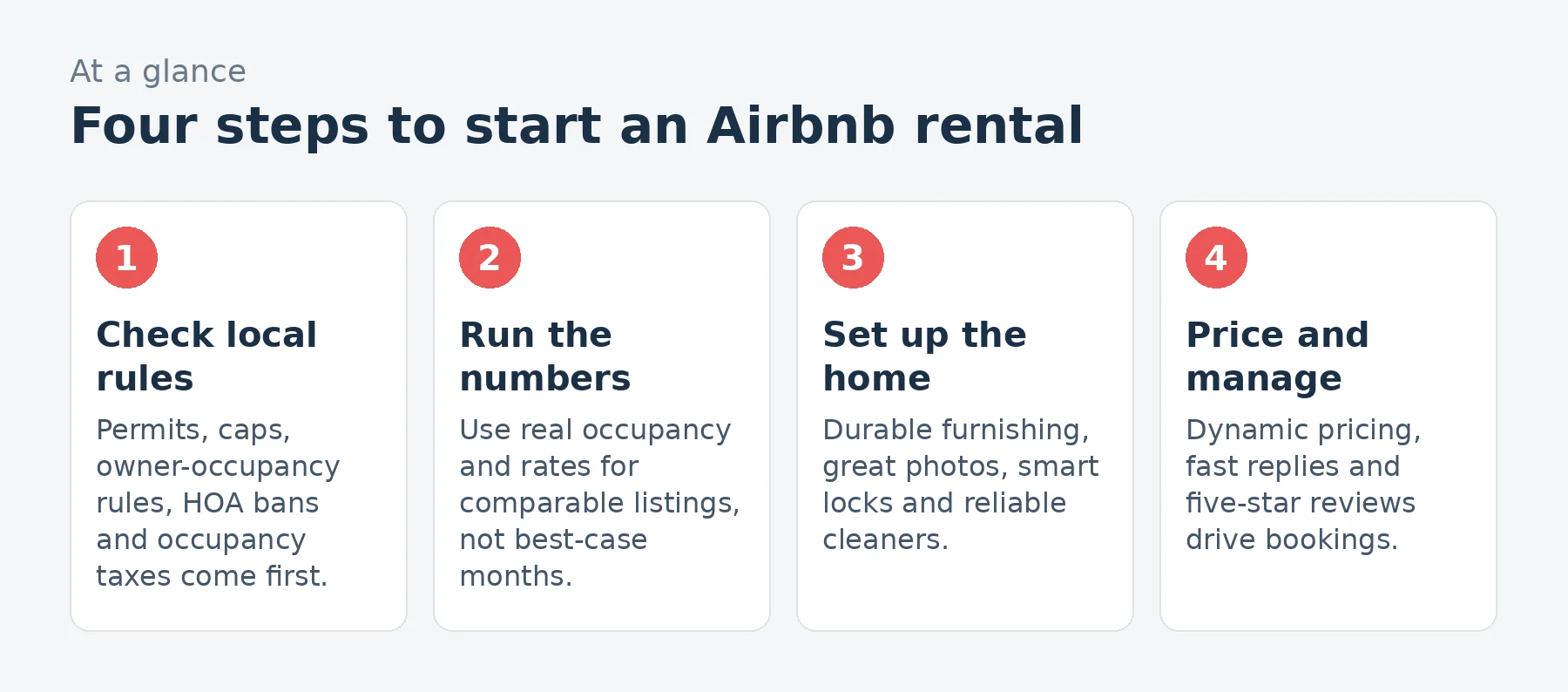
Short-term rental rules are set by cities and counties, and they change often. Before buying, leasing or furnishing a property, check:
- Permits or registration: many cities require a short-term rental permit and display of the permit number in listings.
- Bans and caps: some cities limit rentals to primary residences, cap the number of nights or ban them in certain zones. New York City’s registration law, for example, sharply restricts short stays in most homes.
- Occupancy taxes: hotel and lodging taxes apply in most places; some platforms collect them, but not all taxes everywhere.
- HOA and lease rules: homeowners associations and landlords may prohibit short-term rentals.
- Safety rules: smoke and carbon monoxide detectors, fire extinguishers and occupancy limits.
Enforcement is tightening. California’s SB 346 took effect January 1, 2026, to strengthen enforcement of short-term rental licensing and tax requirements, and Austin has delisted unlicensed rentals since July 2026.
Choosing a market and property
Look for steady demand from tourism, business travel, hospitals, universities or events, and check supply: how many comparable listings compete and how they perform through the year. Data tools such as AirDNA show occupancy, nightly rates and seasonality by market. The best properties offer something guests search for: space for families, parking, a view, a hot tub, pet-friendliness or walkability.
Some operators lease properties with landlord permission to rent them short term (often called rental arbitrage). It needs less capital but adds the risk of rent you owe whether or not guests book, and it requires written permission.
Startup costs to plan for
| Item | What to budget for |
|---|---|
| Property | Down payment and closing costs, or lease deposits |
| Furnishing | Durable furniture, beds, linens, kitchenware, decor |
| Safety and tech | Smart lock, detectors, extinguishers, Wi-Fi, noise monitor |
| Photos and listing | Professional photography |
| Permits and taxes | Short-term rental permit and tax registration |
| Insurance | Short-term rental coverage |
Use our startup cost calculator for your total.
Pricing and occupancy in 2026
AirDNA’s 2026 data gives national context: a forecast 57.4% occupancy for the year, revenue per available rental up about 2.9% thanks to rate growth, and an average daily rate of about $269 in March 2026, when occupancy ran 61.3%. Your market can be far higher or lower.
Use dynamic pricing to adjust rates daily for weekends, seasons, holidays and local events; large events can lift rates dramatically for a few nights. Set minimum stays and cleaning fees thoughtfully, because high fees push guests to competitors.
A worked example: one three-bedroom home
These are illustrative assumptions for a three-bedroom home at about the national occupancy forecast, not predictions.
| Assumption | Monthly | |
|---|---|---|
| Nightly revenue | 17.5 nights a month (about 58% occupancy) at $270 | $4,725 |
| Cleaning fees collected | 5 stays at $180 | $900 |
| Revenue | $5,625 | |
| Platform service fees | Host-side fees on bookings | $(250) |
| Cleaning paid to cleaners | 5 turnovers at $140 | $(700) |
| Supplies and consumables | Linens, toiletries, coffee | $(200) |
| Utilities, internet and streaming | $(450) | |
| Short-term rental insurance | $(210) | |
| Maintenance and repairs reserve | $(400) | |
| Pricing and lock software | $(60) | |
| Profit before owner pay and taxes | $3,355 |
That leaves about $3,355 a month before mortgage or rent, property taxes, occupancy taxes passed to the city and income taxes, on about $5,625 of revenue. The mortgage is often the largest cost of all, so run the full numbers for a specific property before buying.
Furnishing for durability
Furnish for heavy use, not a showroom. Choose performance fabrics, washable slipcovers, solid wood or metal frames, mattress protectors, white linens that can be bleached and enough duplicate sets for quick turnovers. Keep a stocked supply closet so cleaners can replace broken glasses or worn towels immediately, and photograph the furnished home for an inventory record.
Operations that earn five-star reviews
- Reply to inquiries quickly and send clear check-in instructions.
- Use self check-in with a smart lock and unique codes.
- Hire reliable cleaners, with a checklist and photos after each turnover.
- Stock the essentials guests expect: quality linens, coffee, toiletries and a well-equipped kitchen.
- Handle problems fast and kindly; a fixed problem can still earn a good review.
- Ask for reviews and respond to every one.
A listing that converts
Guests decide in seconds, so your listing must sell the stay. Lead with professional photos of the best spaces and features, write a title that names what guests search for (sleeps eight, hot tub, walk to the beach), list every amenity accurately and explain the neighborhood and parking clearly. Keep your calendar current and respond to inquiries within minutes when you can; platforms reward responsive hosts with better placement.
Guest screening and house rules
Clear house rules prevent most problems: maximum guests, quiet hours, no parties, pets, smoking and parking. Use platform tools to review guest profiles and reviews, set minimum ages where allowed and require guests to agree to your rules before booking. Noise monitors that measure sound levels (without recording conversations) can alert you to parties early. Treat every guest fairly and follow fair housing and platform anti-discrimination policies.
Insurance and protecting the property
Standard homeowners policies often exclude business use, so get short-term rental insurance covering liability, property damage and loss of income. Platform host protection programs help but are not a substitute. Use house rules, security deposits or damage protection, and noise and occupancy monitoring (without cameras inside private spaces, which platforms prohibit).
Taxes
Rental income is taxable, and short-term rentals can be treated differently from long-term rentals depending on average stay length and the services you provide. Track every expense, collect and remit occupancy taxes where platforms do not, and talk to an accountant who works with short-term rental owners.
Common mistakes to avoid
- Buying before confirming local permits and HOA rules.
- Projecting income from peak-season months.
- Underestimating cleaning, furnishing and maintenance costs.
- Ignoring occupancy taxes.
- Slow responses to guests.
Your first 90 days
- Days 1-30: research local rules and three markets, and model income with comparable listings.
- Days 31-60: secure the property, permits, tax registration and insurance; furnish and photograph it.
- Days 61-90: launch the listing with competitive opening prices, collect early reviews and refine operations.
Frequently asked questions
Is Airbnb still profitable in 2026?
It can be in the right markets. AirDNA forecasts 57.4% U.S. occupancy for 2026 with revenue per rental up about 2.9%, but local rules, supply and costs decide profitability.
Do I need a permit to rent on Airbnb?
Many cities require permits or registration, and some ban or limit short-term rentals. Check before buying or listing.
Can I rent out an apartment I lease?
Only with written permission from your landlord and if local rules allow it.
What insurance do I need?
Short-term rental insurance covering liability, property damage and lost income, since homeowners policies often exclude business use.
How do I set nightly prices?
Start with comparable listings and use dynamic pricing to adjust for seasons, weekends and events.
Should I use more than one booking platform?
Many hosts list on several platforms and their own website to reach more guests, using a channel manager to keep calendars in sync and avoid double bookings.
How many nights a year do short-term rentals book?
It varies widely by market and season. AirDNA forecast U.S. occupancy of 57.4% for 2026, roughly 210 nights a year on average, but your market and property type matter most.
Keep learning
- Short-term rentals industry data
- How to start a short-term rental co-hosting business
- How to start a short-term rental turnover cleaning business
- Business Idea Reality Check
Sources
- ShortTermRentalz, AirDNA 2026 Midyear Outlook
- AirDNA March 2026 U.S. review (via In Travel Report)
- RedAwning, Is Airbnb worth it in 2026? (AirDNA management fee guidance)
- Coronado Times, Vacation rental investors and 2026 rules (California SB 346, Austin)
- NYC Office of Special Enforcement, Short-term rental registration
- US Bureau of Labor Statistics, Property, real estate and community association managers
Last reviewed November 2, 2026. Startup costs are estimates; check local prices, licensing and tax rules before you commit money.

