
A short-term rental co-host manages vacation rentals for owners who do not want to do the work themselves: listing and pricing, guest messages, cleaning and turnovers, maintenance and reviews. Co-hosting lets you build a hospitality business without buying property, earning a share of each home’s rental income.
Owners pay meaningful fees for this. Full-service short-term rental management typically runs 15% to 25% of rental income, according to AirDNA’s 2026 guidance, with some arrangements higher. Your value is simple: earn the owner more than your fee costs them, with less stress. This guide covers services, fees, licensing, contracts, teams, a worked example and how to win owners.
A co-hosting business at a glance
Table of Contents
| Topic | What to expect |
|---|---|
| Startup cost | Low: software, insurance, business setup and marketing; no property purchase needed |
| Licenses | Business license; some states require a real estate or property management license to manage rentals for others |
| Typical fees | Full-service management about 15% to 25% of rental income (AirDNA 2026 guidance); limited services cost less |
| Key skills | Pricing, guest communication, cleaning logistics and owner reporting |
| Best for | Organized, responsive people who like hospitality and managing teams |
Who co-hosting suits
It suits people who respond fast, solve problems calmly and enjoy making guests happy, and who can manage cleaners and repairs at a distance. Many co-hosts start by managing their own rental, then take on homes for friends and neighbors.
The Bureau of Labor Statistics reports a median pay of $66,700 for property, real estate and community association managers in May 2024.
Services owners pay for
- Listing setup: photos, descriptions, amenities, house rules and pricing settings.
- Dynamic pricing: adjusting rates for seasons, weekends and events.
- Guest communication: inquiries, check-in instructions and problems, around the clock.
- Cleaning and turnovers: scheduling cleaners, inspections and restocking.
- Maintenance: handling repairs through trusted contractors.
- Reviews and reputation: responding to reviews and fixing recurring complaints.
- Owner reporting: monthly income, expenses and occupancy statements.
Some co-hosts offer limited packages (pricing and messaging only) for owners who handle cleaning themselves.
Licensing and the law
In some states, managing rental property for others for compensation requires a real estate broker or property management license, and the rules may cover short-term rentals. Check your state’s real estate commission before taking clients. You also need to follow each property’s local short-term rental rules: permits, occupancy limits and tax collection. California’s SB 346, effective January 2026, and Austin’s 2026 delisting of unlicensed rentals show how enforcement is tightening.
Owner agreements
Use a written management agreement that covers your fee and what it includes, who pays cleaning and supplies, spending limits for repairs without approval, how and when you pay owners, owner use of the property, termination terms and responsibility for permits and taxes. Clear agreements prevent most disputes.
Startup costs to plan for
| Item | What to budget for |
|---|---|
| Software | Channel manager, dynamic pricing, messaging automation |
| Insurance | General and professional liability |
| Licensing | Real estate or property management license if your state requires it |
| Business setup | LLC, contracts, accounting |
| Marketing | Website, case studies, local networking |
Use our startup cost calculator for your total.
Setting your fees
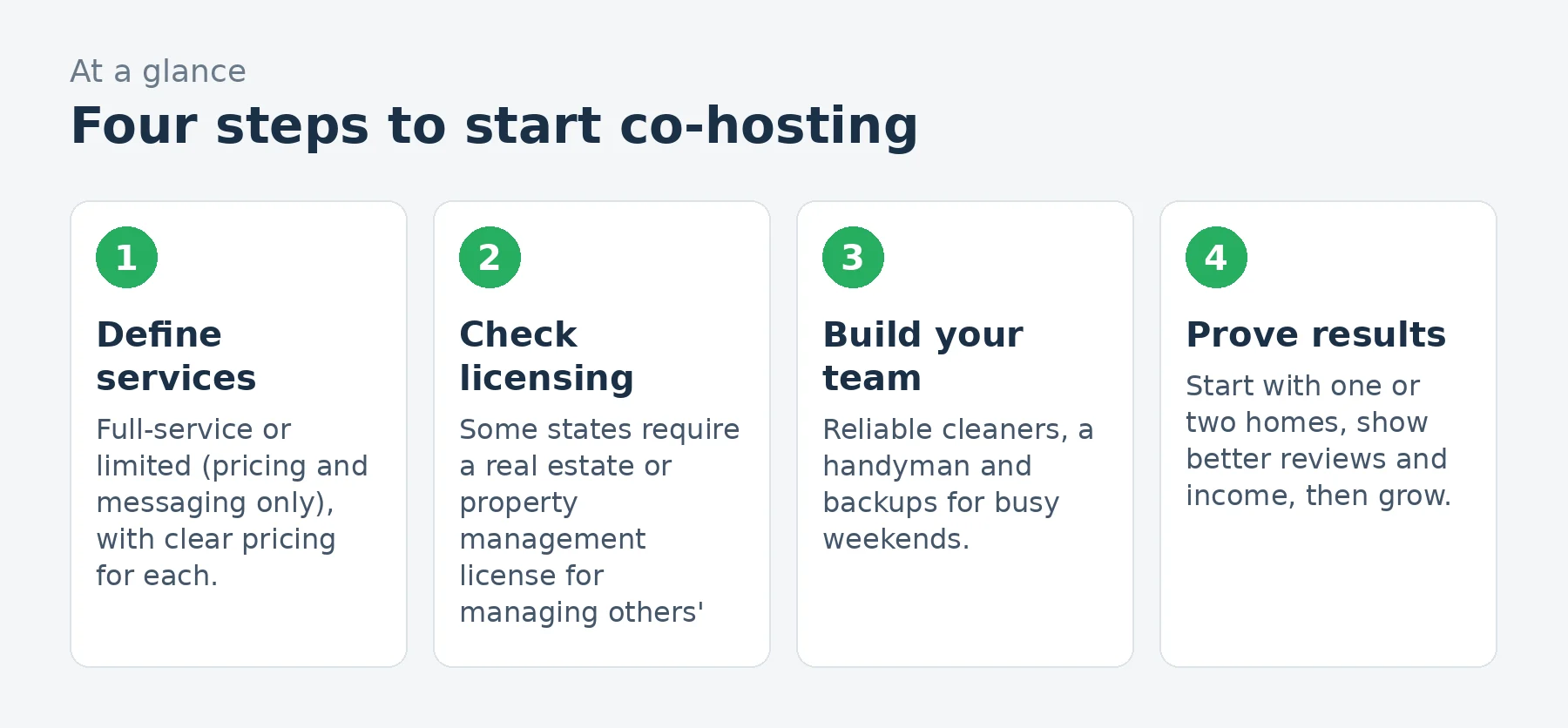
Full-service management typically runs 15% to 25% of rental income, according to AirDNA’s 2026 guidance. Limited services cost less. Many co-hosts also charge a one-time onboarding fee for listing setup and photography. Base your fee on the work involved: a large vacation home with frequent turnovers needs more time than a city apartment with longer stays.
A worked example: eight homes
These are illustrative assumptions for a co-host managing eight homes, not predictions.
| Assumption | Monthly | |
|---|---|---|
| Management fees | 8 homes averaging $4,800 a month in rental income, 20% fee | $7,680 |
| Setup fees | One new home onboarded at $500 | $500 |
| Revenue | $8,180 | |
| Software | Channel manager, pricing and messaging tools | $(400) |
| Assistant or guest messaging help | Part-time | $(1,500) |
| Insurance | General and professional liability | $(150) |
| Vehicle and fuel | Inspections and emergencies | $(350) |
| Marketing | $(300) | |
| Profit before owner pay and taxes | $5,480 |
That leaves about $5,480 a month before the owner’s pay and taxes, on about $8,180 of revenue. In this example owners pay cleaning costs through guest cleaning fees; if your contract includes cleaning, your costs and fees change accordingly.
Building your cleaning and maintenance team
Cleaners are the backbone of the business. Recruit more than you need, pay fairly and promptly, give them checklists and photo standards, and keep backups for busy weekends and holidays. Build relationships with a handyman, plumber, electrician, HVAC company and pest control service who respond quickly.
Landing your first owner
Your first client is the hardest. Offer a free review of the owner’s listing with specific improvements (photos, title, pricing, amenities), or a reduced fee for the first few months in exchange for a testimonial. Track the home’s occupancy, nightly rate and reviews before and after you take over, and turn the results into a short case study you can share with the next owner.
Winning owners
- Start local: owners who live far away or are tired of managing their own rentals.
- Show results: occupancy, average nightly rate and review improvements from homes you manage.
- Real estate agents: buyers of vacation homes often ask for management recommendations.
- Your network: friends and neighbors with spare homes or rooms.
A week in the life of a co-host
- Daily: answer guest messages, confirm cleanings and check upcoming arrivals.
- Each turnover: review cleaner photos, restock supplies and fix small issues.
- Weekly: adjust pricing for upcoming weekends and events, and review occupancy against competitors.
- Monthly: send owner statements, pay cleaners and contractors and review reviews for recurring problems.
- Seasonally: deep cleans, maintenance inspections and listing photo updates.
Automation tools for messages and pricing save hours, but someone must always be reachable when guests need help.
Owner reporting that builds trust
Owners stay when they see clear results. Send a monthly statement with gross booking revenue, platform fees, cleaning costs, your management fee, repairs and the owner’s net payout, plus occupancy, average nightly rate and recent reviews. Explain changes honestly, especially in slow months, and suggest improvements (new photos, a hot tub, pet-friendly policies) backed by data.
Growing beyond one market
Growth usually comes from density: more homes in the same area share the same cleaners, handyman and supplies, so each new home adds profit with little extra cost. Expanding to a new town means building a new local team, so do it deliberately, ideally with a reliable local partner or team lead.
Pricing strategy for client homes
Pricing is where co-hosts earn their fee. Compare each home with similar nearby listings, set base rates by season, raise weekend and event prices, use last-minute discounts carefully and adjust minimum stays to fill gaps between bookings. Review results weekly: if a home is fully booked months ahead, rates are probably too low; if weekends are empty two weeks out, something needs to change.
Handling emergencies
Things go wrong: lockouts, broken heaters, leaks and noise complaints. Keep a written emergency plan for each home with shut-off locations, contractor contacts, spare key or code procedures and the owner’s approval limits. Respond to guests immediately, document the issue with photos and tell the owner promptly. Fast, calm handling often turns a problem into a positive review.
Common mistakes to avoid
- Managing for others without a required license.
- Vague agreements about who pays what.
- Taking on too many homes before your cleaning team is reliable.
- Ignoring local permits and taxes for client homes.
- Promising income you cannot deliver.
Your first 90 days
- Days 1-30: check licensing rules, register your business, buy insurance and draft your management agreement.
- Days 31-60: set up software, recruit cleaners and onboard one or two homes.
- Days 61-90: improve those listings, document results and approach five more owners.
Frequently asked questions
How much do short-term rental co-hosts charge?
Full-service management typically runs 15% to 25% of rental income, according to AirDNA’s 2026 guidance, with limited services costing less.
Do I need a license to co-host?
Some states require a real estate or property management license to manage rentals for others. Check with your state’s real estate commission.
Do I need to own property to co-host?
No. Co-hosts manage homes owned by others.
Who pays for cleaning?
Usually the owner, often covered by guest cleaning fees, but your agreement should say clearly.
How many homes can one co-host manage?
It depends on location, turnovers and support. Many start with a few and add assistants as they grow.
Should co-hosts charge a setup fee?
Many charge a one-time onboarding fee to cover listing setup, photography and initial supplies, separate from the ongoing percentage fee.
What software do co-hosts use?
Most use a channel manager to sync calendars across platforms, a dynamic pricing tool, automated messaging, a cleaning scheduler and accounting software for owner statements.
Can I co-host remotely?
Partly. Pricing and messaging can be done anywhere, but you need a reliable local team for cleaning, inspections, repairs and emergencies.
Keep learning
- Short-term rentals industry data
- How to start an Airbnb rental business
- How to start a short-term rental turnover cleaning business
- Invoice generator
Sources
- RedAwning, Is Airbnb worth it in 2026? (AirDNA management fee guidance)
- ShortTermRentalz, AirDNA 2026 Midyear Outlook
- AirDNA March 2026 U.S. review (via In Travel Report)
- Coronado Times, Vacation rental investors and 2026 rules (California SB 346, Austin)
- US Bureau of Labor Statistics, Property, real estate and community association managers
Last reviewed November 2, 2026. Startup costs are estimates; check local prices, licensing and tax rules before you commit money.

