
Salsas, sauces, snacks, baked goods, granola and specialty foods can grow from a home kitchen into regional and national brands. The path runs through food safety rules, labeling requirements and retail economics that surprise many founders. Food service managers earned a median of $65,310 in May 2024, according to the Bureau of Labor Statistics, and bakers earned about $37,160, according to BLS figures as reported. Below is the key industry data on packaged food brands, with costs, business models and a first-year projection.
Brands typically start under state cottage food laws or in rented commercial kitchens, sell at farmers markets and online, and then move into stores using their own facility or a co-packer.
The workforce
| Occupation | Jobs (2024) | Median pay (May 2024) | Projected growth, 2024 to 2034 |
|---|---|---|---|
| Food service managers | 352,800 | $65,310 | +6% |
| Bakers (figures as reported) | n/a | $37,160 | n/a |
Source: U.S. Bureau of Labor Statistics, Occupational Outlook Handbook and Occupational Employment and Wage Statistics.
Market data
| Measure | Value |
|---|---|
| U.S. retail e-commerce share of total sales, Q2 2026 (Census) | 17.1% |
Business models compared
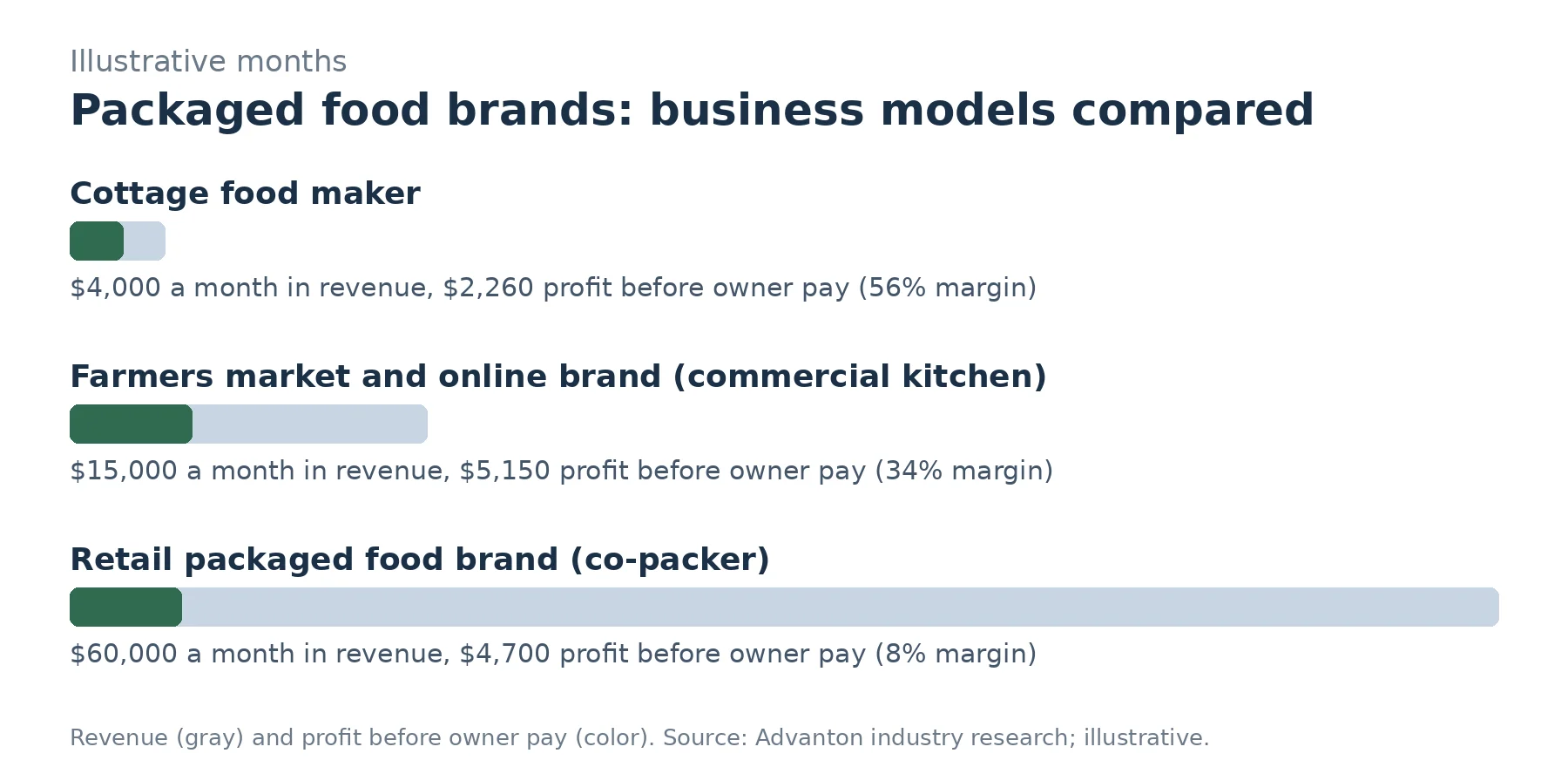
The figures below are illustrative months from our research, not industry averages. They show how revenue and costs typically fit together; your market, prices and costs will differ.
| Business model | Startup costs | Example monthly revenue | Costs | Profit before owner pay | Margin |
|---|---|---|---|---|---|
| Cottage food maker | Low: ingredients, packaging, labels, permits where required | $4,000 | $1,740 | $2,260 | 56% |
| Farmers market and online brand (commercial kitchen) | Moderate: kitchen rental, packaging, labels, shipping | $15,000 | $9,850 | $5,150 | 34% |
| Retail packaged food brand (co-packer) | High: co-packer minimums, packaging, retail fees, inventory | $60,000 | $55,300 | $4,700 | 8% |
Fixed and variable costs
For projections, the most useful split is between variable costs, which rise and fall with sales (materials, supplies, hourly labor, fees), and fixed costs, which you pay every month regardless (rent, salaried staff, insurance, loan payments).
| Business model | Variable costs (% of revenue) | Fixed costs per month | What it means |
|---|---|---|---|
| Cottage food maker | 38.8% | $190 | Balanced: margins improve as volume grows |
| Farmers market and online brand (commercial kitchen) | 50.7% | $2,250 | Mostly variable: profitable early, but watch cash flow |
| Retail packaged food brand (co-packer) | 70.0% | $13,300 | Mostly variable: profitable early, but watch cash flow |
What the numbers say
Direct sales keep the full retail price, giving cottage and market brands strong margins on small volume.
Retail brands give up margin to distributors, retailers, brokers and promotions in exchange for scale.
Co-packers reduce capital needs but require minimum orders and careful planning.
The three models in brief
Cottage food maker. Home-produced foods allowed under state cottage food laws. See bakery data.
Farmers market and online brand. Production in a rented commercial kitchen, selling direct.
Retail packaged food brand. Products made by a co-packer and sold through distributors and stores. See independent retail data.
Cost structure: farmers market and online brand (commercial kitchen)
Each cost as a share of the example month’s revenue ($15,000):
| Cost | Monthly amount | Share of revenue | Type |
|---|---|---|---|
| Ingredients | $3,300 | 22.0% | Variable |
| Production help | $1,500 | 10.0% | Variable |
| Packaging and labels | $1,200 | 8.0% | Variable |
| Kitchen rental | $1,200 | 8.0% | Fixed |
| Shipping | $900 | 6.0% | Variable |
| Marketing | $800 | 5.3% | Fixed |
| Market and platform fees | $700 | 4.7% | Variable |
| Insurance | $150 | 1.0% | Fixed |
| Software | $100 | 0.7% | Fixed |
| Profit before owner pay | $5,150 | 34% |
A first-year projection: farmers market and online brand (commercial kitchen)
New businesses rarely start at full speed. This projection assumes revenue ramps from 35% of the example month in month 1 to 100% by month 12, variable costs move with revenue, and fixed costs stay the same every month. It’s a planning illustration, not a forecast.
| Month | Revenue | Variable costs | Fixed costs | Profit | Cumulative |
|---|---|---|---|---|---|
| 1 | $5,250 | $2,662 | $2,250 | $338 | $338 |
| 2 | $6,750 | $3,422 | $2,250 | $1,078 | $1,416 |
| 3 | $8,250 | $4,183 | $2,250 | $1,817 | $3,233 |
| 4 | $9,300 | $4,715 | $2,250 | $2,335 | $5,568 |
| 5 | $10,500 | $5,324 | $2,250 | $2,926 | $8,494 |
| 6 | $11,400 | $5,780 | $2,250 | $3,370 | $11,864 |
| 7 | $12,300 | $6,236 | $2,250 | $3,814 | $15,678 |
| 8 | $13,050 | $6,616 | $2,250 | $4,184 | $19,862 |
| 9 | $13,650 | $6,921 | $2,250 | $4,479 | $24,341 |
| 10 | $14,250 | $7,225 | $2,250 | $4,775 | $29,116 |
| 11 | $14,700 | $7,453 | $2,250 | $4,997 | $34,113 |
| 12 | $15,000 | $7,605 | $2,250 | $5,145 | $39,258 |
Year one: revenue $134,400, profit before owner pay $39,258. The first profitable month is month 1. Cumulative results stay positive from the start, before any startup costs.
Most costs scale with sales, so this retail brand illustration is profitable from month 1 on paper. The real cash commitment comes first: co-packer minimum production runs, packaging orders, slotting fees and opening inventory, which must be paid long before retail sales arrive.
How food brands earn
- Direct sales at markets and online.
- Wholesale to local stores and cafes.
- Distributor sales to grocery chains.
- Gift boxes and corporate orders.
- Private label production for others.
Cottage food first
Cottage food laws let you test recipes and build a following with low costs. Know your state’s list of allowed foods, sales limits, labeling and where you can sell.
Labels and allergens
Labels must list ingredients, net weight, your business details and major food allergens, which now include sesame. Nutrition facts are required for most products unless you qualify for a small business exemption. Accurate labels protect customers and your brand.
A startup checklist for packaged food brands
- Check cottage food rules or secure a licensed kitchen.
- Register the facility with FDA when required.
- Create compliant labels with allergens.
- Get product liability insurance.
- Test shelf life and food safety.
Co-packers
Co-packers manufacture products to your recipe. Expect minimum runs, formulation and testing costs, and contracts covering quality and recipes. Protect your formulas with clear agreements.
Retail economics
Grocery retail involves distributor margins, retailer margins, slotting fees, promotions and free product. Model your price from shelf price backward to make sure you still profit.
Where the opportunities are
- Better-for-you snacks.
- Regional and cultural foods.
- Allergen-friendly products.
- Gift and specialty markets.
- Local grocery and co-op shelves.
Key terms
| Term | Meaning |
|---|---|
| Co-packer | A manufacturer producing your product |
| Slotting fee | Payment to retailers for shelf space |
| Cottage food | Home-produced foods allowed by state law |
| Velocity | How fast a product sells per store |
Key numbers to track
Track cost per unit, gross margin by channel, sell-through and velocity, promotion costs and inventory age.
Common mistakes
- Entering retail before proving demand.
- Underpricing after retail and distributor margins.
- Label errors.
- Skipping shelf-life testing.
- Too much inventory too early.
Marketing a food brand
Demos, farmers markets, social media, local press and retailer partnerships build demand. See bakery data.
Food safety plans
Written food safety plans, supplier controls and recall procedures protect customers and are required for many facilities.
Online sales
Shipping perishable foods requires insulated packaging and careful logistics; shelf-stable foods ship more easily.
Packaging
Packaging must protect food, meet labeling rules and stand out on shelves.
Pricing from the shelf backward
Start with the shelf price shoppers will pay, then subtract the retailer’s margin, the distributor’s margin, promotions and broker commissions to find what you’ll actually receive. If that amount doesn’t cover your cost per unit plus a healthy margin, rework the product, package size or channel before launching.
Getting into local stores
Independent grocers, co-ops and specialty shops are often the first retail step. Bring samples, a sell sheet with pricing and margins, and offer in-store demos. Local success becomes proof for larger buyers.
Funding growth
Inventory and retail fees require cash; plan funding before major retail launches.
Test these numbers with your own plan
Open this industry in our free Business Idea Reality Check to start from any model above, change prices, costs, startup budget and your own pay, and see your break-even month, the cash you’d need, three scenarios and how new businesses in this sector survive in your state.
- Start with the closest model and its cost structure.
- Replace every price and cost with local quotes.
- Estimate your ramp: how fast customers will realistically come in year one.
- Map cash month by month with the free Cash & Payroll Planner.
- Build the full plan in the free Business Planner.
About this data
Workforce figures come from the U.S. Bureau of Labor Statistics (Occupational Outlook Handbook and Occupational Employment and Wage Statistics, May 2024 wages and the 2024 to 2034 projections, unless noted). Market figures cite their sources above. Business model figures are illustrative months built from typical prices and costs to show how revenue, fixed costs and variable costs fit together; they are not industry averages or guarantees. We review these profiles when new government data is released, at least once a year, and the same figures power the Business Idea Reality Check.
Licensing and rules
Cottage food laws in most states allow certain low-risk foods to be made at home and sold directly, with limits that vary by state; foods sold through stores or across state lines generally must be made in a licensed facility, and food facilities must register with FDA; FSMA preventive controls rules apply with modified requirements for qualified small facilities; labels must include ingredients, net quantity, the business name and address, major allergens (including sesame) and usually nutrition facts unless a small business exemption applies; acidified and low-acid canned foods have special FDA processing rules; meat and poultry products fall under USDA. Requirements change; confirm with your state and local agencies before you start.
Frequently asked questions about packaged food brands
Can I sell homemade food?
Many states allow certain low-risk foods under cottage food laws, with limits.
Do food brands need FDA registration?
Facilities that manufacture, process, pack or hold food for U.S. consumption generally must register.
What allergens must be labeled?
Major allergens, including sesame, must be declared on labels.
What is a co-packer?
A manufacturer that produces food products for brands.
What are slotting fees?
Payments some retailers require for shelf space.
Is a packaged food brand profitable?
It can be, with strong margins after retail costs and good sales velocity.
How can I test these numbers?
Open packaged food brands in the Business Idea Reality Check and enter your own prices and costs.
Keep learning
- Bakery and specialty food data
- Independent retail data
- Dessert shops data
- Business Idea Reality Check
Sources
- U.S. Bureau of Labor Statistics, Food service managers
- Bakers median wage and outlook (BLS OEWS May 2025, as reported)
- U.S. Census Bureau, Quarterly Retail E-Commerce Sales (Q2 2026)
Last reviewed November 1, 2026. Startup costs are estimates; check local prices, licensing and tax rules before you commit money.
In India
Small businesses like this in India
In MoSPI’s survey of unincorporated businesses (proprietorships, partnerships and similar firms), this falls under Food products manufacturing. In 2023-24 India had 21.8 lakh such establishments employing 44.7 lakh workers, and 81.4% were run without hired workers. Across the wider manufacturing group, the number of establishments grew 6.48% between 2023-24 and 2025.
| Urban | Rural | All India | |
|---|---|---|---|
| Value added per business a year | ₹4,39,316 | ₹2,02,804 | ₹2,91,926 |
| Value added per worker a year | ₹1,84,204 | ₹1,10,066 | ₹1,42,615 |
| Pay per hired worker a year | ₹1,37,909 | ₹1,08,520 | ₹1,25,947 |
Running it alone or with staff: businesses with no hired workers added about ₹1,46,818 a year on average, while those with hired workers added about ₹9,26,477 (all India).
Where these businesses are: the states with the most small manufacturing businesses are West Bengal (16.0%), Uttar Pradesh (11.8%), Maharashtra (7.7%), Gujarat (7.2%), Tamil Nadu (6.9%) of the national total (2023-24).
Value added is what a business produces minus what it spends on materials and other inputs, before paying its workers and owner, so it’s a rough guide to the income a typical small business generates. These figures cover the whole activity, which can be broader than this one business type. Across all small businesses, average fixed assets such as equipment, furniture and vehicles were ₹3,42,242 per establishment in 2025.
Licences and registrations to expect
- FSSAI registration (turnover up to ₹12 lakh), a state FSSAI licence (up to ₹20 crore) or a central licence above that.
- A health or trade licence from your municipality, and a fire NOC for restaurants and commercial kitchens where local rules require one.
- An eating house licence from the police in some cities.
- Registration under your state’s Shops and Establishments Act if you have premises or employees.
- A trade licence from your municipal corporation or council for many shop and service businesses.
- GST registration once turnover crosses ₹40 lakh for goods or ₹20 lakh for services (lower in some special category states), or earlier if you sell goods to other states or through e-commerce marketplaces.
- Professional tax registration in states that levy it.
- Free Udyam (MSME) registration, which helps with loans, government schemes and delayed-payment protection.
Rules differ by state and city. Check with your municipal corporation, state departments and a chartered accountant before you start.
Run a business like this in India? List it free in the India Business Directory, with your hours, deals and GST registration.
Free tools for India: Make a GST invoice · Compare business credit cards
Build a market report for Packaged Food Brands in India Pick your state and see market size, earnings, competition and licences, from official data. Free, with a PDF download.
Sources: MoSPI, Annual Survey of Unincorporated Sector Enterprises (ASUSE) 2023-24, full report, Appendix A Tables 4, 29, 33, 35 and 37 (survey period October 2023 to September 2024); MoSPI, Annual Survey of Unincorporated Sector Enterprises (ASUSE) 2025, factsheet (survey period January to December 2025, released 24 March 2026). Licensing summary by Advanton, checked November 2026.