
A mobile coffee business serves espresso drinks from a cart, trailer, small truck or converted vehicle at events, weddings, offices, farmers markets, campuses and busy spots. It costs far less than a café and lets you go where customers are, from corporate events to Saturday markets.
Coffee demand gives you a large audience. According to the National Coffee Association’s 2026 Fall report, 66% of American adults drank coffee in the past day, more than any other beverage. Specialty coffee hit a record, with 48% having it in the past day, and 38% of past-day coffee drinkers had coffee prepared away from home, the highest share since January 2020. The tradeoff is logistics: water, power, permits, weather and finding profitable locations. This guide covers setups, permits and commissaries, equipment, where to sell, pricing, a worked example and a 90-day plan.
A mobile coffee cart at a glance
Table of Contents
| Topic | What to expect |
|---|---|
| Startup cost | Low to moderate: a cart, trailer or small vehicle, espresso machine, grinder, power, water system and permits |
| Licenses | Mobile food unit permit, commissary agreement in many areas, business license, event and location permits |
| Where you sell | Private events and weddings, offices, markets, festivals, campuses and permitted public spots |
| How you charge | Per drink at public spots; per-event packages or hourly rates for private bookings |
| Best for | Energetic baristas who like events, driving and setting up in new places |
Who a mobile coffee business suits
It suits energetic people who make great coffee, enjoy events and do not mind early mornings, setup and teardown, and working outdoors. The Bureau of Labor Statistics reports a median pay of $65,310 for food service managers (May 2024), a benchmark for the management side of food businesses.
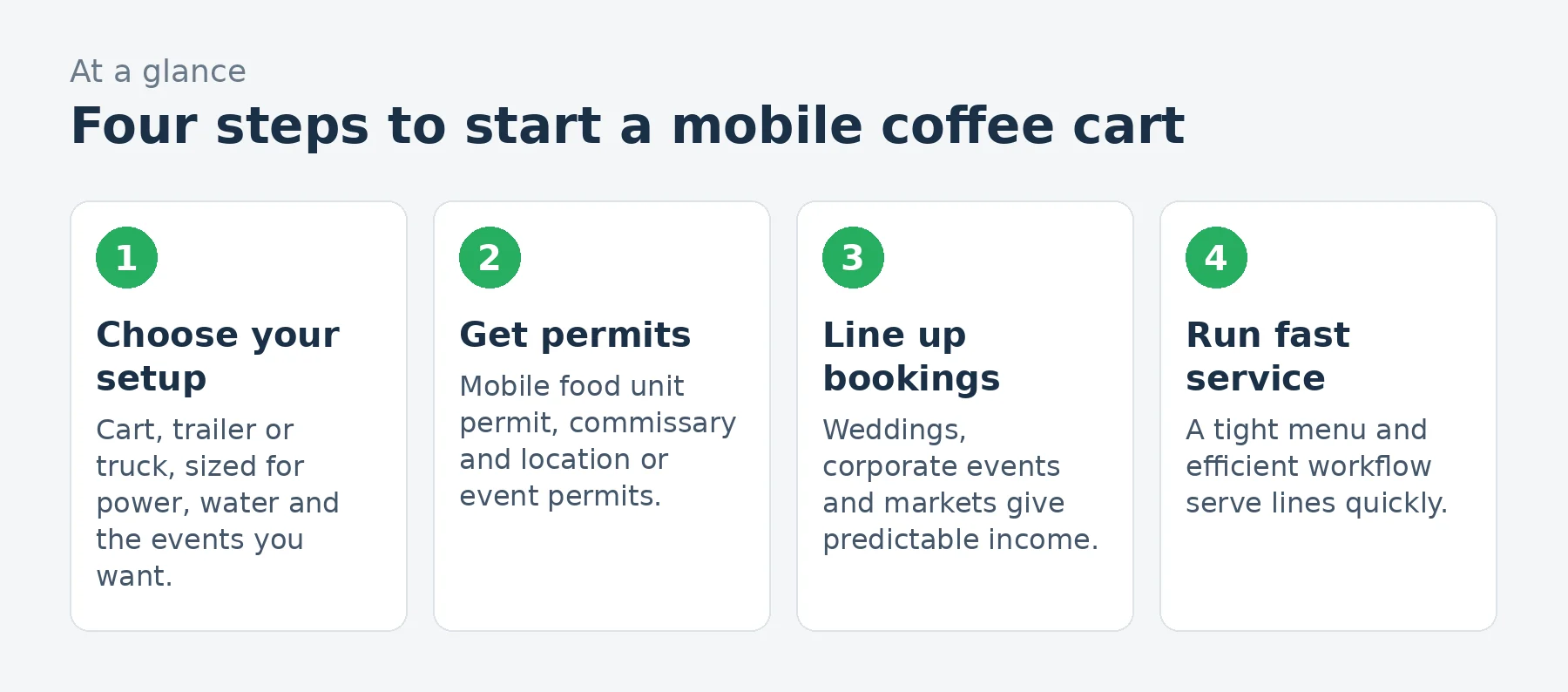
Choosing your setup
- Coffee cart: compact and affordable, ideal for indoor events and weddings, but limited by power and water capacity.
- Trailer: more space, storage and water capacity, towed to sites.
- Truck or van: self-contained and mobile, more expensive and subject to vehicle costs.
- Converted vehicles (such as small vintage vans): eye-catching for weddings and events.
Plan power (commercial espresso machines draw significant electricity; you may need a generator, venue power or a battery system), water (fresh and wastewater tanks) and hand washing, which health departments require.
Permits and commissaries
Mobile food rules are local. Most areas require a mobile food unit permit from the health department, with an inspection of your cart or vehicle. Many require a commissary: a licensed kitchen where you store supplies, fill water, dump wastewater and clean equipment. You may also need permits for specific locations or events, fire inspections for generators or propane, and a business license in each city you serve. Ask event organizers which permits they require.
Equipment
- Commercial espresso machine suited to your power supply.
- Espresso grinder and a backup method (such as batch brew) for big lines.
- Water system with tanks, pump and filtration.
- Refrigeration or coolers for milk.
- Hand-wash station, as required by the health department.
- Point-of-sale system that works offline.
- Signage, menu board and canopy.
Startup costs to plan for
| Item | What to budget for |
|---|---|
| Cart, trailer or vehicle | New or used, built to health code |
| Coffee equipment | Espresso machine, grinder, brewer, refrigeration |
| Power and water | Generator or batteries, tanks, pump |
| Permits and commissary | Mobile food permit, commissary deposit, event permits |
| Branding | Wrap, signage, menu |
| Insurance | General liability, auto if applicable |
Use our startup cost calculator for your total.
Where to sell
- Weddings and private parties: coffee bars are popular for receptions and showers, booked as packages.
- Corporate events and offices: employee appreciation days, conferences and weekly visits.
- Farmers markets and festivals: strong weekend sales, with vendor fees.
- Campuses, hospitals and business parks: steady morning demand where permitted.
- Sports events and schools: early-morning tournaments and fundraisers.
Pricing
Public sales are priced per drink, usually close to local café prices. Private events are priced as packages (a number of drinks or guests) or hourly with a minimum, plus travel. Include setup time, staff, travel and cups in your quotes, and require a deposit to hold dates. Use our pricing calculator to check margins.
A worked example: events plus market days
These are illustrative assumptions for a busy month mixing events and public sales, not predictions.
| Assumption | Monthly | |
|---|---|---|
| Private event bookings | 8 events at $650 average | $5,200 |
| Public market and street sales | 10 days, 120 drinks a day at $5.50 | $6,600 |
| Revenue | $11,800 | |
| Cost of goods | Coffee, milk, syrups and cups for market days and events | $(3,000) |
| Part-time barista | Help at events and busy markets | $(1,600) |
| Commissary rent | $(450) | |
| Vehicle, fuel and generator | $(500) | |
| Permits and event fees | Spread across the year | $(400) |
| Insurance, card fees and supplies | $(650) | |
| Profit before owner pay and taxes | $5,200 |
That leaves about $5,200 a month before the owner’s pay and taxes, on about $11,800 of revenue in a busy month. Event bookings are the backbone: they are paid in advance and do not depend on weather or foot traffic.
Serving lines quickly
Lines form all at once at events. Keep a short menu (espresso drinks, drip or cold brew, a few seasonal specials), prepare cold brew and syrups in advance, pre-stage cups and lids, and use a second person to take orders while the barista makes drinks. The NCA found a record 40% of recent out-of-home buyers ordered on apps, so consider pre-ordering for office visits.
Event contracts and deposits
Every private booking needs a short written agreement: date, times, location, number of guests or drinks included, menu, power and space requirements, travel fees, deposit and cancellation terms. Take a deposit to hold the date and collect the balance before the event. Confirm details a week ahead, including where you will set up, access for unloading and whether the venue provides power.
Weather and seasons
Outdoor markets slow down in cold, rain and extreme heat, while indoor events, offices and holidays stay busy. Plan a seasonal calendar: weddings and festivals in warm months, corporate events, holiday parties and indoor markets in cold months. Have a canopy, weights, side walls and a plan for cancellations due to weather.
Branding that books events
Weddings and corporate clients book with their eyes. A clean, attractive cart, consistent branding, professional photos and a simple menu board make you look premium. Offer custom touches such as branded cup sleeves, signature drinks named for the couple or company, and printed menus that match the event.
Building recurring office and campus routes
Recurring stops smooth out income. Offer offices, business parks, hospitals, schools and car dealerships a regular visit (weekly or monthly) with a set menu, where either the employer pays for staff drinks or employees buy their own. Employers use these visits for staff appreciation and recruiting. A handful of recurring stops can cover your fixed costs, leaving weddings and festivals as profit. Ask property managers about permitted spots on private property, which often avoids street-vending restrictions.
Common mistakes to avoid
- Buying a machine your power supply cannot run.
- Skipping the commissary and permits.
- Relying on public spots instead of booked events.
- Underpricing private events by forgetting setup and travel time.
- Too large a menu for event lines.
Your first 90 days
- Days 1-30: check mobile food rules, find a commissary and choose your setup.
- Days 31-60: build or buy the cart, pass inspection, test your workflow and set event packages.
- Days 61-90: book weddings and corporate events, join a farmers market and ask every client for a review.
Frequently asked questions
Do I need a permit for a coffee cart?
Usually yes: a mobile food unit permit from the health department, often a commissary agreement and permits for specific locations or events.
What is a commissary?
A licensed kitchen where mobile vendors store supplies, fill water, dispose of wastewater and clean equipment. Many areas require one.
How do I power an espresso machine on a cart?
Through venue power, a generator or a battery system sized for the machine. Check the machine’s power requirements before buying.
How much do coffee carts charge for events?
Most charge packages or hourly rates with a minimum, plus travel. Price for setup, staff and supplies.
Is a coffee cart profitable?
It can be, especially with steady event bookings. The worked example shows how events and market days combine.
Can a coffee cart serve weddings?
Yes, coffee bars are popular at weddings and showers. Most are booked as packages with a set number of guests or drinks.
Do I need a generator?
Only if venues do not provide enough power. Commercial espresso machines draw significant power, so check requirements before each event.
What should a coffee cart menu include?
A short list: espresso drinks, drip or cold brew, tea, a hot chocolate for kids and one or two seasonal specials, so lines move quickly.
Can I vend on public streets?
Only where your city allows it, often with specific permits, time limits and distance rules. Private property and events with permission are usually simpler.
Keep learning
- Coffee and beverage industry data
- How to start a coffee shop
- How to start an event planning business
- Pricing calculator
Sources
- Beverage Industry, NCA 2026 National Coffee Data Trends Fall Report
- NACS, NCA specialty coffee consumption hits record high (drive-thru and app ordering)
- US Bureau of Labor Statistics, Food service managers
- FDA, Food Code
- US Small Business Administration, Apply for licenses and permits
Last reviewed November 2, 2026. Startup costs are estimates; check local prices, licensing and tax rules before you commit money.

