
Mobile storage businesses deliver storage containers to customers’ homes or sites, leave them for as long as needed, and pick them up or move them to a storage yard or new address. Homeowners use them for moves and renovations, businesses for extra inventory space, and contractors and farms for secure on-site storage. Shipping containers can also be sold outright for workshops, sheds and site offices. This guide explains how to start a mobile storage container business, from licensing and startup costs to pricing and finding customers.
It’s a rental business: you invest in containers and a delivery truck, then earn monthly rent for years from each container. Profit depends on keeping containers rented, delivering efficiently, and managing placement permits, contracts and insurance carefully.
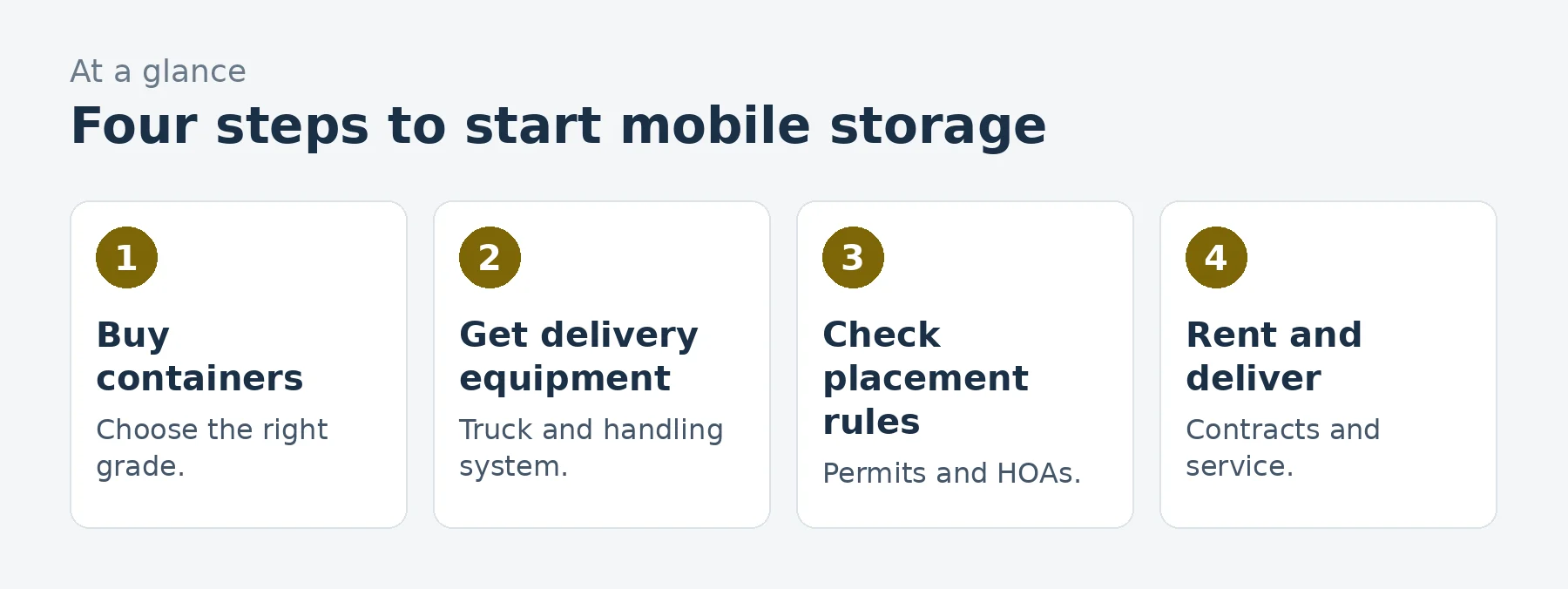
A mobile storage container business at a glance
Table of Contents
| Topic | What to expect |
|---|---|
| Startup cost | Moderate to high: containers, a delivery truck or trailer system, a storage yard, insurance |
| Key rules | Truck licensing and USDOT rules, placement permits, HOA rules, rental agreements and prohibited items |
| Revenue model | Monthly rent plus delivery, pickup and relocation fees, and container sales |
| How you earn | Residential portable storage, job site and business storage, container sales and modifications |
| Best for | Practical people who like equipment, driving and steady rental income |
Who mobile storage suits
It suits people who are comfortable with trucks and heavy equipment, enjoy logistics and want a business that builds recurring rental income. Experience driving trucks, in construction or equipment rental helps, along with good customer service for stressed movers and homeowners.
Choose your market
- Residential portable storage: smaller weather-resistant units for moves, renovations and decluttering, often with storage at your yard.
- Shipping containers for sites: 20- and 40-foot steel containers for contractors, farms, schools and businesses.
- Container sales: used and new containers sold for storage, workshops and conversions.
- Modifications: shelving, doors, windows, ventilation and site offices, done by qualified fabricators.
Buying containers
Shipping containers are sold in grades such as new (one-trip), cargo-worthy and wind and watertight. For storage, wind and watertight containers inspected for holes, rust, floor condition and door seals usually suit; customers who’ll see the container at their home may want newer units. Buy from reputable dealers, inspect before buying, and budget for delivery to your yard, paint and branding. Purpose-built portable storage units for residential use cost more but are easier to place in driveways.
Delivery trucks and rules
Containers are delivered with tilt-bed or rollback trucks, trailers or specialized lifting systems that place the container without damaging driveways. If your truck and trailer combination has a gross combination weight rating over 26,000 pounds, drivers generally need a commercial driver’s license. Commercial vehicles of 10,001 pounds or more used in interstate commerce generally need a USDOT number and must follow FMCSA rules, and many states apply similar rules within the state. Check before buying equipment.
Placement permits and HOA rules
Many cities require a permit to place a container on a street, sidewalk or other public right-of-way, often with time limits, reflectors and placement rules. Some restrict containers in driveways or front yards for more than a set number of days, and many homeowners associations have their own rules. Make the customer responsible for permits and HOA approvals in your contract, help them understand what’s needed, and know your local rules.
Rental agreements and prohibited items
Use a written rental agreement covering the rental period and billing, delivery and pickup terms, the customer’s responsibility for the contents and for damage to the container, access, locks, and termination. List prohibited items: hazardous materials, fuels and chemicals, perishables, firearms and explosives where prohibited, and never people or animals. If you bill monthly or automatically renew, make terms clear and cancellation easy, following the FTC’s rules on online subscriptions and automatic renewals.
Insurance and protection plans
Carry commercial auto insurance for trucks, general liability, and inland marine or property coverage for your containers. Your contract should say whether you’re responsible for customers’ belongings; many companies offer optional contents protection plans through insurers, or require customers to use their homeowner’s coverage. Explain this clearly, especially for moves.
A storage yard
If you store containers for customers, you’ll need a secure yard with fencing, gates, lighting and cameras, zoned for the use, and room for trucks to maneuver. Some businesses start by renting yard space. Plan for access hours if customers visit their containers.
Pricing
Charge monthly rent by container size, plus delivery and pickup fees by distance, and fees for relocation, storage at your yard and protection plans. For long-term job site rentals, offer lower monthly rates. Sell older containers to recover capital. Use our pricing calculator.
Delivering without damage
Customers judge you on a careful delivery. Survey the site first, or ask for photos: check driveway width, slopes, overhead wires and branches, soft ground and where the container will sit. Place containers on level ground, use boards or pads to protect driveways, and leave room for doors to open. Explain how heavy loads should be packed, and that containers must be accessible for pickup.
Tracking your fleet
Track every container’s location, condition, rental dates and billing in software, and inspect containers after each rental for damage, leaks and cleanliness. GPS trackers help locate containers on large sites. Knowing your utilization rate, the share of containers rented at any time, tells you when to buy more and when to sell older units.
Container sales and modifications
Selling containers outright adds income and helps you refresh your rental fleet. Buyers use them for workshops, storage sheds, site offices and farm buildings. Modifications such as roll-up doors, windows, shelving, insulation, ventilation and electrical fit-outs raise prices, but structural changes, electrical work and conversions into occupied spaces should be done by qualified fabricators and electricians, and buyers may need local permits for permanent placement.
Seasonal demand
Residential demand peaks in late spring and summer, when most people move, while job site demand follows construction seasons. Retailers may rent containers for holiday inventory. Plan truck capacity and staffing for busy months, and use slower months for container maintenance, painting and marketing to businesses.
Security for customers
Recommend strong locks, such as disc or shrouded padlocks, and advise customers on placing containers in visible, lit spots. Lockboxes on doors deter cutting.
Startup costs for a mobile storage container business
| Item | What to budget for |
|---|---|
| Containers | Your initial fleet, bought new or used |
| Delivery truck | Tilt-bed or rollback truck, or a trailer handling system |
| Storage yard | Rent or purchase, fencing and security |
| Insurance | Commercial auto, general liability, inland marine |
| Branding | Paint, logos and signage on containers |
| Software | Booking, billing, GPS tracking and inventory |
Use our startup cost calculator for your total.
A worked example: 60 containers and one truck
These are illustrative assumptions for a business with 60 containers and one delivery truck, not predictions.
| Assumption | Monthly | |
|---|---|---|
| Monthly container rent | 48 of 60 rented at $165 | $7,920 |
| Delivery, pickup and relocation fees | 28 trips at $140 | $3,920 |
| Container sales and protection plans | $1,400 | |
| Revenue | $13,240 | |
| Driver wages and payroll costs | 1 part-time driver | $(2,200) |
| Truck payment, fuel and maintenance | $(2,100) | |
| Storage yard rent | $(900) | |
| Insurance | $(700) | |
| Marketing, software and repairs | $(1,100) | |
| Profit before owner pay and taxes | $6,240 |
That leaves about $6,240 a month before the owner’s pay, container loan payments and taxes, on about $13,240 of revenue. Utilization is the key number: idle containers still tie up capital.
Marketing
- Movers and real estate agents for residential customers.
- Contractors and remodelers for job site storage.
- Retailers for seasonal inventory.
- Schools, farms and event organizers.
- Branded containers, which advertise wherever they’re placed.
Common mistakes to avoid when starting a mobile storage container business
- Buying damaged containers that leak.
- Placing containers without permits or HOA approval.
- Unclear contracts about contents and damage.
- Driving trucks without the right license.
- Low utilization from buying too many containers too soon.
Your first 90 days as a mobile storage container business owner
- Days 1-30: choose your market, research placement rules, and get insurance and a truck.
- Days 31-60: buy a starter fleet, set up a yard, contracts and booking software.
- Days 61-90: market to movers and contractors, deliver first units and track utilization.
Frequently asked questions about starting a mobile storage container business
Do I need a CDL for container delivery?
Generally if the truck and trailer combination is rated over 26,000 pounds; check FMCSA and state rules.
Do customers need permits for containers?
Often for street or right-of-way placement, and HOAs may have rules; put responsibility in your contract.
What grade of container should I buy?
Wind and watertight containers suit most storage; newer units suit residential customers who care about appearance.
How do storage container businesses price?
Monthly rent plus delivery, pickup and extra services.
Am I responsible for customers’ belongings?
That depends on your contract; many companies offer optional protection plans.
What items should be prohibited?
Hazardous materials, fuel, perishables, and never people or animals.
Do I need a storage yard?
Yes, if you store containers for customers or keep inventory between rentals.
Can I sell containers too?
Yes; container sales help recover capital and add income.
How do I track containers?
Use rental software for each unit’s location, dates and billing, and inspect containers after every rental.
Can containers be placed on gravel?
Yes, on level, firm ground; avoid soft soil that can sink.
Keep learning
- Moving and storage industry data
- How to start a self-storage facility
- How to start a dumpster rental business
- Pricing calculator
Sources
- FMCSA, Do I need a USDOT number?
- FMCSA, Commercial driver's license program
- US Small Business Administration, Apply for licenses and permits
- OSHA, Hazard Communication standard
- FTC, Restore Online Shoppers' Confidence Act (ROSCA)
- U.S. Department of Labor, Employee or independent contractor classification
Last reviewed November 7, 2026. Startup costs are estimates; check local prices, licensing and tax rules before you commit money.

