
A self-storage facility rents lockable units to households and businesses by the month. It is a real estate business more than a service business: success depends on location, construction or purchase cost, financing and steady occupancy, with relatively few staff once it is running.
It has a reputation as a quiet, dependable investment, and many facilities are. But 2026 is a reminder that it is still a market. According to Yardi Matrix, national advertised street rates were down 1.8% year over year in September 2026, with declines in all of the top 30 metro areas, after years of heavy construction added new supply. This guide covers how to evaluate a market, build or buy, price units, finance the project and run it.
A self-storage facility at a glance
Table of Contents
| Topic | What to expect |
|---|---|
| Startup cost | High: land and construction, or the purchase of an existing facility; usually financed |
| Licenses | Zoning approval and building permits; business license; state lien laws govern unpaid accounts |
| What customers pay | National average street rate about $133 a month in May 2026 (Yardi Matrix via RentCafe), varying widely by market and unit |
| Market conditions | Rates down 1.8% year over year in September 2026 as new supply slowed demand growth |
| Best for | Investors with capital or financing, patience for lease-up and an interest in real estate |
Who self-storage suits
Self-storage suits investors and entrepreneurs with access to capital who think like real estate owners: patient, analytical and comfortable with debt. Day-to-day work is lighter than most businesses, especially with online rentals and gate access systems, but the upfront decisions (location, price paid and financing) determine almost everything.
Facility managers fall under the BLS category of property, real estate and community association managers, with a median pay of $66,700 in May 2024. Owners earn from net operating income after the mortgage, plus any increase in the property’s value over time.
Study the market before anything else
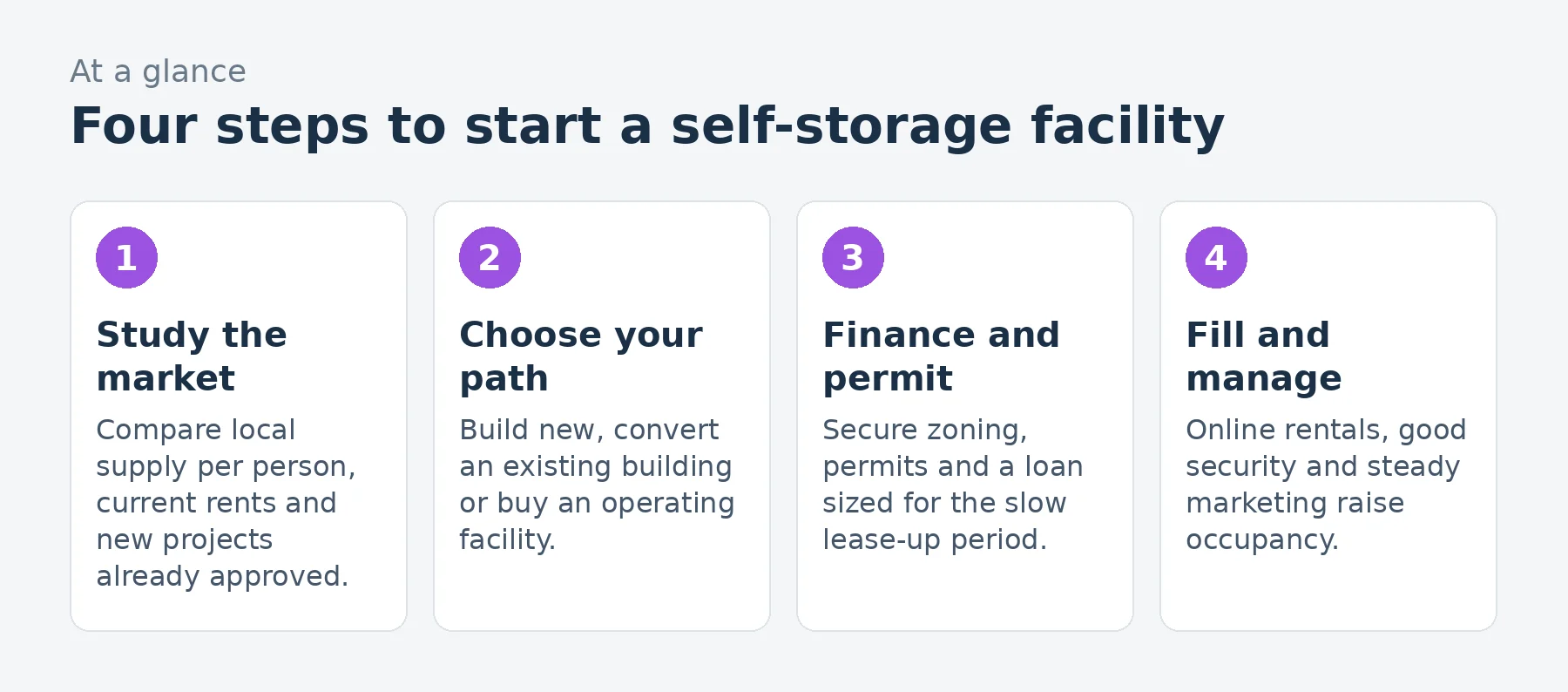
Self-storage demand comes from people moving, downsizing, renovating, going through life changes and running small businesses. Supply comes from every facility within a few miles. Before buying land, research:
- Supply per person: how many rentable square feet already exist per resident in a three- to five-mile radius, compared with similar areas.
- Current rents and specials: check competitors’ websites; heavy discounts signal too much supply.
- The pipeline: facilities under construction or approved nearby, which will compete for the same customers.
- Growth: new housing, apartments and businesses in the area.
The 2026 data shows why this matters. Yardi Matrix reported advertised rates falling year over year through mid-2026, with nearly every major metro declining, as earlier construction caught up with demand.
Build, convert or buy?
- Build new (ground-up): most control over design and climate-controlled space, but the longest timeline, construction risk and a lease-up period with little income.
- Convert an existing building: empty retail stores and warehouses can become climate-controlled storage, sometimes faster and in better locations, but conversion costs and zoning vary.
- Buy an operating facility: immediate income and a track record, at a higher purchase price. Older facilities can improve with better management, online rentals and pricing.
- Smaller formats: RV and boat storage lots and portable container storage need less construction.
Zoning, permits and lien laws
Self-storage usually needs specific zoning, and many communities restrict it in certain districts or require design features. Confirm zoning before you buy land. You will also need building permits and, for conversions, approval for the change of use.
Every state has a self-storage lien law that sets the process for tenants who stop paying: notices, waiting periods and how a public or online auction must be held. Follow it exactly, write it into your rental agreement and use management software that tracks each step.
What customers pay
According to Yardi Matrix data published by RentCafe, the national average street rate was about $133 a month in May 2026, 2.2% lower than a year earlier. Measured per square foot, the annualized average was about $16.39 in August 2026, and September rates were 1.8% below the prior year. Local rates vary widely: dense, expensive metros charge far more than small towns.
Most operators price dynamically, adjusting street rates by unit size and occupancy, and raise existing tenants’ rents periodically. Be careful with aggressive increases; they can drive tenants to new competitors offering move-in specials.
Unit mix and design
The unit mix (how many units of each size you build) should match local demand. The 10-by-10-foot unit is the industry standard and the most common benchmark, but markets differ: apartment-heavy areas rent more small units, while suburbs and rural areas need larger units and vehicle storage.
- Climate-controlled units cost more to build and run but rent for more and attract customers storing furniture, documents and electronics.
- Drive-up units suit contractors and customers moving heavy items.
- Vehicle and boat storage can use land that would otherwise sit empty.
- Design for access: wide drive aisles, good lighting, covered loading areas and enough carts.
Check competitors’ websites to see which sizes are sold out and which are discounted. That is a free, real-time demand survey.
Pricing tactics that work
Most operators set street rates for new customers by unit size, adjusting weekly or monthly as occupancy changes, and use move-in specials to compete. Existing tenants usually receive periodic rent increases. Balance the two: very low move-in specials followed by sharp increases may fill units quickly but can drive tenants out and hurt reviews. Revenue management features in modern storage software help set rates by size and demand.
Financing the project
Self-storage is usually financed with commercial real estate loans, and the U.S. Small Business Administration’s 504 and 7(a) programs can be used for owner-operated facilities in some cases. Lenders look at your equity, experience, market study and projected lease-up. Plan for interest reserves and enough cash to cover the loan during lease-up, which can take years for a new facility.
A worked example: a small, stabilized facility
These are illustrative assumptions for a small, stabilized facility, not predictions. New facilities take time to fill.
| Assumption | Monthly | |
|---|---|---|
| Unit rent | 250 units, 88% occupied, $115 average monthly rent | $25,300 |
| Fees, insurance plans and merchandise | Admin fees, tenant protection plans, locks and boxes | $1,800 |
| Revenue | $27,100 | |
| Debt service | Mortgage payments on the facility | $(11,500) |
| Property tax | $(2,200) | |
| Property insurance | $(700) | |
| Management and staff | Part-time manager or third-party management | $(3,200) |
| Utilities, software and maintenance | $(1,600) | |
| Marketing | Online listings and search ads | $(900) |
| Profit before owner pay and taxes | $7,000 |
That leaves about $7,000 a month before taxes and reserves for roofs, doors and paving, on about $27,100 of revenue. The largest swing factors are occupancy and the loan: at 70% occupancy, unit rent in this example falls by about $5,200 a month, which would erase most of the profit while the mortgage stays the same.
Running the facility
- Online rentals and payments, so customers can rent and move in without visiting an office.
- Security: gated access with codes, cameras, good lighting and individual unit alarms where competitive.
- Tenant protection or insurance plans for stored goods, with clear terms.
- Marketing: your Google Business Profile, listings on storage marketplaces and search ads.
- Maintenance: doors, roofs, paving and climate control on a regular schedule.
Common mistakes to avoid
- Building in a market with high supply per person or a large pipeline.
- Underestimating how long lease-up takes and running short of cash.
- Paying too much for an existing facility based on optimistic rent growth.
- Skipping steps in your state’s lien law process.
- Neglecting online presence, where most renters now start.
Your first 90 days
- Days 1-30: study three or four target markets: supply, rents, specials and the construction pipeline.
- Days 31-60: choose your path (build, convert or buy), check zoning on specific sites or facilities and talk to lenders.
- Days 61-90: commission a feasibility study, get construction or renovation estimates and build a lease-up budget with conservative rents.
Frequently asked questions
Is self-storage a good business in 2026?
It can be, but conditions vary by market. Yardi Matrix reported national rates down 1.8% year over year in September 2026 after heavy construction, so local supply and pricing need careful study.
How much does a storage unit rent for?
About $133 a month on average in May 2026, according to Yardi Matrix data published by RentCafe, with wide variation by city and unit size.
How long does it take a new facility to fill?
Lease-up for new facilities often takes years, depending on the market. Plan financing and cash reserves for a slow ramp.
Can I start with RV and boat storage?
Yes. Outdoor vehicle storage needs less construction, though zoning, paving, fencing and security still matter.
What happens when tenants stop paying?
Each state’s self-storage lien law sets the notice and auction process. Follow it exactly and spell it out in your rental agreement.
What size units should a facility have?
It depends on local demand. The 10-by-10 unit is the most common benchmark, but match your mix to the area, using competitors’ availability and pricing as a guide.
Keep learning
- Self-storage industry data
- How to start a moving company
- Business Idea Reality Check
- Business Planner
Sources
- CRE Daily, Self storage rates fall 1.8% (Yardi Matrix, October 2026 report)
- Multi-Housing News, Self Storage National Report, September 2026 (Yardi Matrix)
- RentCafe / StorageCafe, Yardi Matrix self storage rates (May 2026)
- US Bureau of Labor Statistics, Property, real estate and community association managers
- US Small Business Administration, 7(a) and 504 loans
Last reviewed November 2, 2026. Startup costs are estimates; check local prices, licensing and tax rules before you commit money.

