
People store furniture during moves, belongings after downsizing, business inventory, boats and RVs. Self storage is a real estate business with operating income: once a facility fills, revenue is steady and staffing is light, but construction or purchase costs are large and lease-up takes time. Facilities are run by managers; the Bureau of Labor Statistics counted about 466,100 property, real estate and community association managers in 2024, with a median wage of $66,700 in May 2024 and 4% projected growth, and about a third were self-employed.
Small operators often start by converting an existing building, opening an RV and boat lot, or buying a small facility rather than building from scratch.
The workforce
| Occupation | Jobs (2024) | Median pay (May 2024) | Projected growth, 2024 to 2034 |
|---|---|---|---|
| Property, real estate and community association managers | 466,100 | $66,700 | +4% |
Source: U.S. Bureau of Labor Statistics, Occupational Outlook Handbook and Occupational Employment and Wage Statistics.
Market data
| Measure | Value |
|---|---|
| Share of property managers who are self-employed (2024) | 34% |
Business models compared
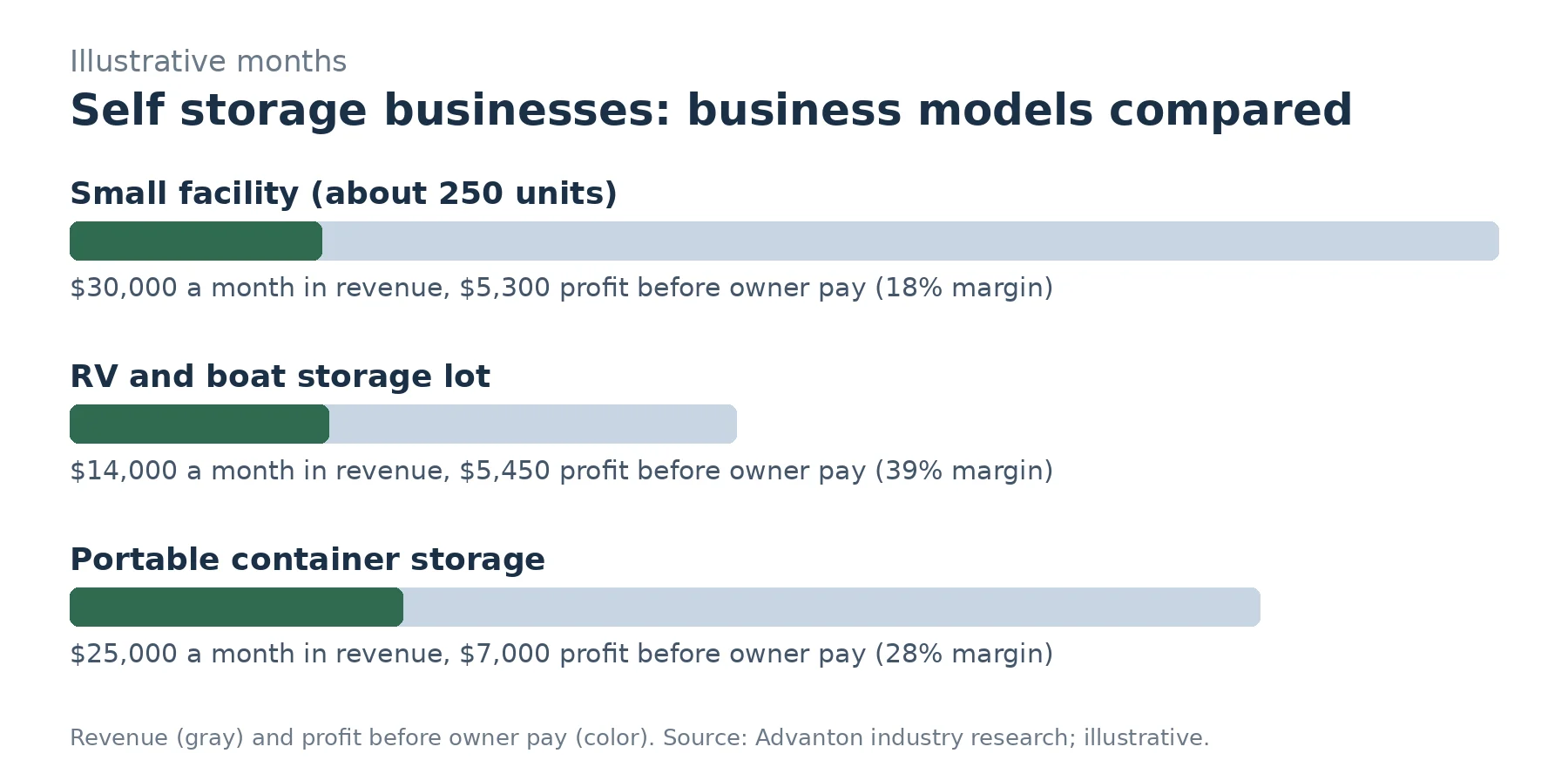
The figures below are illustrative months from our research, not industry averages. They show how revenue and costs typically fit together; your market, prices and costs will differ.
| Business model | Startup costs | Example monthly revenue | Costs | Profit before owner pay | Margin |
|---|---|---|---|---|---|
| Small facility (about 250 units) | High: land and buildings or conversion, gates, cameras, software | $30,000 | $24,700 | $5,300 | 18% |
| RV and boat storage lot | Moderate to high: land, grading, fencing, gate, lighting | $14,000 | $8,550 | $5,450 | 39% |
| Portable container storage | Moderate to high: containers, truck and lift, storage yard | $25,000 | $18,000 | $7,000 | 28% |
Fixed and variable costs
For projections, the most useful split is between variable costs, which rise and fall with sales (materials, supplies, hourly labor, fees), and fixed costs, which you pay every month regardless (rent, salaried staff, insurance, loan payments).
| Business model | Variable costs (% of revenue) | Fixed costs per month | What it means |
|---|---|---|---|
| Small facility (about 250 units) | 4.7% | $23,300 | Mostly fixed: needs steady volume to cover overhead |
| RV and boat storage lot | 2.5% | $8,200 | Mostly fixed: needs steady volume to cover overhead |
| Portable container storage | 22.4% | $12,400 | Mostly fixed: needs steady volume to cover overhead |
What the numbers say
Self storage is mostly fixed cost: mortgage, taxes and insurance stay the same whether units are full or empty, so occupancy decides profit.
Lease-up takes time. New facilities often take a year or more to fill, so plan financing and reserves for the ramp.
Once stabilized, margins are strong and staffing is light, which is why investors value steady occupancy.
The three models in brief
Small facility. Drive-up and indoor units with a gate, cameras and online rentals. See property management data.
RV and boat storage lot. Outdoor or covered spaces with lower construction costs.
Portable container storage. Containers delivered to customers and stored at a yard. See moving and storage data.
Cost structure: small facility (about 250 units)
Each cost as a share of the example month’s revenue ($30,000):
| Cost | Monthly amount | Share of revenue | Type |
|---|---|---|---|
| Mortgage payment | $14,000 | 46.7% | Fixed |
| Property taxes and insurance | $3,500 | 11.7% | Fixed |
| Part-time manager | $2,800 | 9.3% | Fixed |
| Utilities and maintenance | $1,500 | 5.0% | Fixed |
| Marketing | $900 | 3.0% | Fixed |
| Card and payment fees | $800 | 2.7% | Variable |
| Bad debt and collections | $600 | 2.0% | Variable |
| Software and security | $600 | 2.0% | Fixed |
| Profit before owner pay | $5,300 | 18% |
A first-year projection: small facility (about 250 units)
New businesses rarely start at full speed. This projection assumes revenue ramps from 35% of the example month in month 1 to 100% by month 12, variable costs move with revenue, and fixed costs stay the same every month. It’s a planning illustration, not a forecast.
| Month | Revenue | Variable costs | Fixed costs | Profit | Cumulative |
|---|---|---|---|---|---|
| 1 | $10,500 | $494 | $23,300 | -$13,294 | -$13,294 |
| 2 | $13,500 | $634 | $23,300 | -$10,434 | -$23,728 |
| 3 | $16,500 | $776 | $23,300 | -$7,576 | -$31,304 |
| 4 | $18,600 | $874 | $23,300 | -$5,574 | -$36,878 |
| 5 | $21,000 | $987 | $23,300 | -$3,287 | -$40,165 |
| 6 | $22,800 | $1,072 | $23,300 | -$1,572 | -$41,737 |
| 7 | $24,600 | $1,156 | $23,300 | $144 | -$41,593 |
| 8 | $26,100 | $1,227 | $23,300 | $1,573 | -$40,020 |
| 9 | $27,300 | $1,283 | $23,300 | $2,717 | -$37,303 |
| 10 | $28,500 | $1,340 | $23,300 | $3,860 | -$33,443 |
| 11 | $29,400 | $1,382 | $23,300 | $4,718 | -$28,725 |
| 12 | $30,000 | $1,410 | $23,300 | $5,290 | -$23,435 |
Year one: revenue $268,800, profit before owner pay -$23,435. The first profitable month is month 7. Cumulative results bottom out at -$41,737, which is the minimum cash cushion this plan would need, before any startup costs.
The mortgage, taxes and insurance start on day one while units lease up, so this facility illustration turns profitable in month 7, with a cumulative low of about $41,700, before land and construction costs. Real lease-up is often slower than one year.
How self storage earns
- Monthly unit rent by size and features (climate control, drive-up).
- Administrative and late fees.
- Tenant protection or insurance programs.
- Locks, boxes and moving supplies.
- Truck rental partnerships.
Occupancy and rate math
Two numbers drive revenue: physical occupancy (share of units rented) and the average rent per unit. Operators raise rents for existing tenants over time and use promotions to attract new ones, balancing occupancy against rate.
Lien laws and unpaid units
When tenants stop paying, state self-storage lien laws set the notices, timelines and sale procedures operators must follow. Follow them exactly, keep records, and use software that tracks deadlines.
A startup checklist
- Study local supply and demand: existing facilities, occupancy and rents.
- Confirm zoning for storage use.
- Secure financing with reserves for lease-up.
- Choose management software with online rentals and gate access.
- Write rental agreements that follow your state’s lien law.
Where the opportunities are
- Conversions of vacant retail or industrial buildings.
- RV and boat storage in growing suburbs and near lakes.
- Climate-controlled units for documents and valuables.
- Business storage for contractors and online sellers.
- Buying and improving small, poorly run facilities.
Technology and operations
Online rentals, automated gate access, cameras and smart locks let small facilities run with part-time staff or remote management. Good software tracks occupancy, payments and lien deadlines automatically.
Key terms
| Term | Meaning |
|---|---|
| Physical occupancy | Share of units rented |
| Economic occupancy | Rent collected as a share of potential rent |
| Lease-up | The period while a new facility fills |
| Lien sale | Auction of an unpaid unit’s contents under state law |
Key numbers to track
Watch physical and economic occupancy, average rent per occupied unit, move-ins and move-outs each month, delinquency rate and revenue per square foot. Economic occupancy reveals whether discounts and unpaid accounts are eroding the rent you appear to have.
Security and tenant safety
Fencing, gate codes, cameras, good lighting and clean, well-kept grounds make tenants feel safe and reduce theft. Clear rules on prohibited items, such as hazardous materials, protect everyone, and regular site checks catch problems early.
Common mistakes
- Overestimating lease-up speed.
- Building where supply already exceeds demand.
- Ignoring lien law procedures.
- Underinvesting in security and lighting.
- Too little working capital for the first year.
Marketing a self storage business
Google Business Profile, reviews, online rentals, partnerships with real estate agents, movers and apartment communities, and clear pricing online bring tenants. See property management data.
Financing
Most facilities are financed with commercial real estate loans, sometimes SBA loans, plus investor equity. Lenders look at local demand studies, your experience and reserves for lease-up. See SBA loans.
Test these numbers with your own plan
Open this industry in our free Business Idea Reality Check to start from any model above, change prices, costs, startup budget and your own pay, and see your break-even month, the cash you’d need, three scenarios and how new businesses in this sector survive in your state.
- Start with the closest model and its cost structure.
- Replace every price and cost with local quotes.
- Estimate your ramp: how fast customers will realistically come in year one.
- Map cash month by month with the free Cash & Payroll Planner.
- Build the full plan in the free Business Planner.
About this data
Workforce figures come from the U.S. Bureau of Labor Statistics (Occupational Outlook Handbook and Occupational Employment and Wage Statistics, May 2024 wages and the 2024 to 2034 projections, unless noted). Market figures cite their sources above. Business model figures are illustrative months built from typical prices and costs to show how revenue, fixed costs and variable costs fit together; they are not industry averages or guarantees. We review these profiles when new government data is released, at least once a year, and the same figures power the Business Idea Reality Check.
Licensing and rules
Zoning approval for storage use; building and fire codes; most states have self-storage lien laws that set notice and sale procedures for unpaid units; rental agreements should address prohibited items and insurance or tenant protection; environmental review for some sites; commercial property insurance. Requirements change; confirm with your state and local agencies before you start.
Frequently asked questions
Is self storage a good business?
It can produce steady income once full, but it requires large investment, careful market research and patient lease-up.
How long does a storage facility take to fill?
Often a year or more, depending on local demand, competition, pricing and marketing.
What happens when tenants don’t pay?
State lien laws set the notice and sale procedures that operators must follow before selling contents.
Do storage facilities need staff on site?
Not always; many small facilities use online rentals, gate access and cameras, with part-time or remote management.
What size units rent best?
It depends on your market; many facilities offer a mix of small, medium and large units and adjust based on demand.
Can I start small?
Many start with an RV and boat lot, a building conversion or a small existing facility, which costs far less than building a new facility from the ground up.
How can I test these numbers?
Open self storage in the Business Idea Reality Check and enter your own rents, occupancy and costs.
Keep learning
- Property management industry data
- Moving and storage industry data
- SBA loans
- Business Idea Reality Check
Sources
Last reviewed November 1, 2026. Startup costs are estimates; check local prices, licensing and tax rules before you commit money.

