
Property managers keep rentals leased, maintained and profitable for owners, and manage common areas for homeowner associations. The Bureau of Labor Statistics counted about 466,100 property, real estate and community association managers in 2024, with a median wage of $66,700 in May 2024 and 4% projected growth from 2024 to 2034. About 34% were self-employed. Below is the key industry data on property management companies, with costs, business models and a first-year projection.
Property management revenue grows with the number of doors managed, and recurring monthly fees make it one of the more predictable service businesses, once you reach scale. It’s also a major source of work for contractors, who handle the repairs and turnovers.
The workforce
| Occupation | Jobs (2024) | Median pay (May 2024) | Projected growth, 2024 to 2034 |
|---|---|---|---|
| Property, real estate and community association managers | about 466,100 | $66,700 | +4% |
Source: U.S. Bureau of Labor Statistics, Occupational Outlook Handbook.
Market data
| Measure | Value |
|---|---|
| Share of property managers who are self-employed (2024) | 34% |
| Jobs added, 2024-2034 | 17,000 |
Business models compared
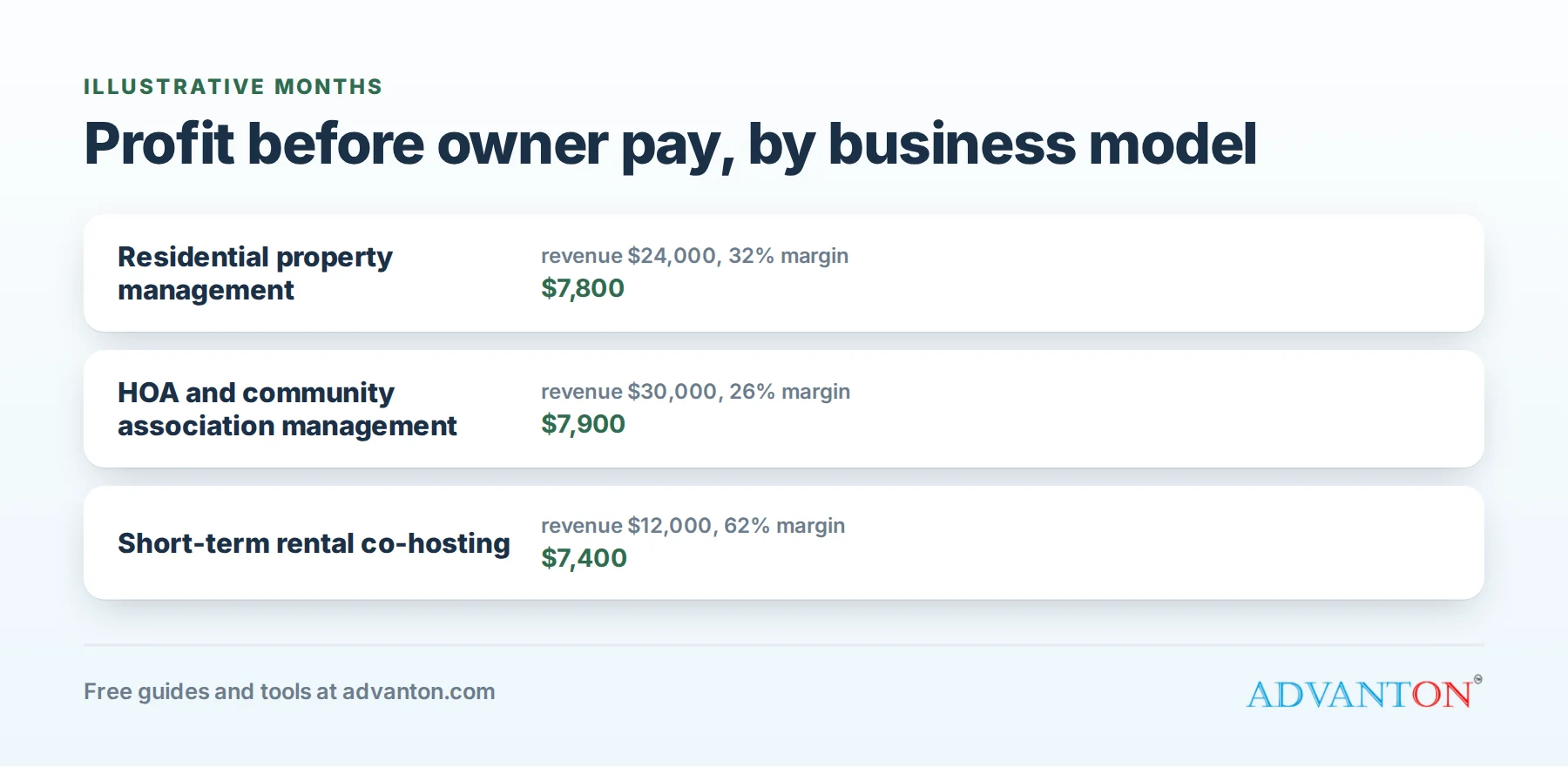
The figures below are illustrative months from our step-by-step guides, not industry averages. They show how revenue and costs typically fit together; your market, prices and costs will differ.
| Business model | Startup costs | Example monthly revenue | Costs | Profit before owner pay | Margin |
|---|---|---|---|---|---|
| Residential property management (150 units) | Moderate: license where required, software, trust accounting, insurance | $24,000 | $16,200 | $7,800 | 32% |
| HOA and community association management | Moderate: certification, accounting software, staff | $30,000 | $22,100 | $7,900 | 26% |
| Short-term rental co-hosting | Low: software, cleaning partners, local knowledge | $12,000 | $4,600 | $7,400 | 62% |
Fixed and variable costs
For projections, the most useful split is between variable costs, which rise and fall with sales (materials, parts, hourly labor), and fixed costs, which you pay every month regardless (rent, salaried staff, insurance, loan payments).
| Business model | Variable costs (% of revenue) | Fixed costs per month | What it means |
|---|---|---|---|
| Residential property management (150 units) | 10.0% | $13,800 | Mostly fixed: slow start-up months are expensive |
| HOA and community association management | 0.0% | $22,100 | Mostly fixed: slow start-up months are expensive |
| Short-term rental co-hosting | 30.0% | $1,000 | Low costs overall: time is the main constraint |
What the numbers say
Revenue builds door by door. Early months carry staff and software costs before the portfolio grows.
HOA management needs accounting depth. Budgets, assessments and board reporting require skilled staff.
Co-hosting is lighter. Short-term rental co-hosting needs less staff but depends on local rules and seasonality.
The three models in brief
Residential property management. Leasing, rent collection, maintenance coordination and owner reporting.
HOA and community association management. Budgets, vendor management, board meetings and resident communication.
Short-term rental co-hosting. Listings, guest communication, cleaning coordination and pricing.
Cost structure: residential property management (150 units)
Each cost as a share of the example month’s revenue ($24,000):
| Cost | Monthly amount | Share of revenue | Type |
|---|---|---|---|
| Property managers | $8,000 | 33.3% | Fixed |
| Leasing commissions | $2,400 | 10.0% | Variable |
| Payroll taxes and benefits | $1,600 | 6.7% | Fixed |
| Office | $1,500 | 6.2% | Fixed |
| Marketing | $1,200 | 5.0% | Fixed |
| Software | $800 | 3.3% | Fixed |
| Insurance | $700 | 2.9% | Fixed |
| Profit before owner pay | $7,800 | 32% |
A first-year projection: residential property management (150 units)
New businesses rarely start at full speed. This projection assumes revenue ramps from 35% of the example month in month 1 to 100% by month 12, variable costs move with revenue, and fixed costs stay the same every month. It’s a planning illustration, not a forecast.
| Month | Revenue | Variable costs | Fixed costs | Profit | Cumulative |
|---|---|---|---|---|---|
| 1 | $8,400 | $840 | $13,800 | -$6,240 | -$6,240 |
| 2 | $10,800 | $1,080 | $13,800 | -$4,080 | -$10,320 |
| 3 | $13,200 | $1,320 | $13,800 | -$1,920 | -$12,240 |
| 4 | $14,880 | $1,488 | $13,800 | -$408 | -$12,648 |
| 5 | $16,800 | $1,680 | $13,800 | $1,320 | -$11,328 |
| 6 | $18,240 | $1,824 | $13,800 | $2,616 | -$8,712 |
| 7 | $19,680 | $1,968 | $13,800 | $3,912 | -$4,800 |
| 8 | $20,880 | $2,088 | $13,800 | $4,992 | $192 |
| 9 | $21,840 | $2,184 | $13,800 | $5,856 | $6,048 |
| 10 | $22,800 | $2,280 | $13,800 | $6,720 | $12,768 |
| 11 | $23,520 | $2,352 | $13,800 | $7,368 | $20,136 |
| 12 | $24,000 | $2,400 | $13,800 | $7,800 | $27,936 |
Year one: revenue $215,040, profit before owner pay $27,936. The first profitable month is month 5. Cumulative results bottom out at -$12,648, which is the minimum cash cushion this plan would need, before any startup costs.
Staff and software costs come before the portfolio is full, so this residential illustration turns profitable in month 5, with a cumulative low of about $12,600. Growth depends on winning owners steadily.
How property managers earn
- Monthly management fees, often a percentage of rent collected.
- Leasing fees for placing tenants.
- Renewal and setup fees where allowed.
- HOA management fees per door or per contract.
A startup checklist for property management companies
- Check licensing: many states require a broker or property management license.
- Set up trust accounts for client funds as required.
- Choose property management software for rent collection, maintenance and reporting.
- Build a vendor network of reliable contractors.
- Learn fair housing and landlord-tenant law in your state.
Where the opportunities are
- Small landlords with a few units who want help.
- HOAs seeking professional management.
- Short-term rental owners in areas where local rules allow.
- Maintenance coordination as a value-added service.
Key terms
| Term | Meaning |
|---|---|
| Door | One rental unit under management |
| Trust account | A separate account for client and tenant funds |
| Turnover | Preparing a unit between tenants |
| Owner statement | Monthly financial report to the property owner |
Contractors are your partners
Reliable plumbers, electricians, handymen, painters and cleaners make or break a management company. Clear work orders, fair pricing and prompt payment keep good vendors loyal.
Marketing a property management company
Landlord referrals, real estate agent partnerships, local search and clear pricing pages bring new owners. Reviews from owners and tenants both matter.
Communication is the product
Owners want clear monthly reports; tenants want fast responses. Strong communication keeps doors under management for years.
How to use these numbers for your own plan
- Start with the closest model above and its cost structure.
- Replace every price and cost with local quotes: insurance, wages, vehicles, materials and your expected prices.
- Estimate your ramp: how many jobs you can realistically win each month in year one.
- Separate fixed and variable costs, then calculate your break-even point with our free break-even calculator.
- Map cash month by month with our cash flow forecast, including equipment and loan payments.
- Build the plan in our free Business Planner.
These figures will also feed a planned Advanton projection tool, so you’ll be able to start from an industry template and adjust it to your situation.
About this data
Workforce figures come from the U.S. Bureau of Labor Statistics (Occupational Outlook Handbook and Occupational Employment and Wage Statistics, May 2024 and the 2024 to 2034 projections). Market figures cite their sources in the list above. Business model figures are illustrative months built from typical prices and costs to show how revenue, fixed costs and variable costs fit together; they are not industry averages or guarantees. We review these profiles when new government data is released, at least once a year. The same figures are available in a structured format for Advanton’s upcoming business projection tool.
Licensing and rules
Many states require a real estate broker or property management license for managing rentals for others; trust account rules for client funds; fair housing and landlord-tenant law; community association manager licensing in some states; local short-term rental rules. Requirements change; confirm with your state and local agencies before you start.
Frequently asked questions about property management companies
What do property managers earn?
The BLS median was $66,700 in May 2024.
Do property managers need a license?
Many states require a real estate broker or property management license.
How do property management companies make money?
Mainly through monthly fees, often a percentage of rent, plus leasing fees.
How can I use these numbers?
Start with the closest property management model, then replace every figure with your local prices, wages and expected volume.
Keep learning
- Residential property management
- Local SEO for contractors
- How to get more contractor leads
- Specialty trades industry data
Sources
Last reviewed October 30, 2026. Startup costs are estimates; check local prices, licensing and tax rules before you commit money.
In India
Small businesses like this in India
In MoSPI’s survey of unincorporated businesses (proprietorships, partnerships and similar firms), this falls under Real estate. In 2023-24 India had 17.9 lakh such establishments employing 18.9 lakh workers, and 98.3% were run without hired workers. Across the wider other services group, the number of establishments grew 10.29% between 2023-24 and 2025.
| Urban | Rural | All India | |
|---|---|---|---|
| Value added per business a year | ₹1,75,223 | ₹65,758 | ₹1,29,885 |
| Value added per worker a year | ₹1,62,589 | ₹64,012 | ₹1,22,902 |
| Pay per hired worker a year | ₹1,69,294 | ₹93,848 | ₹1,60,111 |
Running it alone or with staff: businesses with no hired workers added about ₹1,18,103 a year on average, while those with hired workers added about ₹8,01,583 (all India).
Where these businesses are: the states with the most small other services businesses are West Bengal (13.1%), Uttar Pradesh (11.6%), Maharashtra (8.8%), Tamil Nadu (6.2%), Gujarat (6.0%) of the national total (2023-24).
Value added is what a business produces minus what it spends on materials and other inputs, before paying its workers and owner, so it’s a rough guide to the income a typical small business generates. These figures cover the whole activity, which can be broader than this one business type. Across all small businesses, average fixed assets such as equipment, furniture and vehicles were ₹3,42,242 per establishment in 2025.
Licences and registrations to expect
- Registration under your state’s Shops and Establishments Act if you have premises or employees.
- A trade licence from your municipal corporation or council for many shop and service businesses.
- GST registration once turnover crosses ₹40 lakh for goods or ₹20 lakh for services (lower in some special category states), or earlier if you sell goods to other states or through e-commerce marketplaces.
- Professional tax registration in states that levy it.
- Free Udyam (MSME) registration, which helps with loans, government schemes and delayed-payment protection.
Rules differ by state and city. Check with your municipal corporation, state departments and a chartered accountant before you start.
Run a business like this in India? List it free in the India Business Directory, with your hours, deals and GST registration.
Free tools for India: Make a GST invoice · Compare business credit cards
Build a market report for Property Management Companies in India Pick your state and see market size, earnings, competition and licences, from official data. Free, with a PDF download.
Sources: MoSPI, Annual Survey of Unincorporated Sector Enterprises (ASUSE) 2023-24, full report, Appendix A Tables 4, 29, 33, 35 and 37 (survey period October 2023 to September 2024); MoSPI, Annual Survey of Unincorporated Sector Enterprises (ASUSE) 2025, factsheet (survey period January to December 2025, released 24 March 2026). Licensing summary by Advanton, checked November 2026.