
A dumpster rental business delivers roll-off containers to homes, contractors and businesses, then hauls them away for disposal or recycling. Customers include homeowners cleaning out or renovating, roofers, remodelers, builders, property managers and event organizers.
The business is equipment-heavy but straightforward: dumpsters, a roll-off truck, disposal relationships and fast, reliable service. Profit depends on pricing that covers disposal (tipping) fees, fuel and truck costs, plus heavy-truck rules and local hauler licenses and permits. Advanton’s waste and recycling data shows a median pay of $49,690 for refuse and recyclable material collectors (May 2024), across about 147,900 jobs. Owners earn the profit after trucks, disposal fees, labor and insurance. This guide covers equipment, licensing, disposal, pricing, operations, a worked example and a 90-day plan.
A dumpster rental business at a glance
Table of Contents
| Topic | What to expect |
|---|---|
| Startup cost | Moderate to high: a roll-off truck, a fleet of dumpsters, insurance, permits, yard space and marketing |
| Licensing | Local or state waste hauler licenses, street and right-of-way permits, CDL drivers for heavy trucks and USDOT numbers where required |
| Key costs | Landfill and transfer station tipping fees, fuel, truck payments and maintenance |
| How you charge | Flat rates by dumpster size with a weight allowance and rental period, plus overweight and extra-day fees |
| Best for | Practical operators who like trucks, logistics and contractor relationships |
Who dumpster rental suits
It suits practical, organized people comfortable with trucks, scheduling and physical work, who can build relationships with contractors. Reliability wins repeat business: contractors need containers delivered and swapped on time.
Dumpster sizes
- 10-yard: small cleanouts and heavy materials such as concrete or dirt.
- 20-yard: the most popular size for remodels and cleanouts.
- 30-yard: larger renovations and construction.
- 40-yard: big construction projects and commercial cleanouts.
Many companies start with mostly 20-yard containers plus a few other sizes.
Trucks and driver rules
Hauling heavy loads brings transportation rules. Trucks with a gross vehicle weight rating of 26,001 pounds or more generally require drivers with a commercial driver’s license (CDL), and commercial vehicles over 10,000 pounds used in interstate commerce, or as required by your state, need a USDOT number. Follow weight limits, load securement rules and vehicle inspections, and carry commercial auto insurance.
Licenses and permits
Many cities and counties require waste hauler licenses or registrations, and some limit the number of haulers or require franchise agreements. Placing a dumpster on a street or sidewalk usually needs a right-of-way permit, while placement on private driveways usually does not. Homeowner associations may have rules too. Check local requirements before marketing.
Disposal and recycling
Build relationships with local landfills, transfer stations and recyclers, and know their rates per ton, hours and accepted materials. Sorting recyclable materials such as metal, concrete and clean wood can lower disposal costs, and some jurisdictions require recycling of construction debris.
Prohibited items
Hazardous waste (paints, solvents, chemicals), tires, batteries, electronics, appliances with refrigerants and other restricted items are often banned from dumpsters or carry fees. Give customers a clear list, inspect loads and follow local rules for household hazardous waste, which usually goes to special collection programs.
Startup costs to plan for
| Item | What to budget for |
|---|---|
| Roll-off truck | New or used, with hoist and tarping system |
| Dumpsters | A fleet in popular sizes |
| Yard space | Storage for containers and truck |
| Licenses and permits | Hauler license, USDOT, permits |
| Insurance | Commercial auto, general liability, workers’ compensation |
| Software | Booking, dispatch, routing and invoicing |
Use our startup cost calculator for your total.
Pricing
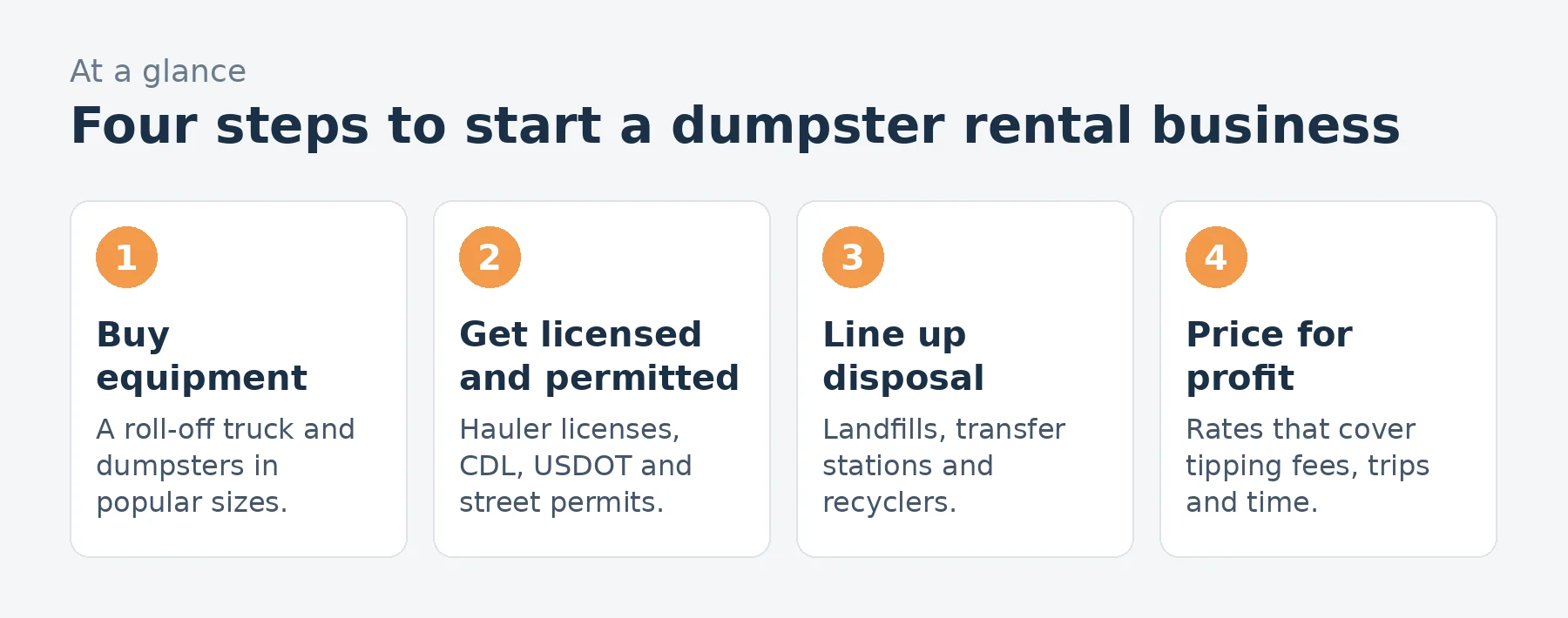
Most companies charge a flat rate by size that includes delivery, pickup, a rental period (often 7 to 14 days) and a weight allowance, with fees for extra tons, extra days and prohibited items. Price to cover tipping fees, fuel, truck time and profit, and adjust for distance. Use our pricing calculator.
A worked example: a one-truck operation
These are illustrative assumptions for a one-truck operation with 30 dumpsters, not predictions.
| Assumption | Monthly | |
|---|---|---|
| Dumpster rentals | 70 rentals at $475 average | $33,250 |
| Overweight and extra-day fees | $2,500 | |
| Revenue | $35,750 | |
| Disposal and tipping fees | $(11,500) | |
| Driver wages | With payroll costs | $(5,200) |
| Fuel | $(2,400) | |
| Truck and dumpster loan payments | $(3,800) | |
| Truck maintenance and repairs | $(1,200) | |
| Insurance | Commercial auto and liability | $(1,300) |
| Permits, software and marketing | $(1,500) | |
| Profit before owner pay and taxes | $8,850 |
That leaves about $8,850 a month before the owner’s pay and taxes, on about $35,750 of revenue. Tipping fees are the biggest variable cost, so weight allowances and overweight charges protect margins.
Loading the calculator…
Operations and dispatch
Plan routes to combine deliveries, pickups and swaps; use dispatch software for scheduling and tracking; protect driveways with boards; and photograph placement and loads. Fast turnaround on swaps is especially valuable for contractors.
Finding customers
- Roofers, remodelers and builders with steady demand.
- Homeowners through local search and reviews.
- Property managers and real estate agents for cleanouts.
- Junk removal companies needing containers.
- Events and municipalities for temporary waste needs.
Choosing a truck
Roll-off trucks vary in hoist capacity, axle configuration and size. Choose a truck that handles your largest containers and heaviest loads legally, with a tarping system for covered loads. A reliable used truck can lower startup costs, but have it inspected thoroughly.
Container care
Inspect dumpsters for damaged doors, rust and holes, repaint them to keep your brand looking professional and fix problems before they cause accidents or leaks. Well-kept containers support higher prices and fewer complaints.
Customer communication
Explain sizes, weight limits, prohibited items, placement and rental periods clearly before booking. Send delivery and pickup windows by text, and photograph containers at delivery and pickup to avoid disputes over damage or overfilling.
Junk removal and add-on services
Many dumpster companies add junk removal, demolition cleanup and roll-off rentals for events. Add-ons use the same trucks and disposal relationships and raise revenue per customer.
Route density and service area
Driving time is expensive. Define a service area where you can deliver, swap and dump efficiently, charge distance fees beyond it and schedule jobs to minimize empty miles. Locating your yard near disposal sites saves fuel and time on every load.
Contractor accounts
Roofers, remodelers and builders can provide steady repeat business. Offer account billing, priority swaps, consistent pricing and fast responses, and check credit before extending payment terms.
Weight tickets and transparency
Keep scale tickets from disposal sites and share them when charging overweight fees. Transparent charges reduce disputes and build trust with contractors who rent often.
Safety on every job
Train drivers to check overhead wires and branches, use spotters when backing, set containers on stable ground, secure loads with tarps and never overload trucks. Safe operations protect workers, customers’ property and your insurance record.
Common mistakes to avoid
- Pricing without accurate tipping fees.
- No weight allowance or overweight fees.
- Placing dumpsters on streets without permits.
- Hiring drivers without the right license.
- Accepting prohibited materials.
Your first 90 days
- Days 1-30: research hauler licensing, disposal sites and rates, and price equipment.
- Days 31-60: buy or finance a truck and dumpsters, get insurance, USDOT and licenses.
- Days 61-90: launch online booking, contact 30 contractors and collect reviews.
Frequently asked questions
How much does it cost to start a dumpster rental business?
It depends on the truck and number of dumpsters; the roll-off truck is usually the largest cost.
Do I need a CDL to drive a roll-off truck?
If the truck’s gross vehicle weight rating is 26,001 pounds or more, drivers generally need a CDL.
Do I need a permit to place a dumpster on the street?
Usually yes; many cities require right-of-way permits for street or sidewalk placement.
What can’t go in a dumpster?
Typically hazardous waste, tires, batteries, electronics and appliances with refrigerants, depending on local rules.
How should I price dumpster rentals?
Flat rates by size with a weight allowance and rental period, plus overweight and extra-day fees.
What size dumpster is most popular?
The 20-yard dumpster is common for remodels and cleanouts.
How many dumpsters do I need to start?
Many start with 15 to 30 containers, mostly 20-yard, and add more as demand grows.
How long do customers keep dumpsters?
Rental periods often run 7 to 14 days, with extra-day fees beyond that.
Is a dumpster rental business profitable?
It can be, when prices cover tipping fees, fuel and truck costs, and contractors provide steady volume.
Do I need a yard for dumpsters?
Usually yes, a secure, properly zoned site to store empty containers and park trucks.
Can I run a dumpster business part-time?
It is possible at small scale, but contractors expect fast service, so reliable scheduling matters.
What insurance does a dumpster business need?
Commercial auto, general liability and workers’ compensation, plus coverage for damage to customer property.
Where do dumpster companies dump waste?
At landfills, transfer stations and recycling facilities that accept the materials, paying tipping fees by weight.
Can dumpsters damage driveways?
They can; use boards under the rails, place carefully and explain placement options to customers.
Keep learning
- Waste and recycling industry data
- How to start a recycling business
- How to start a moving company
- Pricing calculator
Sources
- FMCSA, Commercial driver's license program
- FMCSA, Do I need a USDOT number?
- EPA, Household hazardous waste
- US Bureau of Labor Statistics, Refuse and recyclable material collectors
- US Small Business Administration, Apply for licenses and permits
Last reviewed November 3, 2026. Startup costs are estimates; check local prices, licensing and tax rules before you commit money.

