
Event planners design and manage events from the first idea to the last guest leaving: corporate meetings and conferences, product launches, holiday parties, nonprofit galas and fundraisers, milestone birthdays, reunions and festivals. Clients hire planners to save time, avoid costly mistakes and get better results from vendors and venues.
It is a growing profession. The Bureau of Labor Statistics counts about 155,800 meeting, convention and event planners, with a median pay of $59,440 in May 2024 and employment projected to grow about 5% over the decade. This guide covers choosing a niche, pricing, contracts and insurance, building a vendor network, a worked example and how to win clients.
An event planning business at a glance
Table of Contents
| Topic | What to expect |
|---|---|
| Startup cost | Low: a laptop, planning and contract software, insurance, a website and a portfolio |
| Licenses | A business license; no license is required to plan events, but alcohol, permits and venues have their own rules |
| How you charge | Flat fees, a percentage of the event budget, hourly consulting or a mix |
| Best niches | Corporate meetings, nonprofit fundraisers, social milestones and festivals |
| Best for | Highly organized people who negotiate well and stay calm when plans change |
Who event planning suits
It suits people who love details, timelines and problem-solving, and who stay calm when a speaker cancels or a delivery is late. Strong communication and negotiation skills matter as much as creativity: much of the job is managing vendors, budgets and client expectations.
Many planners come from hospitality, marketing, nonprofit development or corporate administration, where they already planned events as part of their job.
Choosing a niche
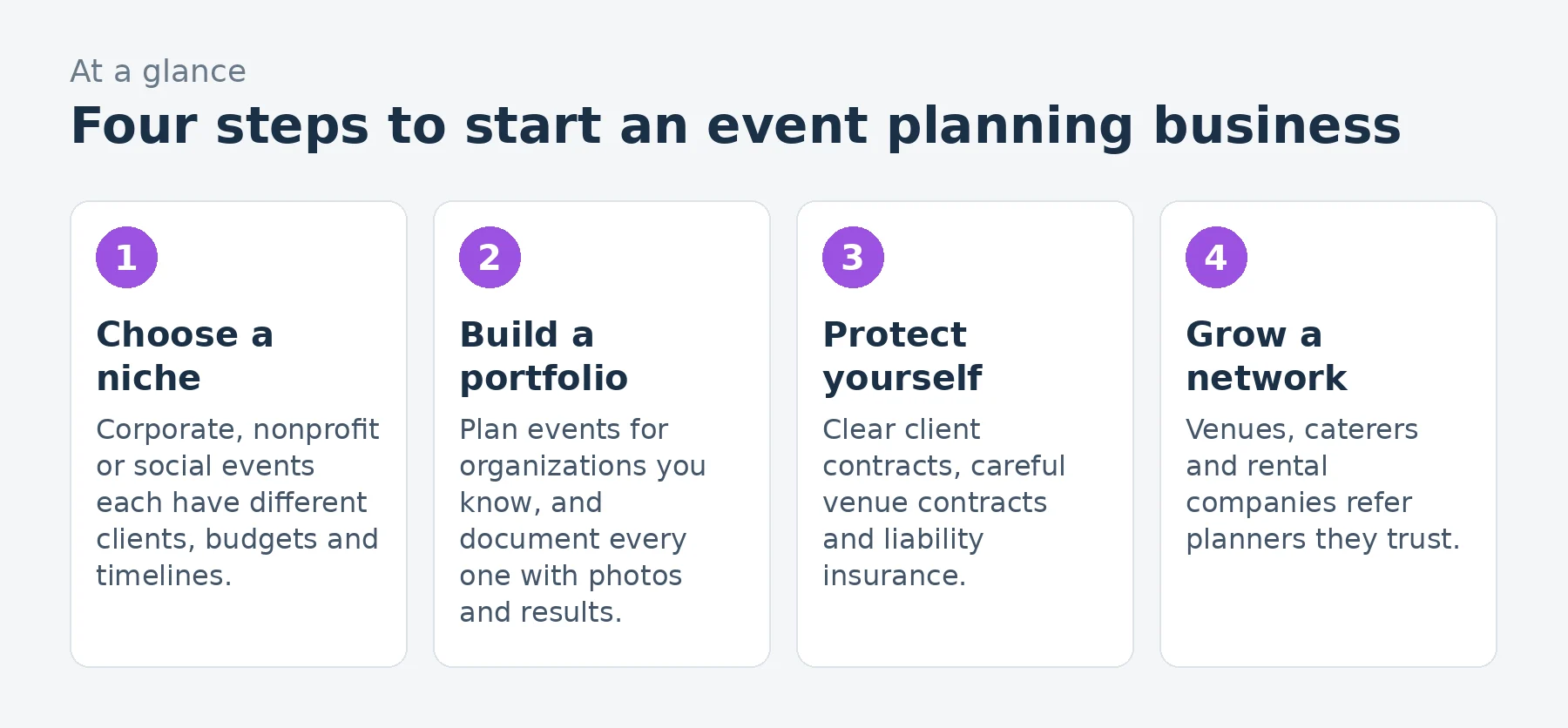
- Corporate meetings and conferences: larger budgets, repeat clients and weekday work, with detailed logistics such as registration, audiovisual and room blocks.
- Nonprofit fundraisers and galas: auctions, sponsors and ticket sales, where planners who raise more money are in demand.
- Social events: milestone birthdays, anniversaries, reunions and holiday parties.
- Festivals and community events: permits, vendors, security and crowd management.
- Weddings: a specialty of its own; see our wedding planning guide.
Contracts, venues and insurance
Use a written contract with every client that covers scope, fees and payment schedule, what is and is not included, cancellation and postponement terms, and who signs vendor contracts. Many planners have clients sign venue and vendor contracts directly, so the client, not the planner, is responsible for those payments.
Read venue contracts carefully. Hotel and conference contracts often include attrition clauses (penalties if fewer rooms or meals are used than promised), food and beverage minimums and cancellation fees that rise as the date approaches. Negotiate these before signing.
Carry general liability and professional liability insurance. Events with alcohol may require liquor liability coverage, often held by the caterer or venue, and many venues require certificates of insurance from every vendor. Ask about event cancellation insurance for clients with large budgets.
Certifications and skills
No license is required to plan events. Certifications can build credibility, especially in corporate work: the Certified Meeting Professional (CMP) from the Events Industry Council is widely recognized for meetings and conferences, and other associations offer certifications for special events. Experience and a strong portfolio still matter most.
Startup costs to plan for
| Item | What to budget for |
|---|---|
| Software | Project management, contracts, invoicing, registration tools |
| Insurance | General and professional liability |
| Marketing | Website, portfolio photography, association memberships |
| Business setup | LLC, license, bank account |
| Emergency kit | Supplies for event day: tape, tools, first aid, chargers |
Use our startup cost calculator for your total.
How to price event planning
- Flat fee: based on the event’s size, complexity and planning time; clear for clients and common for social events.
- Percentage of the event budget: common for large events; it scales with complexity but can make clients wonder whether you are inflating budgets.
- Hourly: for consulting, small events and partial planning.
- Day-of coordination: a set fee for managing the event day only.
Estimate your hours honestly: planning, site visits, vendor meetings, contracts, the event day itself and wrap-up. Then check that your fee covers them at the hourly rate you need. Our pricing calculator helps.
A worked example: owner plus day-of assistants
These are illustrative assumptions, not predictions.
| Assumption | Monthly | |
|---|---|---|
| Corporate events | 2 events at $4,500 planning fees | $9,000 |
| Nonprofit galas and fundraisers | 1 event at $5,000 | $5,000 |
| Social events and consultations | 2 events at $1,800 | $3,600 |
| Revenue | $17,600 | |
| Assistant coordinators | Day-of help for larger events | $(2,400) |
| Software, phone and office | Planning, contracts, design tools | $(300) |
| Insurance | General and professional liability | $(200) |
| Marketing and networking | Website, associations, events | $(900) |
| Travel and site visits | $(500) | |
| Profit before owner pay and taxes | $13,300 |
That leaves about $13,300 a month before the owner’s pay and taxes, on about $17,600 of revenue. Notice that planning fees are the planner’s income; the event budget itself (venue, catering, rentals) usually flows directly from the client to vendors.
Budgets and payment schedules
Clients judge planners on whether the event came in on budget. Build a detailed budget at the start, with every vendor, tax, gratuity, delivery and service charge, plus a contingency of several percent for surprises. Track deposits and due dates in one place, and share updates with the client whenever anything changes.
For your own fees, take a retainer at signing and schedule the remaining payments before the event date, so you are never chasing money after the event is over. Send clear invoices with our invoice generator.
Managing risk: weather, safety and accessibility
- Weather: every outdoor event needs a plan B, such as a tent, an indoor space or a rain date, decided in advance.
- Safety: know the venue’s capacity, exits and emergency procedures; large events may need security, medical staff and permits.
- Alcohol: use licensed caterers or bartenders and plan transportation options for guests.
- Accessibility: choose accessible venues, provide seating, clear routes and accessible restrooms, and ask guests about needs ahead of time.
Good risk planning is invisible when nothing goes wrong, and it is what clients remember when something does.
Building your vendor network
Your network is a large part of your value. Build relationships with venues, caterers, rental companies, florists, audiovisual companies, photographers, DJs and transportation providers. Work with vendors who are reliable under pressure, pay them promptly and send them repeat business. Many referrals in this industry flow both ways.
Be transparent about any commissions or referral fees from vendors; clients should know whose interests you represent.
Running the event day
- Share a minute-by-minute run of show with every vendor and staff member.
- Arrive before vendors and confirm deliveries, setup and timing.
- Keep one point of contact for the client and one for vendors.
- Carry an emergency kit and a list of every vendor’s phone number.
- Solve problems quietly; guests should never notice.
- Confirm teardown and that nothing is left behind.
Winning clients
- Corporate: connect with office managers, HR and marketing teams through chambers of commerce and business associations.
- Nonprofits: volunteer on a gala committee, then offer professional planning.
- Venues and caterers: ask to be on their recommended planner lists.
- Portfolio and reviews: show results such as attendance, money raised and client quotes.
Common mistakes to avoid
- Signing venue contracts in your own name.
- Underestimating planning hours and underpricing.
- Working without written contracts.
- Ignoring attrition and minimum clauses.
- Skipping insurance.
Your first 90 days
- Days 1-30: choose your niche, register your business, draft your client contract and buy insurance.
- Days 31-60: plan two or three events for organizations you know, documenting each with photos and results.
- Days 61-90: launch your website and portfolio, meet 10 venues and caterers and join a local business or nonprofit association.
Frequently asked questions
Do I need a license to be an event planner?
No license is required to plan events, but you need a business license, and events may require permits, alcohol licenses and venue approvals.
How do event planners charge?
Flat fees, a percentage of the event budget, hourly rates or day-of coordination fees, depending on the event and the client.
How much do event planners make?
The BLS reports a median pay of $59,440 for meeting, convention and event planners in May 2024. Business owners earn what remains after their costs.
Is certification worth it?
It can help, especially in corporate work. The CMP is widely recognized for meetings and conferences.
Who should sign vendor contracts?
Many planners have clients sign venue and vendor contracts directly so the client is responsible for those payments, while the planner manages the details.
How much should an event budget include for contingencies?
Many planners hold back a contingency of several percent of the total budget for unexpected costs, such as extra rentals, overtime or weather changes.
Are corporate events or social events better to start with?
Social events are often easier to win first through people you know. Corporate events usually bring larger budgets, weekday work and repeat clients, but buyers expect a professional portfolio, contracts and insurance before hiring you.
Keep learning
- Events and weddings industry data
- How to start a wedding planning business
- How to start a party rental business
- Pricing calculator
Sources
- US Bureau of Labor Statistics, Meeting, convention and event planners
- Events Industry Council, Certified Meeting Professional (CMP)
- The Budget Savvy Bride, The Knot 2025 Real Weddings Study vendor costs
- US Small Business Administration, Get business insurance
Last reviewed November 2, 2026. Startup costs are estimates; check local prices, licensing and tax rules before you commit money.

