
Party rental businesses rent the things that make an event happen: tables and chairs, tents, linens, bounce houses and inflatable slides, concession machines, games, lighting and staging. Customers include families planning birthdays, schools and churches, companies, event planners and wedding couples.
It is an equipment business: you buy inventory once and rent it many times. Prices vary widely by market; Tent & Table’s research puts the median full-day bounce house rental at about $238, and The Knot’s 2025 Real Weddings Study found couples spent about $2,000 on event rentals. Inflatables come with real safety rules, and this guide covers them along with inventory, pricing, a worked example and marketing.
A party rental business at a glance
Table of Contents
| Topic | What to expect |
|---|---|
| Startup cost | Moderate: inventory, a trailer or truck, storage, insurance and a booking website |
| Licenses | Business license; many states regulate inflatables as amusement rides; tent permits in some areas |
| What customers pay | Median full-day bounce house about $238 (Tent & Table); larger inflatables, tents and packages more |
| Busy season | Spring through fall, with weekend peaks and holiday parties |
| Best for | Organized, physically active people who like logistics, equipment and weekends |
Who party rentals suit
It suits organized, energetic people who enjoy logistics and do not mind lifting heavy equipment and working weekends. The business is part retail (booking and customer service), part delivery and part equipment maintenance.
Choosing your inventory
- Inflatables: bounce houses, combos with slides, water slides and obstacle courses. Popular for children’s parties and school events.
- Tables, chairs and linens: steady demand from every kind of event.
- Tents and canopies: higher prices, but more labor and safety requirements.
- Concession machines: popcorn, cotton candy and snow cones, easy add-ons.
- Games and extras: yard games, dunk tanks, lighting and staging.
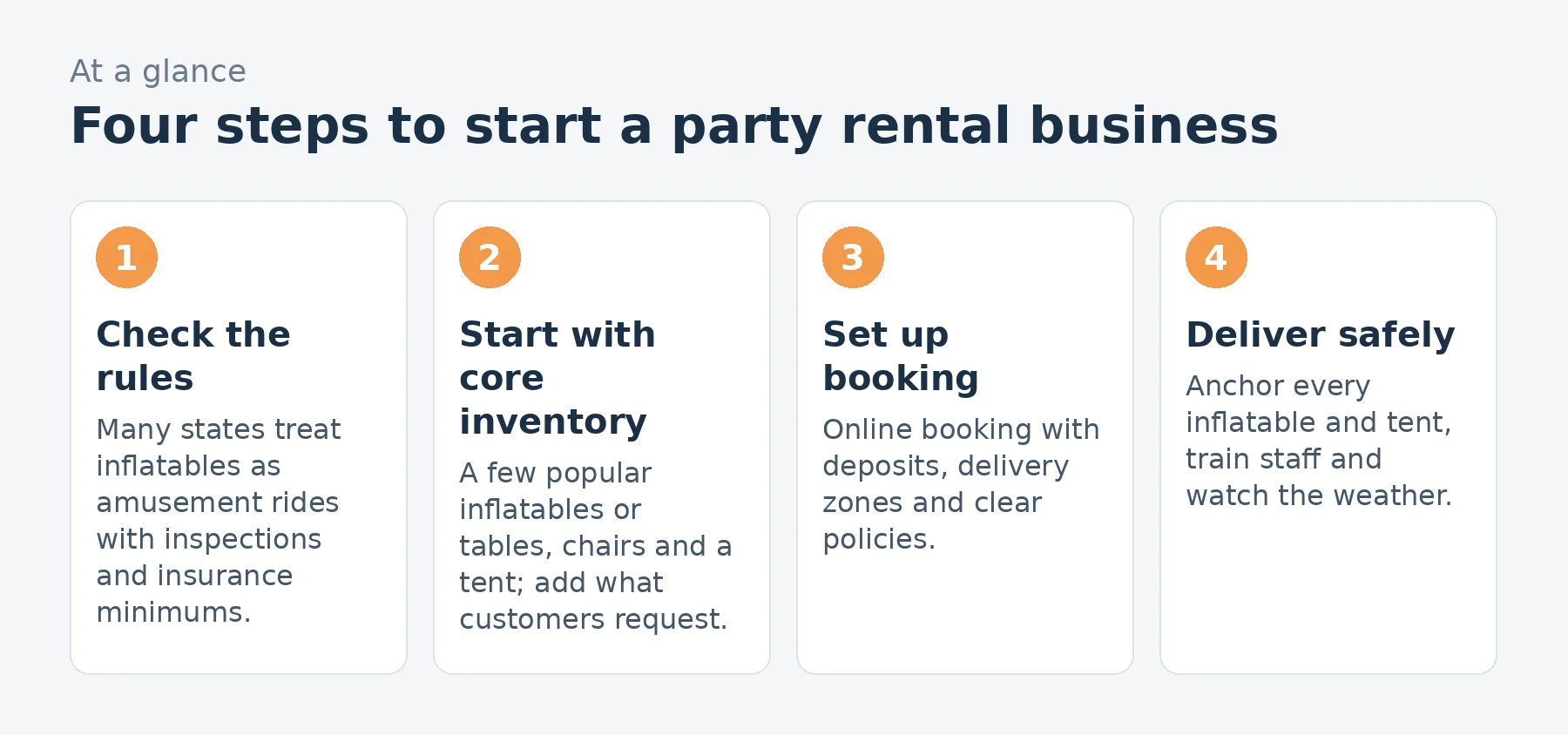
Start with a focused inventory that serves one type of customer well, then add what customers ask for. Commercial-grade equipment costs more but lasts far longer than consumer products.
Inflatable safety rules
Inflatables are where regulation matters most. Many states regulate them as amusement rides or devices. Requirements vary, but often include registering each unit, an annual safety inspection by a qualified inspector, operator training and minimum liability insurance. Texas, for example, requires annual inspections, a $40 filing fee per ride and at least $1 million in liability insurance through the Texas Department of Insurance. Pennsylvania and other states have their own registration and inspection programs, while some states exempt inflatables.
Check your state’s labor or agriculture department or fire marshal before you buy. The industry standard for inflatable design and operation is ASTM F2374; follow the manufacturer’s instructions on anchoring, wind limits, capacity and supervision. Never set up inflatables in high winds, and deflate them when winds rise.
Tents, permits and insurance
Larger tents often require a permit from the local fire department or building office, and may need inspections, fire extinguishers and flame-resistant fabric. Rules depend on tent size and use, so check each jurisdiction you serve.
Carry general liability insurance that specifically covers inflatables and tents (not every policy does), commercial auto for your delivery vehicle and workers’ compensation for employees.
Startup costs to plan for
| Item | What to budget for |
|---|---|
| Inventory | Commercial inflatables, blowers, stakes and sandbags, tables, chairs, tents |
| Vehicle and trailer | Enclosed trailer or box truck with a ramp |
| Storage | Dry, clean space where inflatables can be stored completely dry |
| Insurance and inspections | Liability, auto, workers’ compensation, state inspections |
| Booking website | Online booking with deposits and contracts |
| Cleaning supplies | Vinyl cleaner, sanitizer, blowers for drying |
Use our startup cost calculator for your total.
What customers pay
Tent & Table’s research puts the median full-day bounce house rental at about $238, with low-end averages near $98 and high-end averages near $409. Combos, water slides and obstacle courses rent for more. The Knot’s 2025 study found couples spent about $2,000 on event rentals for weddings.
Price per day (or per event), with delivery fees by distance, setup and teardown charges for tents, and package discounts that raise the average order (an inflatable plus tables, chairs and a concession machine). Require a deposit to hold dates, and set clear weather and cancellation policies.
A worked example: owner plus delivery crew
These are illustrative assumptions for a busy spring or summer month, not predictions.
| Assumption | Monthly | |
|---|---|---|
| Inflatable rentals | 45 rentals at $240 average | $10,800 |
| Tables, chairs and tents | 12 events at $450 average | $5,400 |
| Concessions, games and add-ons | Machines, supplies and delivery fees | $1,500 |
| Revenue | $17,700 | |
| Staff wages | Delivery and setup crew | $(3,800) |
| Insurance | Liability with amusement ride coverage | $(700) |
| Vehicle, trailer and fuel | $(1,200) | |
| Storage space | Warehouse or storage units | $(900) |
| Cleaning, repairs and replacement | $(900) | |
| Booking software and marketing | $(700) | |
| State inspections and permits | Spread across the year | $(150) |
| Profit before owner pay and taxes | $9,350 |
That leaves about $9,350 a month before the owner’s pay and taxes in a busy month, on about $17,700 of revenue. Winter is far slower in most regions, so build cash in peak season and use winter for repairs, cleaning and marketing.
Delivery and setup done right
- Check the forecast and the site before loading; ask customers for photos of the setup area.
- Inspect each item before it leaves and after it returns.
- Set up on a clear, flat surface away from power lines, trees and hazards.
- Anchor inflatables and tents exactly as the manufacturer specifies, with stakes or sandbags.
- Explain safety rules to the adult in charge, and leave them in writing.
- Clean, sanitize and fully dry equipment after every rental to prevent mold.
Weather and cancellation policies
Weather affects every outdoor rental. Write clear policies: when you will cancel for safety (high winds, lightning, heavy rain), whether customers can reschedule or receive a credit, and what happens if they cancel late. Share the policy at booking and in your contract. Many companies offer a weather credit rather than a full refund, which keeps the business fair for both sides. Never let a customer pressure you into setting up an inflatable in unsafe wind.
Caring for inventory
Your inventory is your business, so protect it. Inspect every item after each rental, repair seams and tears promptly, replace worn stakes and straps, and keep blowers in good working order. Track each unit’s rentals and repairs so you know which items earn the most and when to replace them. Rotate popular units so they wear evenly, and store everything clean, dry and off the floor. Inflatables that are stored wet can develop mold within days.
Growing with packages and corporate events
Packages raise the average order and save customers time: a party package might include an inflatable, tables, chairs and a concession machine at a bundled price. Corporate picnics, school field days and community festivals book larger orders and often return every year.
How to get bookings
- A fast booking website showing real-time availability, prices and photos.
- Google Business Profile and reviews for "bounce house rental near me" searches.
- Schools, churches, daycares and companies for field days, festivals and picnics.
- Event planners and venues for weddings and corporate events.
- Repeat customers: birthday reminders a year later.
Common mistakes to avoid
- Buying cheap consumer inflatables for commercial use.
- Skipping state registration, inspections or the required insurance.
- Setting up in high winds or without proper anchoring.
- Storing inflatables wet.
- No deposit or weather policy.
Your first 90 days
- Days 1-30: check state inflatable and local tent rules, register your business and get insurance quotes that cover inflatables.
- Days 31-60: buy core commercial inventory, a trailer and storage; complete any required inspections.
- Days 61-90: launch online booking, contact schools, churches and planners and ask every customer for a review.
Frequently asked questions
How much does a bounce house rent for?
Tent & Table’s research puts the median full-day rental at about $238, with wide differences by market and unit size.
Do bounce houses need to be inspected?
In many states, yes. Inflatables are often regulated as amusement rides, with annual inspections, registration and insurance minimums. Texas, for example, requires annual inspections and $1 million in liability insurance.
Do I need a permit for party tents?
Larger tents often require a permit from the local fire or building department. Check each area you serve.
What insurance does a party rental business need?
General liability that specifically covers inflatables and tents, commercial auto and workers’ compensation for employees.
How do I clean inflatables?
Clean with vinyl-safe cleaner and sanitizer after each rental, then dry completely before storage to prevent mold and damage.
What happens if it rains on a rental day?
That depends on your written weather policy. Many companies cancel for unsafe conditions and offer a credit or rescheduled date.
How many inflatables should I start with?
Many owners start with a few popular units, such as a standard bounce house and a combo with a slide, then add what customers request. Buying commercial-grade units steadily is safer than buying many at once.
Keep learning
- Events and weddings industry data
- How to start an event planning business
- Startup cost calculator
- Local SEO Check
Sources
- Tent & Table, How much to rent a bounce house
- GlobeNewswire (Aug. 2026), Texas TDI compliance for inflatable rentals
- The Budget Savvy Bride, The Knot 2025 Real Weddings Study vendor costs
- ASTM International, F2374 Standard practice for design, manufacture, operation and maintenance of inflatable amusement devices
Last reviewed November 2, 2026. Startup costs are estimates; check local prices, licensing and tax rules before you commit money.

