
Heating and cooling systems run almost every day of the year, and when they fail, homeowners want help the same day. The Bureau of Labor Statistics counted about 425,200 heating, air conditioning and refrigeration mechanics and installers in 2024, with a median wage of $59,810 in May 2024 and 8% projected growth from 2024 to 2034, faster than average, driven by new construction, replacements and the shift to heat pumps.
HVAC businesses earn money three ways: repairs, system replacements and maintenance agreements. Replacements bring the largest tickets, maintenance plans bring recurring revenue and future replacements, and repairs build trust. The strongest companies balance all three.
The workforce
| Occupation | Jobs (2024) | Median pay (May 2024) | Projected growth, 2024 to 2034 |
|---|---|---|---|
| Heating, air conditioning and refrigeration mechanics and installers | 425,200 | $59,810 | +8% |
Source: U.S. Bureau of Labor Statistics, Occupational Outlook Handbook and Occupational Employment and Wage Statistics.
Business models compared
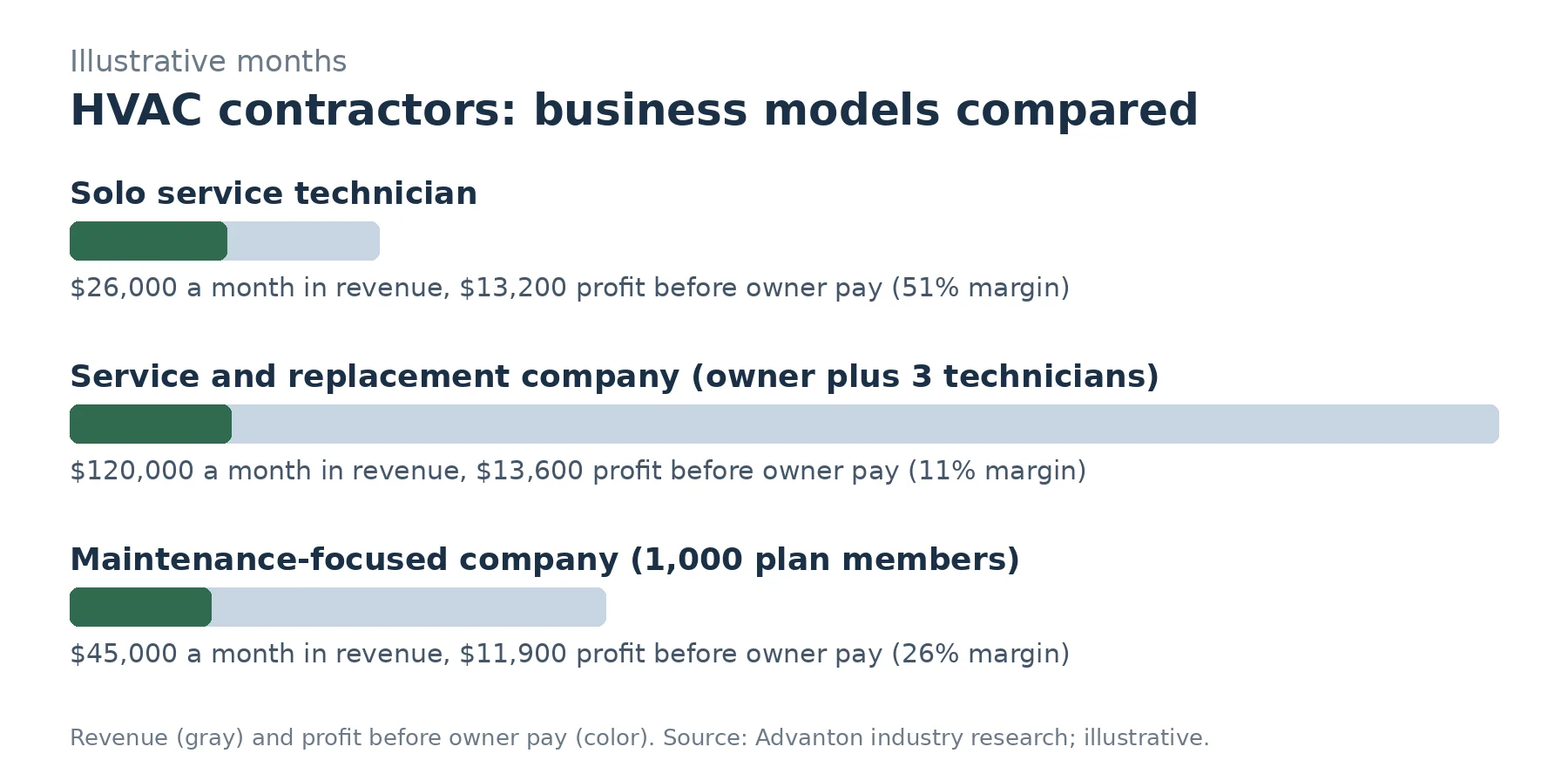
The figures below are illustrative months from our research, not industry averages. They show how revenue and costs typically fit together; your market, prices and costs will differ.
| Business model | Startup costs | Example monthly revenue | Costs | Profit before owner pay | Margin |
|---|---|---|---|---|---|
| Solo service technician | Moderate: van, gauges, recovery machine, tools, license | $26,000 | $12,800 | $13,200 | 51% |
| Service and replacement company (owner plus 3 technicians) | High: vans, equipment stock, staff, financing partner | $120,000 | $106,400 | $13,600 | 11% |
| Maintenance-focused company (1,000 plan members) | Moderate: vans, scheduling software, member billing | $45,000 | $33,100 | $11,900 | 26% |
Fixed and variable costs
For projections, the most useful split is between variable costs, which rise and fall with sales (materials, supplies, hourly labor, fees), and fixed costs, which you pay every month regardless (rent, salaried staff, insurance, loan payments).
| Business model | Variable costs (% of revenue) | Fixed costs per month | What it means |
|---|---|---|---|
| Solo service technician | 30.0% | $5,000 | Balanced: margins improve as volume grows |
| Service and replacement company (owner plus 3 technicians) | 42.0% | $56,000 | Balanced: margins improve as volume grows |
| Maintenance-focused company (1,000 plan members) | 15.1% | $26,300 | Mostly fixed: needs steady volume to cover overhead |
What the numbers say
Replacements drive revenue but equipment costs take a large share, so gross margin depends on pricing discipline and options.
Maintenance agreements are the steadying force. Members provide shoulder-season work, loyalty and future replacement opportunities.
Fixed costs are heavy for growing companies: technicians, vans, sales and marketing need consistent volume, which is why peaks and shoulder seasons must both be planned.
The three models in brief
Solo service technician. Repairs, tune-ups and occasional replacements with low overhead.
Service and replacement company. Technicians, installers and a comfort advisor selling options and financing. See good-better-best pricing.
Maintenance-focused company. Built around plan members and scheduled visits, adding replacements over time. See maintenance agreements.
Cost structure: service and replacement company (owner plus 3 technicians)
Each cost as a share of the example month’s revenue ($120,000):
| Cost | Monthly amount | Share of revenue | Type |
|---|---|---|---|
| Equipment and parts | $48,000 | 40.0% | Variable |
| Technician and installer wages | $26,000 | 21.7% | Fixed |
| Marketing | $9,000 | 7.5% | Fixed |
| Office, dispatch and sales | $7,500 | 6.2% | Fixed |
| Vans, fuel and insurance | $6,000 | 5.0% | Fixed |
| Payroll taxes and workers’ comp | $5,200 | 4.3% | Fixed |
| Financing and card fees | $2,400 | 2.0% | Variable |
| Insurance | $1,400 | 1.2% | Fixed |
| Software and phones | $900 | 0.8% | Fixed |
| Profit before owner pay | $13,600 | 11% |
A first-year projection: service and replacement company (owner plus 3 technicians)
New businesses rarely start at full speed. This projection assumes revenue ramps from 35% of the example month in month 1 to 100% by month 12, variable costs move with revenue, and fixed costs stay the same every month. It’s a planning illustration, not a forecast.
| Month | Revenue | Variable costs | Fixed costs | Profit | Cumulative |
|---|---|---|---|---|---|
| 1 | $42,000 | $17,640 | $56,000 | -$31,640 | -$31,640 |
| 2 | $54,000 | $22,680 | $56,000 | -$24,680 | -$56,320 |
| 3 | $66,000 | $27,720 | $56,000 | -$17,720 | -$74,040 |
| 4 | $74,400 | $31,248 | $56,000 | -$12,848 | -$86,888 |
| 5 | $84,000 | $35,280 | $56,000 | -$7,280 | -$94,168 |
| 6 | $91,200 | $38,304 | $56,000 | -$3,104 | -$97,272 |
| 7 | $98,400 | $41,328 | $56,000 | $1,072 | -$96,200 |
| 8 | $104,400 | $43,848 | $56,000 | $4,552 | -$91,648 |
| 9 | $109,200 | $45,864 | $56,000 | $7,336 | -$84,312 |
| 10 | $114,000 | $47,880 | $56,000 | $10,120 | -$74,192 |
| 11 | $117,600 | $49,392 | $56,000 | $12,208 | -$61,984 |
| 12 | $120,000 | $50,400 | $56,000 | $13,600 | -$48,384 |
Year one: revenue $1,075,200, profit before owner pay -$48,384. The first profitable month is month 7. Cumulative results bottom out at -$97,272, which is the minimum cash cushion this plan would need, before any startup costs.
Technicians, vans, sales staff and marketing start before replacement volume builds, so this company illustration turns profitable in month 7, with a cumulative low of about $97,300. Real HVAC cash flow also follows the seasons, so plan reserves for spring and fall.
How HVAC businesses price
- Flat-rate repairs from a price book.
- Diagnostic fees, often credited toward repairs.
- Good-better-best replacement options with financing.
- Maintenance agreements billed monthly or yearly.
- Commercial service contracts for rooftop units and restaurants.
A startup checklist
- Get EPA Section 608 certification for refrigerant handling.
- Confirm state and local licensing and permit requirements.
- Buy recovery and testing equipment and keep it calibrated.
- Set up a financing partner for replacement customers.
- Build a maintenance plan before your first shoulder season.
Seasonality
Cooling season and heating season bring peaks; spring and fall are shoulder seasons. Successful companies use shoulder months for maintenance visits, replacements for planned customers, training and marketing. See the HVAC marketing calendar.
Where the opportunities are
- Heat pumps and electrification.
- Indoor air quality: filtration, humidity and ventilation.
- Maintenance memberships.
- Commercial rooftop unit service.
- Replacement planning for aging systems.
Refrigerant changes
New residential systems have moved to A2L refrigerants such as R-454B and R-32. Technicians need training on handling, and existing R-410A systems continue to need service. Keeping up with refrigerant rules protects customers and keeps your company compliant.
Commercial HVAC work
Restaurants, offices, clinics and retail stores need rooftop unit maintenance, refrigeration service and fast emergency response. Commercial service contracts bring steady weekday work and predictable revenue, though they require insurance certificates, after-hours availability and clear documentation. Many residential companies add a small commercial division once they have experienced technicians.
Hiring and training
Good technicians are the core of an HVAC company. Offer training paths from installer to service technician, pay for certifications, and coach on honest options rather than pressure. Track callbacks and close rates by technician.
Replacement options and financing
Most replacement customers compare price, efficiency, comfort and warranty. Presenting good, better and best options, with honest repair-or-replace advice and clear financing terms through a lending partner, helps customers choose confidently and protects your reputation. Explain efficiency ratings in plain language, perform a load calculation, and put warranties in writing. See customer financing for contractors.
Key numbers to track
Track calls answered, average repair ticket, replacement close rate, maintenance plan members and renewals, callbacks within 30 days, and revenue per technician per week. Plan member count is one of the best predictors of next year’s replacement revenue.
Key terms
| Term | Meaning |
|---|---|
| Section 608 | EPA certification for handling refrigerants |
| SEER2 and HSPF2 | Current efficiency ratings for cooling and heat pump heating |
| Shoulder season | Mild spring and fall months between peaks |
| Load calculation | Sizing a system to a home’s heating and cooling needs |
Common mistakes
- Relying only on peak-season emergencies.
- Pushing replacements when repairs make sense.
- Underpricing maintenance plans.
- Missing calls during heat waves and cold snaps.
- Skipping load calculations on replacements.
Marketing an HVAC business
Reviews, Google Business Profile, Local Services Ads, maintenance plan reminders and seasonal campaigns bring steady work. See HVAC SEO and how to get more HVAC leads.
Test these numbers with your own plan
Open this industry in our free Business Idea Reality Check to start from any model above, change prices, costs, startup budget and your own pay, and see your break-even month, the cash you’d need, three scenarios and how new businesses in this sector survive in your state.
- Start with the closest model and its cost structure.
- Replace every price and cost with local quotes.
- Estimate your ramp: how fast customers will realistically come in year one.
- Map cash month by month with the free Cash & Payroll Planner.
- Build the full plan in the free Business Planner.
About this data
Workforce figures come from the U.S. Bureau of Labor Statistics (Occupational Outlook Handbook and Occupational Employment and Wage Statistics, May 2024 wages and the 2024 to 2034 projections, unless noted). Market figures cite their sources above. Business model figures are illustrative months built from typical prices and costs to show how revenue, fixed costs and variable costs fit together; they are not industry averages or guarantees. We review these profiles when new government data is released, at least once a year, and the same figures power the Business Idea Reality Check.
Licensing and rules
Technicians who handle refrigerants must hold EPA Section 608 certification; many states or cities license HVAC contractors and require permits and inspections for installations; new systems must meet federal efficiency standards and refrigerant rules (A2L refrigerants such as R-454B and R-32 are used in new equipment); liability insurance and workers’ compensation apply. Requirements change; confirm with your state and local agencies before you start.
Frequently asked questions
What do HVAC technicians earn?
BLS reported a median of $59,810 in May 2024.
What certification do HVAC technicians need?
EPA Section 608 certification to handle refrigerants, plus state or local licenses where required.
Is HVAC a good business to start?
Demand is steady and growing, but startup costs and seasonality require planning and reserves.
How do HVAC companies smooth seasonality?
Maintenance agreements, planned replacements and indoor air quality services.
How many maintenance members does an HVAC company need?
It depends on your size; many companies set goals per technician so shoulder seasons stay busy.
Should a new HVAC business focus on repairs or replacements?
Most start with repairs and maintenance to build trust and reviews, then grow replacement sales.
How can I test these numbers?
Open HVAC contractors in the Business Idea Reality Check and enter your own prices and costs.
Keep learning
- How to get more HVAC leads
- HVAC marketing calendar
- Maintenance agreements for contractors
- Business Idea Reality Check
Sources
Last reviewed November 1, 2026. Startup costs are estimates; check local prices, licensing and tax rules before you commit money.

