
A single price asks a homeowner one question: "Yes or no?" Three options ask a better one: "Which one is right for you?" Good-better-best pricing gives customers control, shows the range of what’s possible and often raises average job values, as long as each option is genuinely different and honestly presented.
This guide explains how to build and present options that sell. For estimate basics, see how to write estimates that win.
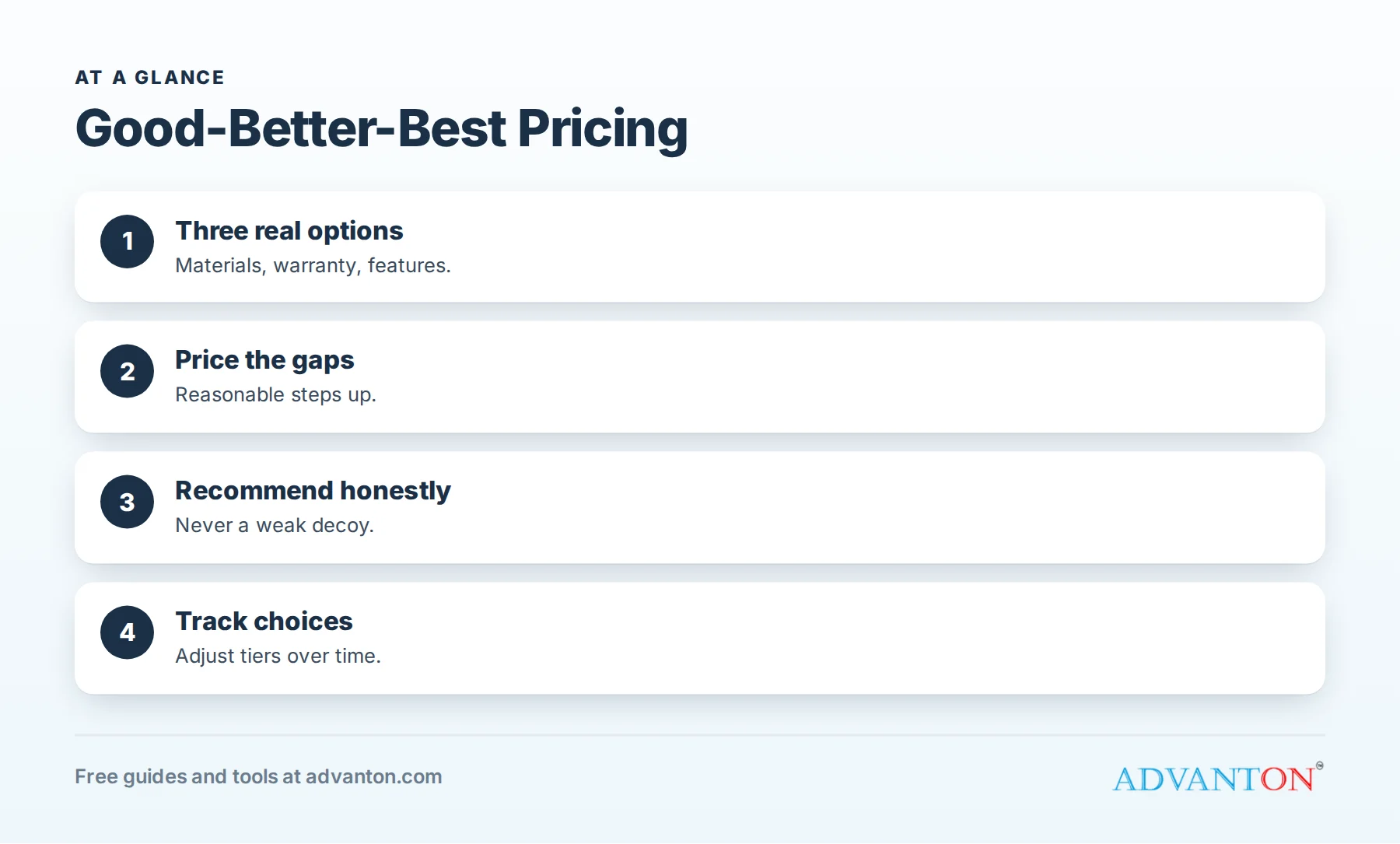
Why options work
Table of Contents
- Customers compare your options, not just your price against competitors.
- Choice builds trust: homeowners feel informed rather than pushed.
- Many choose the middle option, which can be designed as your best value.
- Some choose the top option when they see clear benefits.
- Budget customers stay in the conversation with a solid entry option.
Build three genuinely different tiers
| Tier | Purpose | What changes |
|---|---|---|
| Good | Solves the problem reliably | Standard materials, standard warranty |
| Better | Best value for most homeowners | Upgraded materials, longer warranty, added features |
| Best | Premium experience | Top materials, longest warranty, extras and convenience |
Each tier should differ in ways customers understand: materials, efficiency, warranty length, features, appearance or service.
Examples by trade
| Trade | Good | Better | Best |
|---|---|---|---|
| HVAC | Standard-efficiency system | Higher-efficiency system, longer warranty | Variable-speed system, extended warranty, maintenance plan |
| Roofing | Standard shingles | Architectural shingles, upgraded underlayment | Premium shingles, enhanced warranty, upgraded ventilation |
| Plumbing (water heater) | Standard tank | Higher-capacity or longer-warranty tank | Tankless or heat pump water heater |
| Painting | One coat, standard paint | Two coats, premium paint | Premium paint, extra prep, trim and doors |
| Fencing | Basic wood | Upgraded wood with stain | Vinyl or composite with upgraded gates |
| Remodeling | Refresh: fixtures and finishes | Partial remodel with new layout elements | Full remodel with premium finishes |
Price the gaps
The differences between tiers should feel reasonable for what customers get. If the jump from "better" to "best" is huge but the benefits are small, few will choose it. Price each tier from your real costs, overhead and margin, then check that the gaps match the added value.
Present options honestly
- Explain the problem first: what you found and what needs to happen.
- Walk through each option in plain language.
- Recommend honestly: "For most homes like yours, I’d recommend the middle option because…"
- Let the customer choose without pressure.
- Put all three in writing with clear inclusions.
Never create a deliberately poor "good" option to push customers upward; it erodes trust.
Make options easy to compare
Use a simple table in your estimate with the same rows for each option: materials, warranty, features, timeline and price. Highlight what’s different. See our free quote and invoice generator.
Add-ons and upgrades
Separate add-ons (surge protection, extra outlets, gutter guards, accent walls) let customers customize without complicating tiers. Offer a few relevant add-ons, not a long list.
Options and financing
Monthly payment figures can make better and best options more accessible, if you offer financing through a lending partner. Present them accurately and include required disclosures. See customer financing for contractors.
Include maintenance plans
For trades with recurring service (HVAC, plumbing, pest control), including a maintenance plan in the "best" option adds long-term value for the customer and recurring revenue for you. See maintenance agreements for contractors.
Train your team
Estimators and technicians should present options consistently. Role-play presentations, share price sheets and agree on which tier you’ll typically recommend and why.
Track what customers choose
Record which option each customer chooses. If almost everyone picks "good," your middle option may not be compelling or priced well. If nobody picks "best," the benefits may be unclear. Adjust over time.
A sample options table
| Good | Better | Best | |
|---|---|---|---|
| Equipment | Standard model | High-efficiency model | Premium variable-speed model |
| Warranty | Standard manufacturer | Extended parts | Extended parts and labor |
| Extras | Basic thermostat | Smart thermostat | Smart thermostat, air purifier |
| Maintenance | None | First-year tune-up | Two-year maintenance plan |
| Price | $X | $Y | $Z |
Use the same rows for every option so customers can compare at a glance.
Describe each tier in one sentence
- Good: "A reliable fix that solves the problem today."
- Better: "Our most popular choice: better efficiency and a longer warranty for a modest step up."
- Best: "The premium option for maximum comfort, efficiency and peace of mind."
Short, honest descriptions help customers choose confidently.
Options for commercial and property manager work
Property managers and commercial clients also appreciate options, framed around their priorities: lowest upfront cost, lowest lifetime cost, or fastest turnaround. Present options with clear durability, maintenance and scheduling differences, and their approval processes become easier.
Seasonal and inventory considerations
Material availability and lead times change. If your "best" option requires a longer wait, say so. Some customers will pay more for faster scheduling; others will wait for premium materials. Clear timelines are part of the choice.
When one price is better
For small, simple jobs (a faucet replacement or a single repair), one clear price is often better than three options. Use options where there are meaningful choices in materials, efficiency, warranty or scope.
Build your price book
A price book (a list of your common jobs with good, better and best options already priced) makes estimates faster and more consistent. Start with your ten most common jobs, define the three tiers for each, and calculate prices from materials, labor, overhead and margin. Update it whenever costs change. Technicians can then present options on the spot with confidence.
Use photos and samples
Show customers what they’re choosing: photos of each fixture, shingle line or finish, product brochures, or physical samples. Customers understand differences better when they can see them, and they feel more confident spending more when the upgrade is tangible.
Explain lifetime value
Higher tiers often cost more today and less over time through efficiency, durability or longer warranties. Where you can do so accurately, explain lifetime value in simple terms: "This system costs more upfront but should use less energy each month and comes with a longer warranty." Avoid exaggerated savings claims.
Options in follow-up
Options give you natural follow-up topics: "Did you have any questions about the difference between the better and best options?" See estimate follow-up scripts.
Options for repair vs replace decisions
Many service calls end with a repair-or-replace decision. Present the repair as one option and replacement tiers as others, with honest notes about the age and condition of the existing system or material. Customers appreciate seeing the full picture, including when a repair is the sensible choice for now. Honest recommendations build the trust that brings them back when replacement does make sense.
Review your tiers each year
Materials, equipment, warranties and costs change. Review your options and prices at least once a year, retire products that cause callbacks, and add improved products when they become available. A current, well-tested set of options makes estimating faster and more reliable.
Let customers mix and match
Some customers want the "better" equipment with one "best" feature. Allow reasonable combinations through add-ons rather than forcing all-or-nothing tiers. Flexibility makes customers feel heard and often leads to higher satisfaction.
Common mistakes
- Options that are too similar.
- Too many options, which confuses customers.
- A deliberately weak entry option.
- Pressure to upgrade.
- Unclear differences in writing.
A worked example
A water heater installer used to quote one price. After introducing three options (a standard tank, a longer-warranty tank and a tankless system), many customers chose the middle option, and the average job value rose without changing close rates. This example is illustrative; track your own results.
Frequently asked questions
What is good-better-best pricing?
Offering three options at different price points, so customers choose the one that fits their needs and budget.
Does it work for small jobs?
It works best for jobs with meaningful choices; for very small jobs, one price may be simpler.
Which option do most customers choose?
Many choose the middle option, so design it as your best value.
Is it pushy to offer options?
Not when options are genuine and you recommend honestly; most customers appreciate choices.
How different should the prices be?
Different enough to reflect real added value, and reasonable for the benefits.
Should I always recommend the middle option?
Recommend what genuinely fits the customer’s needs; often that’s the middle option, but not always.
Do options help against cheaper competitors?
Yes. They shift the conversation from your price versus theirs to which of your options fits best. See competing with lowball contractors.
Should the "good" option still be profitable?
Yes. Every tier should cover your costs and margin; it’s simply a smaller scope or standard materials.
How do I start using options?
Pick your three most common jobs, define three tiers for each and use them on every estimate for a month.
How Advanton helps
Advanton is a free resource for small businesses. Present options in professional estimates with our free quote and invoice generator, and track results with the lead source tracker. You can also add your business to the Advanton directory for free. Advanton earns money when you buy a domain or hosting through our store, which helps keep everything else free.
Keep learning
Last reviewed October 30, 2026. Startup costs are estimates; check local prices, licensing and tax rules before you commit money.


Leave a Reply