
Homeowners often compare several estimates, and the cheapest doesn’t always win. The estimate that wins is usually the one that’s easiest to understand, shows exactly what’s included, offers sensible options and arrives first. This guide shows how to write estimates that build trust and close more jobs.
What a winning estimate includes
Table of Contents
| Section | What to include |
|---|---|
| Your details | Business name, license or registration number, insurance, contact |
| Customer and job | Name, address, date and a one-line summary |
| Scope of work | What you’ll do, step by step, in plain language |
| Materials | Brands, models, colors and quantities, or allowances |
| Options | Good, better and best choices where they make sense |
| Exclusions | What isn’t included, such as hidden damage or permits by others |
| Price | Total, plus line items or packages |
| Timeline | Start window and expected duration |
| Payment terms | Deposit, progress payments and final payment |
| Warranty | What you guarantee and for how long |
| Next step | How to accept, and how long the price is valid |
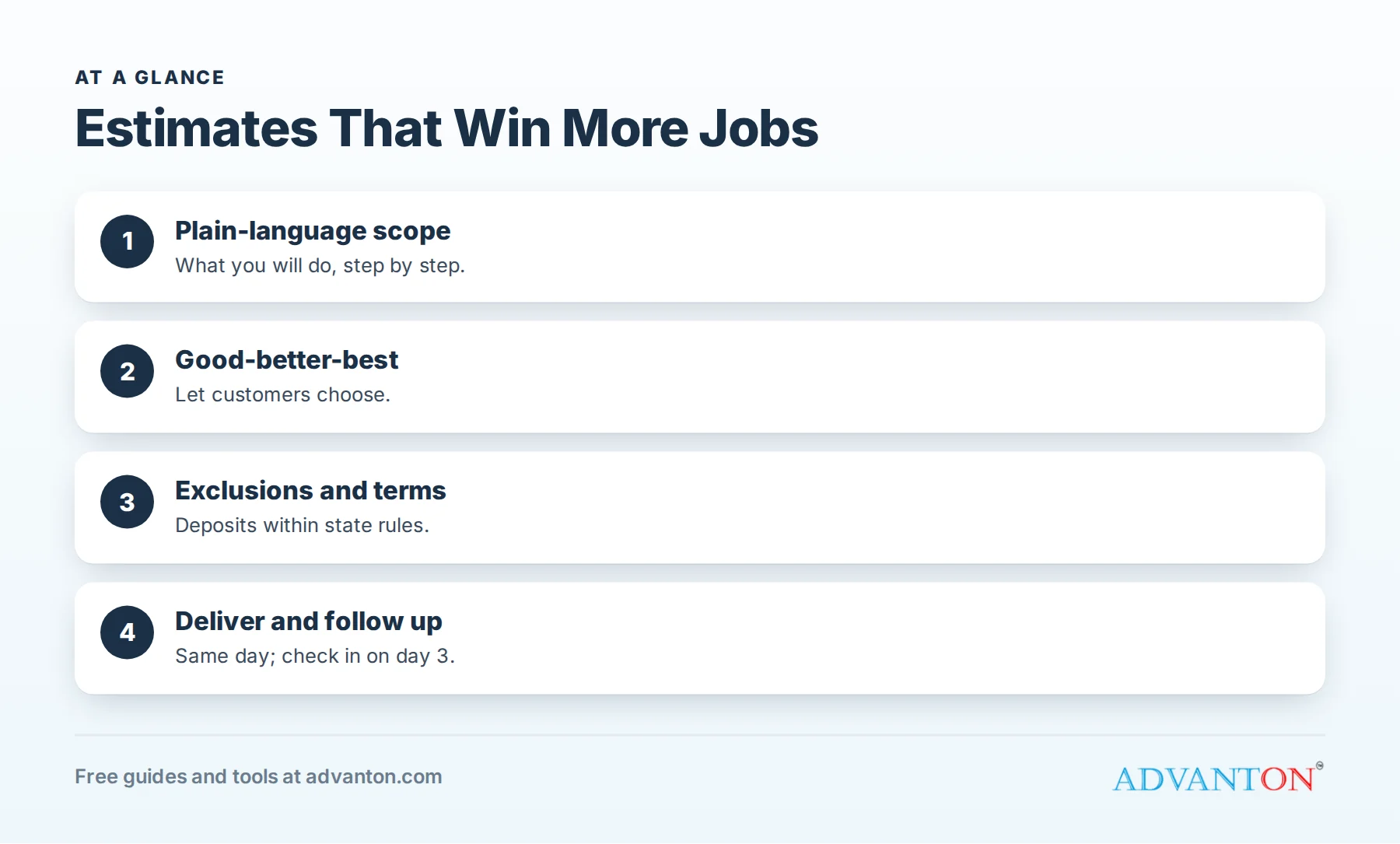
Write the scope in plain language
"Remove existing tile, repair subfloor as needed (up to 20 square feet included), install cement board and porcelain tile, grout and seal, clean up and haul away debris" is clearer than "Bathroom floor: $4,800." Clear scope prevents disputes and makes your price easier to justify.
Offer good-better-best options
Three options let customers choose instead of comparing you only on price. Many choose the middle option. For example: a standard water heater, a high-efficiency model, and a tankless system, each with its warranty and price.
Be honest about exclusions and allowances
State what’s excluded and how unknowns will be handled: "Rotted framing discovered after removal will be repaired at $X per hour plus materials, with your approval first." Allowances for items the customer hasn’t chosen (tile, fixtures) keep estimates accurate.
Set payment terms within the rules
Deposit rules vary by state. California’s licensing board cautions homeowners not to pay more than 10% of the contract price as a down payment, and Massachusetts generally limits deposits to one-third of the contract price, or the cost of special-order materials if higher. Check your state’s rules, and tie later payments to completed milestones.
Deliver it fast and professionally
Send estimates the same day when you can, as a clean PDF or link, with photos of the problem. Our free quote and invoice generator creates professional estimates.
Follow up
Call or text two to three days after sending, and again a week later. Ask if they have questions, rather than pushing. Many jobs are won simply by following up. See speed to lead.
A sample estimate structure
[Business name], License #[number], insured. [Phone] | [Email]
Estimate for: [Customer], [Address]. Date: [date]. Valid for: 30 days.
Project: Replace master bathroom tub with walk-in shower.
Scope: Protect floors and hallway; remove tub, surround and flooring; inspect and repair subfloor (up to 20 sq ft included); install shower pan and waterproofing; tile walls and floor; install glass door, valve and fixtures; caulk, clean and haul away debris.
Options: Standard tile ($X) | Upgraded tile and niche ($Y) | Large-format tile, bench and frameless glass ($Z)
Allowances: Tile $[amount]; fixtures $[amount].
Exclusions: Mold remediation, electrical changes, permit fees if required by the city (estimated separately).
Timeline: Start within 3 weeks of acceptance; about 10 working days.
Payment: Deposit [amount within your state’s rules]; progress payment at tile completion; balance on final walkthrough.
Warranty: 2-year workmanship warranty; manufacturer warranties on products.
Good-better-best in practice
Options work because they change the customer’s question from "Should I hire this contractor?" to "Which option do I want?" Make each option genuinely different (materials, features, warranty), price them sensibly apart, and explain who each option suits. Many customers choose the middle option, and some choose the best when they see the difference clearly.
Present in person when you can
For larger jobs, walk through the estimate with the customer, in person or by video call, instead of only emailing it. You can explain the scope, answer questions and show photos of similar work. Leave or send the written estimate afterward so they can review it.
Handling "your price is too high"
- Ask what they’re comparing: another estimate may exclude items yours includes.
- Walk through the scope line by line: permits, demolition, materials, warranty.
- Offer options: a lower-cost option or phased work, rather than cutting your price on the same scope.
- Explain the risks of the cheapest approach, calmly and honestly.
- Be willing to walk away from jobs that would lose money.
Change orders protect both sides
Any change in scope, such as a different tile, an extra outlet or hidden damage, should be written, priced and signed before work proceeds. Mention your change-order process in every estimate so it’s expected, not a surprise.
Track your close rate
Record every estimate, its value, its source and whether it closed. If your close rate drops, check response speed, estimate clarity and follow-up first. Our free lead source tracker helps.
Your 30-day plan
| Week | Actions |
|---|---|
| 1 | Build an estimate template with scope, options, exclusions and terms |
| 2 | Add good-better-best options to your three most common jobs |
| 3 | Set a same-day delivery rule and a follow-up schedule |
| 4 | Start tracking estimates, close rates and reasons for lost jobs |
Price for profit, not just to win
An estimate that wins but loses money isn’t a win. Build every price from:
- Direct costs: materials, labor hours at your real cost, subcontractors, equipment and disposal.
- Overhead: your share of vehicles, insurance, office, software and marketing.
- Profit: a margin that rewards your risk and funds growth.
- Contingency: for jobs with likely unknowns, such as older homes.
Review finished jobs against their estimates. If your actual hours keep exceeding the estimate on a type of job, adjust your pricing for that job type.
Use photos and simple tools
Photos of the problem area, marked up with arrows or notes, make estimates easier to understand and harder to dispute. A template with your logo, license number and standard terms saves time and looks professional. Our free quote and invoice generator creates clean estimates you can send the same day.
Follow-up messages that don’t feel pushy
Day 1:
"Thanks for meeting with me today. Here’s your estimate with the three options we discussed. Happy to answer any questions."
Day 3:
"Just checking in on the estimate. Did you have any questions about the options or the timeline?"
Day 7:
"We’re scheduling jobs for [month] now. If you’d like to hold a start date, I can pencil you in. No pressure either way."
Estimates by trade: what customers want to see
| Trade | What to highlight in the estimate |
|---|---|
| Roofing | Squares, tear-off layers, underlayment, ventilation, warranty level, cleanup |
| HVAC | Equipment model, efficiency, warranty, permits, removal of the old system |
| Plumbing | Fixture models, access work, permits, haul-away |
| Painting | Surfaces, prep, coats, paint line and color process |
| Remodeling | Detailed scope, allowances, schedule, change-order process |
| Concrete and fencing | Measurements, base or post depth, materials, permits and 811 |
Customers trust estimates that speak their project’s language and show you’ve thought it through.
Make accepting easy
Tell customers exactly how to say yes: sign and return the estimate, reply by email, or approve online. Explain what happens next (deposit, scheduling, permits and the start date) so the decision feels simple. A clear next step at the bottom of every estimate turns interested customers into booked jobs.
Common mistakes
- One-line prices with no scope.
- No options, forcing a yes-or-no decision.
- Hidden exclusions that surprise customers later.
- Slow delivery after the site visit.
- No follow-up.
Frequently asked questions
Should contractors charge for estimates?
Many offer free estimates for standard jobs and charge for detailed design, inspections or diagnostics, often credited toward the work.
How long should an estimate be valid?
Commonly 15 to 30 days, since material prices change.
How much deposit can a contractor ask for?
It depends on your state; California cautions against more than 10% down, and Massachusetts generally limits deposits to one-third.
Should I send estimates by email or present them in person?
For small jobs, a clear emailed estimate is fine. For larger jobs, walk through it with the customer, then send the written copy.
What should an estimate include?
Your details and license, scope, materials, options, exclusions, price, timeline, payment terms, warranty and how to accept.
How soon should I send an estimate?
The same day when possible. Fast, clear estimates often win against cheaper but slower competitors.
How do I handle hidden damage?
State in your estimate how unknowns will be priced and approved before work proceeds, and use written change orders.
Do I need a license number on estimates?
Many states require license numbers on contracts and advertising; including it on every estimate also builds trust.
How Advanton helps
Advanton is a free resource for small businesses. Free tools that help here: the quote and invoice generator, the lead source tracker and the contractor website builder. Advanton earns money when you buy a domain or hosting through our store, which helps keep everything else free.
Keep learning
Sources
Last reviewed October 30, 2026. Startup costs are estimates; check local prices, licensing and tax rules before you commit money.
This article is general information, not financial, legal or tax advice. Check the rules that apply to you or talk to a qualified professional before making decisions. See our disclaimer.
Leave a Reply