
Every contractor eventually hears it: "Someone else quoted half your price." Sometimes the other quote covers less work, uses cheaper materials, skips permits or comes from someone without a license or insurance. Sometimes they’re simply more efficient. Either way, cutting your price to match usually isn’t the answer. Contractors who win consistently help homeowners compare fairly, show their value clearly and give choices, without badmouthing competitors.
This guide explains how to compete with low bids while protecting your margins and reputation.
Why low bids happen
Table of Contents
| Reason | What it means for the homeowner |
|---|---|
| Different scope | Some work is left out or will cost extra later |
| Cheaper materials | Shorter life, weaker warranties |
| No permits | Risk at resale and with insurance |
| No license or insurance | Risk if something goes wrong |
| Underpricing to win | Risk of corners cut or an unfinished job |
| Genuine efficiency | Sometimes another contractor really can do it for less |
Not every low bid is a bad bid. Your job is to help homeowners understand the differences.
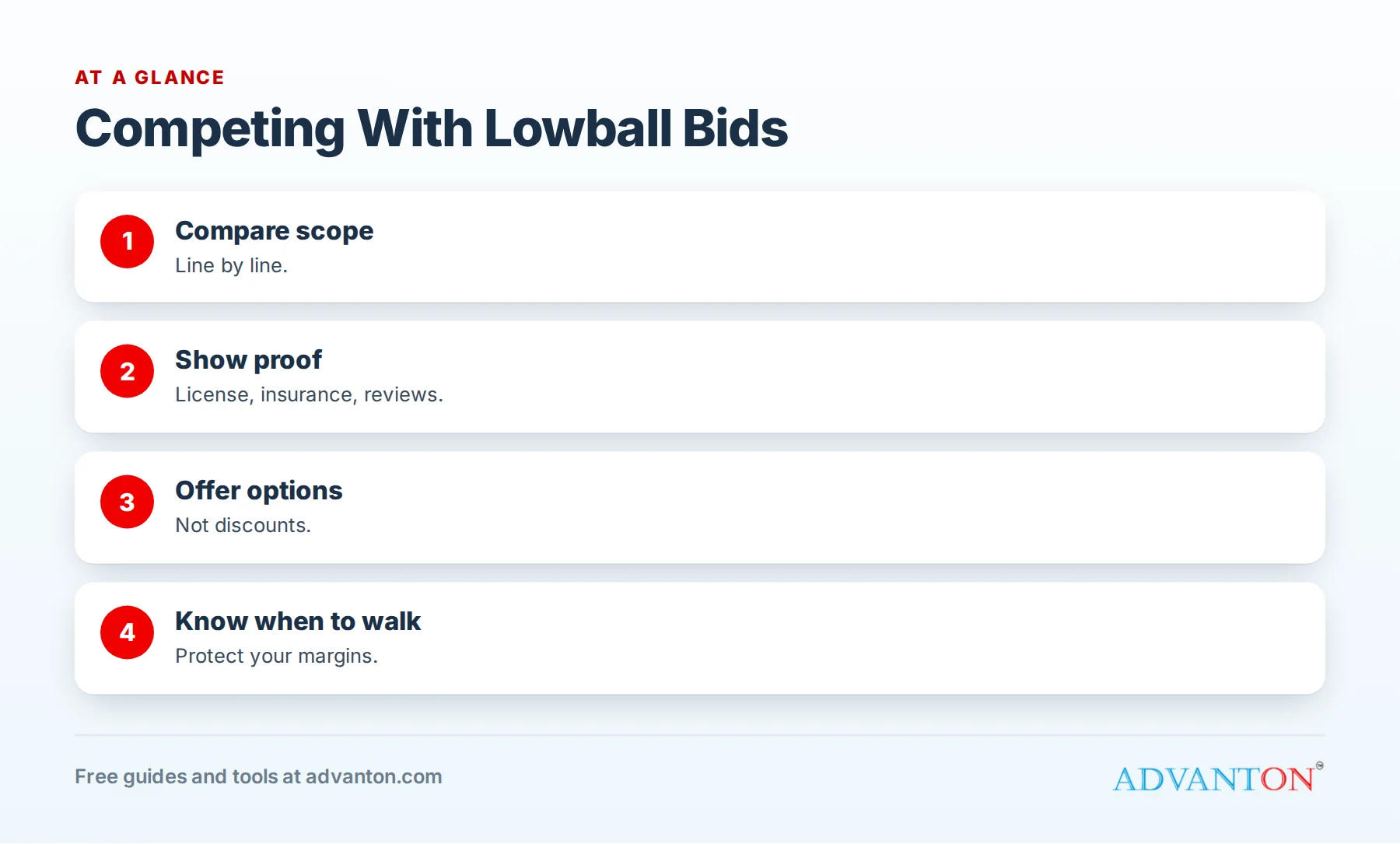
Compare scope line by line
When a homeowner mentions a lower quote, ask politely what it includes. Then walk through your estimate:
- Demolition and disposal.
- Materials and brands.
- Preparation steps.
- Permits and inspections.
- Warranty on labor and materials.
- Cleanup.
- Timeline.
Often the "cheaper" quote is missing items. A clear, itemized estimate makes the comparison easy. See how to write estimates that win.
Show proof
- License and insurance: offer copies of your certificates.
- Reviews: recent local reviews mentioning similar work.
- Photos: before-and-after projects nearby.
- References: customers willing to talk about their experience.
- Warranties: written workmanship and manufacturer warranties.
Offer options instead of discounts
Rather than cutting your price on the same scope, offer a lower-cost option with a smaller scope or standard materials. Customers can then choose between your options, not between you and a lowball bid. See good-better-best pricing.
Educate without criticizing
Never badmouth competitors; it makes you look defensive. Instead, give homeowners a neutral checklist:
"When you compare quotes, I’d suggest checking that each includes permits, the same materials, the same warranty, disposal and cleanup, and that the contractor is licensed and insured. If you’d like, I can go through ours line by line."
Homeowners appreciate guidance, and the checklist often reveals the differences on its own.
Explain the cost of doing it twice
Homeowners rarely consider what happens if a cheap job fails: redoing work, water damage, failed inspections at resale or voided warranties. Share honest examples from your experience, without exaggeration.
Speed and professionalism win too
Many homeowners choose the contractor who responds fastest, communicates clearly and makes the decision easy, even at a higher price. Quick, professional quotes and follow-up are part of your value. See speed to lead and estimate follow-up scripts.
Know your numbers
Before negotiating, know your costs, overhead and minimum acceptable margin for each job. If matching a price would lose money, don’t. Walking away from unprofitable work protects your business.
When to walk away
- The customer only cares about the lowest price.
- Matching the price would mean cutting corners or losing money.
- The scope keeps growing without budget.
- Red flags suggest payment problems.
A polite exit keeps the door open: "I understand. If anything changes, I’d be glad to help."
Target customers who value quality
Your marketing affects who calls. Reviews, project galleries, credentials, warranties and clear process pages attract customers who care about quality. Referrals from past customers, real estate agents and property managers often bring buyers less focused on the lowest price. See contractor referral programs.
Track why you lose
Record lost jobs and the reasons. If price is the reason often, check your pricing, options and presentation. If lost jobs cluster around a specific service, review your costs and scope there.
A checklist homeowners can use
Give homeowners this checklist with every estimate:
- Is the contractor licensed and insured? Ask for certificates.
- Does the quote include permits and inspections?
- Are materials and brands listed?
- What warranty covers labor? Materials?
- Is disposal and cleanup included?
- What’s the timeline?
- What’s the payment schedule?
- Are there reviews from recent local customers?
A checklist positions you as helpful and confident, and it quietly highlights gaps in weaker quotes.
Position yourself clearly
Compete on something other than price: speed ("same-week installs"), specialty ("historic homes," "accessible bathrooms"), experience, warranty or service ("we clean up every day"). A clear position attracts customers who value what you do best.
Add value without discounting
Small value-adds can tip decisions without cutting price: an extended warranty, a free first maintenance visit, priority scheduling, or haul-away included. Choose add-ons that cost you little but matter to customers.
Raise prices when you need to
If you’re consistently booked out, your prices may be too low. Raise them gradually, watch close rates, and focus on customers who value quality.
Unlicensed competitors
If you believe a competitor is working without a required license, focus on your own credentials with homeowners rather than accusations. Where appropriate, you can report suspected unlicensed contracting to your state licensing board, which handles investigations.
Explain materials in plain language
Homeowners can’t tell the difference between materials on paper. Explain simply: "This shingle line has a stronger wind rating and longer warranty" or "This paint covers better and lasts longer on exteriors." Plain explanations make value visible.
Use reviews that mention quality
Ask customers to mention what mattered to them in reviews: communication, cleanliness, quality and staying on budget. Reviews that describe the experience help future customers see why your price is worth it, in words they trust more than yours. See review request templates.
Lead with the homeowner’s goals
Start estimate visits by asking what the homeowner wants: longevity, appearance, budget, timeline, resale value. When your recommendations clearly connect to their goals, price becomes one factor among several rather than the only one. Customers who feel understood are less likely to choose the cheapest bid.
Follow up after you lose
If a homeowner chooses a cheaper contractor, thank them graciously and stay in touch with a seasonal note. Some come back when the cheaper job disappoints, and they remember the contractor who stayed professional.
Protect your team’s time
Price-shopping homeowners can consume estimate time. A short phone conversation before the visit (sharing typical price ranges and asking about budget and timeline) helps you focus estimate visits on serious customers.
Show your process
Homeowners worry about disruption, mess and surprises. Explaining your process (how you protect their home, communicate during the job, handle changes and clean up) shows value that a lowball bid rarely matches. A one-page "how we work" sheet with your estimate does this quietly and effectively.
Keep your own costs competitive
Competing on value doesn’t mean ignoring costs. Review material purchasing, crew efficiency, drive time and callbacks regularly. Efficient operations let you price fairly, earn healthy margins and still win against competitors who cut corners.
Stay confident in your price
Homeowners can sense hesitation. When you present your estimate, explain it calmly and confidently, without apologizing for your price. Confidence signals that you stand behind your work and pricing.
Common mistakes
- Cutting price on the same scope.
- Criticizing competitors.
- Vague estimates that make comparison hard.
- Not showing proof of licensing, insurance and reviews.
- Taking unprofitable jobs to keep crews busy.
A worked example
A roofer loses several bids to lower quotes. After switching to itemized estimates with three options, a comparison checklist and copies of insurance and warranties, homeowners begin noticing missing items in competitors’ quotes, and the roofer wins more jobs at the same prices. This example is illustrative.
Frequently asked questions
Should I match a lower quote?
Usually not on the same scope. Compare scope, offer options and explain your value; adjust price only if your costs allow.
How do I explain why my price is higher?
Walk through your itemized estimate, credentials, materials, warranties and process, and offer a lower-cost option if appropriate.
Is it okay to criticize competitors?
No. Give homeowners a neutral checklist for comparing quotes instead.
What if the customer only cares about price?
It may be a job to walk away from politely.
How can I attract customers who value quality?
Strong reviews, galleries, credentials, warranties and referrals attract quality-focused customers.
Do low prices bring more jobs?
They may bring more price-focused customers, but often at lower margins and with more callbacks; value-focused positioning is usually more sustainable.
Should I lower prices in slow seasons?
Consider seasonal offers or maintenance promotions rather than cutting core prices.
How do I respond when a customer says "That’s too expensive"?
Ask what they’re comparing, walk through your scope and offer options; avoid immediately discounting.
How Advanton helps
Advanton is a free resource for small businesses. Create itemized estimates with options using our free quote and invoice generator, and earn reviews with the review request kit. You can also add your business to the Advanton directory for free. Advanton earns money when you buy a domain or hosting through our store, which helps keep everything else free.
Keep learning
Last reviewed October 30, 2026. Startup costs are estimates; check local prices, licensing and tax rules before you commit money.


Leave a Reply