
Nail care is one of the most consistent beauty services: many clients book every two to three weeks, and gel, acrylic and nail art have made the average visit more valuable. Because clients return so often, the quality of every visit (hygiene, comfort, skill and timing) decides whether they stay loyal or try the salon down the street. A well-run nail salon with skilled technicians, spotless hygiene and a welcoming atmosphere can build a large base of loyal regulars.
It’s also an industry with specific responsibilities. Nail products contain chemicals that can affect workers’ health without proper ventilation, poor sanitation can spread infections, and labor practices are closely watched. This guide covers licensing, safety, fair employment, pricing, startup costs, a worked profit example and how to build repeat business.
Nail salon at a glance
Table of Contents
| Topic | What to expect |
|---|---|
| Startup cost | Moderate: lease, build-out with ventilation and plumbing, stations, pedicure chairs, products and licensing |
| License required? | Yes: technicians need a state nail technician (manicurist) or cosmetology license, and the salon usually needs an establishment license and inspections |
| What customers pay | Zenoti benchmarks: basic manicure $25 to $45, gel nails $35 to $60, acrylic full set $45 to $75 |
| Repeat business | Many clients return every two to three weeks |
| Best for | Licensed nail professionals ready to manage a team and a busy front desk |
Licensing
- Technician licenses: states license nail technicians (often called manicurists) through training hours and exams; requirements vary by state.
- Salon or establishment license: most states license the salon itself, inspect it, and set rules for sanitation, equipment and record-keeping.
- Local requirements: business license, zoning, building permits and any local health rules.
Check your state’s cosmetology board before you sign a lease.
Health and safety: protect your team and clients
Nail products can contain chemicals that cause headaches, breathing problems and skin irritation with repeated exposure. OSHA and the EPA both publish guidance for nail salons. Key steps:
- Ventilation: good general ventilation, and source capture where possible, such as ventilated tables that pull fumes away from the technician’s breathing zone.
- Safer products: choose products with fewer harmful ingredients, and keep safety data sheets for every product.
- Protective equipment: gloves suited to the chemicals used, and appropriate masks where needed.
- Training: teach staff about the products they use and how to handle them safely.
- Storage: keep containers closed, and store chemicals properly away from heat.
Sanitation: the foundation of trust
Infections from poorly cleaned tools and pedicure tubs can seriously harm clients and destroy a salon’s reputation. Follow your state board’s rules exactly:
- Clean and disinfect reusable tools with an EPA-registered disinfectant for the required contact time, or use single-use tools.
- Clean and disinfect pedicure basins between every client, and follow any additional rules your state sets for whirlpool tubs.
- Discard single-use items such as files and buffers after each client.
- Keep cleaning logs where required, and make hygiene visible to clients.
Fair pay and correct classification
Nail technicians are often paid by commission, but minimum wage and overtime laws still apply to employees, and some states have specific rules for the nail industry. Classify workers correctly (employees who work under your control are usually not independent contractors), keep accurate records of hours, and pay at least minimum wage for all hours worked. The Department of Labor and state labor departments actively enforce these rules in salons.
Design your service menu
Keep your menu clear and profitable:
- Core services: manicures, pedicures, gel, acrylic and dip.
- Maintenance: fills, removals and repairs, priced separately.
- Upgrades: nail art, chrome, French tips, paraffin and longer massages.
- Packages: manicure and pedicure combinations, or a monthly maintenance plan.
Show prices and service lengths clearly, and train technicians to recommend upgrades naturally rather than pressuring clients.
Laying out your salon
Plan ventilation before the build-out, not after. Position manicure stations where fumes can be captured or removed, keep pedicure chairs near plumbing, create a separate area for mixing products, and give clients a calm, clean space to wait. A layout that keeps air moving away from technicians and clients protects health and makes the salon more pleasant.
Startup costs to plan for
| Item | What to budget for |
|---|---|
| Lease and build-out | Ventilation, plumbing for pedicure stations, electrical, flooring |
| Stations and chairs | Manicure tables, pedicure chairs, ventilated tables |
| Products and tools | Polishes, gels, acrylics, tools, UV/LED lamps |
| Sanitation equipment | Disinfectants, sterilization supplies, single-use items |
| Licensing and inspections | Salon license, local permits |
| Software | Booking, payments and client records |
| Insurance | General liability, professional liability, workers’ compensation |
| Marketing | Grand opening, website, social media |
Use our startup cost calculator.
What customers pay
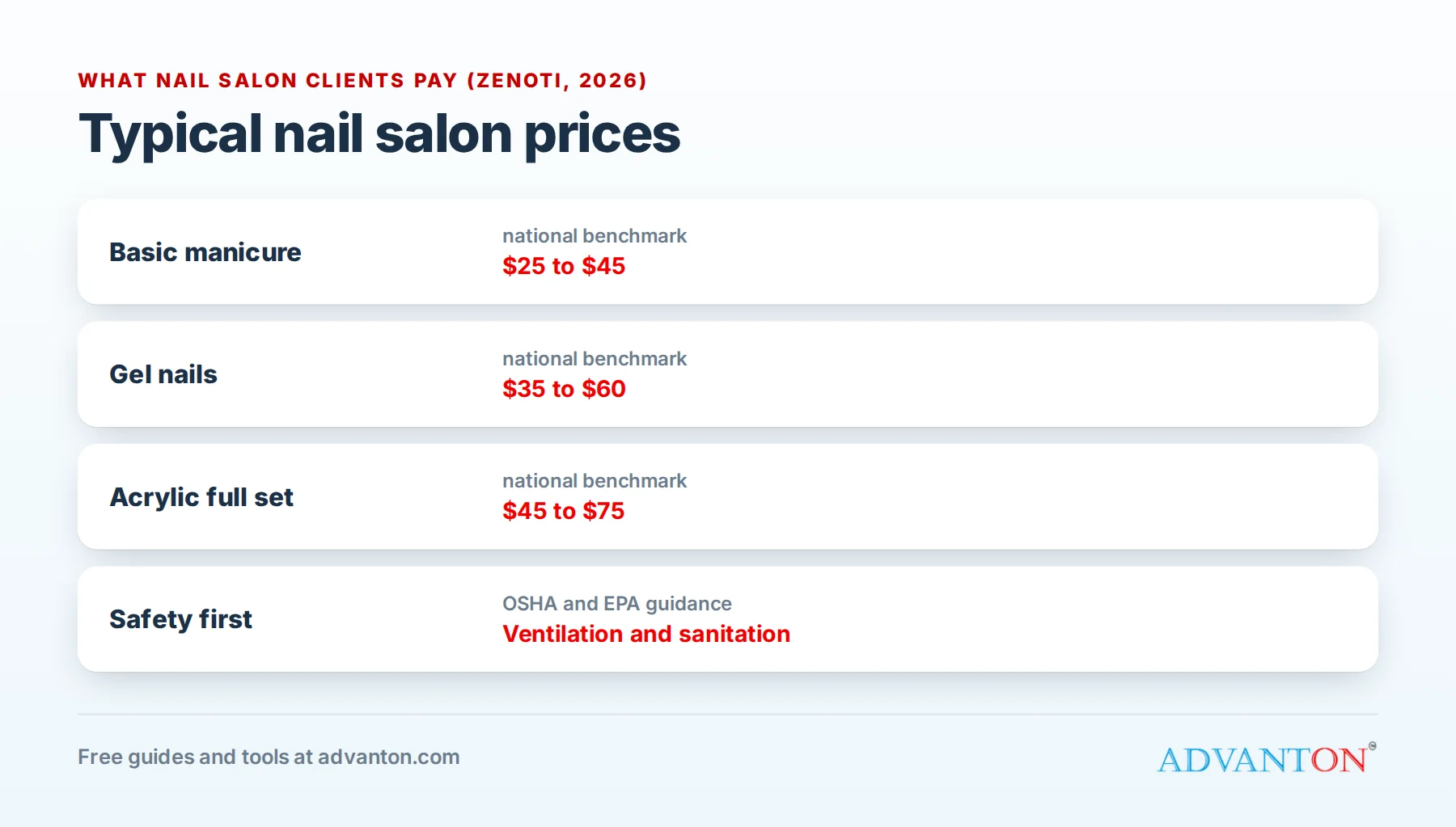
| Service | Typical 2026 prices (Zenoti benchmarks) |
|---|---|
| Basic manicure | $25 to $45 |
| Gel nails | $35 to $60 |
| Acrylic full set | $45 to $75 |
| Pedicures | Typically priced above manicures for the extra time |
| Nail art and add-ons | Priced per nail or per design |
| Fills and removals | Separate prices for maintenance visits |
Price by time, not just by competitors
Every service uses a technician’s time, and time is what you’re really selling. Work out your cost per technician hour (wages, rent share, products and overhead), time each service, and make sure every price covers its time plus a margin. A detailed gel set that takes 90 minutes needs a very different price from a 30-minute polish change, even if a nearby salon charges less. Review prices at least once a year as costs rise, and adjust any service that consistently runs longer than planned.
A worked example: a four-technician salon
These are illustrative assumptions, not predictions.
| Assumption | Monthly | |
|---|---|---|
| Services | 4 technicians, 7 services a day each, 26 days, $45 average | $32,760 |
| Technician pay and payroll taxes | About 45% of service revenue (at least minimum wage for all hours) | $(14,742) |
| Rent | $(4,500) | |
| Products and supplies | About 8% of revenue | $(2,621) |
| Utilities and ventilation | $(800) | |
| Insurance, software and payment fees | $(1,300) | |
| Marketing | $(700) | |
| Profit before owner pay and taxes | $8,097 |
The levers are services per technician per day (online booking and efficient scheduling), average ticket (gel, art and add-ons) and rebooking (clients who book their next visit before leaving).
Hiring and training technicians
Hire licensed technicians with strong skills and a professional manner, and test their work before hiring. Train everyone in your sanitation procedures, product safety, service standards and booking system. Encourage continuing education in new techniques such as gel extensions and nail art, which keep your menu fresh and justify higher prices.
How to build repeat clients
- Rebook at checkout: schedule the next appointment before clients leave.
- Use reminders by text or email to reduce no-shows. See best free scheduling apps.
- Show your work on Instagram and TikTok; nail art is highly shareable.
- Make hygiene visible: clients notice sealed tool packets and clean basins.
- Ask every client for a review with our review request kit.
- Offer loyalty rewards for regular visits.
- Build a website with your services, prices and booking; our free website builder has a template designed for salons.
Common mistakes to avoid
- Poor ventilation, harming staff health and driving away clients.
- Cutting corners on sanitation.
- Misclassifying technicians or paying below minimum wage.
- Discount-only pricing that leaves no room for quality products or fair pay.
- No rebooking system.
Your first 90 days
- Confirm licensing for technicians and the salon.
- Find a location suitable for ventilation and pedicure plumbing.
- Build out with proper ventilation and pass inspection.
- Hire licensed technicians and set fair, legal pay.
- Train your team on safety and sanitation.
- Launch booking, your website and Google Business Profile.
- Hold an opening event and start collecting reviews.
Frequently asked questions
Do I need a license to own a nail salon?
The salon usually needs an establishment license, and every technician needs a state license. Some states also require a licensed manager. Check your state cosmetology board.
How do I keep a nail salon safe for workers?
Ventilate well, choose safer products, provide gloves and training, and follow OSHA and EPA guidance for nail salons.
How should nail technicians be paid?
Employees must receive at least minimum wage for all hours worked, plus overtime where it applies, even if pay includes commission. Classify workers correctly.
How can a nail salon increase revenue?
Gel and art services, add-ons, retail products, memberships and keeping technicians fully booked through rebooking and reminders.
How many stations should a new nail salon have?
Start with what you can staff and fill, often four to eight stations. An empty station still costs rent, so add stations as your client base and team grow.
Should I offer memberships?
Monthly memberships for regular manicures or fills can smooth revenue and reward loyal clients. Keep terms simple and make sure each member visit still covers its cost.
What licenses do my technicians need?
Each technician needs a current state nail technician or cosmetology license. Display licenses as your state requires, and check renewal dates so nobody works with an expired license.
Keep learning
Sources
- Zenoti, Nail salon prices 2026
- OSHA, Health hazards in nail salons
- US Environmental Protection Agency, Protecting the health of nail salon workers
- US Department of Labor, Wage and Hour Division
Last reviewed October 26, 2026. Startup costs are estimates; check local prices, licensing and tax rules before you commit money.


Leave a Reply