
A great barbershop is part business, part neighborhood institution. Clients come back every few weeks for years, they bring friends and family, and the right chair, the right barbers and the right atmosphere can build a loyal community. Haircuts are also one of the services people keep buying in good times and bad.
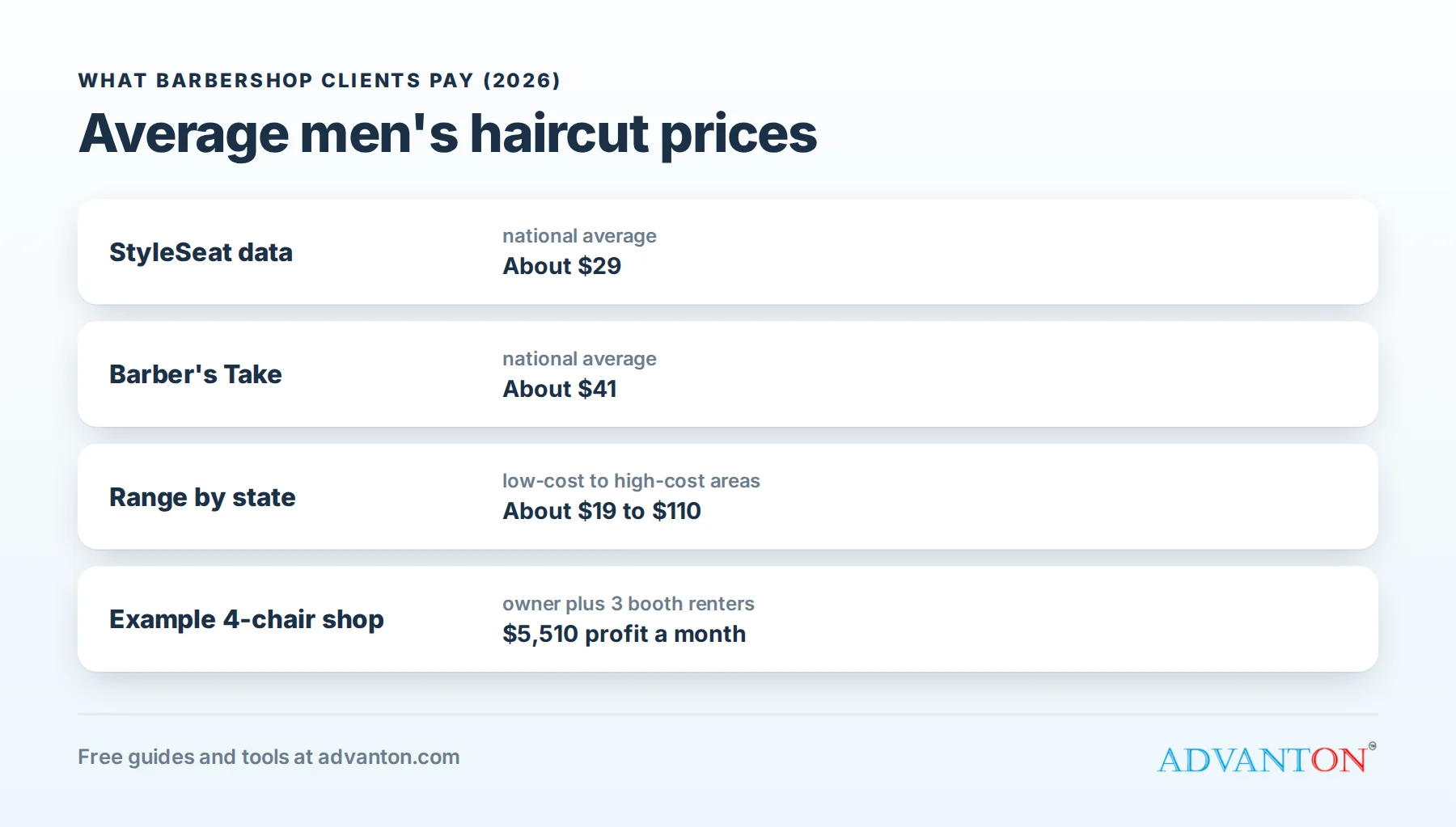
Prices have risen steadily. The average men’s haircut is about $29 according to StyleSeat’s stylist data, and about $41 according to Barber’s Take, which reports a range of roughly $19 to $110 across states, with high-cost areas such as New York, California and Hawaii at the top. This guide covers licensing, the three ways to structure your shop, pricing, startup costs, a worked profit example and how to keep chairs full.
Barbershop at a glance
Table of Contents
| Topic | What to expect |
|---|---|
| Startup cost | Moderate: lease, build-out, chairs, stations, plumbing, licensing and launch marketing |
| License required? | Yes: barbers need a state barber license, and the shop usually needs a state establishment license and inspections |
| What customers pay | Average men’s haircut about $29 to $41 nationally, varying widely by state and city |
| Revenue model | Your own chair, booth rent from other barbers, or commission from employed barbers, plus retail |
| Best for | Licensed barbers with a client base who want to build a team and a brand |
Licensing: barber and shop
- Barber license: every state licenses barbers. Requirements typically include barber school (often 1,000 or more training hours, depending on the state) or an apprenticeship, plus written and practical exams.
- Shop or establishment license: most states require the barbershop itself to be licensed, inspected and kept to sanitation standards, often with a licensed manager on site.
- Local requirements: business license, zoning, building permits for plumbing and signage.
- Sanitation rules: your state board sets standards for disinfecting tools, capes and stations; follow them strictly, because inspections are routine.
Check your state’s barber board for exact requirements before you sign a lease.
Three ways to structure your shop
| Model | How it works | Pros | Cons |
|---|---|---|---|
| Booth rental | Barbers rent a chair weekly or monthly and run their own business | Predictable income for you; less management | Less control over pricing, schedules and service standards |
| Commission | Barbers work for the shop and keep a percentage of their service revenue | More control and shared brand | Payroll, scheduling and management responsibilities |
| Hourly or salary plus commission | Barbers are employees with a base wage plus incentives | Most control; good for building a consistent brand | Highest management and payroll cost |
Classify workers correctly. Booth renters who set their own hours, prices and clients may be independent contractors; barbers who work under your control are usually employees. The IRS and many states look closely at this, and misclassification can bring back taxes and penalties.
Designing your shop
- Chair layout: enough space between stations for barbers to move comfortably and clients to feel at ease.
- A welcoming waiting area with seating, Wi-Fi and a view of the action.
- Shampoo bowls if you offer washes, which require plumbing.
- Good lighting at every station: barbers need to see fine detail.
- Storage and a sanitation station for tools, towels and capes.
- A look that matches your brand, from classic to modern; your shop’s style is part of what clients pay for.
Startup costs for a barbershop
| Item | What to budget for |
|---|---|
| Lease and build-out | Plumbing for shampoo bowls, electrical, flooring, lighting and signage |
| Chairs and stations | Barber chairs, mirrors, stations, sterilization equipment |
| Tools and supplies | Clippers, trimmers, shears, razors, capes, products |
| Licensing and inspections | State shop license and local permits |
| Software | Online booking, payments and client records |
| Insurance | General liability, professional liability and property |
| Launch marketing | Grand opening, signage, website and social media |
Use our startup cost calculator for your total.
Pricing your services
| Service | How to approach it |
|---|---|
| Standard haircut | Base it on local prices; the national average is roughly $29 to $41 |
| Skin fades and detailed cuts | Price higher for the extra time and skill |
| Beard trims and shaves | Separate prices, or bundle with a cut |
| Kids’ and seniors’ cuts | Optional discounts, often at quieter times |
| Memberships | Monthly plans for regular cuts build predictable revenue |
| Retail products | Pomades, beard oils and shampoos add margin |
Raise prices gradually as demand grows, and reward loyal clients with memberships rather than discounts. When a barber’s book is full weeks ahead, it’s a clear signal their prices can rise.
A worked example: a four-chair shop
These are illustrative assumptions, not predictions. The owner cuts in one chair and rents three chairs to booth-renting barbers.
| Assumption | Monthly | |
|---|---|---|
| Booth rent | 3 barbers at $250 a week | $3,250 |
| Owner’s own cuts | 8 cuts a day, 22 days, $35 average | $6,160 |
| Retail sales (net) | $600 | |
| Revenue | $10,010 | |
| Rent | $(3,000) | |
| Utilities | $(500) | |
| Insurance and software | $(400) | |
| Supplies | $(300) | |
| Marketing | $(300) | |
| Profit before owner taxes | $5,510 |
Booth rental gives steady, predictable income; a commission model can earn more per chair when the shop is busy, but adds payroll and management. Many owners start with booth rental and move to commission as their brand grows.
Loading the calculator…
A booth renter agreement checklist
If you rent chairs, put the terms in writing:
- Rent amount and due date, and what happens if it’s late.
- What’s included: chair, station, utilities, Wi-Fi, products or booking software.
- Shop hours and conduct: when the shop is open, cleanliness standards and how clients are treated.
- Sanitation responsibilities under state rules.
- Licensing and insurance: each renter keeps a current license and their own liability insurance.
- Notice periods for leaving, and what happens to client records.
Clear agreements prevent most disputes between owners and renters.
Retail and memberships
Retail products (pomades, beard oils, shampoos) add profit with little extra time, especially when barbers recommend what they use during the cut. Memberships (for example, unlimited or two cuts a month) turn regulars into predictable monthly revenue and make clients less likely to try another shop.
How to build a loyal client base
- Bring your existing clients, and encourage your barbers to bring theirs.
- Offer online booking with reminders, and walk-ins if your community expects them. See best free scheduling apps.
- Complete your Google Business Profile with photos of cuts, your barbers and your shop, and ask every client for a review with our review request kit.
- Post your work on Instagram and TikTok: fresh cuts are made for social media.
- Create an atmosphere people want to return to: music, conversation, cleanliness and consistency.
- Run referral rewards, and memberships for regulars.
- Partner with local schools, sports teams and businesses.
Walk-ins or appointments?
Many barbershops run on a mix. Walk-ins suit busy neighborhoods and clients who like dropping by; appointments reduce waiting, smooth the schedule and help barbers plan their day. A common approach is appointments for most chairs, with one barber or certain hours reserved for walk-ins. Online booking with reminders lowers no-shows, and a visible wait-time estimate keeps walk-in clients happy.
Common mistakes to avoid when starting a barbershop
- Signing a lease before checking zoning and plumbing.
- Misclassifying barbers as contractors when they’re employees.
- No clear shop rules for booth renters on hours, cleanliness and conduct.
- Underpricing to compete with chain salons.
- Weak sanitation, risking failed inspections and reputation.
Your first 90 days as a barbershop owner
- Confirm licensing for yourself, the shop and a shop manager if required.
- Choose your model: booth rental, commission or employees.
- Find a location with suitable plumbing and zoning.
- Build out, buy equipment and pass inspection.
- Recruit barbers with their own clients.
- Launch online booking, your website and Google Business Profile.
- Hold a grand opening and start collecting reviews.
Frequently asked questions about starting a barbershop
Do I need a barber license to own a barbershop?
In many states, an owner doesn’t need to be a licensed barber, but the shop must be licensed and staffed by licensed barbers, often with a licensed manager. Check your state board’s rules.
Is booth rental better than commission?
Booth rental offers predictable income and less management; commission offers more control and potentially more revenue. The right choice depends on your goals and how much you want to manage.
How much do barbers earn?
The Bureau of Labor Statistics publishes pay data for barbers, hairstylists and cosmetologists. Earnings vary widely with location, tips, clientele and whether barbers rent booths or work on commission.
How can a barbershop increase revenue?
Memberships, premium services such as hot towel shaves, retail products, and keeping every chair filled at peak times.
How many chairs should a new barbershop have?
Start with as many as you can realistically fill. Four to six chairs is common for an independent shop, but empty chairs still cost rent, so add more only as demand and barbers grow.
Should barbers rent booths or work on commission when starting out?
New barbers without a client base often prefer commission or wages, because the shop provides clients and steady pay. Experienced barbers with loyal followings often prefer booth rental, which lets them keep more of each service.
Keep learning
Sources
- Barber's Take, Men's haircut prices by state
- StyleSeat, Average men's haircut price
- US Bureau of Labor Statistics, Barbers, hairstylists and cosmetologists
- IRS, Independent contractor (self-employed) or employee?
Last reviewed October 26, 2026. Startup costs are estimates; check local prices, licensing and tax rules before you commit money.
Leave a Reply