
A staffing agency recruits workers and places them with client businesses, usually on temporary or temp-to-hire assignments: warehouse and light industrial work, office and administrative roles, hospitality, events, construction trades and professional positions. Clients get flexible labor without hiring costs; workers get access to jobs.
For temporary staffing, the agency is usually the employer of record: it pays workers, withholds and pays payroll taxes, provides workers’ compensation and unemployment coverage and verifies work eligibility, then bills the client a higher rate. Staffing firms also share safety and anti-discrimination responsibilities with clients, and some states regulate temporary staffing directly. The Bureau of Labor Statistics reports a median pay of $72,910 for human resources specialists, a group that includes recruiters (May 2024), with about 944,300 jobs and employment projected to grow about 6% over the decade. This guide covers models, employer duties, regulations, pricing, funding, a worked example and a 90-day plan.
A staffing agency at a glance
Table of Contents
| Topic | What to expect |
|---|---|
| Startup cost | Moderate: business setup, workers’ compensation and liability insurance, staffing software, recruiting, and working capital to fund payroll |
| Employer duties | Payroll, taxes, workers’ compensation, unemployment insurance, I-9 verification and wage and hour compliance for temporary workers |
| Regulation | Federal employment laws plus state rules, such as Illinois and New Jersey temporary worker laws and state agency registration |
| How you earn | Bill rates marked up over workers’ pay, plus direct hire and conversion fees |
| Best for | Sales-driven, organized operators who can recruit quickly and manage cash flow |
Who a staffing agency suits
It suits energetic people who enjoy sales and recruiting, can respond quickly when clients need workers tomorrow and manage details and cash flow carefully. Many founders come from staffing sales or recruiting roles.
Staffing models
- Temporary staffing: workers on your payroll, assigned to clients for days, weeks or months.
- Temp-to-hire: temporary assignments that may convert to permanent jobs, with conversion fees.
- Direct hire: recruiting for permanent roles for a placement fee (see our recruiting firm guide).
- Payrolling: employing workers the client found, for a lower markup.
Your duties as employer of record
- Payroll and taxes: withholding, employer payroll taxes and state unemployment insurance.
- Workers’ compensation insurance for your temporary workers, priced by job classification.
- Form I-9: verifying identity and work eligibility for every hire, plus E-Verify where required.
- Wage and hour compliance: minimum wage, overtime, recordkeeping and pay timing laws.
- Benefits and paid leave required by federal, state and local laws, including employer health coverage rules for larger employers.
Shared responsibilities with clients
Staffing agencies and client worksites share some obligations. OSHA treats both as responsible for temporary workers’ safety: the client controls the worksite, while the agency should assess hazards, ensure training and stay in contact with workers. The EEOC’s guidance explains that staffing firms and clients can both be liable for discrimination. Put responsibilities in client contracts, visit worksites and never place workers in unsafe conditions.
State and local rules
Some states regulate temporary staffing directly. Illinois requires day and temporary labor service agencies to register and follow rules on pay, transportation and equal pay for certain assignments; New Jersey’s Temporary Workers’ Bill of Rights adds pay and notice requirements for certain temporary workers. Other states and cities license employment agencies, limit fees charged to workers or require specific notices. Check rules wherever you place workers.
Client contracts
Service agreements should cover bill rates and overtime rates, timesheet approval, payment terms, conversion fees if a client hires your worker, safety responsibilities, insurance, indemnification, non-solicitation and termination. Clear terms protect your margin and limit risk.
Startup costs to plan for
| Item | What to budget for |
|---|---|
| Insurance | Workers’ compensation, general liability, employment practices, crime |
| Staffing software | Applicant tracking, onboarding, timekeeping and payroll |
| Background checks and drug testing | As clients require |
| Working capital | Funding weekly payroll before clients pay |
| Office | Recruiting office or virtual setup |
| Marketing | Job advertising, sales outreach |
Use our startup cost calculator for your total.
Bill rates and markups
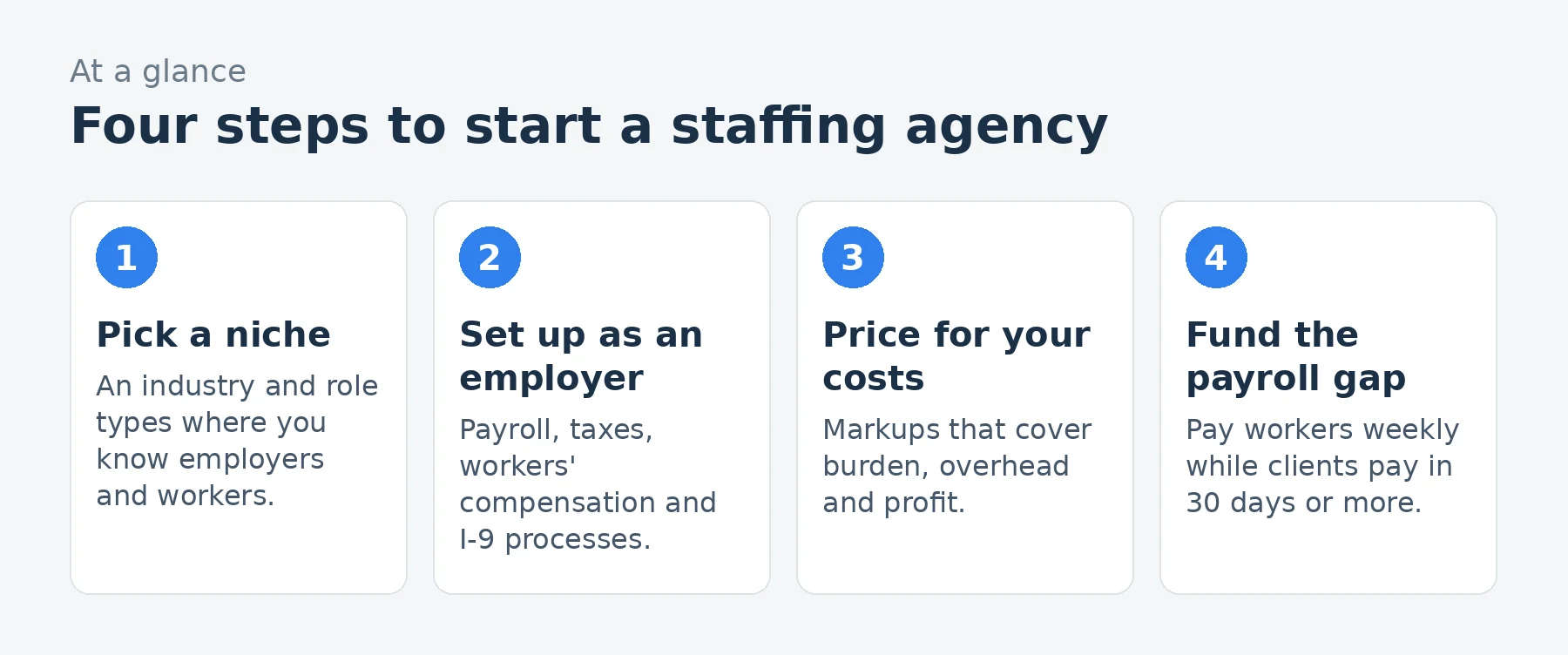
The bill rate is what the client pays per hour; the pay rate is what the worker earns. The difference must cover employer payroll taxes, workers’ compensation, unemployment insurance, benefits required by law, overhead and profit. Calculate your full burden per hour by job type before quoting, since workers’ compensation rates differ greatly between office and industrial work. Use our pricing calculator.
A worked example: a small agency
These are illustrative assumptions for a small light industrial and office staffing agency, not predictions.
| Assumption | Monthly | |
|---|---|---|
| Temporary staffing billings | 6,000 hours at a $26 bill rate | $156,000 |
| Direct hire fees | $4,000 | |
| Revenue | $160,000 | |
| Temporary worker wages | 6,000 hours at $18 | $(108,000) |
| Employer payroll costs | Payroll taxes, unemployment insurance and workers’ compensation | $(16,200) |
| Internal staff | Recruiters and account manager, with payroll costs | $(14,000) |
| Staffing software and background checks | $(1,500) | |
| Payroll funding costs | Factoring or credit line fees | $(2,300) |
| Office, insurance and marketing | $(4,500) | |
| Profit before owner pay and taxes | $13,500 |
That leaves about $13,500 a month before the owner’s pay and taxes, on about $160,000 of revenue. Gross margin per hour is what pays for everything, so small changes in markup, workers’ compensation rates or unpaid invoices make a large difference.
Loading the calculator…
Funding payroll
Agencies pay workers weekly, but clients often pay invoices in 30 to 60 days, which creates a cash gap that grows as the business grows. Options include a business line of credit, invoice factoring (selling invoices at a discount for immediate cash) and payroll funding providers that specialize in staffing. Check clients’ credit before extending terms.
Recruiting workers
- Job boards and social media job posts.
- Referral bonuses for current workers.
- Community organizations and workforce centers.
- A fast, mobile-friendly application and onboarding process.
- Treating workers well, so they come back and refer friends.
Finding clients
- Warehouses, manufacturers and distribution centers with seasonal peaks.
- Offices needing administrative and customer service help.
- Event, hospitality and catering companies.
- Construction contractors for laborers and trades helpers.
- Local business associations and chambers of commerce.
Keeping good workers
Reliable temporary workers are your product. Pay on time every week, offer steady assignments, communicate clearly about shifts and recognize good work. Agencies known for treating workers well fill orders faster and keep clients happier.
Seasonal surges
Warehouses, retailers and event companies need many workers at once during peaks. Recruit months ahead, build a bench of pre-screened candidates and confirm workers the day before assignments. Handling surges reliably wins long-term accounts.
Vendor management systems
Larger clients often buy staffing through vendor management systems or managed service providers that route orders to approved agencies and take a fee. Getting approved can bring volume, but compare the fees and payment terms with your margin.
Safety visits and training
Visit client sites before placing workers, review hazards and required protective equipment and confirm the client will provide site-specific training. Ask workers to report unsafe conditions, and follow up quickly. Safety programs also help control workers’ compensation costs.
Choosing an industry niche
Light industrial, office and administrative, hospitality, skilled trades and professional staffing each have different margins, insurance costs and recruiting channels. Starting in one niche you know helps you price correctly and build a reputation.
Common mistakes to avoid
- Pricing without full burden costs.
- Running out of cash funding payroll.
- Skipping I-9 verification.
- Placing workers in unsafe conditions without assessing the site.
- Ignoring state temporary worker laws.
Your first 90 days
- Days 1-30: choose a niche, register as an employer in your state, buy workers’ compensation and set up staffing software.
- Days 31-60: arrange payroll funding, write client agreements and build a pool of candidates.
- Days 61-90: sign first clients, fill orders quickly and track margin per hour.
Frequently asked questions
Who is the employer of temporary workers?
Usually the staffing agency, which pays wages, taxes and workers’ compensation, while sharing some duties with the client.
How do staffing agencies make money?
By billing clients a higher hourly rate than workers are paid, plus direct hire and conversion fees.
Do staffing agencies need a license?
It depends on the state; some, such as Illinois, require registration for certain temporary labor agencies, and others license employment agencies.
How do staffing agencies fund payroll?
Through working capital, credit lines, invoice factoring or staffing payroll funding providers.
Who is responsible for temp worker safety?
OSHA treats both the agency and the host employer as responsible for temporary workers’ safety.
What is a markup in staffing?
The amount added to the worker’s pay rate to cover employer costs, overhead and profit.
How fast should a staffing agency fill orders?
Clients often expect same-day or next-day fills for temporary roles, so a ready pool of screened workers is essential.
What insurance does a staffing agency need?
Workers’ compensation, general liability, employment practices liability and often crime or fidelity coverage, plus coverage levels clients require.
Can I start a staffing agency with no money?
It is hard, because you must fund weekly payroll before clients pay; payroll funding or factoring can help, but plan for working capital.
Keep learning
- Staffing and recruiting industry data
- How to start a recruiting firm
- How to start a healthcare staffing agency
- Pricing calculator
Sources
- American Staffing Association, Staffing industry resources
- OSHA, Protecting temporary workers (shared host employer and staffing agency responsibilities)
- EEOC, Enforcement guidance on staffing firms and contingent workers
- Illinois Department of Labor, Day and Temporary Labor Services Act
- New Jersey Department of Labor, Temporary Workers' Bill of Rights
- USCIS, Form I-9 and E-Verify
- US Bureau of Labor Statistics, Human resources specialists (includes recruiters)
Last reviewed November 3, 2026. Startup costs are estimates; check local prices, licensing and tax rules before you commit money.

