
Contractors and small businesses constantly struggle to find reliable workers, which creates steady demand for staffing agencies and recruiters. The Bureau of Labor Statistics counted about 944,300 human resources specialists (including recruiters) in 2024, with a median wage of $72,910 in May 2024, 6% projected growth and about 81,800 openings a year.
Staffing businesses come in two main types: temporary staffing, where the agency employs workers and bills clients hourly, and direct-hire recruiting, where the agency earns a fee for each placement.
The workforce
| Occupation | Jobs (2024) | Median pay (May 2024) | Projected growth, 2024 to 2034 |
|---|---|---|---|
| Human resources specialists (includes recruiters) | about 944,300 | $72,910 | +6% |
Source: U.S. Bureau of Labor Statistics, Occupational Outlook Handbook.
Market data
| Measure | Value |
|---|---|
| HR specialist openings per year, 2024-2034 | about 81,800 |
Business models compared
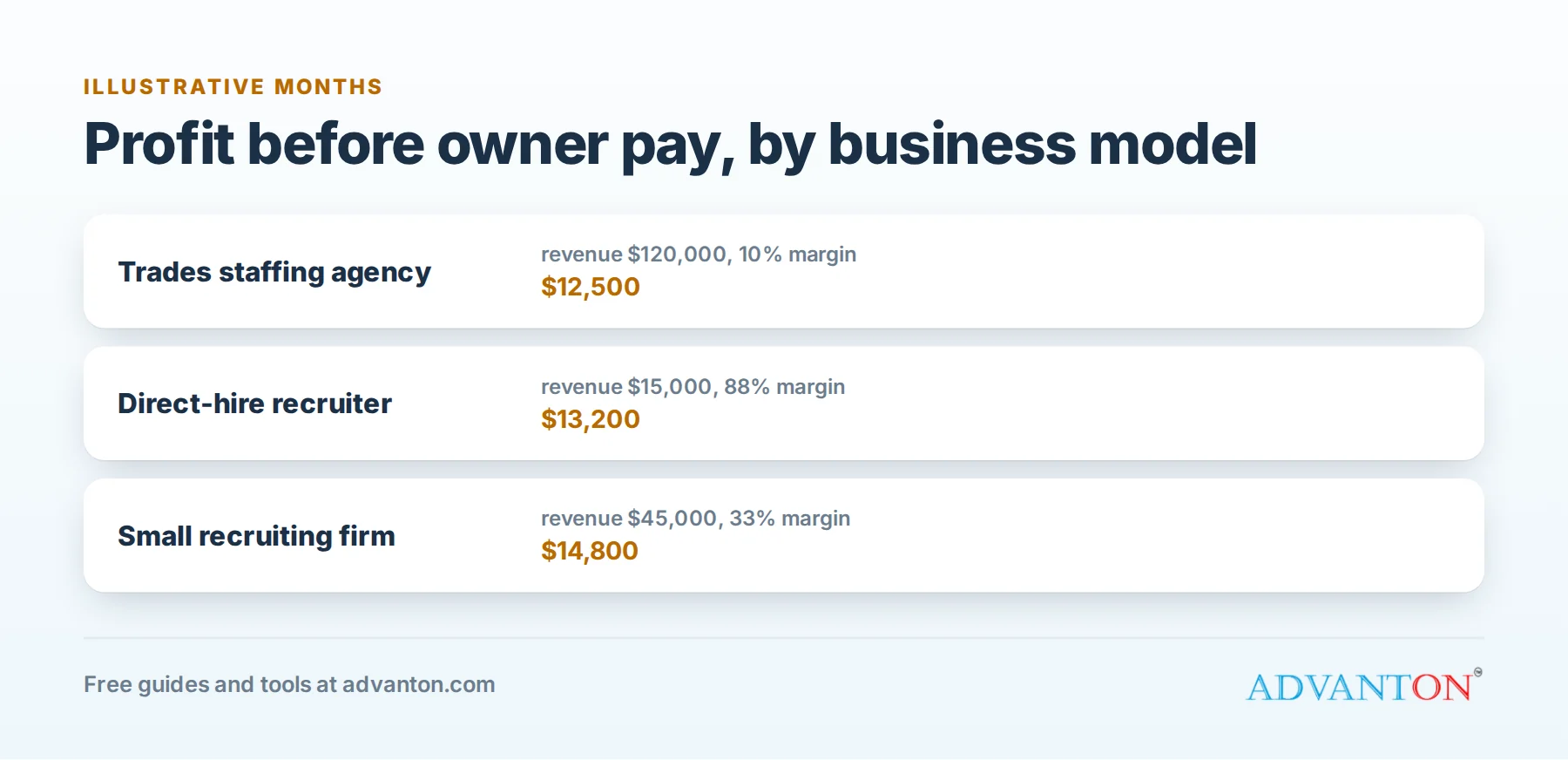
The figures below are illustrative months from our step-by-step guides, not industry averages. They show how revenue and costs typically fit together; your market, prices and costs will differ.
| Business model | Startup costs | Example monthly revenue | Costs | Profit before owner pay | Margin |
|---|---|---|---|---|---|
| Trades staffing agency (temporary workers) | Moderate to high: payroll funding, workers’ comp, recruiters | $120,000 | $107,500 | $12,500 | 10% |
| Direct-hire recruiter (solo) | Low: job board access, CRM, network | $15,000 | $1,800 | $13,200 | 88% |
| Small recruiting firm (3 recruiters) | Moderate: recruiters, tools, office | $45,000 | $30,200 | $14,800 | 33% |
Fixed and variable costs
For projections, the most useful split is between variable costs, which rise and fall with sales (materials, parts, hourly labor), and fixed costs, which you pay every month regardless (rent, salaried staff, insurance, loan payments).
| Business model | Variable costs (% of revenue) | Fixed costs per month | What it means |
|---|---|---|---|
| Trades staffing agency (temporary workers) | 76.5% | $15,700 | Mostly variable: profitable early, but watch cash flow |
| Direct-hire recruiter (solo) | 0.0% | $1,800 | Low costs overall: time is the main constraint |
| Small recruiting firm (3 recruiters) | 0.0% | $30,200 | Mostly fixed: slow start-up months are expensive |
What the numbers say
Temp staffing has thin margins. Worker wages, payroll taxes and workers’ comp take most of each dollar.
Direct hire has high margins but uneven revenue, depending on placements.
Recruiter capacity drives growth. Firms grow by adding productive recruiters.
The three models in brief
Trades staffing. Temporary laborers and tradespeople for contractors.
Solo recruiter. Placement fees for permanent hires.
Small recruiting firm. Several recruiters across industries. See hiring your first employee for employer-side context.
Cost structure: trades staffing agency (temporary workers)
Each cost as a share of the example month’s revenue ($120,000):
| Cost | Monthly amount | Share of revenue | Type |
|---|---|---|---|
| Worker wages | $78,000 | 65.0% | Variable |
| Recruiters | $9,000 | 7.5% | Fixed |
| Payroll taxes | $7,800 | 6.5% | Variable |
| Workers’ comp | $6,000 | 5.0% | Variable |
| Office and software | $3,000 | 2.5% | Fixed |
| Marketing and job boards | $2,500 | 2.1% | Fixed |
| Insurance | $1,200 | 1.0% | Fixed |
| Profit before owner pay | $12,500 | 10% |
A first-year projection: trades staffing agency (temporary workers)
New businesses rarely start at full speed. This projection assumes revenue ramps from 35% of the example month in month 1 to 100% by month 12, variable costs move with revenue, and fixed costs stay the same every month. It’s a planning illustration, not a forecast.
| Month | Revenue | Variable costs | Fixed costs | Profit | Cumulative |
|---|---|---|---|---|---|
| 1 | $42,000 | $32,130 | $15,700 | -$5,830 | -$5,830 |
| 2 | $54,000 | $41,310 | $15,700 | -$3,010 | -$8,840 |
| 3 | $66,000 | $50,490 | $15,700 | -$190 | -$9,030 |
| 4 | $74,400 | $56,916 | $15,700 | $1,784 | -$7,246 |
| 5 | $84,000 | $64,260 | $15,700 | $4,040 | -$3,206 |
| 6 | $91,200 | $69,768 | $15,700 | $5,732 | $2,526 |
| 7 | $98,400 | $75,276 | $15,700 | $7,424 | $9,950 |
| 8 | $104,400 | $79,866 | $15,700 | $8,834 | $18,784 |
| 9 | $109,200 | $83,538 | $15,700 | $9,962 | $28,746 |
| 10 | $114,000 | $87,210 | $15,700 | $11,090 | $39,836 |
| 11 | $117,600 | $89,964 | $15,700 | $11,936 | $51,772 |
| 12 | $120,000 | $91,800 | $15,700 | $12,500 | $64,272 |
Year one: revenue $1,075,200, profit before owner pay $64,272. The first profitable month is month 4. Cumulative results bottom out at -$9,030, which is the minimum cash cushion this plan would need, before any startup costs.
A temp staffing agency pays workers weekly while clients pay later, so cash flow is tight; this illustration turns profitable in month 4, with a cumulative low of about $9,000. Payroll funding is often needed.
How staffing businesses earn
- Bill rate markups on temporary workers’ wages.
- Placement fees for direct hires, often a percentage of first-year salary.
- Temp-to-hire conversion fees.
A startup checklist
- Check state licensing for employment agencies.
- Set up payroll, workers’ comp and insurance for temporary workers.
- Arrange payroll funding if clients pay on terms.
- Follow anti-discrimination and I-9 rules.
- Build a pipeline of reliable candidates.
Where the opportunities are
- Skilled trades staffing for contractors.
- Seasonal labor for landscaping and construction peaks.
- Niche recruiting for hard-to-fill roles.
- Small businesses hiring for the first time.
Key terms
| Term | Meaning |
|---|---|
| Bill rate | What the client pays per hour |
| Pay rate | What the worker earns per hour |
| Employer of record | The company legally responsible for the worker |
| Placement fee | Fee for a permanent hire |
Reputation on both sides
Agencies depend on trust from employers and workers. Pay workers on time, screen carefully and communicate honestly.
Marketing a staffing agency
Contractor associations, local business groups, referrals and job boards bring clients and candidates.
Manage risk
Workers’ comp, safety training and clear job descriptions protect workers, clients and your agency.
How to use these numbers for your own plan
- Start with the closest model above and its cost structure.
- Replace every price and cost with local quotes: insurance, wages, vehicles, materials and your expected prices.
- Estimate your ramp: how many jobs you can realistically win each month in year one.
- Separate fixed and variable costs, then calculate your break-even point with our free break-even calculator.
- Map cash month by month with our cash flow forecast, including equipment and loan payments.
- Build the plan in our free Business Planner.
These figures will also feed a planned Advanton projection tool, so you’ll be able to start from an industry template and adjust it to your situation.
About this data
Workforce figures come from the U.S. Bureau of Labor Statistics (Occupational Outlook Handbook and Occupational Employment and Wage Statistics, May 2024 and the 2024 to 2034 projections). Market figures cite their sources in the list above. Business model figures are illustrative months built from typical prices and costs to show how revenue, fixed costs and variable costs fit together; they are not industry averages or guarantees. We review these profiles when new government data is released, at least once a year. The same figures are available in a structured format for Advanton’s upcoming business projection tool.
Licensing and rules
Some states license employment agencies; staffing firms are the employer of record for temporary workers (payroll taxes, workers’ comp, wage and hour rules); anti-discrimination and immigration verification rules apply. Requirements change; confirm with your state and local agencies before you start.
Frequently asked questions
What do recruiters earn?
BLS reports a median of $72,910 for human resources specialists, which includes recruiters (May 2024).
Do staffing agencies need a license?
Some states license employment agencies; check your state.
Why are temp staffing margins thin?
Worker wages, payroll taxes and workers’ comp take most of each billing dollar.
How can I use these numbers?
Start with the closest staffing model, then replace every figure with your local prices, commissions, wages and expected volume.
Keep learning
- Trades staffing agency
- Local SEO for contractors
- How to get more contractor leads
- Specialty trades industry data
Sources
Last reviewed October 30, 2026. Startup costs are estimates; check local prices, licensing and tax rules before you commit money.

